The issue often isn't a lack of innovation. They have an execution problem. A staggering 94% of global executives report dissatisfaction with their organization's innovation performance according to the Mack Institute at Wharton.
That number should change how you plan innovation workshops.
If you're a corporate event planner, workshop owner, or executive sponsor, the job isn't to fill a room with sticky notes and hope something useful happens. The job is to design a working session that produces decisions, ownership, and follow-through. Good innovation workshops create momentum. Bad ones create a highlight reel and then disappear into a shared drive.
I've seen the same pattern repeatedly. Teams spend most of their planning energy on the room, the icebreakers, and the agenda blocks. They spend too little time on the business question, the decision rights, and what happens after the event. That's why ideation theater is common. It feels productive in the room, but it doesn't survive contact with budgets, governance, or delivery teams.
Start With the End in Mind Before You Plan
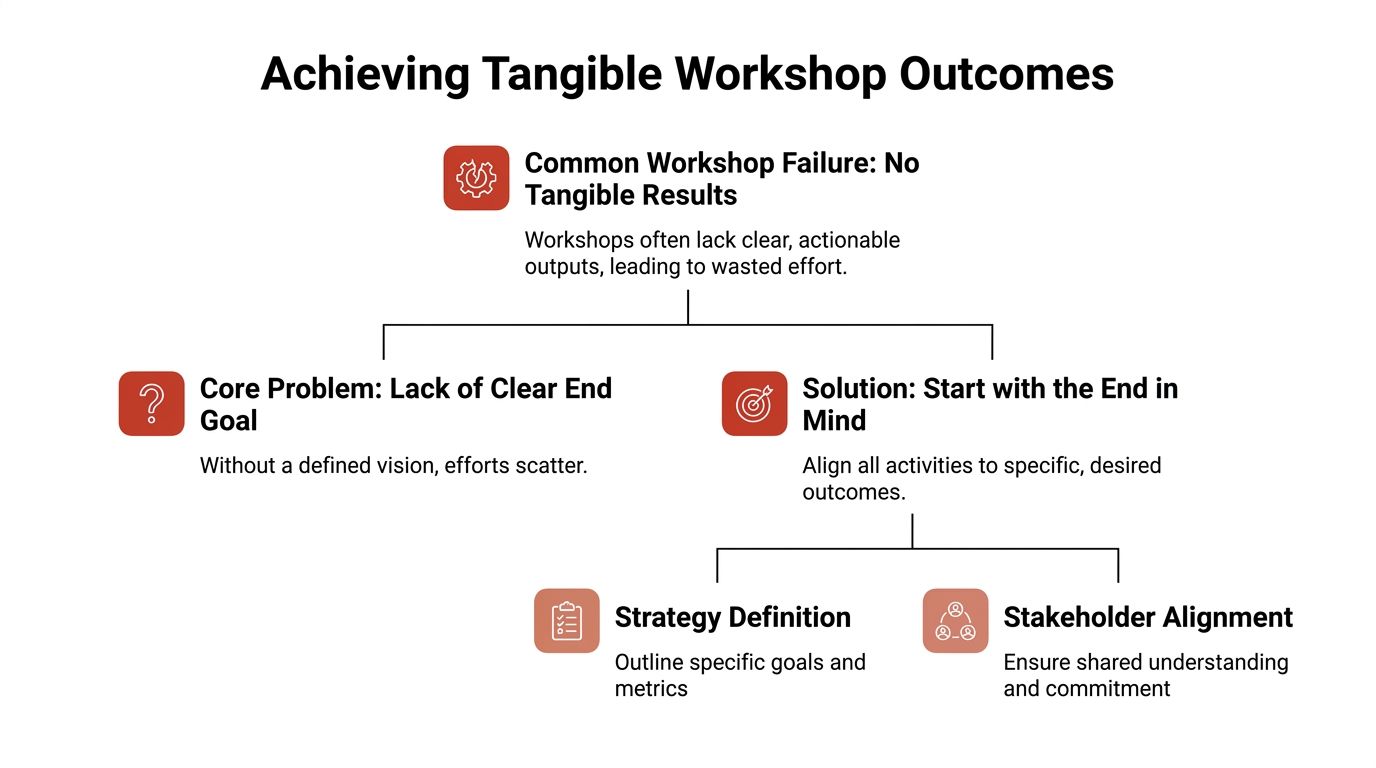
Workshops fail at the brief, not at the whiteboard. If the sponsor cannot state the business outcome, decision, and owner before invitations go out, the session is being planned too early.
Tie the workshop to a business decision
The starting point is a business decision the room needs to support. That could be choosing which customer problem to prioritize, agreeing on a 90-day experiment plan, selecting concepts for funding, or defining where AI belongs in an operating model. Clear decisions produce useful workshops. Vague ambition produces busy calendars and weak follow-through.
I advise planners to test the brief with one question: what will leadership be able to approve, stop, fund, or change because this workshop happened? If no one can answer that in concrete terms, the session will drift toward idea generation without accountability.
A strong pre-workshop brief answers five practical questions:
- What decision must this workshop help the team make?
- What business outcome matters most?
- Who owns implementation after the session?
- What constraints are real?
- What evidence or output must the team leave with?
Practical rule: If the executive sponsor cannot describe success in one sentence, do not schedule the workshop yet.
Align stakeholders before you design activities
Good activities cannot rescue a misaligned sponsor group. One executive may want fresh concepts. Another may expect a ranked shortlist. A delivery lead may need an implementation plan with owners and dates. Those are different jobs, and they require different workshop designs.
Get the sponsor, key functional leaders, and facilitator aligned on four points before the agenda is built:
- Primary objective: discovery, prioritization, decision-making, or implementation planning
- Decision authority: who can approve, who can advise, and who must sign off later
- Boundaries: budget, timing, legal limits, technical constraints, brand risk, and capacity
- Outputs: the exact artifacts expected by the end of the session
This early alignment step is where experienced practitioners add disproportionate value. A strong workshop lead does more than run exercises. They pressure-test the brief, expose conflicting expectations, and protect the session from becoming ideation theater.
For larger offsites, this planning discipline should sit inside the broader event process. A corporate event planning guide for aligning purpose, audience, and logistics helps event planners sequence those decisions in the right order. For team dynamics and workshop format ideas, Corporate Challenge Events' comprehensive guide is a useful reference point.
Define success at three levels
Teams often define workshop success too loosely. "Good energy" and "lots of ideas" are not enough, especially inside a corporate setting where budget, governance, and delivery capacity decide what survives.
Use three levels instead:
- In-room success: the group reaches a decision, produces clear outputs, and assigns owners
- Post-event success: the next actions happen, blockers are addressed, and teams start the agreed work
- Business success: the work contributes to the commercial or operational result that justified the session
That framework changes planning decisions fast. Participant selection gets sharper. Pre-read requirements become obvious. The facilitator can cut any exercise that does not improve the odds of a decision or a usable next step.
A workshop is successful when the business can act differently the next week, not when the feedback forms say the session was engaging.
Designing Your Workshop Blueprint and Agenda
A good workshop agenda isn't a script. It's a decision architecture.
The mistake I see most often is packing the day with activities that look creative but don't build toward an output. You need a sequence that opens the problem, sharpens the evidence, generates options, and narrows those options into decisions. That's what separates a workshop from a brainstorming session.
Use ODI to keep the work grounded
A useful planning lens comes from Outcome-Driven Innovation. According to Strategyn's explanation of the 6-step ODI process, organizations that adopt it can achieve up to an 86% product success rate when they identify unmet customer needs before ideation.
For workshop design, the practical takeaway is simple. Don't start with ideas. Start with outcomes customers are trying to achieve.
If your session is focused on redesigning a customer onboarding process, don't open with "How can we improve onboarding?" That's too loose. Open with the customer's job and the moments where they struggle to make progress. That gives the room a target.
Build the day in modules
For event planners, a modular agenda works better than a one-size-fits-all template. You can adjust the time blocks, but the flow should usually look like this:
| Agenda block | Purpose | Example for onboarding challenge |
|---|---|---|
| Frame the challenge | Align on business context and constraints | Current onboarding friction, customer complaints, internal bottlenecks |
| Map desired outcomes | Define what success looks like for customers and the business | Faster activation, clearer guidance, fewer support escalations |
| Surface friction points | Identify where the current experience breaks down | Handoffs, unclear instructions, duplicate requests |
| Generate options | Create multiple ways to solve the highest-value problems | Guided setup, AI assistant, role-based onboarding paths |
| Prioritize and test | Compare options against feasibility and business impact | Select concepts for pilot, define assumptions to validate |
| Commit to action | Assign owners and immediate next steps | Experiment lead, timeline, dependencies, sponsor review |
Many planners underinvest. They obsess over room energy, then rush the final hour. The final hour should be protected. That's where teams decide what moves forward.
A one-day structure that works
Here's a practical shape for a one-day session. Treat it as a blueprint, not a formula.
- Opening block: Set the business problem, success criteria, and absolute constraints.
- Evidence block: Bring in customer insight, operational facts, or frontline observations.
- Divergence block: Generate multiple responses to the key friction points.
- Convergence block: Use decision criteria to cut weak ideas fast.
- Commitment block: Name owners, next actions, and review points.
For broader team dynamics and workshop design ideas, Corporate Challenge Events' comprehensive guide is worth scanning because it reinforces a useful principle: workshops work better when the structure supports collaboration instead of forcing generic participation.
Your agenda should also match the event format. If you're planning an offsite, this offsite agenda template can help you balance strategic work, working sessions, and the human need for breaks and reset time.
The agenda should answer one question at every stage: why is this activity necessary for the decision we're trying to make?
When a workshop has that logic, participants feel it. The day moves with purpose instead of feeling like a stack of disconnected exercises.
Essential Facilitation Techniques for Engagement
A strong agenda can still collapse in the room. Facilitation is what turns a design into useful participation.
The facilitator's job isn't to dominate the discussion or impress the room with methods. The job is to make it easy for the right people to contribute at the right time, especially when power dynamics, uncertainty, or disagreement show up.
Match the technique to the moment
Most engagement problems happen because teams use the wrong method for the phase they're in. They ask a large group for instant verbal brainstorming, then wonder why only the loudest people speak. Or they use open discussion when the group needs a faster way to narrow options.
This simple map is more reliable.
| Goal | Technique | Best For |
|---|---|---|
| Opening | Framing round | Getting every voice into the room early |
| Opening | Silent reflection | Helping people think before reacting |
| Ideation | 1-2-4-All | Inclusive idea generation across mixed personalities |
| Ideation | Brainwriting | Producing more ideas without airtime bias |
| Ideation | How might we prompts | Turning complaints into design challenges |
| Convergence | Dot voting | Fast prioritization when many options exist |
| Convergence | Effort versus impact mapping | Comparing practical trade-offs |
| Convergence | Assumption ranking | Identifying what needs testing first |
| Closing | Commitment round | Creating public ownership of next steps |
| Closing | Barrier check | Surfacing what could block execution |
Protect quieter voices
Innovation workshops often fall short. The room looks busy, but the same few people shape every outcome. That's risky because the best operational insight often comes from frontline managers, technical specialists, or customer-facing staff who don't naturally fight for airtime.
Use these habits to correct that:
- Start independently: Give participants time to write before anyone speaks.
- Break into pairs first: People contribute more when they've rehearsed an idea in a smaller setting.
- Rotate who reports out: Don't let the same senior person summarize every table.
- Use anonymous voting when needed: It reduces hierarchy effects during prioritization.
Good facilitation doesn't create equality of personality. It creates equality of contribution.
Handle conflict without draining energy
Disagreement is useful in innovation workshops. Confusion isn't. The difference usually comes down to how the facilitator frames tension.
When two groups disagree, don't ask who is right. Ask what assumptions differ. That shifts the room from defending positions to comparing evidence. If legal, product, and sales are stuck, write each concern visibly and sort them into constraints, risks, and unknowns. Once people see the disagreement categorized, it becomes easier to act on.
A few practical cues help in harder moments:
- Name the decision point: "We're choosing what to test first, not deciding final rollout."
- Separate idea quality from idea ownership: Critique the concept, not the person who proposed it.
- Use time limits: Short limits force clarity and prevent circular debate.
- Park issues deliberately: If a topic matters but doesn't belong in the room, capture it with an owner and follow-up path.
Keep the room moving
Energy matters, but not in the superficial sense. You don't need forced enthusiasm. You need pace, clarity, and visible progress.
That means changing formats before attention drops, summarizing often, and making outputs visible on walls, boards, or shared digital spaces. If the room can't see what it's building, participants stop trusting the process.
The best facilitators make a workshop feel lighter than it is. That's a skill. Underneath that ease is strict discipline about timing, participation, and decisions.
Adapting Workshops for Virtual and Hybrid Teams
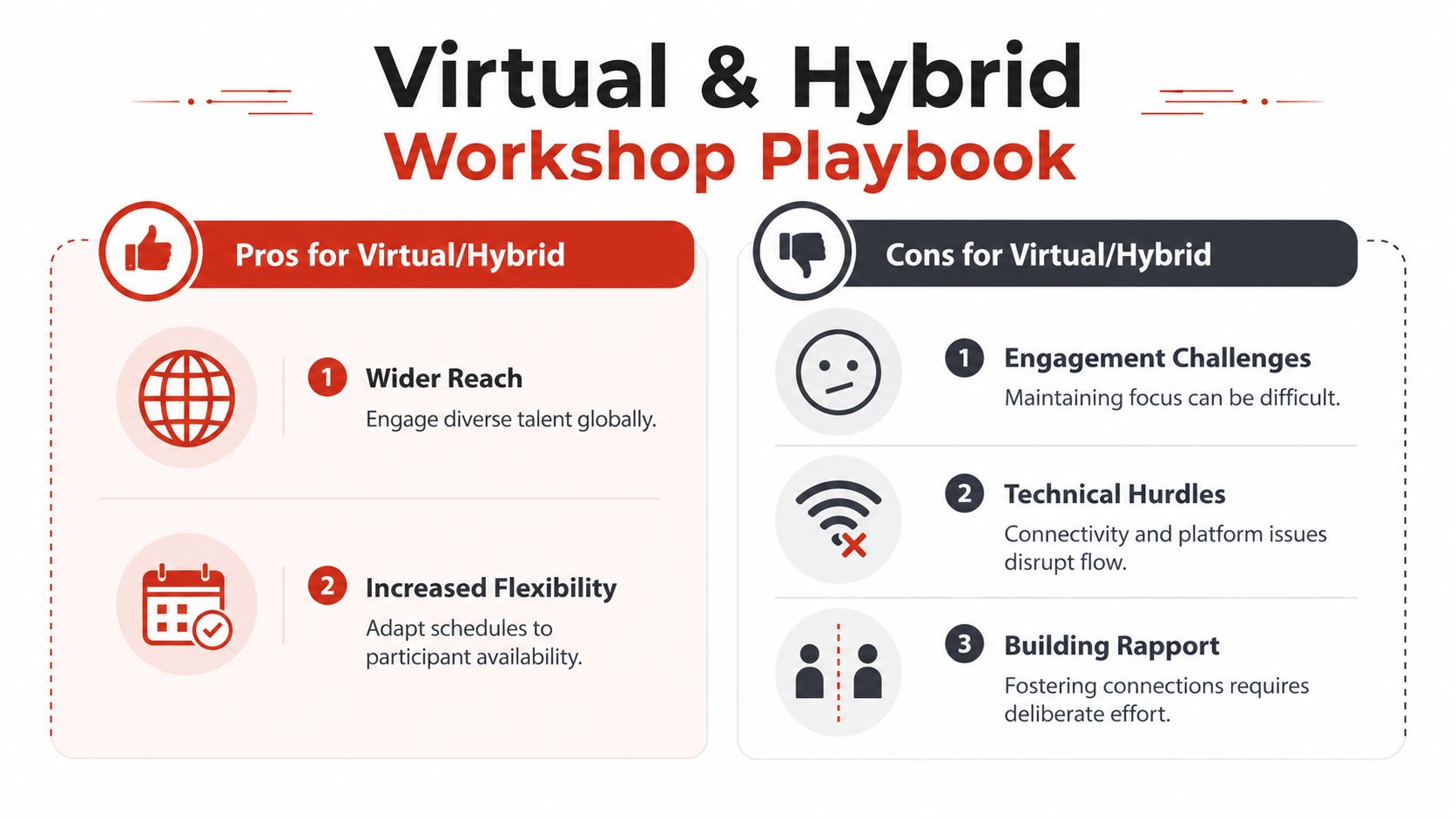
Virtual and hybrid innovation workshops don't fail because the tools are weak. They fail because planners copy an in-person design into a different environment and expect the same result.
Remote formats need tighter turn-taking, more explicit participation rules, and better visual structure. Hybrid formats are harder. They create two different experiences at once, and the remote side usually loses unless you design against that bias.
Virtual versus hybrid
Virtual sessions are easier to equalize because everyone enters through the same interface. Hybrid sessions create status imbalance fast. The people in the room read body language, interrupt more easily, and have side conversations. Remote participants become observers if the facilitator isn't deliberate.
A simple comparison helps:
| Format | Main advantage | Main risk | Best response |
|---|---|---|---|
| Virtual | Shared digital experience | Screen fatigue and passive attendance | Shorter blocks, more interaction, visible co-creation |
| Hybrid | Access to both in-room and remote talent | Uneven participation | Remote-first facilitation and mirrored collaboration tools |
Use the tools for specific jobs
Miro and Mural work well for virtual whiteboarding, clustering, and collaborative mapping. Their sticky notes, voting, and template features are most useful when the board is simplified. Too many frames and instructions create friction.
Use tools with intent:
- Miro or Mural: Map customer journeys, cluster themes, run voting, and document outputs live.
- Zoom or Microsoft Teams: Use breakout rooms for pair work and small-group synthesis.
- Anonymous polling features: Collect honest prioritization input before discussion starts.
- Shared docs: Capture action owners and next steps in real time, not after the session.
In hybrid settings, design for the person on the screen first. If the remote participant can fully engage, the in-room participant will be fine.
Prevent virtual fatigue
Don't schedule virtual innovation workshops like conference programming. Long presentation blocks kill contribution.
A better pattern is brief framing, active work, rapid synthesis, then reset. Keep cameras useful rather than mandatory theater. Ask for visible participation in the board, chat, polls, and spoken discussion. If a participant can contribute in multiple channels, engagement improves.
For hybrid sessions, assign one person to watch the remote experience closely. That's not optional. A lead facilitator can't run the room, track chat, manage timing, and protect remote voices at the same time.
The practical rule is simple. If your format changes, your facilitation design has to change with it.
How to Measure Real Workshop Impact
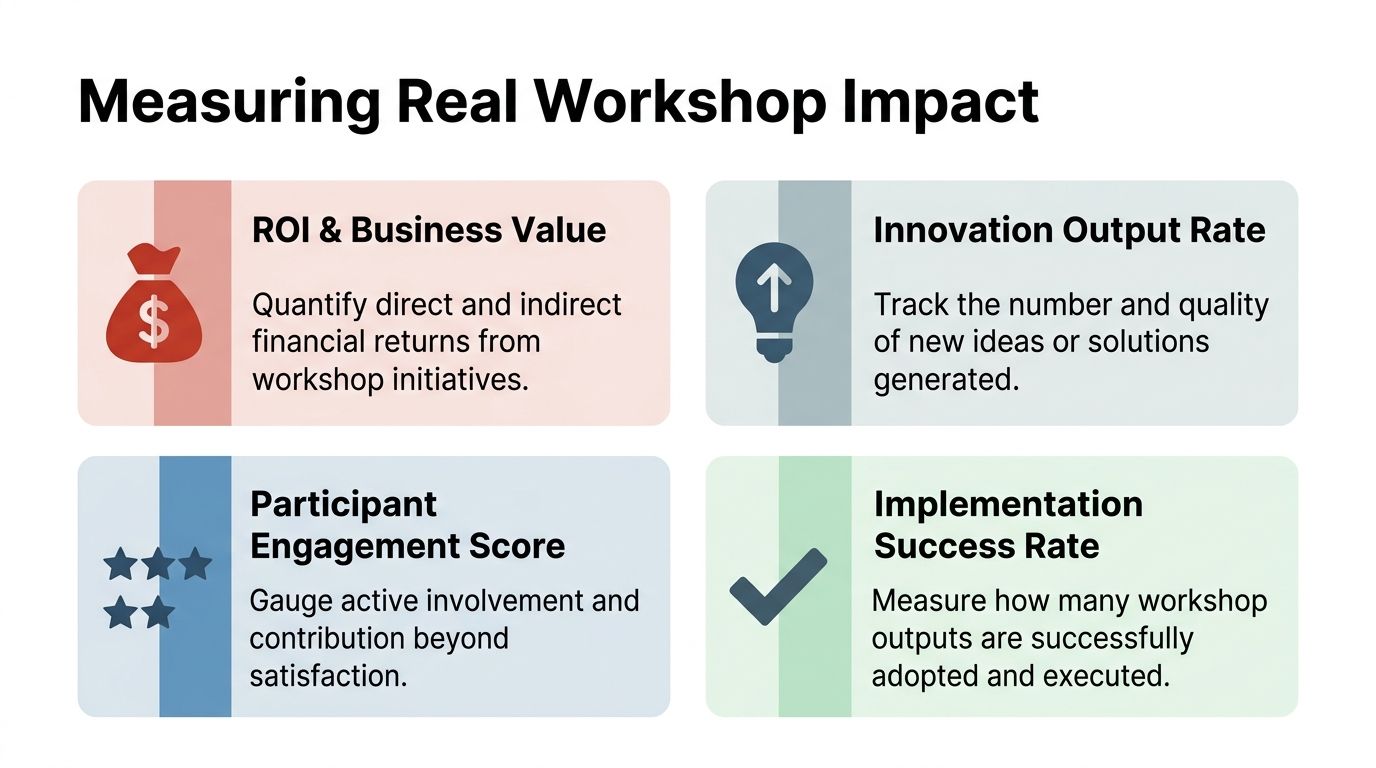
Most workshop evaluation is too soft to be useful. A smile sheet might tell you whether people liked the session. It won't tell you whether the business got value.
That distinction matters because innovation workshops are often funded like strategic work and evaluated like entertainment. If you want continued support, measure what happens after the room goes quiet.
Start with this visual model for the categories that matter.
Replace satisfaction scores with action evidence
The most practical evaluation method I've seen is also the simplest. As noted in this workshop evaluation guidance, measure impact with two questions:
"What is one key action you will take as a result of this workshop?"
"What barriers might prevent you from taking this action, and how can we help?"
Those two questions force a higher standard. They move the evaluation from reaction to behavior. They also give planners and sponsors immediate implementation data. You learn what participants intend to do and what might stop them.
Place the questions at the end of the workshop, then revisit the answers later in the implementation cycle.
A related resource on post-training follow-through is understand training effectiveness with SpeakNotes, which is useful because it focuses attention on retention, application, and evidence rather than event-day sentiment.
Track leading and lagging indicators
You don't need a giant dashboard. You need a small set of indicators that match the maturity of the program.
For newer programs, team engagement matters early. According to InnovationCast's discussion of measuring innovation, a key success metric for nascent programs is team-level engagement, defined by the number of active employees or users in innovation activities and collaboration velocity measured through behaviors like reading peer ideas and iterations until first evaluation.
For the funnel itself, Tenity's framework for innovation metrics is useful because it centers on three dimensions: the quantity of ideas passing through gates, the quality of insights generated per disruptive experiment such as a prototyping workshop, and the velocity of ideation-to-validation measured by experiments performed per unit time.
That gives you a practical split:
- Leading indicators: Active participation, number of concepts selected for testing, quality of insights gathered, speed to first experiment.
- Lagging indicators: Time to market, revenue from new initiatives, market penetration, or other business outcomes chosen at the start.
Here's a short video worth using with internal stakeholders when you need to reinforce why measurement matters before the workshop begins.
Measure the adoption gap
Many innovation workshops often lose value. Teams leave with ideas, but not with a path for adoption.
That gap is especially visible in equity-focused work. VentureWell's 2024 discussion of equity-inclusive innovation notes that 68% of equity-focused innovation initiatives from US universities stall after the workshop phase due to missing resource-allocation strategies. Even if your context is corporate rather than university-based, the lesson holds. Post-ideation support is part of workshop design, not an optional extra.
Build your measurement model around implementation questions:
| What to measure | Why it matters | How to review it |
|---|---|---|
| Named action owners | Confirms accountability | Check immediately after the workshop |
| Blockers to execution | Reveals where support is needed | Review in sponsor follow-up |
| Experiments launched | Shows movement from idea to validation | Track in the first implementation window |
| Decisions made | Distinguishes progress from discussion | Confirm in written recap |
| Adoption progress | Tests whether outputs are used | Review with functional leaders |
If you only measure enjoyment, you'll miss the only part executives care about. Did the workshop change behavior, produce action, and help the business move faster or smarter?
Finding the Right Expert to Amplify Your Workshop
An external expert can raise the quality of innovation workshops fast, but only if you choose the right kind of expert.
A generic moderator can keep time and move slides. That's useful, but limited. A true practitioner changes the ambition level of the room because they've built, invented, shipped, or led through the kind of uncertainty your team is facing.
Choose a catalyst, not just a presenter
The value of an outside expert isn't just inspiration. It's acceleration.
ExperiencePoint describes innovation workshops as mechanisms for translating abstract ideas into real-world breakthroughs, and notes that leaders who “imagine impossible futures and make them happen” can act as powerful catalysts. That's the right lens for selection. You want someone who expands what the room thinks is possible, while staying grounded in execution.
That could mean different profiles for different moments:
- An AI pioneer to frame the art of the possible before an AI strategy workshop.
- A patent-holding founder to pressure-test whether an idea is defensible and practical.
- A performance expert to help a leadership team handle uncertainty, resilience, and decision pressure.
- An operator to turn broad innovation language into implementation discipline.
Vet the expert against the workshop outcome
Event planners often choose speakers based on stage presence first. For innovation workshops, relevance matters more.
Ask these questions before booking anyone:
- What have they built or led that resembles our challenge
- Can they work interactively, not just deliver a keynote
- Will they provoke useful thinking without taking over the room
- Can they speak to executives and operators with equal credibility
- Will participants leave with tools, examples, or decision frameworks they can effectively use
If the session is part of a leadership retreat or executive offsite, this perspective on choosing a leadership keynote speaker helps clarify the difference between a memorable talk and a strategically useful one.
The best outside experts don't replace the team's work. They sharpen it, challenge it, and speed it up.
Used well, an expert practitioner becomes an impact multiplier. They give the room language, examples, and confidence that generic facilitation alone usually can't provide.
If you're planning innovation workshops, leadership offsites, or high-stakes company events, Silicon Valley Speakers can help you find practitioners who have built real breakthroughs, not just talked about them. Their curated roster includes builders, inventors, and visionaries who can enhance a keynote, frame a strategic workshop, or turn a leadership session into something teams will apply.
Related speaker rosters
Browse innovation keynote speakers and entrepreneurship keynote speakers available for 2026 events.