A well-crafted offsite agenda template is the single most important piece of the puzzle for a successful corporate retreat. It’s what separates a focused, productive event from an expensive, unstructured hang-out. Think of it as your strategic roadmap, guiding your team from scattered conversations to real, measurable outcomes.
Why a Strategic Agenda Is Your Most Important Tool
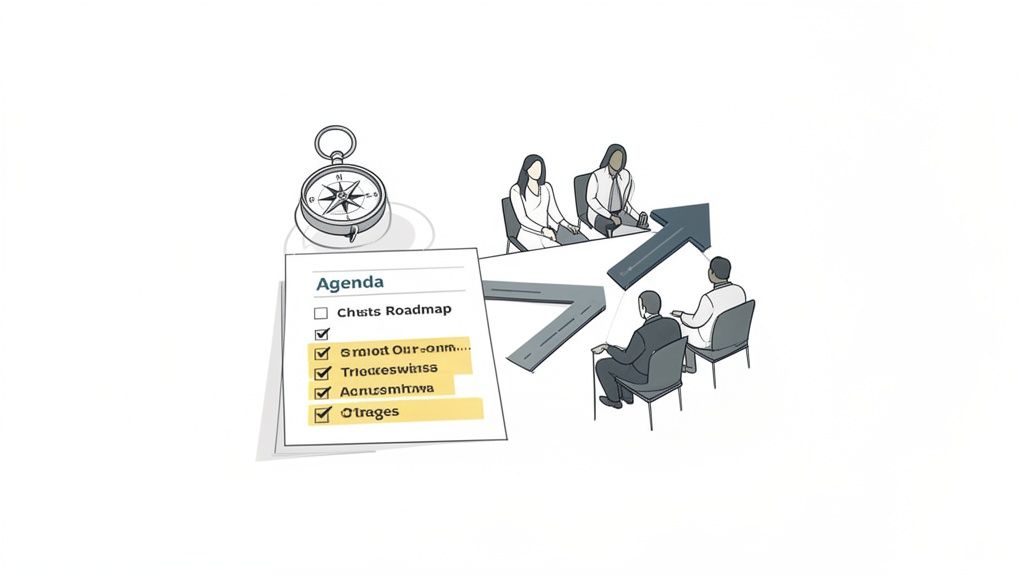
Let’s be honest: a lot of corporate offsites are expensive failures. I've seen it happen time and again. Without a solid plan, these events quickly devolve into rambling discussions that lead nowhere, leaving everyone wondering why they bothered to show up.
The difference between a high-impact retreat and a costly waste of time almost always comes down to the quality of the agenda. An offsite without one isn't a strategic session; it's a vacation on the company's dime.
The Real Cost of Poor Planning
When an offsite goes wrong, the cost is much higher than just flights and hotels. The real damage is in the wasted salary hours, the missed opportunity to get everyone aligned, and the hit to morale when people feel their time has been disrespected.
Pulling your team away from their day-to-day work is a huge investment, especially in a world of constant digital pings and overflowing inboxes. A disciplined agenda is how you make sure that investment actually pays off.
An agenda isn't just a schedule of events. It's the strategic blueprint that focuses your team, clarifies what success looks like, and guarantees every activity is driving the business forward. It's about shifting from just 'getting away' to 'advancing with purpose.'
Why Agenda Discipline Is So Critical Now
Our schedules have never been more crowded. Since early 2020, the average person's meeting load has shot up by nearly 70%, with many of us juggling over 25 meetings per week. This meeting fatigue makes every moment of an offsite incredibly precious.
The data backs this up. Distributing a clear agenda beforehand boosts meaningful preparation by 73% and cuts down on off-topic chatter by 58%. Suddenly, that discipline isn't just a nice-to-have; it's an economic necessity. You can explore more data on how strategic meeting protocols impact productivity to see the full picture.
A thoughtful agenda acts as your North Star, protecting your team's time and energy. It does three critical things:
- It focuses the team. Everyone arrives on the same page, with the same goals in mind before the first coffee is even poured.
- It defines clear outcomes. The agenda forces you to answer the most important question: "What must we accomplish by the end of this?"
- It drives the business forward. It ensures that every session, from a deep-dive workshop to a team-building activity, is tied directly back to a core business objective.
Anatomy of a High-Impact Offsite Agenda
A great offsite agenda is more than just a schedule. Think of it as a story, one that guides your team from an initial point of discovery to a final destination of clear alignment and shared commitment. The best agendas I've seen aren't just a list of back-to-back meetings; they are carefully crafted experiences.
They masterfully balance intense strategic work with those key moments for genuine human connection. The real goal is to create a natural rhythm for the event, starting broad, diving deep into problem-solving, and wrapping up with concrete next steps everyone can get behind.
Establishing a Clear Theme and Purpose
Every truly successful offsite I've been a part of started with a powerful, unifying theme. This theme becomes your compass for every single session and activity, constantly answering the fundamental question: "Why are we all here?"
Maybe your goal is to hash out a new three-year strategy, or perhaps you need to finally tackle a nagging operational bottleneck. It could even be about rebuilding team spirit after a tough reorganization. Whatever it is, define it.
Once you have your theme, every agenda item must earn its spot by supporting it. If your theme is "Innovating for the Next Decade," a workshop on new product ideas fits perfectly. A random session on tweaking internal expense reports? Not so much. This ruthless focus is what separates a genuinely useful offsite from just another long meeting.
Key Roles for Flawless Execution
An agenda is just a piece of paper until people bring it to life. I’ve seen perfectly planned schedules crumble because no one was in charge of making them happen. Assigning a few key roles is absolutely critical for a smooth, productive event.
Here are the non-negotiables:
- The Facilitator: This person isn't just running the meeting; they are guiding the conversation. Their job is to draw out quiet voices, keep discussions on track, and ensure the dialogue remains constructive. They’re the impartial conductor of the orchestra.
- The Timekeeper: This role is deceptively important. The timekeeper is the guardian of the agenda, gently nudging the group along to ensure one great conversation doesn't derail the entire day's plan.
- The Note-Taker: This person captures the gold: key decisions, breakthrough insights, and most importantly, the action items. Their notes are what turn great ideas into tangible progress after everyone heads home.
A well-structured agenda is the foundation, but assigning roles is what makes it functional. When everyone knows their part, the team can focus on the content of the discussions, not the logistics of the meeting itself.
Balancing Work, Connection, and Recharge
One of the biggest mistakes you can make is cramming the agenda too full. A wall-to-wall schedule of intense workshops is a surefire recipe for exhausted minds and diminishing returns. The most effective agendas intentionally build in different "modes" of activity to keep energy and engagement high. If you want to dive deeper, we cover this extensively in our guide to planning effective team offsites.
A balanced agenda needs a mix of essential building blocks. Here’s a simple breakdown of what that looks like in practice.
Core Components of a Successful Offsite Agenda
| Component | Purpose | Example Activity |
|---|---|---|
| Strategic Work | To tackle complex business challenges, make key decisions, and align on future direction. | A 90-minute workshop on identifying the top three priorities for the next quarter. |
| Team Connection | To build trust, improve communication, and strengthen interpersonal relationships. | A structured storytelling exercise where team members share a past success or failure. |
| Recharge Breaks | To provide mental and physical rest, allowing for informal conversation and reflection. | A 30-minute walk outdoors or a designated "no-screens" coffee break. |
By weaving these different elements together, you’re not just planning a meeting. You're designing a holistic experience. You're respecting people's intellectual horsepower, emotional needs, and physical energy, which is what unlocks better thinking, stronger bonds, and results that actually stick.
How to Customize Your Offsite Agenda Template
Let's be honest: a generic, one-size-fits-all agenda is a recipe for a failed offsite. The real magic happens when you tailor every single session to your specific goals, your team's unique personality, and the outcomes you absolutely need to achieve. Think of the offsite agenda template as your starting block, not the finish line.
Customizing your agenda really boils down to making a few key strategic choices upfront. The biggest question you have to answer is this: does your team need to do deep, strategic work, or do they desperately need time to reconnect and strengthen their bonds?
This simple decision tree is a great visual for how that primary goal should shape your entire agenda.
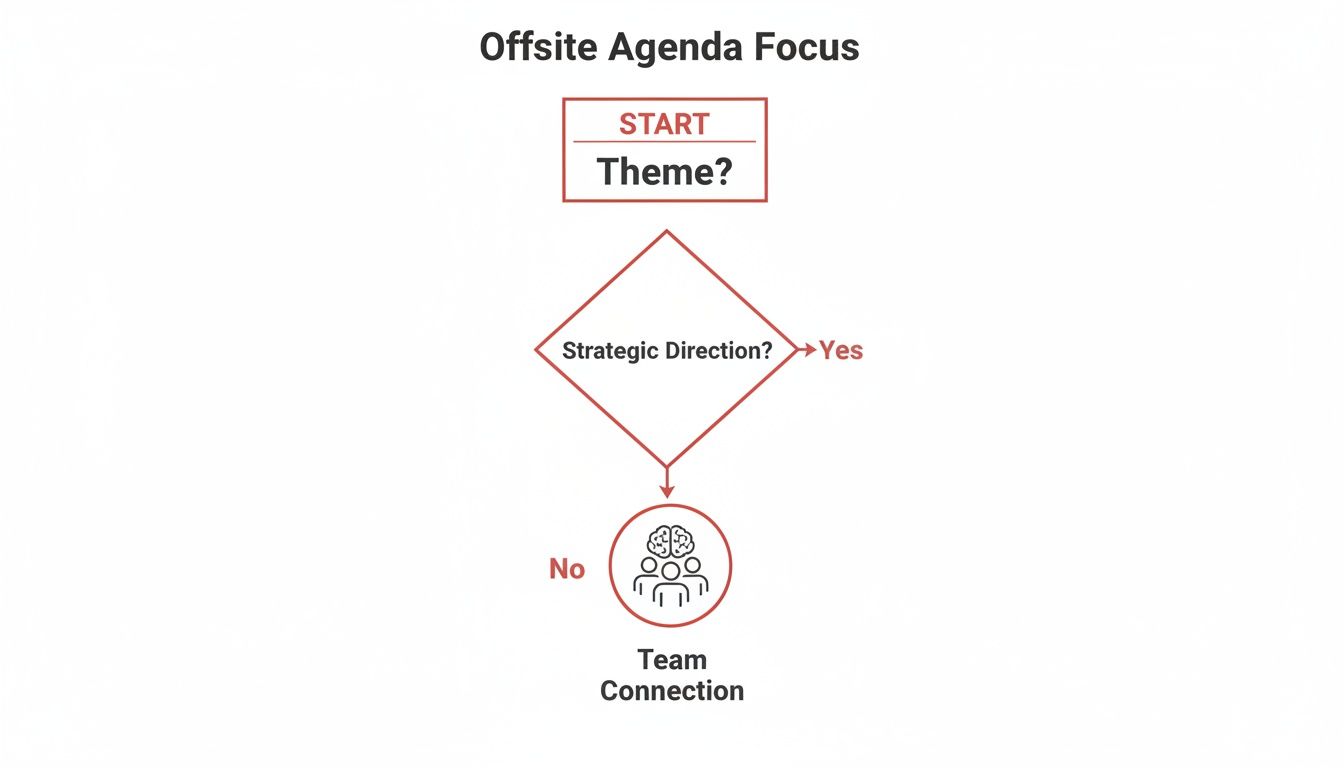
From my experience, the most important takeaway here is to pick a lane. If you try to do too much of both, you’ll likely leave feeling like you accomplished neither. Start by defining that one primary objective.
Sample Agenda: Full-Day Sales Kickoff
A sales kickoff (SKO) is all about bottling lightning. You need to build energy, motivation, and practical skills. The entire point is to arm your sales team with the confidence and tools they need to crush their targets. You want the day to feel like a crescendo, building from core knowledge to pure, unadulterated motivation.
Here’s a structure that works well:
- 9:00 AM - 9:30 AM: Welcome & Vision Setting (Leadership)
- 9:30 AM - 10:30 AM: Deep Dive: Product Roadmap & Competitive Market
- 10:30 AM - 10:45 AM: Break
- 10:45 AM - 12:00 PM: Interactive Workshop: Role-playing objection handling
- 12:00 PM - 1:00 PM: Lunch & Networking
- 1:00 PM - 2:30 PM: Guest Keynote: Inspiring Peak Performance (e.g., an Olympian like Shannon Rowbury on resilience and drive)
- 2:30 PM - 3:30 PM: Breakout Sessions: Territory Planning & Account Strategy
- 3:30 PM - 4:00 PM: Closing Remarks & Awards
Sample Agenda: Half-Day Leadership Alignment
A leadership offsite has a completely different feel. It’s less about broad skill-building and more about having the tough conversations, aligning on high-level strategy, and making critical decisions. With a compressed timeline, every single minute has to count.
This agenda cuts the fluff and prioritizes focused, facilitated debate.
- 8:30 AM - 9:00 AM: Framing the Challenge: Reviewing Q3 Data & Defining Core Problems
- 9:00 AM - 10:30 AM: Facilitated Debate: Top 3 Strategic Priorities for Next Year
- 10:30 AM - 10:45 AM: Coffee Break (Silent reflection is encouraged here)
- 10:45 AM - 12:00 PM: Decision & Commitment Session: Finalizing Priorities & Assigning Ownership
Sample Agenda: Multi-Day Strategic Planning Retreat
When you have a few days, you can go deep. A multi-day retreat lets you balance intense, focused work with the downtime that’s so essential for reflection and genuine team bonding. The key is an intentional flow, with the heaviest strategic lifting on Day 1 and a shift toward implementation on Day 2.
Day 1: Strategic Deep Dive
- Morning: State of the Union, Market Analysis, and Future-Gazing
- Afternoon: Breakout Groups on "What If" Scenarios & Long-Term Threats
- Evening: Keynote on AI and Future Trends (e.g., Siri co-creator Adam Cheyer on seeing what's next) followed by a team dinner.
Day 2: From Strategy to Action
- Morning: Translating Day 1 Ideas into a 12-Month Roadmap
- Afternoon: Defining Q1 "Rocks" & Assigning Action Items
- Late Afternoon: Closing Circle: Commitments & Next Steps
For a truly high-impact offsite, you have to think about how decisions get recorded and tracked. A great example of how to formalize this is a well-structured board meeting minutes template.
The best offsites don’t just generate ideas; they generate documented commitments. The agenda must build toward clear, assigned action items that will be tracked long after the retreat ends.
Of course, a killer agenda is just one piece of the puzzle. A comprehensive offsite requires careful planning from top to bottom. For more guidance, our complete event planning checklist will help ensure no detail gets missed. Each of these agendas serves a different purpose, but they all share one common thread: they are designed with a crystal-clear outcome in mind.
Facilitation Techniques to Keep Your Retreat on Track
An offsite agenda template is your roadmap, but even the best map won't get you to your destination if you can’t navigate the twists and turns of group dynamics. Strong facilitation is what brings that agenda to life.
I’ve learned the hard way that a facilitator's job isn't just about watching the clock. It's about reading the room, guiding the energy, and making sure every discussion is actually moving the team forward. You have to create a space where people feel comfortable speaking up, even on difficult topics, and know when to gently pull the conversation back when it starts to wander.
Encouraging Equal Participation
In almost every offsite, a few dominant personalities will naturally take up most of the airtime. If you let this happen, you'll miss out on key insights from the quieter, more reflective members of your team.
One of my go-to moves for this is the simple "round-robin." When it's time to brainstorm or get feedback, I go around the room and give each person the floor for a minute or two, completely uninterrupted. This simple structure guarantees every single voice is heard and almost always brings brilliant ideas to the surface that would have otherwise been lost.
Managing Off-Topic Ideas Productively
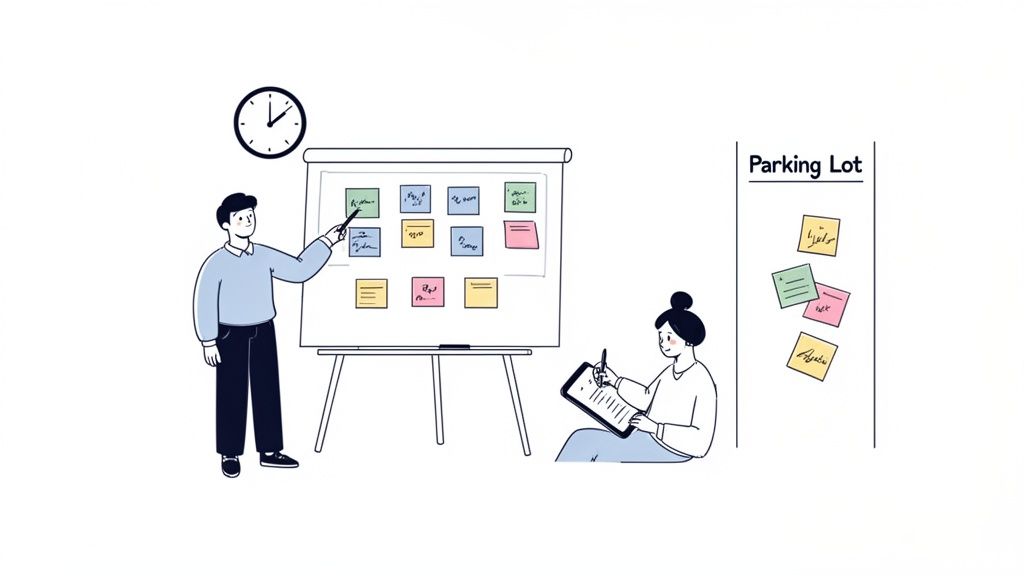
During a great brainstorming session, brilliant but off-topic ideas will inevitably pop up. The last thing you want to do is shut them down and kill the creative vibe. That's where the "Parking Lot" comes in.
A Parking Lot is just a designated spot (a corner of the whiteboard or a sheet of flip-chart paper) where you can "park" these valuable but tangential thoughts.
Doing this accomplishes two critical things at once:
- The person feels heard. You've acknowledged their idea is valuable.
- You keep the session on track. You can smoothly steer the focus back to the topic at hand.
Later, you can circle back to the Parking Lot to decide which ideas need follow-up or should be tackled in a future meeting.
Boosting Engagement with Gamification
That post-lunch energy slump is real. When you feel the engagement dipping, especially during a long problem-solving block, introducing a little bit of play can work wonders. This isn't about playing silly games; it’s about using game mechanics to make the work itself more engaging.
I've found that turning a complex brainstorming session into a friendly competition—like "which team can generate the most viable solutions in 20 minutes?"—instantly re-energizes the room and unlocks new levels of collaboration.
We’ve seen this work time and again. In fact, adding these kinds of problem-solving challenges has boosted participant engagement scores from an average of 6.2/10 to an impressive 8.7/10 in post-event surveys. If you want to dive deeper, you can find more on how competition and collaboration drive engagement on consultantsconsultant.com.au. By turning a task into a game, you shift the team from passive discussion to active, solution-focused thinking.
Measuring the True ROI of Your Offsite
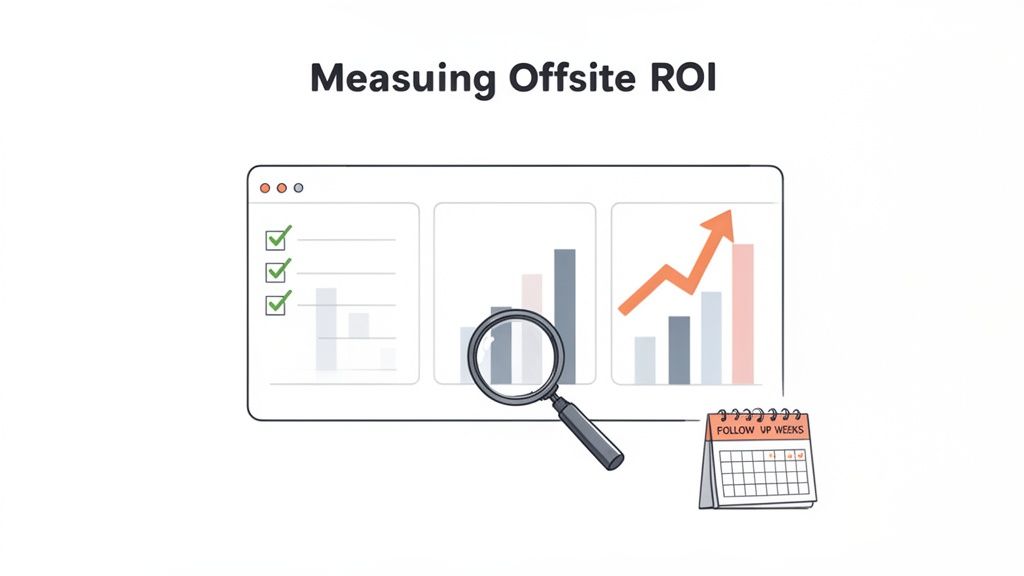
So, how do you prove the offsite was worth it, beyond just some nice feedback? The real test isn't the high-fives as everyone heads home; it’s about what actually changes back at the office in the weeks and months that follow. Measuring the true return on your investment means looking past the warm-and-fuzzies to connect the event directly to tangible business results.
This whole process has to start way before the first workshop. It begins the moment you build your offsite agenda template. Every single session, every activity, needs a clear, measurable outcome tied to it. Vague goals like "improving communication" are a dead end because you can't track them. You have to define what success actually looks like from the get-go.
Setting Pre-Event KPIs
Before anyone even thinks about packing a bag, you need to establish clear Key Performance Indicators (KPIs) that directly link to your agenda. This simple step is what turns your offsite from a line-item expense into a strategic investment with a measurable payoff.
Let's say a big chunk of your agenda is dedicated to aligning the team on a new sales strategy. Your KPIs could look something like this:
- A 15% shorter sales cycle in the quarter immediately following the offsite.
- A 10% bump in the average deal size for all new business closed.
- A 95% completion rate on all post-offsite action items related to the new strategy.
Designing Effective Post-Offsite Surveys
Getting immediate feedback is still a good idea, but your survey questions need to be smarter. Don't just ask, "Did you have a good time?" You need to dig deeper to gauge alignment and clarity. It's not just about who showed up; you have to know how to measure event success by focusing on what people actually took away from it.
The most powerful question you can ask is: "On a scale of 1 to 10, how clear are you on our top three priorities for the next 90 days?" A high average score here is a leading indicator of future execution.
Tracking Action Item Implementation
Honestly, the single most important measure of your offsite's ROI comes down to one thing: did people do what they said they would do? A great offsite doesn't just generate ideas; it produces a concrete list of decisions and commitments, each with a clear owner and a firm deadline.
The best way to do this is to get those action items into a simple project management tool or even a shared doc that everyone can see. Reviewing this list during your regular leadership meetings creates accountability and keeps the momentum from the offsite from fizzling out. This is how you draw a straight line from the investment you made in the retreat to real, measurable improvements in how your team performs.
For a deeper look at the mechanics of organizing such events, our guide on how to plan a corporate event provides a complete roadmap.
Your Top Offsite Agenda Questions, Answered
Planning an offsite is full of moving parts, and even with the perfect template, a few key questions always come up. I’ve seen these small details make or break an event, so let's get them sorted out. Here are the answers to the questions I hear most often from leaders trying to get their agenda just right.
How Far in Advance Should I Share the Offsite Agenda?
This is a simple one, but it has a big impact. My rule is to send out the final, detailed agenda at least 72 hours before the offsite kicks off. Anything less, and you're not giving your team enough time to switch gears from their daily work, do any pre-reading, and show up ready to dive in.
Honestly, a full week in advance is even better. It signals that you respect their time and want them to come prepared. You’ll see the difference in the quality of the conversation right from the first session.
What Is the Ideal Balance Between Work and Fun?
I’ve found the sweet spot is an 80/20 split: that’s 80% of your time dedicated to structured, goal-oriented work sessions and 20% for social activities that build connection. The key here is making sure the "fun" part isn't just an afterthought. It needs to be purposeful.
For example, on multi-day retreats, we always front-load the most intense strategy sessions. Get the heavy lifting done when energy is highest. Then, we schedule the more relaxed, connective activities toward the end. This lets everyone finish on a high, feeling energized and more bonded with their colleagues, not drained.
The goal is strategic integration, not just tacking on an unrelated happy hour. A well-chosen activity can be the perfect way to break down barriers and spark the informal conversations where some of the best ideas are born.
How Can I Make a Virtual Offsite Agenda Engaging?
Keeping people engaged during a virtual offsite is a whole different ballgame. Screen fatigue is real, so your agenda needs to be tighter, faster-paced, and full of variety. Forget trying to replicate an in-person schedule online.
Here are a few things that have worked wonders for virtual events I've helped plan:
- Shrink your work blocks. Cap sessions at 90 minutes, max. Any longer and you’ll start losing people.
- Live in breakout rooms. Small-group problem-solving is infinitely more engaging on a screen than a large-group lecture. Use them constantly.
- Lean on interactive tools. A digital whiteboard for brainstorming or live polls to get instant feedback can keep the energy up.
- Send something physical. A simple kit with snacks, company swag, or printed materials for a workshop makes the event feel more tangible and shared.
A high-energy virtual keynote speaker can also be a unlock. They can set an engaging tone from the start and rally everyone around a single powerful message, no matter where they’re dialing in from.
Planning an offsite that delivers real results starts with a world-class agenda, often anchored by a speaker who can bring your theme to life. At Silicon Valley Speakers, we connect you with visionaries and builders who have turned impossible ideas into reality. Let us help you find the perfect voice to inspire your team and ensure your next event is unforgettable.