Before you even think about venues or catering, the first, most critical step in planning any corporate event is getting crystal clear on why you're doing it. A successful event is built on a foundation of sharp, measurable goals tied directly to a real business need. Everything else (the agenda, the speakers, the follow-up) flows from there.
Setting Goals That Actually Move the Needle
Forget generic objectives like "team building" or "networking." Those are happy byproducts, not the core mission. A great event is a strategic tool, not just a well-organized get-together. It’s designed to produce a specific, tangible outcome.
To get to the heart of it, you have to ask the tough questions. Are we trying to supercharge the sales pipeline for Q3? Do we need to get the entire leadership team on the same page about a new go-to-market strategy? Or maybe the real goal is to stop customer churn by showing our top accounts how to get more value from our latest product update.
First, Figure Out Who It's For
The "who" is just as critical as the "why." Your event's entire purpose and feel will change based on who is in the room. You wouldn't plan a sales kickoff (SKO) for your top reps the same way you'd plan an offsite for the C-suite.
Think about the different needs of these groups:
- Sales Teams at an SKO: They're looking for energy, clear sales plays, and practical training. Your goal is to fire them up for the year and give them the tools to hit their numbers.
- Executives at a Leadership Summit: This is about high-level strategy. They need a secure space to debate, solve complex problems, and align on the company's future.
- Customers at a User Conference: These folks want to learn. They're looking for product tips, best practices from others like them, and a peek at what's coming next. Your objective is to deepen their loyalty and product usage.
When you nail down the audience, you can shape every single detail—from the session topics to the keynote speaker—to hit on their specific pain points and motivations. This is how you make sure the message lands and sparks action.
Turn Business Needs into Event Objectives
Once you know your "why" and your "who," you can finally craft objectives that mean something. This is what turns a simple meeting into a powerful business driver.
Instead of a fuzzy goal like "improving company culture," you get to something concrete: "Achieve a 15% increase in employee engagement scores in our post-event survey by designing workshops focused on cross-departmental collaboration."
This kind of clarity becomes your North Star for the rest of the planning process. It helps you justify the budget, find the perfect speakers, and build an agenda where every session serves a purpose. Suddenly, every dollar and every minute spent is directly tied to achieving a measurable return on your investment.
Building Your Event Budget and Master Timeline
Once you’ve nailed down why you’re hosting this event, it’s time to get into the nuts and bolts: your budget and timeline. These aren't just administrative tasks; they are the strategic blueprints that turn your vision into a reality. Think of them as your guardrails, ensuring every decision is not only on-brand and on-message but also on-time and on-budget.
This is where the real work begins: moving from the big idea to a concrete, executable plan.
Crafting a Budget That Leaves No Surprises
I've seen it happen a hundred times: a planner focuses on the big-ticket items like the venue and catering, only to get blindsided by a dozen smaller costs later on. A truly effective budget anticipates everything.
The best way to do this is to break it down into major categories. This simple act of organization helps you see exactly where your money is going and prevents those little expenses from slipping through the cracks.
A solid corporate event budget usually includes:
- Venue Costs: More than just the room rental. Dig into the fine print for security fees, insurance requirements, and charges for specific setups.
- A/V and Production: This is a big one. It's not just a projector and a mic anymore. You need to account for staging, dynamic lighting, potential live streaming, and the skilled tech crew to make it all run flawlessly.
- Speaker Fees & Travel: A fantastic keynote speaker is an investment. Remember to budget not only their fee, but travel, hotel, and ground transportation.
- Food and Beverage: This covers everything from the welcome coffee to the closing reception, including all meals and breaks in between.
- Marketing and Promotion: How will people find out about your event? Factor in costs for registration software, email campaigns, and any paid ads you might run.
- On-site Staffing: Do you need extra hands on deck? Budget for temporary staff to handle registration, guide attendees, or manage breakout sessions.
- Contingency Fund: This is non-negotiable. Always, always build in a buffer. A contingency fund of 10-15% of your total budget is your safety net for the inevitable curveballs.
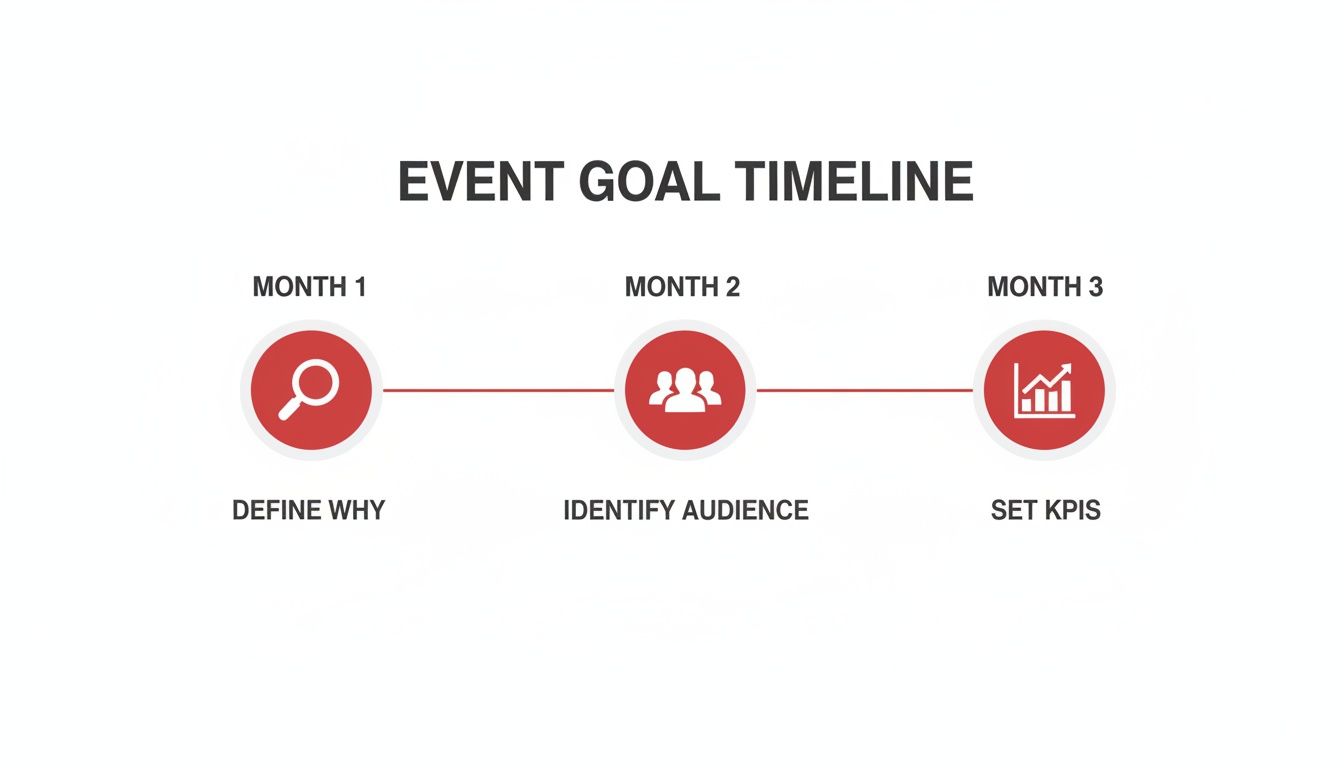
As this timeline shows, you can't build a realistic budget or a practical schedule until you've clearly defined your purpose and your audience. Those foundational decisions inform everything that comes next.
Your Master Timeline Is Your Strategic Advantage
Your timeline is just as critical as your budget. The amount of lead time you have will fundamentally shape your entire planning process. And trust me, more time isn't just about reducing your stress levels. It's a genuine strategic advantage.
Planners who book 12-18 months in advance consistently get better rates on venues, AV, and top-tier speakers. That runway can be the difference between settling for a filler keynote and affording one who actually moves the needle.
A well-managed timeline is your project's command center. It gives your team clarity, manages stakeholder expectations, and keeps all the moving pieces perfectly synchronized.
For a full walkthrough of every single step, you can grab our complete event planning checklist.
Whether you have a full year or just a few months, the key is to break the work into phases with clear, achievable milestones. The table below shows how the key tasks shift depending on your runway.
Sample Corporate Event Planning Timelines
| Milestone | 12-Month Timeline | 12-Week Timeline |
|---|---|---|
| Strategy & Budget | Months 12-10: Set goals, define audience, create initial budget. | Week 12: Immediately define goals, audience, and lock budget. |
| Venue & Key Vendors | Months 10-8: Research, conduct site visits, sign venue & key vendor contracts. | Weeks 11-10: Rapidly source and book venue & essential vendors. |
| Speaker Sourcing | Months 9-7: Identify, vet, and contract keynote speakers and main talent. | Weeks 10-9: Secure available speakers; may have fewer options. |
| Marketing Launch | Month 6: Announce event, open registration, launch "early bird" pricing. | Week 8: Announce event and open registration simultaneously. |
| Content & Agenda | Months 5-3: Finalize agenda, session details, and speaker logistics. | Weeks 7-5: Lock down agenda and all content details. |
| Final Logistics | Months 2-1: Finalize F&B, AV specs, attendee comms, and run-of-show. | Weeks 4-2: Confirm all final details with vendors and speakers. |
| Event Execution | Event Day | Event Day |
| Post-Event | 1-4 Weeks Post: Send surveys, analyze data, and conduct debrief meetings. | 1-2 Weeks Post: Quickly gather feedback and measure ROI. |
A longer timeline gives you breathing room for thoughtful negotiation and secures the best talent, while a shorter one forces you to be decisive and focus only on what's most important. Either way, mapping it all out from day one is the only way to avoid that last-minute chaos.
Finding the Right Venue and Tech Partners
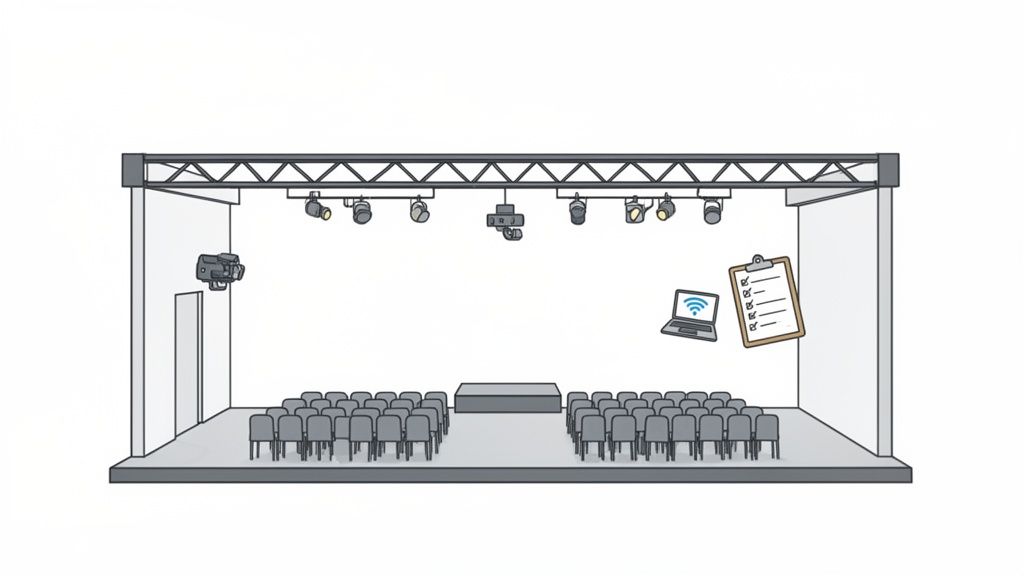
The place where your event comes to life, whether it's a hotel ballroom or a virtual platform, is so much more than a simple background. Your venue and tech stack are core to the entire experience, and they can either make or break your event.
Get these two right, and you’ve built a seamless environment where your message can shine. Get them wrong, and you'll spend the whole time putting out fires instead of connecting with your audience.
Your search should always circle back to the goals you set in the beginning. An executive offsite needs a private, inspiring space that encourages big-picture thinking. A user conference, on the other hand, needs a venue with tons of breakout rooms and rock-solid Wi-Fi. It’s not about finding the biggest room; it's about finding the right room.
Evaluating Venues Beyond the Basics
Site visits are where you get to see past the polished photos and uncover what a venue is really like. Of course, you’ll check the basics like capacity and available dates, but the real magic happens when you start asking the questions other planners might overlook.
Think of it this way: you’re not just renting four walls, you're entering a partnership.
When you're on-site, bring a detailed checklist and don't be shy. Digging into the details is your job. After all, you’re the one who has to anticipate every need your attendees might have.
A few things I always look for during a walkthrough:
- Atmosphere and Brand Alignment: Does the space just feel right for your company? A fast-growing tech startup might thrive in a modern, industrial space, whereas a financial firm might need the classic polish of a hotel conference center.
- Accessibility and Flow: Picture the entire attendee journey from start to finish. How easy is it to park? To find the registration desk? To get from the main hall to the breakout rooms? Look for clear signage, ADA compliance, and a layout that just makes sense.
- Infrastructure and Support: This is where you get technical. Grill them on their in-house A/V, ask about their Wi-Fi capacity (can it handle 500 people live-tweeting at once?), and get a feel for how responsive their on-site team is.
A great venue partner sees themselves as an extension of your team. The professionalism of their staff, their flexibility with setup times, and their honesty about all-in costs are just as critical as the square footage.
Demystifying Your A/V and Tech Needs
Audio-visual production can feel like a totally different language, but it doesn't have to be overwhelming. The best A/V makes the technology completely invisible, letting your speakers and their message take center stage.
The trick is to find a production partner who starts by asking about your goals, not by listing their gear.
Before you even talk to a vendor, get clear on what you need the tech to do. A single keynote presentation has totally different needs than an event with five simultaneous breakout tracks and a livestream for a virtual audience.
Your tech plan should answer a few key questions:
- Main Stage Production: What kind of sound, lighting, and screen setup will make our keynote presenter look and sound amazing?
- Breakout Room Support: Will we need dedicated mics, projectors, and technicians in each of the smaller session rooms?
- Hybrid and Virtual Elements: If we're streaming, we absolutely need a partner who gets camera switching, tools for online audience engagement, and broadcast-quality internet.
When you're vetting A/V companies, ask to see case studies from events similar in size and scope to yours. A true partner will act more like a consultant, helping you translate a speaker's technical rider or suggesting creative ways to make the experience more dynamic, not just trying to upsell you on more speakers. You want a team obsessed with flawless execution so you can stay focused on your attendees.
How to Choose a Speaker Who Drives Outcomes
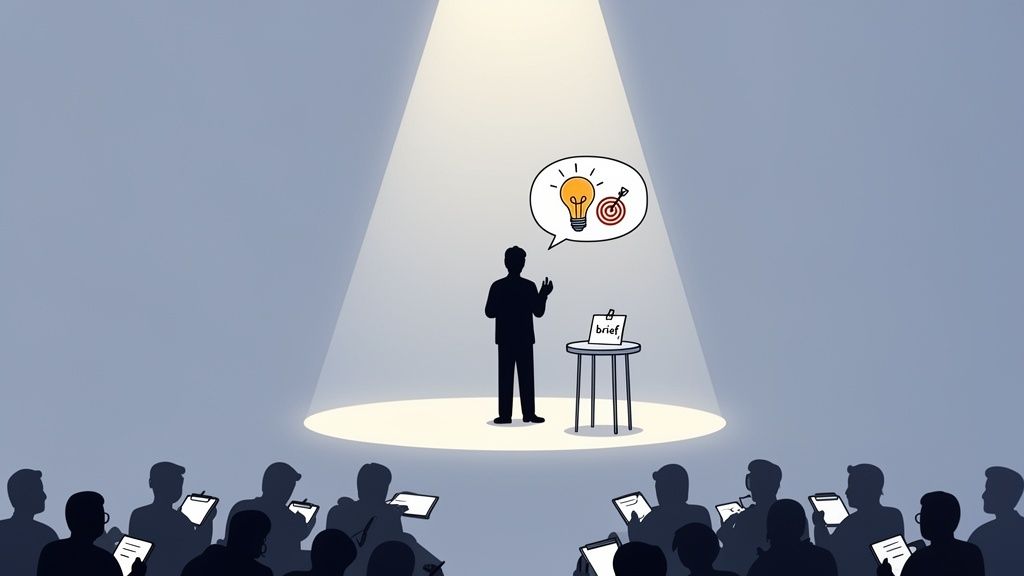
Let's be honest: a great keynote speaker does a lot more than just fill an hour on your agenda. They're the strategic anchor for your entire event. The right person on stage can lock in your core message, ignite real inspiration, and get your audience to take action long after the applause fades.
The trick is to stop "hiring a speaker" and start finding a strategic partner. Forget scrolling through endless lists of generic motivational gurus. Your real goal is to find an expert whose unique, real-world story connects directly to your business objectives.
When you nail this, the keynote stops being an expense and starts becoming an investment that pays real dividends.
Align Speaker Expertise with Your Event Goals
The most common mistake I see is when planners focus on name recognition alone. Sure, a famous face might create a little buzz, but if their message doesn't directly support your event's "why," the impact evaporates the moment they walk off stage.
Before you even start looking, circle back to the goals you set at the beginning of your planning process. What do you need this speaker to accomplish?
- Hosting a sales kickoff focused on resilience? Instead of a generalist, find someone like Shannon Rowbury. An Olympic athlete can speak with unshakable authority on peak performance and overcoming crushing setbacks. Her stories from the track provide concrete lessons in mental toughness that a sales team can actually use.
- Planning a leadership offsite on innovation? You need an inventor or founder who has genuinely built something from the ground up. Someone like Adam Cheyer, the co-creator of Siri, can give an authentic, first-hand account of turning an impossible idea into a world-changing reality.
- Running a user conference about future tech? You need an expert who can do more than just explain AI. They need to show your audience what's coming next. A speaker with a deep background in pioneering new technology gives your customers a credible, exciting vision of the future.
This kind of alignment is what separates a forgettable speech from a session that becomes a defining moment for your team. The speaker’s credibility flows from their lived experience, not just their polish on stage.
Look for a Compelling Narrative, Not Just a Topic
Once you've zeroed in on the right expertise, the next filter is the power of their story. People forget facts and figures, but they remember stories. The best speakers are masterful storytellers who weave their own triumphs (and failures) into a narrative that hits you on a human level.
A truly compelling story has a few key ingredients:
- Authenticity: The story is theirs and theirs alone. It's not a repackaged collection of anecdotes; it's a genuine account of their journey.
- Struggle and Triumph: A story without conflict is just a report. A speaker who is vulnerable about the challenges they faced makes their success that much more powerful.
- Actionable Takeaways: The story must lead somewhere. It should deliver clear, practical lessons the audience can apply to their own work.
Here’s a pro tip: When you're vetting potential speakers, ask them to walk you through the core narrative of their keynote. If it doesn't give you goosebumps or make you think, it probably won't do that for your audience, either.
Prepare Your Speaker for Maximum Impact
Your job isn’t finished when the contract is signed. The final, essential step is to treat your speaker like a true partner in the event's success. This means giving them a thorough briefing so they can customize their content and knock it out of the park.
A detailed briefing is non-negotiable. Don't just forward the agenda. To help them truly tailor their message, you need to provide:
- Audience DNA: Who is in the room? What are their roles, their biggest challenges, and their current mood?
- Event Goals: Be crystal clear. What do you want the audience to think, feel, and do after the session?
- Company Context: Share recent wins, current struggles, and any internal lingo or acronyms they should know.
This level of preparation allows a great speaker to weave your company's story into their own. It’s the difference between a canned speech and a custom-built experience that connects with every single person in the room.
If you're ready to find a speaker who can deliver this kind of impact, you can explore our roster of innovators and builders and see how their unique stories can align with your event goals.
Crafting an Unforgettable Attendee Experience
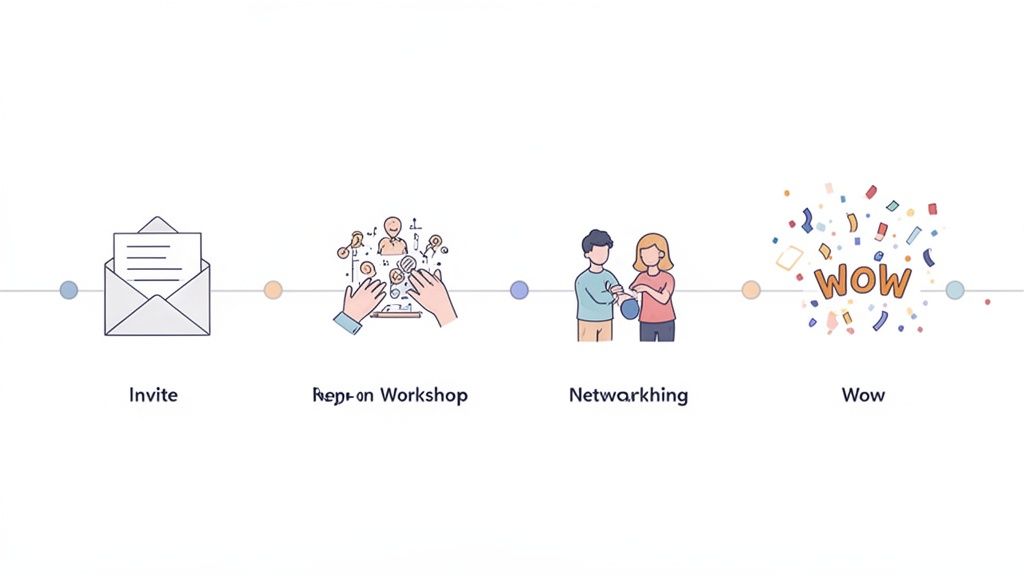
A great corporate event is so much more than a string of presentations. It's a journey. The real secret to making an event memorable, instead of just another meeting, lies in the run-of-show. This is your master script, the document that dictates the flow, energy, and rhythm of the entire experience.
Think of it as your blueprint for holding your audience's attention from the moment they check in to the final applause. It’s where you strategically map out every session, break, and transition to build a story that sticks.
Designing an Agenda with Purpose
Your agenda's structure needs to be a direct reflection of your event's primary goal. There’s no such thing as a one-size-fits-all agenda. A high-energy sales kickoff, for instance, needs a completely different flow than a deep-dive leadership offsite.
For an SKO, it’s all about building momentum. You might kick things off with a high-impact opening keynote to get everyone fired up. From there, you could move into practical product training, and then cap it off with a competitive team-building activity that puts that new energy to use.
A leadership retreat, on the other hand, requires room to breathe. The agenda should feature longer, more interactive workshop blocks, plenty of unstructured time for networking, and sessions designed for genuine problem-solving, not just one-way information delivery.
The best agendas feel intentional. They balance high-energy moments with periods for reflection and connection, guiding attendees through an emotional arc that reinforces the event’s core message.
This kind of thoughtful pacing is what prevents attendee burnout and makes sure your key messages actually land.
To give you a clearer picture, here's what a typical run-of-show for a full-day Sales Kickoff might look like.
Sample Run-of-Show for a Sales Kickoff
This example agenda is designed to build energy, deliver critical information, and build team connection over the course of a single day.
| Time Slot | Activity | Objective |
|---|---|---|
| 8:00 - 9:00 AM | Registration, Breakfast, & Networking | Create a welcoming atmosphere and allow for informal team connection. |
| 9:00 - 9:45 AM | Opening Keynote: "The Year Ahead" by CEO | Set an inspirational tone, align the team on company vision and annual goals. |
| 9:45 - 10:45 AM | Product Deep Dive: "What's New in Q1" | Equip the sales team with in-depth knowledge of new products and features. |
| 10:45 - 11:00 AM | Coffee & Networking Break | Provide a short rest and encourage peer-to-peer discussion. |
| 11:00 - 12:30 PM | Interactive Workshop: "Mastering the New Sales Playbook" | Facilitate hands-on practice with new sales strategies in small, collaborative groups. |
| 12:30 - 1:30 PM | Lunch | Offer a substantial break for rest, refueling, and social interaction. |
| 1:30 - 2:30 PM | Customer Panel: "Voices from the Field" | Provide valuable customer insights and reinforce the impact of the sales team's work. |
| 2:30 - 4:00 PM | Team-Building Challenge: "The Ultimate Pitch-Off" | Build healthy competition, build camaraderie, and apply learned skills in a fun setting. |
| 4:00 - 4:30 PM | Closing Remarks & Awards Ceremony | Recognize top performers, summarize key takeaways, and end on a high note. |
| 4:30 PM onwards | Happy Hour & Socializing | Celebrate successes and allow for relaxed, unstructured networking. |
Notice how the day flows from high-level inspiration to tactical skills, practical application, and finally, celebration. That's a journey, not just a schedule.
Weaving Your Theme Through Every Touchpoint
A strong, consistent theme is the glue that holds the entire experience together, making it feel polished and cohesive. Your event theme should be more than just a tagline on a slide; it should show up everywhere, from the graphics to the content of each session.
Here’s how you can thread your theme through the entire event:
- Pre-Event Buzz: The first invitation and all reminder emails should introduce the theme and start building anticipation.
- On-Site Branding: Use signage, screen graphics, and even the stage design to visually reinforce the central idea.
- Session Content: Ask your speakers to connect their presentations back to the theme. A keynote on resilience, for instance, fits perfectly with a theme like "Forging a New Path."
- Post-Event Follow-Up: A final thank you that summarizes key takeaways and references the theme brings the experience full circle.
When your theme is consistently present, it turns a collection of individual moments into a single, powerful story. This is a essential part of how to plan a corporate event that people actually remember.
Building in Moments That Matter
Beyond the mainstage talks, the most memorable parts of an event are often the small, intentional moments designed to surprise and delight your guests. These are the "wow" factors that get people talking and make them feel genuinely appreciated.
These moments don't have to break the bank. They just need to be thoughtful.
- Interactive Workshops: Ditch the passive listening. A hands-on workshop gets attendees to apply new concepts and collaborate with their peers, which helps the learning stick.
- Dedicated Networking Time: Don't just hope people will mingle during the coffee break. Schedule facilitated networking blocks designed to help people make meaningful connections.
- Personal Touches: Little things go a long way. A handwritten welcome note, a unique gift from a local vendor, or even a killer playlist during breaks can make a huge impression.
When you design a thoughtful run-of-show and weave a consistent theme through every detail, you’re creating something far more valuable than a meeting. You're crafting an unforgettable experience that energizes your team, reinforces your goals, and delivers a lasting return.
Measuring Your Event's Success and Proving ROI
When the last attendee walks out the door, your job isn't quite done. The real final step in planning a corporate event is proving it was worth the time, effort, and money. This isn't just about justifying the spend for this one event; it’s about gathering the ammunition you need to make the next one even better.
This is where everything comes full circle. You're taking the results and tying them directly back to the goals you established way back at the beginning of this whole process. It's how you build a powerful feedback loop that shows leadership the undeniable value of great events.
Linking Outcomes to Objectives
Your measurement plan needs to be a smart mix of feelings and facts: qualitative feedback and hard, quantitative data. The trick is to pick metrics that actually line up with your original goals. For example, if your primary objective was to speed up the sales pipeline, positive attendee feedback is nice, but a spike in demo requests from attendees is what really matters.
Start gathering feedback right away while the experience is still fresh. Post-event surveys are a classic for a reason. They’re quick, easy, and give you an immediate pulse check on how things went.
But don’t stop there. The real proof of ROI often comes from looking at what happens after the event is over. You need to track the metrics that show a genuine change in behavior.
Here are a few things to keep an eye on in the weeks and months that follow:
- Sales and Lead Generation: How many new qualified leads did you generate? Did the sales cycle shorten for attendees? How many deals that closed can be traced back to the event?
- Employee Engagement and Retention: For an internal event like a sales kickoff, look at post-event engagement scores. You could even track changes in employee turnover for the teams that attended.
- Customer Adoption: If you hosted a user conference, what was the adoption rate for that new feature you launched? Did you see a drop in customer support tickets related to topics you covered?
The best ROI stories are built on concrete data. Saying "it was a great event" is one thing. Showing a 15% lift in pipeline created by attendees tells a story that gets an executive's attention.
Building Your ROI Report
Once you have all your data, it's time to package it into a report that tells a clear and compelling story for your stakeholders. This shouldn't be just a dry spreadsheet. Your job is to translate those numbers into a narrative that screams "business impact."
Structure your report to highlight the big wins and explicitly connect them to the initial investment. How you present your findings is just as important as the data itself. To really drive the point home, you can use visuals to help leaders quickly grasp the results. For more on this, check out our guide on data visualization for event professionals.
By systematically measuring your success and clearly communicating the return on investment, you do more than just prove an event's worth. You cement your role as a strategic partner who knows how to drive real business results.
Burning Questions About Corporate Event Planning
Let's be honest, even the most seasoned planners run into the same tricky questions when mapping out a corporate event. Here are my straight-to-the-point answers to a few of the most common ones I hear.
How Far Out Should I Really Start Planning?
This is the big one, and the answer is simple: it depends entirely on scale.
For a major event like your annual user conference or a national sales kickoff with 200+ people, you need to be thinking 9 to 12 months ahead. Seriously. That kind of lead time is your best weapon for locking in the perfect venue and the most in-demand speakers before they get snatched up, often at a much better price.
If you're planning something smaller and more intimate, like a leadership offsite or a regional team meeting, a 3 to 6-month window usually gives you enough breathing room to get everything sorted without the last-minute chaos.
What's the Single Biggest Mistake I Can Make?
Hands down, the most critical mistake is not defining crystal-clear, measurable goals from the very beginning. An event without a specific purpose is just a party, and it’s impossible to prove its value to your leadership team later.
Every decision you make—from the content on the agenda to the swag you hand out—should directly tie back to a tangible business outcome. Fuzzy goals get you fuzzy results. Anchor your event to something concrete, like "generate 20% more marketing qualified leads" or "get the entire sales team certified on the new messaging."
How Do I Find a Keynote Speaker That Actually Connects?
Forget about just finding a big name. The right speaker is someone whose expertise and story directly support your event's core message and speak to the real-world problems your audience is facing.
Think about it: if you're hosting an innovation summit, who's going to make a bigger impact? A generic motivational speaker, or a founder who actually built a category-defining company from scratch? You want someone who can offer practical, actionable insights that get people excited to do something different when they get back to the office.
At Silicon Valley Speakers, we specialize in connecting you with builders and innovators whose real-world stories align perfectly with your event goals. Find a speaker who can deliver tangible outcomes for your next event.