

A leadership keynote speaker isn't just someone who gives a good speech. They’re a professional brought in to deliver the core message of your event—be it a conference, a sales kickoff, or an executive retreat. They take their deep knowledge in fields like innovation, resilience, or team dynamics and turn it into real, practical takeaways for your people.
Aligning Your Event Goals with the Right Speaker
Before you even think about scrolling through speaker profiles, you have to do the most important work first: define what a "win" looks like for your event. If you don't know what you're aiming for, even the most charismatic speaker on the planet will miss the target.
So, start by asking the big question: What are we trying to accomplish here? Are you hoping to fire up a sales team for the next quarter? Or do you need to give newly-promoted managers a crash course in effective communication?
The answer changes everything. An event meant to spark creative thinking among senior leaders needs a totally different kind of speaker and message than one designed to build resilience in a team going through a massive company change.
Defining Your Core Objectives
You have to get really specific with your goals. "Motivating the team" is nice, but it's not a goal—it's a wish. You need to frame your objectives as tangible outcomes.
Let’s get practical:
- For a Sales Kickoff: Don't just "motivate." Aim to "Equip the sales team with three new strategies for handling objections, with the goal of increasing qualified leads by 10%."
- For a Leadership Summit: Instead of just "inspiring," try this: "Introduce a new framework for empathetic leadership that managers can start using in their very next one-on-one meeting."
- For an All-Hands Meeting: Forget "improving morale." A better goal is to "Realign the entire company with our mission by sharing a powerful innovation story, aiming to boost engagement scores on our post-event survey."
A great speaker doesn't just deliver a speech; they deliver an outcome. When you can articulate the exact outcome you need, you've already done the hardest part of the hiring process.
Building a Detailed Audience Profile
Once you’ve nailed down your objectives, it's time to think about the people who will actually be in the room. Who are they? Knowing their mindset is how you find a leadership keynote speaker who can actually connect with them.
Think about their day-to-day reality. Are they seasoned C-suite execs who think they’ve heard it all before? Or are they up-and-coming leaders who are hungry for new skills?
A message that resonates deeply with a room full of software engineers could easily fall flat with a team of HR managers. This is where you need to do your homework. This prep work ensures the speaker you ultimately choose doesn’t just talk at your audience—they speak to them, hitting on the very challenges and goals that keep them up at night.
Budgeting and Choosing the Best Format
Alright, let's talk money. Before you even start looking at speaker profiles, you need to get real about your budget. The amount you have to invest is the single biggest factor determining the caliber and recognition of the speaker you can bring in. Having a clear number in mind from the get-go saves everyone a ton of time and keeps your search focused.
But the speaker's fee is just the starting point. I've seen too many planners get caught off guard by the "extras." You have to account for their round-trip airfare, ground transport, hotel, and meals. And don't forget the tech rider—some speakers need specific gear like a confidence monitor or a certain microphone, which might be an extra charge from your A/V crew.
Keynote vs. Workshop: Which is Right for You?
Once you have a handle on the budget, the next big question is format. Are you looking for a big, splashy keynote or a hands-on, roll-up-your-sleeves workshop? They serve very different purposes.
A keynote is all about a powerful, high-level message meant to inspire and energize a large crowd. Think big conference openings or sales kickoffs. A workshop, on the other hand, is designed for deeper learning and interaction in a smaller group setting, perfect for leadership retreats or focused training.
So, what's your goal? If you want to send your team off with a jolt of new energy and a fresh perspective, a keynote is your best bet. But if you need them to leave with a concrete, practiced skill they can use Monday morning, a workshop is the way to go.
This chart can help you think through which path makes the most sense for your event.
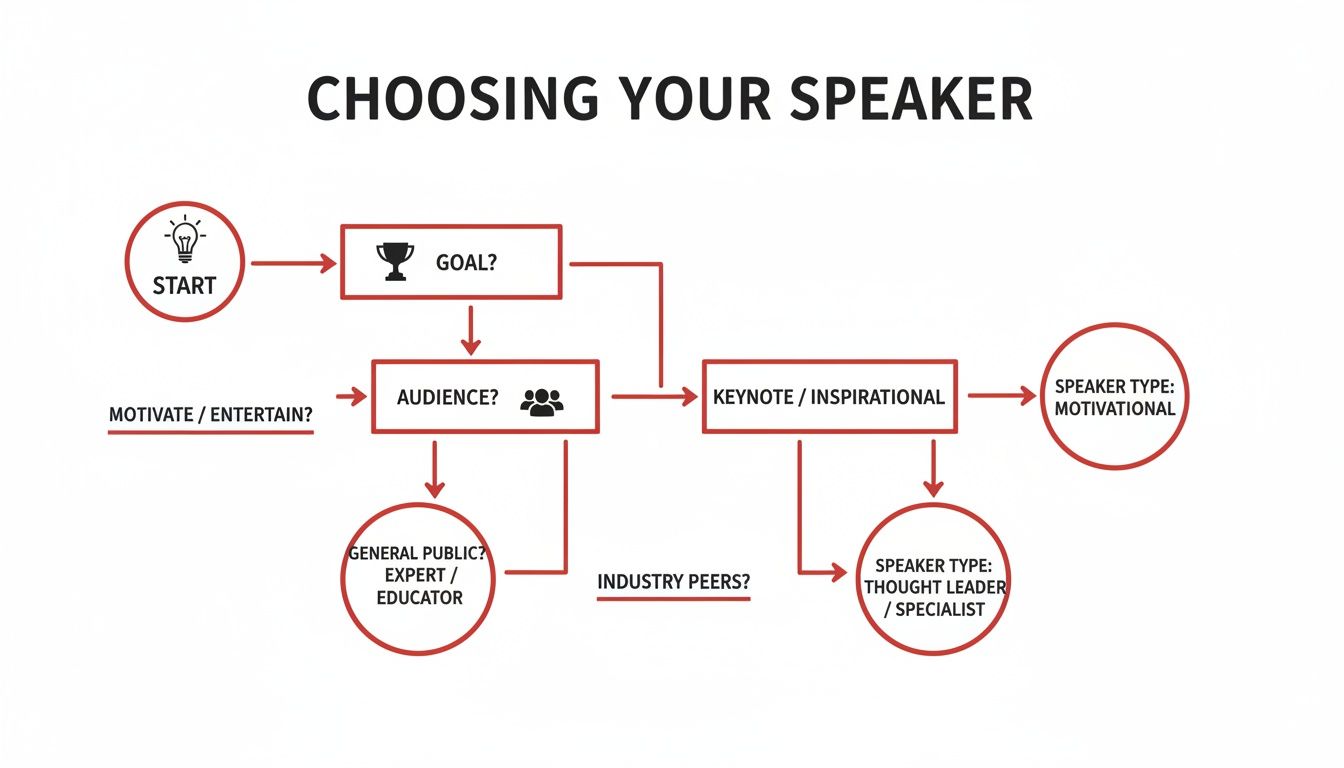
The decision really boils down to whether you're aiming for broad inspiration or deep skill development.
To make the choice even clearer, here's a side-by-side breakdown of what you can expect from each format.
Keynote vs Workshop Format Comparison
| Attribute | Keynote (60-90 Mins) | Workshop (Half/Full Day) |
|---|---|---|
| Primary Goal | Inspire, motivate, shift perspective | Build skills, solve problems, apply concepts |
| Audience Size | Large (50 to 5,000+) | Small to medium (15-50) |
| Interaction Level | Low (mostly one-way communication) | High (group work, Q&A, exercises) |
| Content Depth | High-level concepts, big ideas | In-depth, practical, hands-on |
| Best For | Conferences, kickoffs, all-hands meetings | Leadership retreats, team training, skill-building |
| Key Takeaway | A new way of thinking, renewed energy | A new skill, an actionable plan |
Choosing between a keynote and a workshop isn't about which is "better"—it's about which format will deliver the specific outcome you need for your audience.
Making a Strategic Financial Decision
As you lock in your numbers, remember that the biggest name isn't always the best value. The market is shifting. We're seeing a clear trend where substance is winning out over pure celebrity.
Budgets are still tight across the board. Recent data shows that 47% of planners are working with less than $10,000, and only a tiny 9% can afford fees north of $50,000. With 41% of planners saying that staying on budget is their top concern, many are looking for visionary speakers who can also lead practical, skill-based workshops. If you want to dig deeper, you can explore the top speaker trends for business events and see how the industry is adapting.
A hard-earned lesson: Never, ever allocate your entire speaker budget to just their fee. The hidden costs will get you. A safe rule of thumb is to budget an extra 15-20% of the speaker's fee to cover travel, lodging, and tech. It will save you a lot of stress down the road.
A Practical Guide to Vetting Potential Speakers
Anyone can have an impressive bio, but a truly great leadership speaker is a rare find. Once you've got a shortlist, the real work begins. It's time to look past the slick marketing and figure out who has real substance and stage presence. This is where you separate the performers from the partners. For example, the speakers we represent at this tier — like Adam Cheyer (co-creator of Siri and ex-VP AI Experience at Airbnb) or Drue Kataoka (keynoter at Davos, the Milken Global Conference, and the Pontifical Academy of Sciences at the Vatican) — have decades of operating credibility you can verify in 30 seconds of Googling. For example, the speakers we represent at this tier — like Adam Cheyer (co-creator of Siri and ex-VP AI Experience at Airbnb) or Drue Kataoka (keynoter at Davos, the Milken Global Conference, and the Pontifical Academy of Sciences at the Vatican) — have decades of operating credibility you can verify in 30 seconds of Googling.
First thing's first: get your hands on their speaking reels. Don't just settle for the sizzle reel—that high-energy, 90-second highlight clip. You need to see the real deal. Ask for a full, unedited recording of a recent keynote, preferably one given to an audience like yours.
Watch how the crowd responds. Are they engaged, leaning in, and taking notes? Or are their faces buried in their phones? A speaker’s ability to hold a room for a full hour is the truest test of their impact.
Moving Beyond the Speaking Reel
Video is a great starting point, but it only tells you so much. You also need to understand their process and how they work with clients. That's why a direct conversation is non-negotiable. Think of the interview as a chemistry check—you're looking for someone who will be a genuine partner in your event's success.
Get a call on the calendar and come prepared. You want questions that dig into how they customize their content and prepare for an event. A true pro will appreciate your diligence. Their answers will tell you everything you need to know about their working style and whether they're committed to delivering more than just a canned speech.
A speaker's reel shows you what they did for someone else. Your interview process reveals what they can do for you. Look for a partner who is just as curious about your event goals as you are about their speaking topics.
Critical Interview Questions to Ask
During your chat, the goal is to understand how they think and operate. Generic questions get you generic answers, so you have to be more strategic. Focus on questions that peel back the layers on their process, experience, and adaptability.
Here are a few questions that get straight to the point:
- "Can you walk me through your process for customizing a keynote for a new client?" This tells you how much homework they do. Are they crafting a message for your audience or just dusting off an old script?
- "Tell me about a time you spoke to an audience similar to ours. What were their biggest challenges, and how did you address them?" This is a great way to gauge their industry knowledge and see if they can genuinely connect with your attendees.
- "How do you prefer to be briefed, and what information is most critical for you to deliver a successful talk?" A seasoned speaker will have a clear, thoughtful answer. It shows they have a system and know what they need to succeed.
If you want to speed up your initial search, a speaker discovery engine can help you find professionals who have already been vetted.
And finally, always ask for references. Get the contact info for a few recent clients who had similar event goals or audiences. Talking to someone who has already worked with them gives you an unfiltered look at their professionalism, flexibility, and overall impact. A confident speaker will have these ready to go. This last step ensures you’re not just hiring a speaker; you’re investing in a reliable partner.
Crafting a Speaker Brief That Guarantees a Home Run
A killer speech is never an accident—it’s the direct result of a solid partnership between you and your speaker. And the most critical tool you can give a leadership keynote speaker is a detailed, thoughtful briefing document. This isn't just about dates and times; it’s about arming them with the insider knowledge they need to connect deeply with your audience.
Think of the brief as the blueprint for your event's success. It’s your chance to give the speaker a complete picture of who they'll be talking to, what keeps those people up at night, and what you need them to think, feel, and do once the applause dies down. A well-crafted brief is your secret weapon for making sure the message doesn't just land, but sticks.
Setting the Stage for Success
Start with the basics, but then go deeper. Don't just list a bunch of job titles; paint a picture of the audience’s mindset. Are they feeling burned out after a rough quarter? Are they skeptical about a new company direction? That kind of emotional context is pure gold for a great speaker.
You also need to be upfront about the business challenges you're facing. Is a new competitor eating into your market share? Are you having trouble keeping your best people? When a speaker can tie their message directly to these real-world problems, their content becomes instantly relevant and incredibly valuable.
A briefing document is more than a checklist; it's a conversation starter. It’s your opportunity to tell the speaker, "This is who we are, this is where we're struggling, and here is how we believe you can help us."
The Anatomy of an Effective Speaker Brief
To put together a brief that truly empowers your speaker, you need to cover a few key areas. Every detail you provide helps them tailor their stories, fine-tune their examples, and sharpen their takeaways so they resonate on a personal level with your team. This is what separates a generic, off-the-shelf talk from a customized, unforgettable experience.
Below is a checklist of the essential components every briefing document should have. Think of it as your guide to making sure nothing gets lost in translation.
Essential Speaker Briefing Checklist
| Section | Key Information to Include |
|---|---|
| Audience Profile | Demographics, roles, seniority, and their current emotional state (e.g., excited, anxious, skeptical). |
| Event Goals | Your top 1-3 measurable objectives for the session. What should the audience think, feel, or do differently? |
| Business Context | Recent company wins, current challenges, and industry-specific jargon or acronyms to use (or avoid). |
| Key Takeaways | The three most important messages you want the audience to remember a week after the event. |
| Logistics | Event schedule, A/V setup, stage layout, dress code, and names of other speakers or key executives. |
Using this structure ensures all your bases are covered.
More and more, planners are looking for speakers who can share authentic stories about leading through change and building psychologically safe workplaces. This makes sense, especially when you consider that companies with diverse leadership teams are 39% more profitable. Your brief is the perfect place to flag these themes if they’re a priority for your organization. You can get more ideas by checking out the latest keynote speaking trends.
From Handshake to Standing Ovation: Logistics and Proving the Value
Once the contract is signed, your focus shifts from finding the right speaker to creating the perfect stage for them. This is where the magic really happens—or where things can go sideways if you're not careful. It’s all about the details that ensure both your speaker and your audience have a seamless, powerful experience.
Think of it this way: your job now is to remove every possible point of friction. Clear, proactive communication is your best tool. Nail down travel plans, hotel confirmations, and ground transportation details early. Most importantly, schedule a dedicated tech check. A fuzzy slide or a crackling microphone can instantly kill the momentum of even the most captivating speaker. Don't assume anything; confirm their specific A/V needs, from clicker preferences to confidence monitors, well ahead of time.
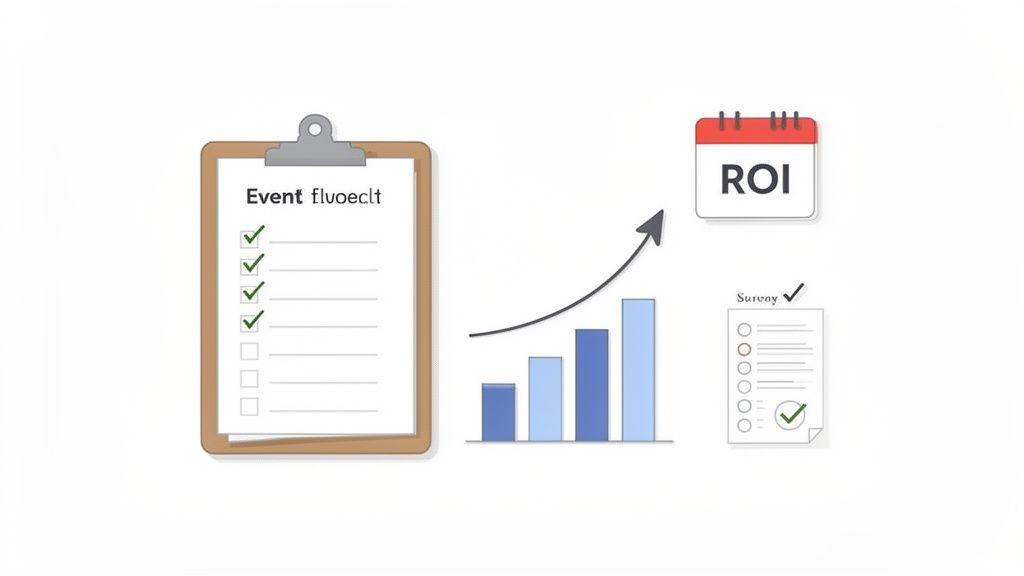
Beyond the Applause: Measuring What Matters
The real measure of a great keynote isn't the volume of the applause; it's the lasting impact on your business. To get a true sense of your return on investment, you have to connect the speaker's message back to the goals you set in the very beginning. This means moving past simple "feel-good" feedback.
This is where your post-event survey becomes a critical business tool. Ditch the generic questions. Instead of asking, "Did you enjoy the session?" dig deeper with questions that measure real change.
- Pinpoint specific takeaways: "Which of the speaker's three leadership principles are you most likely to try with your team this month?"
- Track shifts in confidence: "On a scale of 1-10, how much better equipped do you feel to handle difficult conversations after this keynote?"
- Prompt immediate action: "What’s one thing you’ll do differently this week based on what you learned today?"
True ROI isn't just a feeling; it's data. It’s the measurable shift in team performance, the increase in employee engagement scores, or the successful adoption of a new leadership framework in the months following your event.
Tying the Keynote to Long-Term Wins
A single keynote can light a fire, but the real value is in the change that happens weeks and months later. The smartest event planners I know are experts at connecting the dots between the event and their company's key performance indicators (KPIs).
For instance, if your speaker's topic was all about improving collaboration, you should be tracking project cycle times or the number of cross-departmental projects launched in the next quarter. If they spoke on resilience, keep an eye on employee retention rates or productivity metrics during your next big push. This approach turns the speaker's fee from a line-item expense into a verifiable investment in your company's future.
The numbers back this up. An incredible 87% of clients see an ROI between one and five times the speaker's cost when they use these kinds of advanced metrics. As more companies seek out speakers who can tackle complex topics like emotional intelligence, proving this value is more important than ever. To keep all these final pieces in order, our detailed event planning checklist can be a lifesaver.
Your Top Speaker-Hiring Questions, Answered
If you're new to hiring keynote speakers, you probably have a few questions. That's completely normal. Let's walk through some of the most common things event planners ask, so you can feel confident you're making the right call.
How Far in Advance Should I Book a Leadership Keynote Speaker?
Honestly, the sooner, the better. For your big annual conference or if you have your heart set on a well-known speaker, you really want to start looking 6 to 12 months out.
Booking that far ahead does two things. First, it locks in your top choice before their calendar is completely jammed. Second—and this is the important part—it gives them plenty of time to really get to know your company. They can dig into your culture and your goals, which is how a good speech becomes a truly great one. If it’s a smaller internal meeting, you might get away with a 3 to 6-month lead time, but giving yourself more runway is always less stressful.
What Is a Speaker Rider and Should I Be Worried About It?
Don't let the term "rider" scare you—it's not about a list of diva-like demands. A speaker rider is just a simple document that lists their technical and travel needs to ensure they can deliver their best performance.
Think of it as their professional checklist. You'll typically see things like:
- A/V Gear: They might need a specific microphone (like a hands-free lavalier), a monitor on stage so they can see their slides, or a particular stage layout.
- Travel Details: This usually covers standard flight and car service arrangements to make sure they arrive on time and ready to go.
- On-Site Basics: This is often as simple as having bottled water on stage or a quiet green room to focus in before their talk.
The key is to share the rider with your A/V and logistics teams right away. It helps you catch any potential issues early and guarantees a smooth, professional experience on event day.
How Do I Make Sure the Speaker's Message Actually Fits Our Company?
This is the million-dollar question, and the answer starts way back in your vetting process. When you're first talking to potential speakers, ask them directly how they customize their message for different audiences and company cultures.
A true pro doesn’t just show up and give a canned speech. For that hour on stage, they should feel like an extension of your own leadership team, speaking your company's language.
Your most valuable tool here is the detailed speaker brief we talked about earlier. When you give a speaker a brief that lays out your company values, inside jokes, recent wins, and current obstacles, you give them the ingredients to craft something truly special. They can weave your stories and terminology into their talk, making the message resonate on a much deeper level.
Is It Worth It to Use a Speaker Bureau?
For many planners, absolutely. A good speaker bureau is more of a strategic partner than just a booking agent, and they can save you a massive amount of time and headache.
They’ve already done the hard work of vetting speakers for quality, professionalism, and stage presence, so you get a curated list of proven talent. A bureau will work with you to understand your event goals and then connect you with the perfect leadership keynote speaker from their roster. They also manage all the contracts, logistics, and back-and-forth communication, which frees you up to focus on the million other things on your event checklist.
At Silicon Valley Speakers, we connect you with visionaries who have built the future and can inspire your team to do the same. We provide a curated roster of proven innovators and leaders to deliver tangible outcomes for your event. Discover the right speaker for your next meeting at https://svsb.ai.