Ever wonder how some companies just get it? They launch products and services that feel like they were made just for you. This isn’t luck—it’s the result of a deliberate, structured approach to understanding what people actually need. That approach is called design thinking.
The 5 Stages of Design Thinking
At its core, design thinking is a problem-solving framework that puts people first. It’s a way to move past our own assumptions and connect with the real-world challenges our customers face.
Think of it less like a rigid, step-by-step recipe and more like a mindset for innovation. It's a dynamic loop of discovery that helps you build things people truly want.
A Foundation for Human-Centered Solutions
The entire process is built on a simple, powerful idea: the best solutions emerge from genuine empathy. It’s about finding that sweet spot where what’s desirable for people meets what’s technologically possible and commercially viable.
"The main tenet of design thinking is empathy for the people you're trying to design for. Leadership is exactly the same thing—building empathy for the people that you're entrusted to help.” — David Kelley, Founder of IDEO
This people-first philosophy is also smart business. By testing ideas early and cheaply, you drastically reduce the risk of investing in a flop. You can learn more about the methodology by exploring these core Design Thinking Process Steps in greater detail.
More Than Just a Process
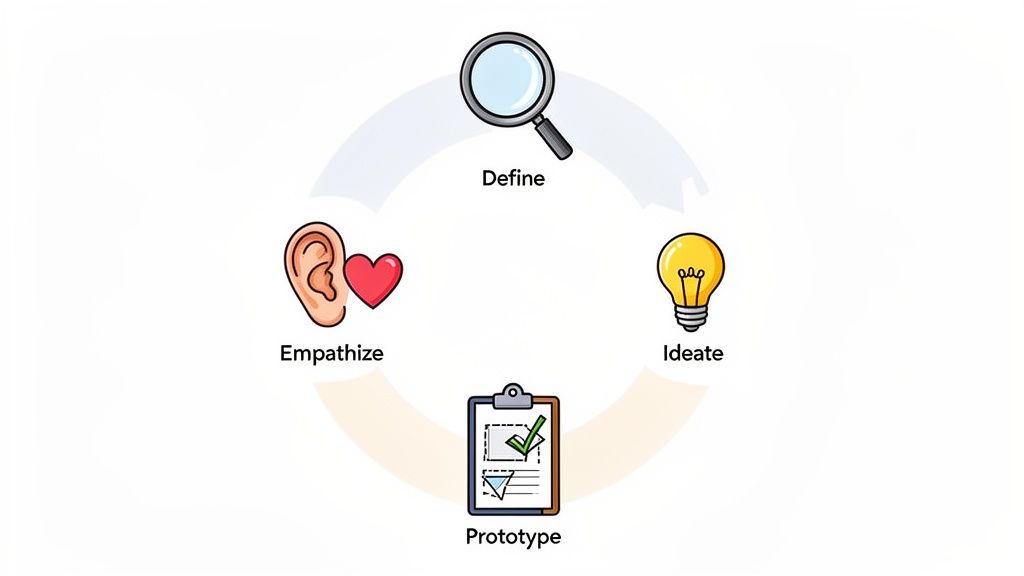
While we often talk about the five stages of design thinking, it’s not a strict, linear path. It’s an iterative cycle. Teams frequently jump back and forth between stages as they learn more, and that’s a feature, not a bug. This flexibility is what allows for constant refinement and improvement.
The process is generally broken down into these five key activities:
- Empathize: Get to know your audience on a human level. Observe, listen, and understand their world and their pain points.
- Define: Use your research to pinpoint the core problem you need to solve. This becomes your mission statement.
- Ideate: Brainstorm a wide range of creative solutions. At this stage, no idea is too wild—the goal is quantity over quality.
- Prototype: Create simple, low-cost mockups of your best ideas. Make them tangible so people can interact with them.
- Test: Put your prototypes in front of real users. Gather feedback, see what works, and learn what doesn’t.
To help you get a clearer picture, here’s a quick overview of each stage and what it aims to achieve.
The 5 Stages of Design Thinking at a Glance
| Stage | Core Question | Primary Objective |
|---|---|---|
| Empathize | What do my users think, feel, and say? | To gain a deep, empathetic understanding of the user. |
| Define | What is the core problem I need to solve? | To frame a clear, actionable problem statement. |
| Ideate | How might we solve this problem? | To generate a broad diversity of potential solutions. |
| Prototype | How can I make my ideas tangible? | To build low-cost, experimental versions of ideas. |
| Test | Does this solution work for our users? | To gather user feedback and refine the solution. |
By moving through this cycle of discovery, organizations can build a sustainable culture of innovation. It gives everyone—not just designers—the tools to contribute to building better products, services, and experiences.
Where Modern Design Thinking Comes From
Design thinking feels like a very modern concept, but its journey didn't start in a Silicon Valley garage. To really get a feel for how it works, it helps to know where it came from—a story that stretches back decades, from university halls to the boardrooms of the world's most innovative companies.
It all started back in the 1960s with something called the design methods movement. At the time, thinkers started asking a fundamental question: how do designers actually solve problems? They wanted to bring some logic and structure to a field that often felt like pure, unteachable intuition. This was the first real attempt to map out the creative process.
From Academia to Action
Things really started to take shape in the 1970s, largely because of Nobel laureate Herbert Simon. In his influential work, he proposed a radical idea: design wasn't just for professionals who make things look nice; it was a unique "way of thinking."
Simon boiled it down to two core activities that sound very familiar today:
- Observing people: Paying close attention to how humans behave and what they truly need.
- Building rough models: Creating simple, tangible versions of ideas to see how they work.
This simple but powerful concept changed everything. It took design out of the art studio and positioned it as a serious method for solving complex problems, whether in business, science, or society.
The Rise of a Business Revolution
The real explosion happened much more recently. The version of design thinking most businesses use today is a product of the last 15-20 years. The shift from an academic idea to a practical business tool really kicked off in the 1990s with the design firm IDEO and was supercharged by Stanford University's Hasso Plattner Institute of Design (the d.school) in the 2000s. These two institutions were instrumental in teaching design thinking as a powerful way to drive innovation. If you want a quick overview of its history, you can see just how quickly it went from a niche idea to a global business standard.
IDEO, founded by David Kelley, was brilliant at packaging these concepts. They created a clear, repeatable process built on empathy, brainstorming, and rapid prototyping that even people with no design background could pick up and use.
At the heart of this new approach was a relentless focus on the end-user. It insisted that empathy—truly understanding the people you're designing for—is the only real starting point for meaningful innovation.
Around the same time, Stanford's d.school started teaching this methodology to a mix of students in engineering, business, medicine, and law. It turned out to be a universally effective tool for problem-solving, proving it wasn't just for creating the next cool gadget.
This history is exactly why companies like Apple and Google embraced design thinking so fiercely. They saw it for what it was: not just another buzzword, but a structured, reliable way to make creative breakthroughs happen again and again. It gives teams a roadmap for dealing with uncertainty and turning genuine human needs into real business value.
Exploring the 5 Stages of Design Thinking
So, what does the design thinking process actually look like in practice? It’s best understood as a five-stage framework. But don't think of it as a rigid, step-by-step checklist. It’s more of a flexible cycle—a roadmap that guides your team from the fog of uncertainty to a clear, user-approved solution.
This framework didn't just appear overnight. It has a rich history, evolving from an academic concept in the 1960s into the powerful business tool we use today.
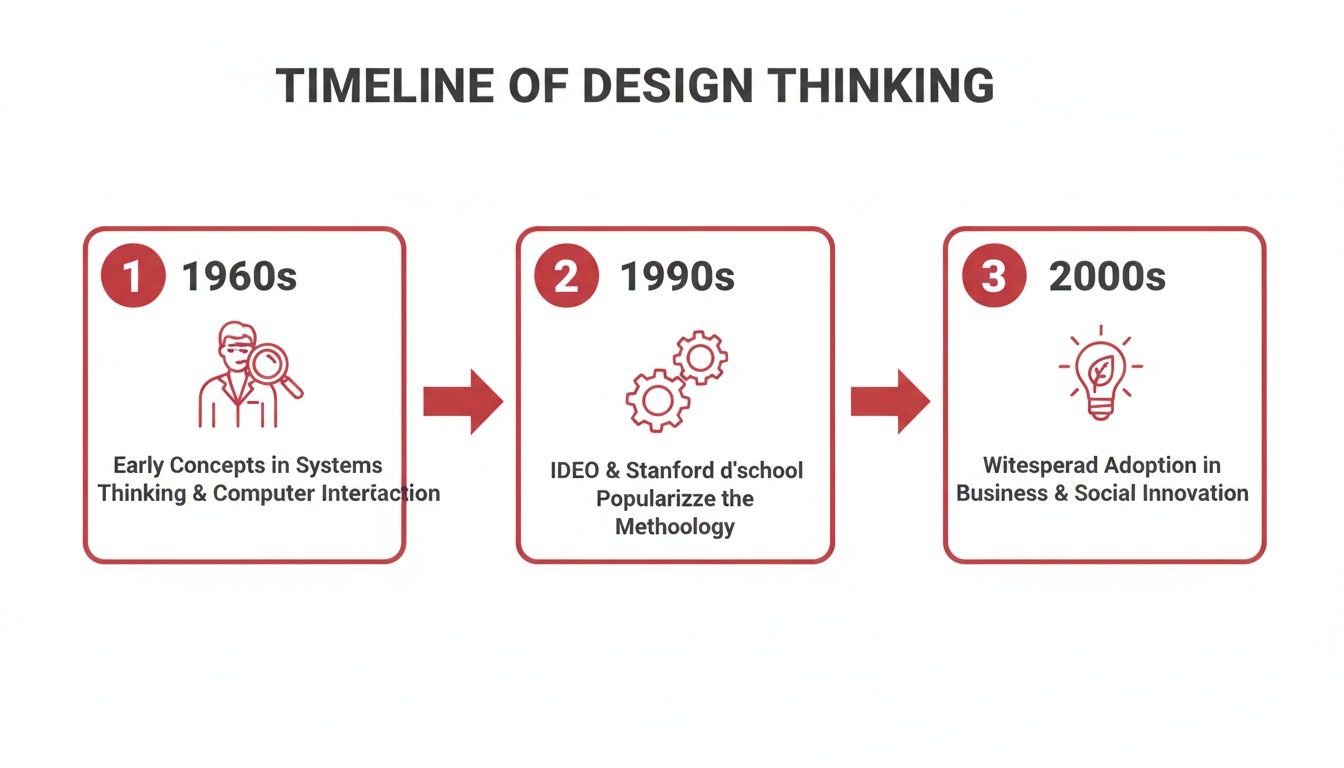
As you can see, the early scientific methods gradually gave way to a more structured, gear-like process in the 1990s, which eventually blossomed into the modern, idea-centric model we see in action. Each of the five stages we're about to cover builds on this legacy, turning human insights into real-world results.
Stage 1: Empathize
Everything starts with Empathize. This is where you deliberately set aside your own assumptions to understand the people you’re designing for. It’s about getting to know their world on a deeply human level. Think less market research, more genuine connection.
I like to compare it to old-school detective work. You wouldn’t solve a mystery from behind your desk; you'd hit the streets, interview witnesses, and look for clues everyone else missed. That’s exactly what the Empathize stage is about: observing users in their element, hearing their stories, and truly feeling their frustrations.
A few classic techniques for this phase include:
- User Interviews: Open-ended chats that dig into what really motivates people, their pain points, and their ultimate goals.
- Observation: Simply watching how people interact with a product or navigate a situation, without interfering.
- Immersion: Walking a mile in your user’s shoes by directly experiencing what they experience.
The goal isn’t to collect data points. It's to build a real, empathetic understanding of your user's reality. This emotional insight is the foundation for any truly meaningful solution.
Stage 2: Define
Once you’ve gathered all those stories and observations, you’re ready for the Define stage. This is where your team comes together to make sense of everything you've learned. You’ll connect the dots and pinpoint the core problem you're actually trying to solve.
This stage is absolutely critical. If you frame the problem poorly, even the most brilliant solution will miss the mark. The objective here is to craft a clear, actionable problem statement, which is often called a Point of View (POV).
A great problem statement is:
- Human-centered: It must focus on a real person's need, not a business objective. So, instead of "We need to increase gym memberships," you’d say, "Young professionals need a quick and motivating way to fit exercise into their unpredictable schedules."
- Broad enough for creativity: It should never prescribe a solution. You want to leave plenty of room for your team to brainstorm freely.
- Narrow enough to be actionable: It needs to set clear boundaries to keep the team focused and on track.
The Define stage is where you turn a messy pile of human insights into a clear, shared mission. It becomes the North Star that guides your team through the rest of the journey.
Stage 3: Ideate
With a sharp problem statement to guide you, it’s time to Ideate. This is the part everyone loves—the brainstorming phase. But it’s more structured than just throwing ideas at a whiteboard. The most important rule? Go for quantity over quality.
To get the creative juices flowing, we use specific techniques to push teams beyond the obvious answers. One of the most effective methods is reframing the problem with "How Might We" (HMW) questions.
Let's say your problem is helping busy parents pack healthy school lunches. Your HMW questions might look something like this:
- How Might We make lunch prep faster on chaotic mornings?
- How Might We get kids genuinely excited about eating healthy food?
- How Might We help families reduce the cost of packing daily lunches?
These simple questions magically transform challenges into opportunities, sparking collaborative and creative thinking. The goal is to generate a massive pool of ideas, from the wonderfully practical to the wildly imaginative. At this stage, there are no bad ideas.
Stage 4: Prototype
The Prototype stage is where your ideas start to feel real. Instead of investing months and a huge budget into building a final product, you create simple, low-cost, and scaled-down versions of your best concepts. A prototype isn't a finished product; it’s a learning tool.
Think of an author scribbling a rough draft or an architect building a quick model out of foam board. It’s all about testing your core assumptions quickly and cheaply.
Prototypes can be surprisingly simple things, like:
- Paper sketches of a new app screen.
- Role-playing a new customer service experience.
- A physical mock-up of a device made from cardboard and tape.
- A storyboard that walks through a new service from start to finish.
The whole point is to invest just enough effort to make an idea tangible enough for a user to interact with and react to. This "fail fast, learn faster" mindset can save you a staggering amount of time and money down the road.
Stage 5: Test
Finally, we arrive at the Test stage. This is where you put your rough prototypes into the hands of real users and watch what happens. The key is to listen with an open mind and observe—not to defend your idea, but to see where it shines and, more importantly, where it breaks.
This phase delivers the honest feedback you need to make your solution better. You might find that a feature is confusing or that your "solution" doesn't actually solve the problem you thought it did. This feedback, good or bad, is pure gold.
Design thinking is iterative. The insights from the Test stage will almost always send you back to an earlier stage. You might need to refine your problem statement, brainstorm a new batch of ideas, or build a totally different prototype. This loop—build, test, learn, repeat—is what drives constant improvement and leads you to a final product that people truly love.
How to Put Design Thinking Into Practice
Knowing the theory behind design thinking is one thing, but actually putting it to work is where the real learning begins. It can feel like a big jump, but it’s more straightforward than you might think. The core shift is simple: move from guessing what customers want to actively discovering their real-world needs.
This isn’t a solo mission. Whether you're kicking off a small pilot project or aiming for a company-wide change, it all starts with building the right team. Design thinking thrives on collaboration, not departmental silos.
Building Your Innovation Squad
Your first goal is to assemble a diverse, cross-functional team. Think of it as your innovation squad.
A strong team should pull people from different corners of the business—product, engineering, marketing, sales, and especially customer support. This mix is your biggest advantage. An engineer can spot technical opportunities, a marketer knows the competitive market, and a support agent has a direct line to everyday customer frustrations.
For this group to do its best work, you have to create an atmosphere of psychological safety. This means setting ground rules where no idea is a bad idea during brainstorming, and failure is just another word for a learning opportunity. Without this foundation, people will play it safe, and you’ll miss out on breakthrough thinking.
Once your team is ready, you can introduce a few simple tools to get started.
Empathy Maps: This is a fantastic tool for getting everyone to step into the user’s shoes. The team works together to map out what a user says, thinks, does, and feels, creating a shared, deep understanding of their world.
Customer Journey Maps: This visualizes the entire experience someone has with your company, from the moment they first hear about you to becoming a loyal customer. It’s the best way to pinpoint specific pain points and uncover moments of unexpected delight.
These aren't just box-ticking exercises. They are structured canvases that fuel conversation and keep your team anchored in the user's reality.
Starting Small and Measuring Success
You don't need a massive budget or a six-month plan to get going. The best approach is to start with a well-defined pilot project. Pick a problem that's manageable but still meaningful, like a feature with low engagement or an internal process that everyone knows is clunky. This gives your team a safe space to practice and score an early win.
A common mistake is trying to get everything perfect on the first go. The real goal is to make progress, not to flawlessly execute every step. Think of your first project as a prototype for how your organization will use design thinking in the future.
As you get underway, you need a way to track your progress. This means looking beyond the usual business metrics. While those are still important, you also need to measure the human side of the equation. A complete picture of your ROI comes from combining both.
Think about tracking a mix of metrics like these:
Human-Centered Metrics
- Customer Satisfaction (CSAT): Are people genuinely happier with the new solution?
- Team Morale: Does the team feel more engaged and empowered by this new way of working?
- Qualitative Feedback: What are users actually saying in interviews and surveys?
Business-Focused KPIs
- User Adoption Rates: Are more people using the product or feature?
- Time to Market: Did this process help you launch a better solution, faster?
- Reduction in Support Tickets: Did your solution actually solve the problems it was designed to fix?
Many organizations find that a little expert guidance can make all the difference. For leaders who want to build this capability from the ground up, professionally led corporate workshops offer the hands-on training needed to quickly turn theory into practice.
Putting design thinking into action is about giving your teams the tools, the permission, and the confidence to solve real problems for real people.
Real-World Examples of Design Thinking Success
Theory is great, but nothing beats a good story to show how design thinking really works. Let's move past the frameworks for a moment and look at how this human-first approach has created incredible results out in the wild. These stories show what happens when companies stop guessing what their customers want and start listening instead.
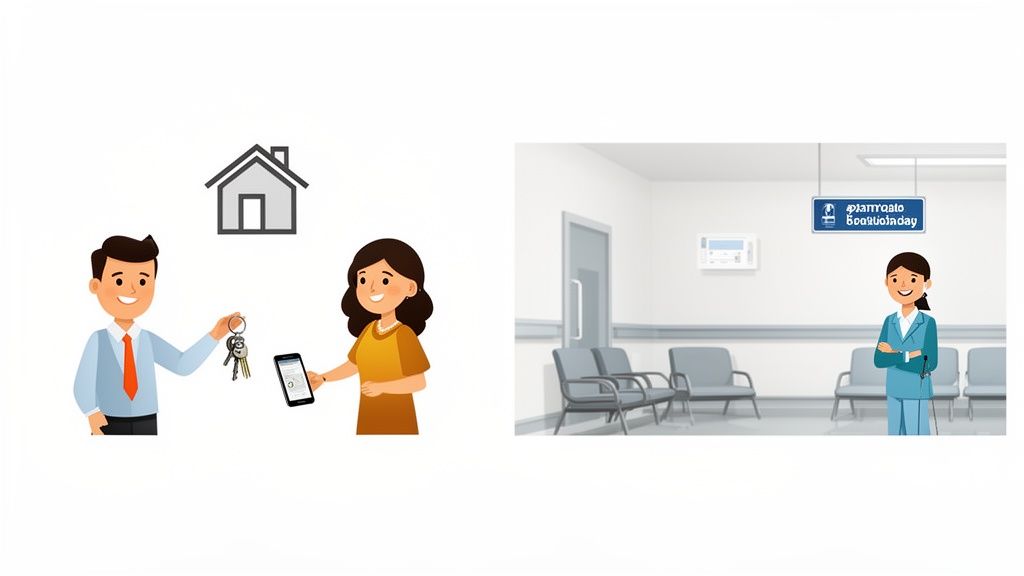
These aren't just feel-good stories about better products. They're about uncovering deep, often unspoken, human needs and turning that understanding into a serious competitive advantage. Two SVSB speakers whose work translates design-thinking principles into the AI era: Drue Kataoka (visual generative AI authority, who teaches leaders to think visually about strategy — empathy and prototyping made tangible) and Dr. Maya Ackerman (CEO of WaveAI, whose computational-creativity research is essentially design thinking applied to machine-generated art).
Airbnb: From Struggling Startup to Global Giant
It’s hard to imagine now, but in its early days, Airbnb was on the verge of collapse. The company was burning through cash, bookings were flat, and the founders were stumped. Instead of burying their heads in spreadsheets or tweaking ad campaigns, they did something radical: they decided to empathize.
The team flew to New York to meet their hosts and see the product through their eyes. What they found was a simple but profound problem: the photos of the listings were awful. They were dark, blurry, and low-quality, failing to build the basic trust someone needs to sleep in a stranger's home.
The core problem wasn't the platform; it was the emotional gap between hosts and guests. The lack of professional photos created a barrier of distrust that no amount of website optimization could fix.
This insight gave them a clear problem to solve: "How might we help hosts present their homes in a way that builds trust and desire?" Their solution wasn't a complex new feature. It was brilliantly simple and hands-on. The founders rented a high-quality camera and went door-to-door, taking beautiful pictures of the listings themselves.
The impact was immediate and staggering. Listings with professional photos saw 2-3 times more bookings. That single, empathy-driven experiment was the spark that ignited Airbnb's explosive growth. They learned their business wasn't about software; it was about building trust. This is a classic example of mastering product discovery to find out what users truly need before you build a solution.
GE Healthcare: A Less Frightening MRI
An MRI machine is a medical marvel, but for a child, it's a terrifying monster. The loud, banging noises and the cramped, dark tube were so distressing that up to 80% of pediatric patients had to be sedated just to get through the scan. Doug Dietz, a lead designer at GE Healthcare, was heartbroken when he saw a little girl crying in fear before using a machine he had designed.
He knew he had to fix it. Doug began the design thinking process by truly empathizing with the kids. He spent time in hospitals, observing their experience, and collaborated with child life specialists and even experts from a children's museum. He realized the entire experience needed to be reframed from a scary medical procedure into a fun adventure.
The ideation sessions that followed produced a wonderful concept: what if the MRI scan was part of a story? This led to the "Adventure Series." The team quickly created prototypes, using colorful decals and simple scripts to transform the intimidating scanner into a pirate ship, a spaceship, or a submarine adventure.
The test results were extraordinary. Kids weren't scared anymore; they were playing along, some even asking if they could do it again. Patient satisfaction scores shot up by 90%, and most importantly, the need for sedation plummeted.
These stories prove that design thinking delivers more than just a slicker product. It creates solutions that resonate on a deeply human level, building lasting loyalty and driving remarkable change. You can see this same kind of human-centered approach in our guide to effective leadership development program examples.
Accelerate Innovation with Expert-Led Workshops
Reading about design thinking is a great start. But knowing the steps is one thing; actually living and breathing the mindset is a whole different ballgame. The fastest way to get your teams from theory to practice is with expert guidance that turns abstract ideas into real, practical skills.
Think of it this way: interactive workshops and keynotes from seasoned innovators are like a training ground for your company’s biggest challenges. They create a space where your teams can work through the five stages—empathize, define, ideate, prototype, and test—on problems that matter to your business. This is how you build the creative muscle memory needed to solve problems on the fly.
Bridging Theory and Practice
There’s a huge difference between reading a manual and learning from someone who has actually been in the trenches. Getting insights from people who have guided a rough idea all the way to a global launch is incredibly powerful. The journey of design thinking, from its roots in 1960s design science to the human-centered approach we use today, is a story of integrating psychology, systems thinking, and more. You can explore the detailed history of design thinking to see how these disciplines came together, but hearing an expert tell that story brings it to life.
For example, who better to learn from than someone like Adam Cheyer, the creator of Siri? He didn't just study these principles; he used them to build technology that changed the world. That kind of firsthand experience is simply priceless.
The most effective way to build a true culture of innovation is to learn from those who have already built it. Their stories of trial, error, and breakthrough provide a realistic roadmap for your own teams.
Driving Real Business Growth
These sessions do more than just walk you through a process—they kickstart a cultural shift. When your teams hear directly from visionary founders and builders, they start to see what’s truly possible. It gives them the confidence to take these methods back to their own desks and apply them. That spark of inspiration is what drives real business outcomes, from shipping products faster to boosting employee engagement.
These experiences help a new way of thinking take root across the entire organization. When you invest in this kind of hands-on learning, you can:
- Build Team-Wide Capabilities: Give everyone, not just the design department, a shared language and toolkit for innovation.
- Inspire Action: Fire up your teams and set the tone at major events like sales kickoffs, annual meetings, or leadership retreats.
- Accelerate Adoption: Help your people move quickly from just knowing the concepts to putting them into practice.
If you're ready to build these skills from the ground up, exploring professionally guided innovation workshops will give you the structure and inspiration you need to make design thinking a core part of your company's DNA.
Answering Your Top Design Thinking Questions
Once you get a handle on the five core stages, you’ll naturally start wondering how it all works in the real world. That’s a great sign. Here are a few straightforward answers to the questions we hear most often from teams just getting started.
Is the Design Thinking Process Only for Designers?
That’s one of the biggest myths out there. While it was born in the design world, its true power is as a problem-solving framework for everyone.
In fact, the process works best when you bring different perspectives together. Engineers, marketers, executives, and even HR teams use it to tackle complex business challenges every day. Think of it as a team sport—a diverse, cross-functional group is one of the most important ingredients for success.
How Long Does the Design Thinking Process Take?
There’s no magic number here. The timeline really depends on the problem you’re trying to solve.
A design thinking sprint can be as short as a single, high-energy workshop focused on a small challenge. On the other hand, it could stretch over several months for something massive, like developing a brand-new product from scratch.
The key is to remember that the process is iterative, not linear. The goal isn’t to rigidly "finish" each stage. It's to learn and refine your ideas as quickly as possible. Progress always beats a perfect plan.
What Is the Difference Between Design Thinking and Agile?
They’re partners, not rivals. Many of the most successful product teams use both together, and they complement each other beautifully.
Here’s a simple way to look at it:
- Design Thinking is about finding the right problem to solve. It helps you explore ideas and make sure you're building something people actually want. It answers the question, “Are we building the right thing?”
- Agile is about building the solution efficiently. It's a method for executing that vision once you know what it is and who you're building it for. It answers the question, “Are we building the thing right?”
Often, teams will start with design thinking to get a clear, user-validated direction. Then, they switch to an agile workflow to build and deliver that solution piece by piece.
Can Design Thinking Be Used for Services and Not Just Products?
Absolutely. Design thinking is just as powerful for improving intangible services and internal processes as it is for creating physical products.
Whether you’re redesigning a frustrating customer support experience, rethinking how a hospital onboards new patients, or just streamlining an internal company workflow, the human-centered approach is a perfect fit. It succeeds because it always brings the focus back to the real needs and pain points of the people involved.
Ready to bring this mindset to your own organization? Silicon Valley Speakers connects you with proven innovators and builders who live and breathe this process. They can turn these principles into actionable insights for your team at your next event.