You can't just tell a team to "be better at solving problems." It’s not an innate talent people are born with. It's a discipline, a muscle that needs consistent training with the right frameworks—like root-cause analysis—and daily habits that build analytical thinking. It also requires an environment where people feel safe enough to experiment, make mistakes, and learn from them.
Why Problem Solving Is the Real Engine of Innovation
In any competitive field, the ability to untangle complex problems isn't just a nice-to-have skill; it's what separates market leaders from everyone else. But there’s a huge gap between the demand for elite problem-solvers and the skills most teams actually possess.
We’re not talking about basic troubleshooting, like fixing a quick software bug. We’re talking about adaptive, systemic problem-solving. It's the difference between patching a leaky pipe every few months and completely redesigning the plumbing to prevent leaks from ever happening again. Most teams are great at patching the pipe. Very few are trained to rethink the system, and that's where massive opportunities are lost.
The Problem-Solving Skills Gap Is Wider Than You Think
The world of innovation is built by people who can see a path through impossible-seeming challenges, but the data shows we have a serious shortage of them.
A landmark study by the OECD on adult skills found that only a tiny 6% of adults globally reach the highest proficiency level in adaptive problem-solving. Meanwhile, a massive 29% operate at the lowest levels, struggling with even simple, one-step problems. You can dig into the full country rankings and what this means for the global workforce over at Human Resources Online.
This skills gap has real consequences for any company trying to stay ahead. When a team isn’t equipped to solve problems effectively, you start seeing familiar patterns:
- They recycle old solutions: Instead of analyzing a new problem on its own terms, they just apply whatever worked last time, often with poor results.
- They treat the symptoms: The focus stays on the immediate pain point, not the underlying cause, which guarantees the problem will return.
- They shy away from ambiguity: Faced with a complex or undefined challenge, they retreat to familiar, predictable tasks, killing creativity in the process.
The biggest breakthroughs never come from having all the answers. They come from having the courage and the skill to dissect the hardest questions. Real innovation starts the moment a team stops asking, "What happened?" and starts asking, "Why did it happen?"
To help you gauge where your team stands, the OECD defines several distinct levels of proficiency. Understanding these levels is the first step toward identifying skill gaps and knowing what to aim for.
Levels of Problem Solving Proficiency
This table breaks down the proficiency levels defined by the OECD. Use it to get a clearer picture of your team's current abilities and the skills needed to move to the next level.
| Proficiency Level | Description of Abilities | Example Task |
|---|---|---|
| Below Level 1 | Can only solve simple, explicit problems with a single step and clear goal. | Using an office calendar to find the time of a single scheduled meeting. |
| Level 1 | Can handle problems with one or two steps where the goal is clear and the context is familiar. | Sorting emails into pre-existing folders based on the sender. |
| Level 2 | Can manage multi-step problems that require monitoring progress and using information from various sources. | Finding a specific document on a company intranet that wasn't where it was expected to be. |
| Level 3 | Can solve complex problems with multiple constraints, evaluate the relevance of information, and adapt their strategy. | Planning a multi-city business trip, optimizing for both time and budget using different booking platforms. |
Seeing where your team members fall on this spectrum can be an eye-opener. The goal is to create a plan that methodically moves them up the ladder, from basic troubleshooting to true systemic thinking.
It's a Learnable Skill, Not Magic
Here’s the good news: elite problem-solving isn’t some magical ability reserved for a few geniuses. It is a systematic skill that anyone can learn.
As a leader, your job is to shift your team's mindset from reactive fire-fighting to proactive solution design. This journey begins with a commitment to building a culture where curiosity is rewarded, structured thinking is taught, and failure is just a data point on the path to getting it right.
By adopting proven frameworks and integrating them into your team's daily work, you can dramatically elevate their problem-solving game. This guide will give you a clear roadmap to do just that. Strong leadership is the catalyst for this change, and you can learn more about how to inspire your team by understanding what transformational leadership is and how it drives growth. The next sections will give you the practical tools you need to get started.
Mastering the Frameworks That Experts Use
If you want your team to stop chasing symptoms and start solving problems for good, you need to move beyond unstructured brainstorming. Quick fixes and gut feelings might feel productive in the moment, but they rarely last. The real magic happens when you adopt a methodical approach.
Structured frameworks give your team a reliable roadmap. They turn the messy, chaotic nature of problem-solving into a repeatable process, guiding you from confusion to clarity.
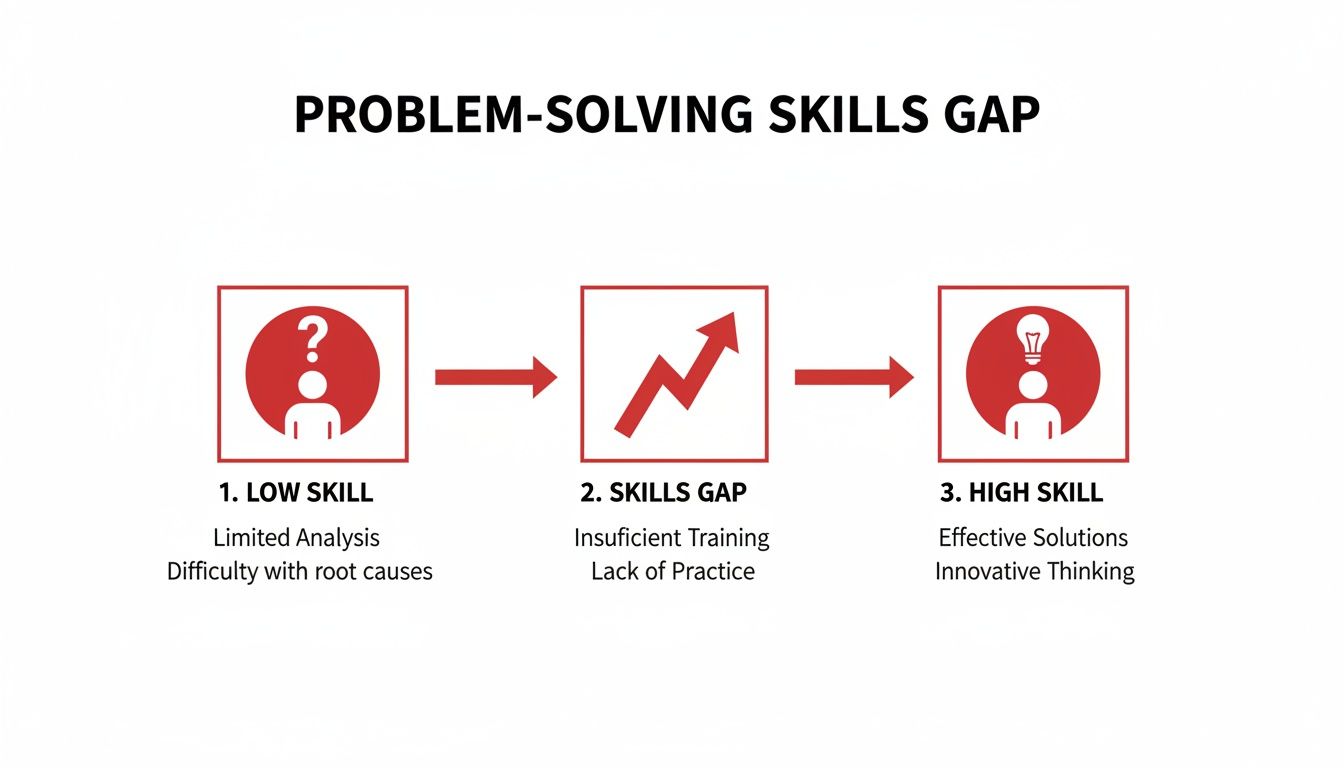
As you can see, building this skill is a deliberate journey. It's not about being born a "good problem-solver"—it's about learning the right techniques. Two of the most powerful and practical frameworks I've seen teams use successfully are Root Cause Analysis and Design Thinking.
Digging Deeper with Root Cause Analysis
Root Cause Analysis (RCA) is all about asking one simple question: what's really going on here? Instead of just patching up the obvious symptom, RCA pushes your team to uncover the foundational issue. Fix that, and you prevent the problem from ever happening again.
Two incredibly effective tools for this are the '5 Whys' and the Fishbone Diagram.
The '5 Whys' technique sounds almost too simple to work, but it’s brilliant. You just keep asking "Why?" until you hit the core of the issue. Imagine a product team is staring at a sudden drop in user engagement.
- Problem: User engagement with our new feature is down 30%.
- Why? Users are reporting that it’s slow and buggy. (Okay, but that's a symptom.)
- Why? The last software update introduced some performance issues. (Getting warmer.)
- Why? We rushed the update to hit a deadline and didn't have enough time for proper testing. (Now we're talking.)
- Why? The project timeline didn't accurately account for how complex the new code integrations were. (Interesting...)
- Why? Our entire planning process consistently underestimates the time needed for testing major updates. (Bingo. The root cause.)
See what happened? The team went from "fix the bug" to realizing they have a systemic flaw in their planning process. One is a patch, the other is a permanent solution.
Another great tool is the Fishbone Diagram, sometimes called an Ishikawa Diagram. It’s a visual way to brainstorm all the potential causes of a problem, grouped into common categories like People, Process, Technology, and Environment. For that same user engagement drop, a Fishbone Diagram might show that the issue isn't just a flawed process but also a lack of specific developer training (People) and outdated testing software (Technology).
The goal of Root Cause Analysis isn’t just to find an answer; it’s to find the right answer. It’s the discipline of asking "Why?" one more time when everyone else is ready to stop.
Solving for Humans with Design Thinking
While RCA is perfect for figuring out why something broke, Design Thinking is your go-to framework for innovation and creating new solutions that people will actually love. It's a five-stage process that puts the human user at the absolute center of everything you do.
Here’s how it typically unfolds:
- Empathize: Get out of the office and talk to your users. Observe them. Interview them. You need to deeply understand their world and their frustrations.
- Define: Take all that raw data and synthesize it into a clear, compelling problem statement from the user's point of view. What’s the real need you’re trying to meet?
- Ideate: This is the time for wide-open brainstorming. Go for quantity over quality at first—no idea is too wild. The goal is to generate a massive pool of potential solutions.
- Prototype: Build cheap, low-fidelity versions of your most promising ideas. Think paper sketches, simple wireframes, or role-playing scenarios. The key is to make your idea tangible.
- Test: Put those prototypes in front of real users and watch what happens. Gather their feedback, learn what works and what doesn't, and get ready to refine your ideas.
Let's go back to our user engagement problem. A team using Design Thinking wouldn't just see a "slow feature." After interviewing users, they'd redefine the problem as: "Our users feel frustrated and unproductive when the feature interrupts their workflow."
That shift in perspective is everything. It opens the door to much more creative solutions than simply optimizing a few lines of code. By combining these frameworks, your team can develop the skills to tackle any challenge thrown their way, moving from abstract goals to concrete, effective action.
Building a Culture of Daily Problem Solving
You can’t teach great problem-solving in a one-off workshop or a single all-hands meeting. It’s a muscle. And like any muscle, it gets stronger with consistent, daily exercise, not just once a year. While formal frameworks have their place, the real magic happens when you weave critical thinking into the day-to-day rhythm of your team.
The goal is to shift from a culture where people just report updates to one where they’re constantly solving small problems together. It's about making curiosity a reflex. I’ve seen this in action on high-performing teams, like those at Netflix; they don't just wait for problems to appear—they actively hunt for them. They create an environment where questioning the status quo isn't just tolerated, it's expected.
And let's be honest, this isn't just a "nice-to-have" skill. The data is pretty stark. A RISE Programme analysis looked at 159 countries and found that at least two-thirds of young people aren't even hitting basic skill levels, which includes problem-solving. It gets worse: 62% of kids attending secondary school still miss these benchmarks, proving that traditional education isn’t cutting it. Even in high-income regions like North America, 24% of youth fall short. It's a clear signal that we have to build these skills on the job. You can dig into more of these global skill development challenges on VoxDev.org.
Integrate Micro-Practices into Daily Routines
So how do you close that gap without adding a ton of overhead? You don’t need a massive new initiative. The answer lies in "micro-practices"—small, consistent habits that bake problem-solving into your team's existing routines.
Here are a few I’ve seen work wonders:
- 'What-If' Scenarios in Stand-Ups: Take just three minutes in your daily stand-up for a quick hypothetical. Toss out a question like, "What if our main competitor launched this feature tomorrow?" or "What if our key payment API went down for a full day?" It’s a simple exercise that gets the team thinking proactively instead of just reacting.
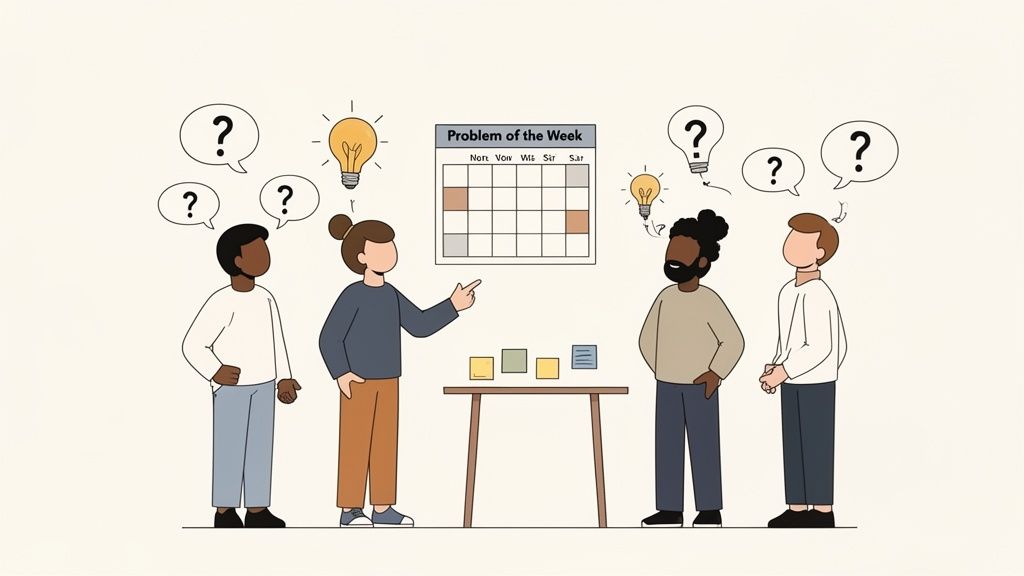
- The 'Problem of the Week' Challenge: Pick a non-urgent but important issue—something like, "How could we cut down on internal emails?" or "How might we make our new hire onboarding smoother?"—and frame it as a weekly challenge. Put it on a whiteboard or a shared digital space and let everyone add their thoughts all week.
- Solution-Focused Meeting Agendas: Stop using meetings for status reports. Turn them into working sessions by framing agenda items as questions. Instead of an item that says "Discuss Q3 Marketing Campaign," change it to "How can we generate 20% more qualified leads with our Q3 marketing budget?"
These little tweaks start to add up, making critical thinking feel less like a special event and more like just part of the job.
The real measure of a problem-solving culture isn’t how a team performs when a crisis hits. It’s how they behave when things are calm. Are they questioning, exploring, and looking for better ways to do things even when everything seems fine? That’s where excellence is born.
Build Psychological Safety to Unlock Ideas
Of course, none of these practices will stick if there isn't a foundation of psychological safety. People have to feel completely secure to voice a half-formed idea, challenge a sacred cow, or just say, "I don't know the answer." If they’re worried about looking stupid or being penalized for speaking up, they’ll clam up. And you'll lose out on their best thinking.
As a leader, you set the tone. Building this safety net really comes down to a few key behaviors:
- Model Vulnerability: Be the first one to admit you don't have it all figured out. Saying things like, "I'm not sure what the right move is here, let's explore it together," or "That was a mistake on my part, and here’s what I learned" gives everyone else permission to be human.
- Reward Thoughtful Questions: When someone pushes back or asks a tough question, thank them for it—publicly. You're reinforcing that curiosity is a valued behavior, not an act of defiance.
- Separate Brainstorming from Decision-Making: Create clear guardrails. Have sessions where the only goal is to generate ideas, with no judgment allowed. Then, have separate sessions to evaluate those ideas. This gives creative, out-of-the-box thoughts the space to emerge without being shot down prematurely.
By focusing on these daily habits and creating a safe environment, you stop teaching problem-solving and start living it. Your team begins to see every task, every meeting, and every setback as another chance to get better.
How to Run a High-Impact Problem-Solving Workshop
Daily practice is essential, but sometimes you need a focused sprint to really level up your team's skills. A dedicated workshop is the perfect way to do that. It’s a chance to get everyone out of their day-to-day grind and immerse them in practical frameworks they can start using immediately. This is where the theory gets real, and your team builds the confidence to tackle tough business challenges head-on.
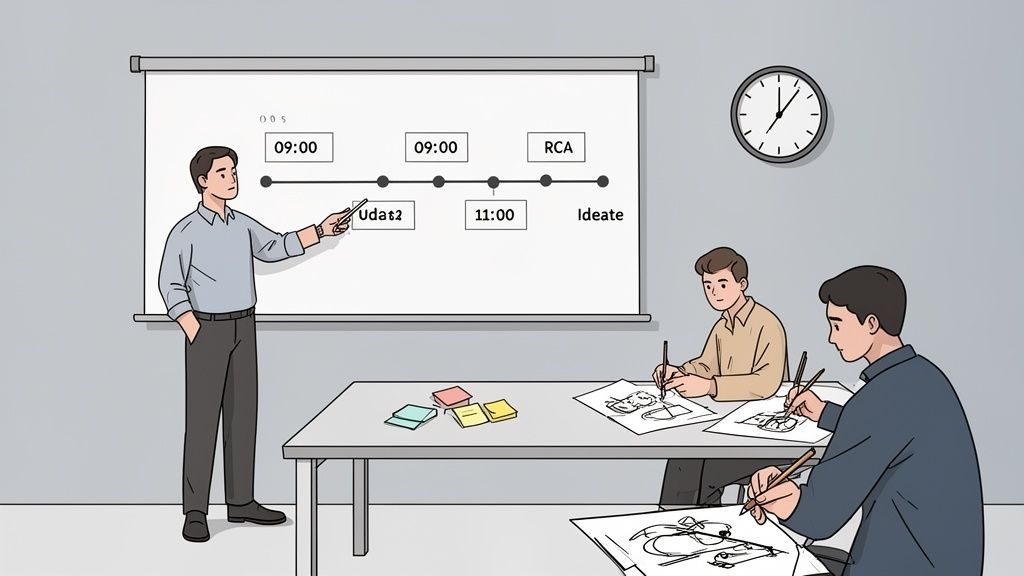
A great workshop isn’t just a long meeting—it's a guided learning experience with a clear purpose. To give you a starting point, I’ve put together two sample agendas I’ve used before: a quick, punchy half-day session and a more comprehensive full-day deep dive.
Sample Half-Day Root Cause Analysis Workshop
This four-hour session is perfect for introducing a team to Root Cause Analysis (RCA) without pulling them away for an entire day. The goal is simple: have them walk out knowing how to use the '5 Whys' and a Fishbone Diagram on a real issue they’re facing.
Here’s a look at how you could structure the morning.
Sample Half-Day Root Cause Analysis Workshop Agenda
| Time Slot | Activity | Objective |
|---|---|---|
| 9:00 - 9:30 AM | Intro & Problem Framing: Define problem-solving and introduce a real, non-critical business issue (e.g., "customer service response times have increased by 15%"). | To align the team on the workshop's purpose and present a tangible problem to solve. |
| 9:30 - 10:30 AM | '5 Whys' Deep Dive: Teach the '5 Whys' method and facilitate a group exercise to dig into the sample problem. | To practice moving beyond symptoms and identify a potential root cause through guided questioning. |
| 10:30 - 11:30 AM | Fishbone Diagram Exercise: Introduce the Fishbone Diagram. In small groups, have teams map out all potential causes for the sample problem. | To visually organize complex causes and understand how different factors contribute to a single issue. |
| 11:30 AM - 12:00 PM | Action Planning & Debrief: Each group presents its findings. The team collectively decides on one or two actionable next steps. | To translate analysis into a concrete plan and reinforce the day's learnings. |
This condensed format gives the team a quick, tangible win and a foundational skill they can build on. It’s an efficient way to make a big impact in a short amount of time.
Sample Full-Day Immersive Workshop
When you have a full day, you can go deeper and blend different problem-solving methods. This agenda combines the analytical rigor of RCA with the human-centered approach of Design Thinking.
Morning Session (9 AM - 12 PM) Empathy & Definition: We start by understanding the people behind the problem. Instead of just looking at metrics, we'll use an Empathy Map (90 mins) to explore the customer's world. What are their pains and gains? From there, we’ll spend time reframing the problem statement based on those human insights (60 mins).
Lunch (12 PM - 1 PM)
Afternoon Session (1 PM - 4 PM) Ideation & Prototyping: This is where creativity kicks in. I love using Constraint Cards (60 mins) to spark unconventional ideas—things like "solve this with no new budget" or "design a solution that works offline." These force the team out of their usual thinking patterns. Afterward, they'll build a simple, low-fidelity prototype of their best idea using paper, sketches, or even role-playing (90 mins).
Wrap-Up (4 PM - 5 PM) Assessment & Debrief: We finish with group presentations and peer feedback. The focus here is on turning ideas into action and assessing how we worked together as a team.
If your team is working on highly visual or creative challenges, you might also find it useful to develop ideas with our Visual AI Workshop, which introduces powerful tools for ideation and concept development.
Assessing the Workshop's Impact
The real test of a workshop isn’t how everyone felt at the end of the day, but what changes on Monday morning. A quick self-assessment during the final debrief can make all the difference.
The most powerful question you can ask at the end of a workshop is not "What did you learn?" but "What will you do differently on Monday?"
Ask your team to rate themselves on a scale of 1-5 for these three areas:
- Problem Clarity: How well did we define the real problem versus just discussing symptoms?
- Solution Diversity: Did we explore multiple, genuinely different ideas, or did we stick to the familiar?
- Feasibility & Actionability: Is our proposed solution something we can actually start working on next week?
This simple exercise shifts the focus from a one-off event to a commitment to continuous improvement. It builds accountability and ensures the momentum from the workshop carries forward.
Keeping the Momentum: How to Measure and Sustain Problem-Solving Skills
Workshops and new frameworks are a great launchpad, but the real test begins when your team gets back to their daily work. Did the training actually stick? True growth isn't about one great brainstorming session; it's about seeing your team handle challenges better, day in and day out, long after the workshop ends.
To make sure these new skills become permanent habits, you need a smart way to track progress and a solid plan to keep the momentum going.
Forget the "happy sheets" they fill out right after a session. While it's nice to know your team enjoyed the training, what really counts is seeing a real-world impact on their work. The goal is simple: link better problem-solving directly to better business results.
Moving Beyond Feelings: Tracking Real Progress
So, how do you know if it's actually working? "Feeling" more creative is nice, but it's not a metric. You need to focus on concrete key performance indicators (KPIs) that tell a clear story.
Pick a couple of these metrics that make sense for your team and start tracking them. If the training is hitting the mark, you'll see these numbers move in the right direction.
Here are a few I've seen work wonders:
- Faster Fixes: How long does it take to crush a software bug, resolve a customer ticket, or sort out an internal snag? A consistent drop in resolution time is a clear sign your team is getting more efficient.
- Fewer "Déjà Vu" Problems: When a problem is solved for good, it shouldn't pop up again next quarter. If you see fewer recurring issues, it means your team is digging for root causes instead of just slapping on a temporary patch.
- More Proactive Ideas: Start counting the number of unsolicited ideas for improvement. Are people spotting opportunities to make things better without being asked? That's the sign of a team that owns its work.
The real breakthrough happens when your team stops waiting for problems to be handed to them and starts hunting for opportunities to improve things. They shift from being reactive firefighters to proactive architects.
Why This Can't Wait
Keeping this skill-building effort alive is more than just a good idea—it’s an urgent business need. The Future of Jobs Report puts critical thinking and complex problem-solving at the top of the list of essential skills for 2026.
But here's the reality check: PISA data shows that only 11% of 15-year-olds in OECD countries are top-tier problem solvers. The gap is even more stark when you look at specific countries. Singapore leads with 29% of its students at the top, while the US lags at a worrying 3.9%. This isn't just an academic issue; it’s a clear signal that we have to be intentional about training these skills to stay competitive. You can read more about the future skills outlook from the World Economic Forum.
Knowing When to Call in an Expert
While building skills internally is essential, sometimes you need an outside catalyst to spark a bigger change. Bringing in an expert isn't just about learning a new framework; it's about shifting mindsets and inspiring your team to aim higher.
Consider bringing in a specialist when:
- You're trying to shift the company culture. A dynamic keynote can energize everyone and send a clear message that problem-solving is now a core value.
- The team is completely stuck. A seasoned facilitator can guide them through a particularly gnarly challenge, teaching them advanced methods as they go.
- You want to show them what's truly possible. Hearing from someone who has built world-changing technology can fundamentally reset your team's belief in their own abilities.
Think about it. Visionaries like Adam Cheyer, the mind behind Siri, or the prolific inventor Zach Rattner don't just tell stories. They embody an elite problem-solving mindset. They’ve spent their careers turning impossible ideas into reality. Hearing from them gives your team both inspiration and battle-tested strategies that stick. Exploring how a top-tier leadership keynote speaker could open your team’s eyes is one of the most strategic investments you can make.
Your Top Questions, Answered
As you start rolling this out with your team, you're bound to hit a few common questions. I’ve run into these plenty of times myself, so here’s some straightforward advice to help you navigate them.
Where’s the Best Place to Start?
Start small. And start with a real problem.
It’s tempting to get excited and try to introduce a bunch of new, complex frameworks all at once. Don't do it. You'll just overwhelm everyone. Instead, pick one simple tool and apply it to a genuine, nagging issue your team is already dealing with.
A great first move is introducing the '5 Whys' for root-cause analysis. It's incredibly intuitive and needs almost no formal training. Find a small, recurring headache—maybe a persistent snag in a workflow or a common customer complaint—and walk the team through asking "Why?" five times to dig deeper.
Getting a quick win on a real problem is the most powerful thing you can do. It proves the value of this approach right away and builds the momentum you’ll need for more advanced skills later. You instantly shift the conversation from "another corporate training" to "a useful tool that makes our jobs easier."
The goal isn't to turn everyone into a problem-solving guru overnight. It's to prove that a little structure can fix a real annoyance. That first small success is what gets everyone hooked for the long haul.
Once you have that initial buy-in, start weaving in "micro-practices." These are small, consistent habits that make analytical thinking feel normal. For example, you could dedicate the first ten minutes of your weekly team meeting to a quick 'what-if' scenario. This makes critical thinking a regular, low-pressure part of the routine, not some big, scary event.
How Do I Actually Measure the ROI of This?
Measuring the return on this kind of training is about connecting the dots between skills and business results. You need a mix of hard data and a good eye for cultural changes.
First, identify a few key numbers you can track. These metrics will tell a clear, undeniable story of impact.
- Efficiency Gains: Are you seeing fewer customer support tickets? A drop in bug reports? Are projects getting done faster?
- Product Wins: Look for improvements in things like user adoption, feature engagement, or customer satisfaction scores (CSAT).
- Resolution Time: Track the average time it takes to fix issues, both internal and external. If that number is trending down, your team is getting better.
Beyond the spreadsheets, pay attention to how your team's behavior is changing. These qualitative shifts are often the first signs that the training is working. Are more people speaking up with ideas in meetings? Is the team catching potential problems earlier? Are they less dependent on you to solve every little thing?
A simple survey before and after training can also work wonders to capture the team's growing confidence. The real ROI becomes clear when you see your team shift from just fighting fires to proactively building a better product and business.
Do My Technical Experts Really Need This?
Yes, they absolutely do. This is a question I get all the time.
Your technical experts are masters of solving problems within their domains. A star engineer can probably debug a gnarly algorithm in their sleep. But the challenges that lead to true innovation are almost never just technical. That same engineer might be completely stumped trying to figure out why nobody is using the brilliant feature they just spent months building.
That's because systemic, cross-functional, and human-centered problems require a different kind of thinking. Technical skill doesn't automatically translate to user empathy or a gut feeling for business strategy.
This is where training in frameworks like Design Thinking reshapes how technical teams work. It forces them to step outside of the code and connect with real user behavior, motivations, and frustrations. It teaches them to ask, "Why is the user struggling with this?" instead of just, "How do I fix the bug?"
This kind of training empowers your experts to build things that people actually want and need. It helps them collaborate better with folks in marketing, sales, and design, so they’re not just solving technical puzzles, but creating real-world impact.
When Should I Bring in an Outside Speaker or Facilitator?
Bringing in an external expert is a power play. You save it for when you need to make a big splash or break through a plateau. While you can build a solid foundation internally, an outside voice has a unique ability to inspire, challenge, and accelerate change.
Think about hiring an external speaker or facilitator for a few key moments:
- To kick off a major cultural shift. When you need to signal that problem-solving is now a company-wide priority, a dynamic keynote at an all-hands or kickoff meeting sends a powerful message.
- To get unstuck from a big, hairy problem. If the team is spinning its wheels on a persistent challenge, a skilled facilitator can guide them through it, teaching them advanced methods in the process.
- To radically raise the team's ambition. There's nothing quite like hearing from someone who has solved a problem everyone thought was impossible. A keynote from a world-class innovator like Adam Cheyer (the creator of Siri) can completely reset your team’s belief in what they can achieve. His story is a masterclass in creative thinking and resilience that you just can't replicate with an internal presentation.
An expert is the perfect catalyst for an executive offsite, an annual sales meeting, or an innovation workshop where the goal is to unlock a new level of thinking.
At Silicon Valley Speakers, we connect you with the visionaries and builders who have solved the world's toughest problems. Bring in an exclusive voice like Adam Cheyer to inspire your team with real stories of turning impossible ideas into reality.
Discover our roster of world-class innovation speakers and workshop facilitators.