In a world of constant change, generic leadership training falls short. The most forward-thinking companies understand that building exceptional leaders requires more than just theory; it demands practical, hands-on experiences that build real-world skills. But what do these programs actually look like? How do you move from abstract concepts like "innovation" or "resilience" to tangible results?
This article provides a full breakdown of concrete leadership development program examples that deliver measurable impact. We will break down proven models used by top organizations, offering a clear look into their structure, who they're for, and how you can adapt them for your own team. You will gain a strategic playbook of actionable frameworks designed for immediate application.
We'll explore everything from high-impact executive coaching and immersive leadership retreats to project-based action learning that solves real business problems. You'll see how to structure skill-building workshops that stick and how to use keynote speakers to anchor a powerful thought leadership event. Forget the outdated manuals; these are the blueprints for building the leaders who will navigate and create the future. This guide moves beyond ideas to give you the specific tactics and formats you need to develop talent effectively.
1. Executive Coaching and 1-on-1 Leadership Development
Executive coaching offers a hyper-personalized approach to leadership development, pairing senior leaders with a certified, external coach for a dedicated period, typically 6-12 months. This one-on-one relationship focuses on sharpening specific skills like strategic thinking, emotional intelligence, and executive presence. Unlike group training, coaching addresses the unique, real-time challenges a leader faces within their role and organizational context.

This method is one of the most effective leadership development program examples for senior executives because it provides a confidential, objective space for deep self-reflection and behavioral change. Companies like Google and Microsoft use extensive coaching networks to support director-level and senior management, recognizing that the challenges at these levels are often too nuanced for a standardized curriculum.
Strategic Analysis & Implementation
For Whom: Best for senior executives (VP-level and above), high-potential leaders being groomed for succession, and leaders navigating significant organizational change or a new, challenging role.
Desired Outcomes:
- Improved decision-making and strategic planning.
- Greater self-awareness and emotional regulation.
- Strengthened communication and influence with stakeholders.
- Successful navigation of specific business or team challenges.
Key Insight: The power of executive coaching lies in its "just-in-time" nature. A coach helps a leader solve immediate, high-stakes problems while building long-term capabilities, delivering a direct and measurable impact on business performance.
Actionable Takeaways
To implement a successful coaching program, start with a solid foundation.
- Initiate with 360-Degree Feedback: Before coaching begins, gather anonymous feedback from the leader's peers, direct reports, and superiors. This data provides a clear, objective baseline for identifying blind spots and setting targeted goals.
- Define Measurable Goals: Work with the leader and coach to establish 3-4 specific, measurable objectives for the engagement. Examples include "Improve team engagement scores by 15% within 9 months" or "Successfully lead the cross-departmental merger integration."
- Select the Right Coach: Choose a coach with proven experience in your industry and a deep understanding of the challenges common to your organizational culture. A good fit is critical for building trust and ensuring a successful engagement.
2. Immersive Leadership Retreats and Off-Sites
Immersive leadership retreats and off-sites are multi-day programs designed to remove leaders from their daily operational duties, creating a focused environment for strategic thinking and skill development. These intensive events typically blend keynote presentations, interactive workshops, peer problem-solving sessions, and team-building activities. By creating distance from the workplace, these retreats minimize distractions and encourage deeper connection and reflection.

This format is a powerful leadership development program example because it accelerates bonding and aligns the entire leadership team around a unified vision. Major tech companies like Apple and Amazon use annual off-sites to crystallize strategy and reinforce company culture. For instance, a retreat might focus on navigating market disruptions or, as with Meta, address emerging challenges in complex fields like AI strategy. The shared experience builds a strong sense of camaraderie and collective purpose.
Strategic Analysis & Implementation
For Whom: Best for senior leadership teams (C-suite, VPs), cross-functional department heads, and high-potential managers. Ideal for annual strategic planning, culture resets, or preparing for major organizational change.
Desired Outcomes:
- Strengthened relationships and trust among the leadership team.
- Clear alignment on strategic priorities and company vision.
- Development of specific skills through focused workshops.
- Generation of innovative solutions to real-world business challenges.
Key Insight: The true value of a retreat is the combination of structured learning and unstructured networking. Dedicated time away from the office builds candid conversations and creative thinking that is nearly impossible to replicate during regular business hours.
Actionable Takeaways
To maximize the impact of your leadership off-site, focus on purpose and follow-through.
- Blend Internal and External Voices: Combine sessions led by external keynote speakers with workshops run by your own internal subject matter experts. This approach grounds inspirational new ideas within your specific company context.
- Incorporate "Live" Problem-Solving: Design breakout sessions where leaders work in small groups to tackle an actual, pressing business challenge. This makes the learning immediate and practical, often producing actionable solutions.
- Establish Post-Retreat Accountability: Ensure the momentum continues by assigning follow-up projects and creating accountability partners. Schedule check-ins to track progress on commitments made during the retreat. To see how these events are structured, you can explore examples of leadership retreats for more ideas.
3. Leadership Skills Workshops and Skill-Building Programs
Leadership skills workshops are structured, intensive sessions designed to build specific competencies in a targeted, hands-on environment. Typically formatted as half-day or full-day events, these programs move beyond theory to include case studies, role-playing, and practical exercises. They focus on core leadership capabilities like emotional intelligence, strategic decision-making, effective communication, and conflict resolution.
This approach is one of the most scalable leadership development program examples, allowing organizations to efficiently train groups of new or mid-level managers. For instance, Amazon's workshops on bias reduction and decision-making equip leaders with frameworks to make fairer, more data-driven choices. Similarly, Google's famous 'Search Inside Yourself' program was born from a workshop model to improve emotional intelligence and mindfulness at scale.
Strategic Analysis & Implementation
For Whom: Ideal for first-time managers, mid-level leaders, and high-potential employees who need to develop foundational leadership skills quickly. Also effective for entire leadership teams seeking to build a shared language and toolkit around a specific competency.
Desired Outcomes:
- Mastery of a specific, defined leadership skill (e.g., delegation).
- Improved team communication and reduced conflict.
- Increased confidence in handling difficult conversations.
- Application of practical tools and frameworks to daily work.
Key Insight: Workshops are most effective when they are not one-off events. Success depends on creating a system of reinforcement, including pre-work, post-workshop accountability, and manager support to ensure learned behaviors are applied on the job.
Actionable Takeaways
To maximize the ROI of your workshops, focus on practical application and follow-through.
- Use Expert Facilitators: Select facilitators who possess both deep subject matter expertise and real-world leadership experience. An engaging presenter who can connect theory to practical business challenges is critical for credibility and impact. For some of the best interactive workshop offerings, look for providers who specialize in dynamic, hands-on learning.
- Provide Practical Job Aids: Equip attendees with simple, one-page frameworks, checklists, or reference guides. These tools make it easy for leaders to recall and apply new concepts in the middle of a busy workday, long after the workshop has ended.
- Establish Accountability Partnerships: At the end of the session, pair up participants to serve as accountability partners. Task them with checking in on each other’s progress in applying a new skill 30, 60, and 90 days after the workshop, creating a simple yet powerful reinforcement loop.
4. Peer Learning Groups and Leadership Communities
Peer learning groups create structured cohorts where leaders meet regularly to discuss challenges, share best practices, and hold each other accountable. These communities tap into the collective wisdom of the group, creating a safe space for vulnerable learning and peer mentoring without the pressure of hierarchical dynamics. This model is built on trust, shared experience, and mutual support.
This approach is one of the most scalable leadership development program examples, as it can be adapted for any level, from emerging managers to senior directors. Companies like Google and Meta use peer learning extensively, forming cohorts for new managers, high-potential talent, and specific groups like 'Women in Leadership'. The shared context allows participants to solve relevant problems and build a strong internal support network.
Strategic Analysis & Implementation
For Whom: Ideal for new managers, mid-level leaders, and high-potential employees. It's also highly effective for creating support networks within specific employee resource groups (ERGs).
Desired Outcomes:
- Accelerated problem-solving for common leadership challenges.
- Increased psychological safety and trust among peers.
- Development of a strong internal coaching and support network.
- Enhanced sense of belonging and improved employee retention.
Key Insight: The main value of peer learning groups is the creation of a 'personal board of directors' for each participant. This trusted circle offers diverse perspectives and practical advice on real-world issues, which is something a formal training class cannot replicate.
Actionable Takeaways
To launch an impactful peer learning community, focus on structure and safety.
- Establish Clear Ground Rules: Begin by co-creating a group charter that defines norms for confidentiality, active listening, and constructive feedback. This step is critical for building the psychological safety needed for honest and open discussion.
- Use Structured Prompts: Don't leave discussions to chance. Provide a framework for each meeting, such as a "challenge and commitment" format where each member shares a current problem and commits to a specific action before the next session.
- Keep Groups Small and Consistent: Limit cohorts to 6-12 members to ensure everyone has an opportunity to contribute. Keeping the group membership consistent over a set period (e.g., 6-12 months) builds the deep trust required for meaningful conversations.
5. Keynote Speaker Series and Thought Leadership Events
A keynote speaker series offers a powerful way to inspire leaders and expose them to fresh, external perspectives. By curating a series of events featuring accomplished speakers on topics like innovation, peak performance, and future trends, companies can inject new energy and ideas into their leadership culture. These events create memorable learning experiences through the authentic stories of builders and innovators who have achieved real-world breakthroughs.
This method stands out among leadership development program examples because it moves beyond internal training to connect leaders with broader industry conversations. Companies like Apple, Google, and Amazon regularly feature prominent external speakers in their major conferences and internal leadership meetings. They use these platforms to challenge conventional thinking, introduce emerging concepts, and motivate their teams with compelling, firsthand accounts of success and failure. On the SVSB roster, four named examples programmers can plug into different leadership briefs: Adam Cheyer (AI strategy and entrepreneurship, co-creator of Siri, ex-VP AI Experience at Airbnb), Chris Barton (innovation and "Start From Zero" thinking, inventor of Shazam), Dr. Maya Ackerman (generative AI and creativity, Wiley-published author), and Drue Kataoka (visual AI for leadership audiences, Davos and Vatican keynoter).
Strategic Analysis & Implementation
For Whom: Best for all levels of leadership, from emerging managers to senior executives. Highly effective for annual leadership offsites, sales kick-offs (SKOs), and company-wide all-hands meetings where inspiration and a shared vision are key objectives.
Desired Outcomes:
- Increased motivation and a renewed sense of purpose.
- Exposure to new mental models and strategic frameworks.
- Alignment of leadership thinking with key organizational priorities.
- A common language and set of ideas to guide future discussions and initiatives.
Key Insight: The impact of a great keynote speaker isn't just the 60 minutes they are on stage; it's the conversations that follow. The true value is unlocked when their message becomes a catalyst for internal reflection and strategic action, sparking new ideas that teams can apply to their own work.
Actionable Takeaways
To maximize the return on a speaker series, thoughtful planning before and after the event is essential.
- Select Speakers with Authentic Stories: Look for keynote speakers with proven track records of creating tangible breakthroughs, not just academic theories. Their authenticity and real-world experience are what make their messages resonate and stick.
- Provide Pre-Event Context: Before the event, communicate to attendees why a particular speaker was chosen and how their topic aligns with current business challenges or strategic goals. This primes the audience to listen for relevant insights.
- Structure Post-Keynote Reflection: Immediately follow the keynote with structured breakout sessions or guided team discussions. Prompt teams to connect the speaker's insights to their specific projects and challenges, turning inspiration into concrete action plans. You can find the right fit for your organizational goals by exploring a curated list of leadership speakers.
6. Formal Leadership Certification Programs
Formal certification programs offer a structured, credentialed pathway for developing leaders in specific, high-value domains. These multi-month programs combine rigorous academic learning, practical case studies, and hands-on projects, culminating in a recognized certification. Unlike general training, they focus on building deep, verifiable expertise in areas critical to future business success, such as digital transformation or AI-driven strategy.
This method is one of the most powerful leadership development program examples for building targeted, future-ready capabilities across an organization. Companies partner with universities like Cornell or Stanford Continuing Studies or use platforms like Coursera to equip leaders with specialized knowledge. The formal credential signals a new level of proficiency and prepares leaders to guide their teams through complex technical and strategic shifts.
Strategic Analysis & Implementation
For Whom: Best for mid-to-senior level managers, functional heads, and high-potential individuals tasked with leading strategic initiatives in specialized fields like AI, data science, or sustainable business practices.
Desired Outcomes:
- Deep, certifiable expertise in a specific strategic domain.
- Ability to translate complex technical concepts into business strategy.
- Improved leadership of cross-functional, project-based teams.
- Creation of a common language and framework for new initiatives.
Key Insight: The value of a formal certification program is its blend of external validation and internal application. Leaders return not just with new knowledge, but with a credential that builds their authority and a project that has already delivered initial business value.
Actionable Takeaways
To maximize the return on investment from certification programs, integrate them directly into your talent strategy.
- Align Programs with Business Needs: Select certifications that directly support your company's 3-to-5-year strategic plan. If AI integration is a priority, invest in an AI leadership program; if global expansion is key, choose one focused on international business.
- Require an Application Project: Mandate that each participant use their program learnings to develop and execute a project that solves a real business problem. This ensures the knowledge is applied, not just acquired.
- Create Peer Accountability Cohorts: Send small groups of 6-8 leaders through the same program. This builds an internal support network for applying the new skills and reinforces learning through shared experience and peer accountability.
7. Reverse Mentoring and Cross-Generational Leadership Programs
Reverse mentoring flips the traditional mentorship model on its head by pairing senior leaders with junior, often younger, employees. The goal is to facilitate mutual learning where the senior leader gains insights into new technologies, digital trends, and evolving workplace cultures, while the emerging leader receives career guidance and visibility. This approach breaks down hierarchical barriers and builds a more inclusive, collaborative environment.
This method stands out among leadership development program examples for its ability to bridge generational gaps and accelerate digital literacy among senior executives. Tech giants like Google and Microsoft use it to keep their leadership teams connected to the innovations and perspectives of their emerging talent. This ensures that decision-makers understand the tools, platforms, and cultural shifts shaping the future of their business.
Strategic Analysis & Implementation
For Whom: Best for senior executives needing to update their skills on new technology (like AI), social media, or cultural trends. Also ideal for high-potential junior employees who can offer fresh perspectives and benefit from executive exposure.
Desired Outcomes:
- Increased digital fluency and awareness of emerging trends among senior leaders.
- Improved cross-generational communication and collaboration.
- Enhanced employee engagement and retention of high-potential talent.
- A more inclusive culture where diverse perspectives are valued.
Key Insight: The true value of reverse mentoring is its dual impact. It directly addresses senior leaders' knowledge gaps while simultaneously creating a powerful development and engagement opportunity for junior employees, delivering two distinct benefits from a single program.
Actionable Takeaways
To launch an effective reverse mentoring program, focus on structure and clear communication.
- Establish Clear Matching Criteria: Don’t leave pairings to chance. Match participants based on complementary goals. Pair a senior leader who wants to understand AI’s practical applications with a junior data scientist, or an executive looking to improve their social media presence with a marketing intern.
- Provide a Structured Kick-off: The first meeting is critical. Provide both mentor and mentee with a structured agenda, conversation starters, and a template for setting mutual expectations and learning objectives. This prevents awkward initial sessions and sets the partnership up for success.
- Facilitate Regular Check-ins and Networking: Schedule periodic check-ins to monitor progress and address challenges. Also, host small networking events for all program pairs to share their experiences and learnings, building a broader community of practice within the organization.
8. Innovation and Entrepreneurship Leadership Programs
These programs are designed to cultivate an intrapreneurial mindset, teaching leaders how to build a culture of innovation, manage experimentation, and drive change. Participants learn to lead through ambiguity by applying methodologies like design thinking and lean startup. The curriculum often includes case studies from successful founders, hands-on workshops, and the development of actual innovation projects tied to business challenges.
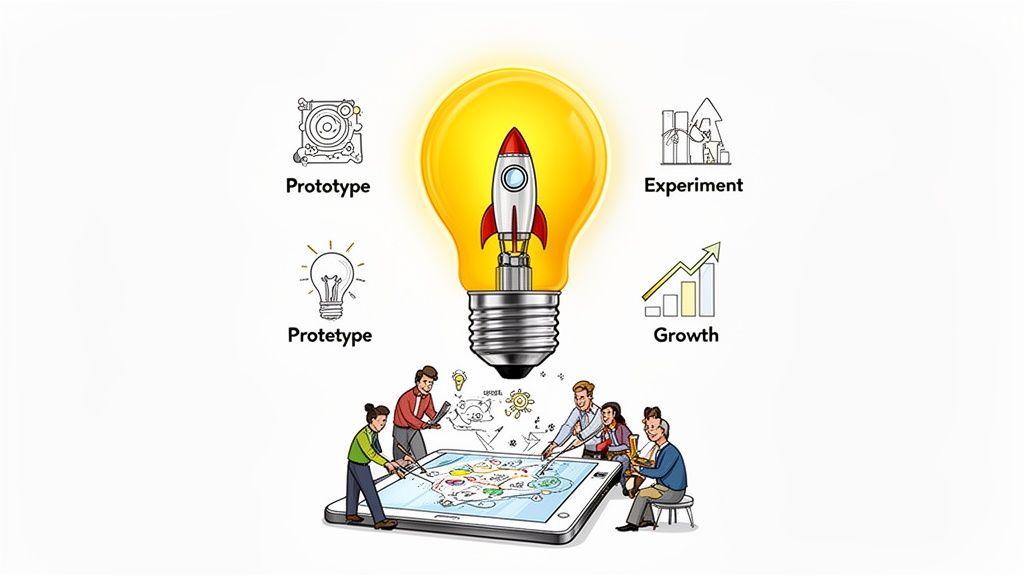
This model stands out as one of the most forward-thinking leadership development program examples for companies aiming to disrupt their own markets. Tech giants like Google and Apple have long embedded these principles into their leadership DNA, creating environments where controlled experimentation is encouraged. By simulating the startup experience, these programs equip leaders with the skills to identify and act on new growth opportunities.
Strategic Analysis & Implementation
For Whom: Best for mid-to-senior level managers in R&D, product, and strategy roles, as well as high-potential leaders tasked with creating new revenue streams or transforming business units.
Desired Outcomes:
- Increased ability to identify and validate new market opportunities.
- Development of a "fail-fast" culture that encourages experimentation.
- Proficiency in innovation frameworks like Design Thinking and Lean Startup.
- Launch of one or more viable internal ventures or process improvements.
Key Insight: The true value of these programs is their ability to make innovation a repeatable process, not a random act of genius. By giving leaders a structured framework and a safe space to fail, organizations can build a sustainable engine for growth and adaptation.
Actionable Takeaways
To launch a program that drives real innovation, focus on practical application and psychological safety.
- Use Real Business Challenges: Ground the program in actual strategic problems the company faces. Form teams and task them with developing solutions, creating an immediate and relevant learning context.
- Teach Specific Methodologies: Don't just talk about "being innovative." Provide formal training in proven frameworks like Design Thinking for understanding user needs and Lean Startup for rapid prototyping and validation.
- Create a "Safe Space" for Failure: Publicly acknowledge that not all projects will succeed. Celebrate the learning that comes from failed experiments as much as the successful outcomes to encourage risk-taking and honest assessment.
9. Performance and Peak Performance Leadership Programs
These programs concentrate on helping leaders achieve and sustain peak performance by drawing on principles from sports psychology, neuroscience, and behavioral science. Instead of focusing solely on business acumen, they address the leader's holistic ability to perform under pressure. Core topics include mindset, resilience, energy management, and high-stakes decision-making.
This style of training is a powerful leadership development program example because it equips leaders with the mental and physical tools to thrive in high-stress environments. Organizations bring in experts like Olympic athletes, military special forces veterans, and performance psychologists to share their real-world experience. These authentic voices provide practical strategies for managing energy, focus, and emotional state, which directly impacts leadership effectiveness and business results.
Strategic Analysis & Implementation
For Whom: Ideal for leaders in high-pressure roles, sales teams facing aggressive targets, executives managing constant change, and any leader who needs to maintain high energy and sharp decision-making.
Desired Outcomes:
- Increased resilience and ability to perform under pressure.
- Improved energy management to prevent burnout.
- Enhanced focus and clearer decision-making.
- Development of sustainable high-performance habits.
Key Insight: Peak performance is not about working harder; it’s about working smarter and recovering strategically. These programs teach that stress and rest are equally important parts of the growth equation, a concept borrowed directly from elite athletics and applied to the corporate world.
Actionable Takeaways
To create a program that genuinely moves the needle on performance, focus on practical application and authenticity.
- Start with Personal Assessment: Use assessments to help leaders understand their current performance patterns, energy levels, and stress responses. This self-awareness is the foundation for targeted improvement.
- Focus on Practical Habits: The curriculum should emphasize simple, repeatable practices leaders can implement immediately. This includes routines for managing energy, improving sleep, and maintaining focus throughout the day.
- Bring in Authentic Experts: Select speakers and coaches who have lived the principles of peak performance. An Olympic athlete like Shannon Rowbury or a former special operations leader brings a level of credibility and real-world insight that a purely academic approach cannot match.
10. Action Learning and Project-Based Leadership Development
Action learning programs immerse leaders in real-world business challenges, turning strategic projects into powerful development opportunities. Instead of just learning theory, participants apply new frameworks directly to actual business problems, often working in diverse, cross-functional teams. This approach bridges the gap between knowing and doing, creating immediate business value while building critical leadership skills.
This model is a highly effective example of a leadership development program because it delivers tangible results on two fronts: project success and leader growth. Companies like Amazon and Google use this method to solve operational puzzles and drive innovation, tasking emerging leaders with projects that directly support business priorities. The process typically spans several months and includes project work, coaching, and periodic learning labs.
Strategic Analysis & Implementation
For Whom: Best for mid-level to senior managers, high-potential employees, and emerging leaders who learn best by doing. It is ideal for organizations looking to solve complex, cross-functional problems while simultaneously upskilling their talent.
Desired Outcomes:
- Development of practical problem-solving and project management skills.
- Increased cross-functional collaboration and a broader organizational perspective.
- Demonstrated ability to lead through influence and navigate ambiguity.
- Delivery of a tangible solution or recommendation for a real business challenge.
Key Insight: Action learning creates a virtuous cycle. The organization gets fresh, diverse thinking on a strategic issue, while participants gain high-visibility experience, build new networks, and hone their leadership abilities in a relatively low-risk environment.
Actionable Takeaways
To structure an impactful action learning program, focus on creating the right environment for both learning and results.
- Select Strategic, Not Critical, Projects: Choose projects that are important to the business but are not so mission-critical that a potential failure would be catastrophic. This gives teams the psychological safety to experiment and take calculated risks.
- Ensure Executive Sponsorship: Assign a senior executive sponsor to each project team. This sponsor provides guidance, removes roadblocks, and ensures the team's recommendations receive serious consideration, signaling the program's importance.
- Integrate Reflection and Coaching: Build structured time for reflection into the program. Use regular coaching sessions and "learning labs" for teams to discuss their process, challenges, and what they are learning about leadership, teamwork, and themselves.
Top 10 Leadership Development Programs Compared
| Program | Implementation complexity | Resource requirements | Expected outcomes | Ideal use cases | Key advantages |
|---|---|---|---|---|---|
| Executive Coaching and 1-on-1 Leadership Development | High: bespoke, relationship-driven engagements | High cost per participant; significant time commitment | Deep behavioral change, improved self-awareness, measurable leader impact | C-suite, senior executives, leaders in transition | Highly personalized, accountability-focused, targets blind spots |
| Immersive Leadership Retreats and Off-Sites | Medium–High: complex logistics and facilitation | High (venues, travel, speakers, time away) | Strategic alignment, stronger team cohesion, memorable insights | Executive teams, annual summits, culture-building events | Uninterrupted focus, strong team bonding, high-impact messaging |
| Leadership Skills Workshops and Skill-Building Programs | Low–Medium: standardized curriculum delivery | Moderate (facilitator, materials, time) | Rapid skill acquisition, common language and tools | Emerging and mid-level leaders, skill-specific development | Scalable, cost-effective, immediately applicable tools |
| Peer Learning Groups and Leadership Communities | Low–Medium: ongoing coordination and facilitation | Low–Moderate (internal facilitation, meeting time) | Sustained peer support, knowledge sharing, increased belonging | Mid-to-senior leaders, culture building, ERG support | Low cost, sustainable, leverages collective intelligence |
| Keynote Speaker Series and Thought Leadership Events | Low: curation and event production | Moderate–High (speaker fees, production) | Inspiration, fresh perspectives, short-term engagement boost | All-hands, retreats, kickoffs, large gatherings | High-impact inspiration, elevates brand and shared language |
| Formal Leadership Certification Programs | High: multi-month curriculum and assessment | High (tuition, faculty, participant time) | Deep domain expertise, recognized credential, cohort networks | Specialized capability building, succession planning | Credibility through certification, measurable completion |
| Reverse Mentoring and Cross-Generational Programs | Medium: structured matching and support | Low–Moderate (coordination, time) | Bidirectional learning, inclusion, updated leader perspectives | Bridging generational gaps, diversity & inclusion initiatives | Mutual learning, low-cost visibility for emerging talent |
| Innovation and Entrepreneurship Leadership Programs | Medium–High: project-based, requires facilitation | Moderate–High (experts, project resources) | Innovation mindset, prototypes, capability to lead experiments | Tech/innovation firms, digital transformation efforts | Practical innovation methods, tangible project outcomes |
| Performance and Peak Performance Leadership Programs | Medium: specialized content and assessments | Moderate (coaches, assessments, practice time) | Improved resilience, energy management, decision-making under pressure | High-stress roles, sales leaders, scaling organizations | Evidence-based habits, addresses wellbeing and burnout risk |
| Action Learning and Project-Based Leadership Development | High: project selection, sponsorship, coaching | High (time, executive sponsors, resources) | Immediate business value, cross-functional leadership skills | Strategic priorities, high-potential acceleration, change initiatives | High ROI, real-world application, strong accountability |
Putting It All Together: Designing Your Own High-Impact Program
We've explored a range of powerful leadership development program examples, from the deep personal work of executive coaching to the collaborative energy of action learning projects. The common thread connecting the most successful initiatives is their deliberate design. They aren't random collections of events but strategic journeys built to address specific business needs and cultivate desired leadership qualities.
The most effective programs move beyond isolated training days. They create an integrated ecosystem where learning is continuous. A powerful keynote speech on resilience might kick off a quarter, followed by skill-building workshops on managing difficult conversations, and supported by peer learning groups where managers can share real-world challenges and solutions. This layered approach ensures that inspiration is translated into action and action is refined through shared experience.
From Examples to a Blueprint: Your Actionable Next Steps
Seeing these leadership development program examples is the first step; building your own is the next. Rather than trying to replicate a program exactly, focus on the underlying principles. The key is to diagnose your organization's unique needs before prescribing a solution.
Start with these fundamental questions:
- What is our primary business objective? Are we trying to increase market share, build a more creative culture, improve operational efficiency, or prepare for digital disruption? Your leadership program must directly support this goal.
- What specific leadership gaps are holding us back? Do our managers struggle with giving feedback? Do our senior leaders need to think more strategically? A clear diagnosis points to the right blend of program elements.
- Who is our target audience? The needs of a first-time manager are vastly different from those of a C-suite executive. Tailor the content, format, and intensity of the program to the specific cohort you are developing.
With these answers, you can begin to mix and match the models we've discussed. For instance, if your goal is to accelerate the readiness of high-potential employees, a powerful combination could be:
- A Rotational Stretch-Assignment Program: To provide broad business exposure.
- A Peer Learning Community: To build a strong cross-functional network.
- An Executive Coaching Package: To provide personalized guidance for navigating new challenges.
- A Capstone Action Learning Project: To solve a real business problem and present findings to senior leadership.
The End Goal: Developing Leaders Who Build the Future
Building a great leadership development program is an act of organizational design. You are creating the systems and experiences that will shape the leaders who, in turn, will shape your company's future. It's about moving from a mindset of "training" to one of "cultivation." You are not just teaching skills; you are building an environment where curiosity, resilience, and strategic thinking can flourish.
A critical element in this process is exposure to authentic, real-world expertise. Anchoring your program with speakers who have actually built companies, led high-stakes projects, and navigated immense uncertainty provides a level of credibility and inspiration that no textbook can match. These builders and visionaries offer more than just theories; they provide practical frameworks and the motivation for your leaders to apply them. By thoughtfully combining the leadership development program examples from this guide, you can construct a system that delivers a measurable return, producing leaders equipped to guide your organization toward its most ambitious goals.
Ready to anchor your leadership program with an unforgettable, high-impact experience? The experts at Silicon Valley Speakers can connect you with the world's leading builders, innovators, and thinkers who provide more than a speech; they deliver actionable insights from the front lines of business and technology. Explore our roster of visionaries and discover how the right voice can transform your next leadership event.