
Choosing the right finance speaker can make or break your event. It’s not just about filling a slot on the agenda; it’s about delivering real, tangible value. The best speakers don't just throw numbers at your audience—they connect the dots between complex economic trends and the actions your business can take right now.
Defining Your Event Goals and Financial Topics
Before you even think about searching for a speaker, take a hard look in the mirror. What are you actually trying to achieve with this event? A world-class speaker can deliver a phenomenal message, but if that message doesn't align with a clear business goal, it's just noise. Hiring a big name without a strategy isn't a plan; it's a very expensive gamble.
It all comes down to connecting your event's purpose to your company's objectives. Start by picturing what success looks like for your attendees after they leave the room.
- Got a sales team? Your goal might be to arm them with insights into how economic shifts will impact their customers. A great topic could be something like, "Navigating Market Volatility to Close More Deals."
- Briefing your leadership team? You probably want to spark new ideas for growth. A session on "The Future of AI in Fintech" or "Sustainable Investing for Long-Term Profit" would hit the mark.
- Speaking to customers or partners? The aim here is often about building trust and offering practical help. Topics such as "Financial Wellness in an Uncertain Economy" or "Decoding Global Supply Chain Disruptions" provide immediate, actionable value.
Aligning Topics with Business Outcomes
Once you know your main objective, you can start narrowing down the themes. Think of it as building a bridge from your company's current pain points to the solutions a speaker can offer. Are you trying to lift team morale during a tough economic patch? Or maybe you're prepping your executive team for a potential merger?
Each of these scenarios requires a very different flavor of financial expertise. This is why we've seen such a huge demand for highly specialized speakers on finance. It's part of a much bigger trend; the professional speaking industry is expected to grow by a massive USD 608.4 million between 2026 and 2029, with a 4.6% compound annual growth rate.
North America is a big piece of that puzzle, accounting for 30% of the growth as companies hunt for targeted knowledge. And despite the rise of virtual, in-person events still dominate, making up 88% of bookings. Experts are constantly flying into hubs like Las Vegas and Chicago to break down real-time data on interest rates and market forecasts. You can get more insights from this Technavio report on professional speaker market trends.
Expert Tip: The more specific you are about your desired outcome, the easier your search will be. Don't just look for "a finance speaker." Instead, look for "an expert in corporate financial strategy for mid-market C-suite executives." That clarity makes all the difference.
Pinpointing Your Core Message
With your audience and goals clear, the last piece of the puzzle is to nail down your core message. What's the one big idea you want every single person to remember? This single point of truth will be your North Star as you find and brief your speaker.
For example, let's say your goal is to get your finance department ready for AI. Your core message might be: "AI isn't here to take our jobs; it’s here to supercharge our skills and find new efficiencies." A great speaker can then weave a compelling story around this idea, backing it up with powerful data and real-world case studies.
Doing this homework upfront means you're not just booking another generic presentation. You're crafting an experience that will educate, inspire, and directly contribute to your company's bottom line. That's how you get a real return on your investment.
How to Find and Vet the Right Finance Speaker
Now that you have your goals locked in, the real hunt begins: finding the perfect finance speaker. This isn't just about finding someone who knows their numbers. You're looking for a financial visionary who has actually been in the trenches—a builder, a practitioner. The right expert doesn't just read off data points; they weave them into compelling stories that get people to sit up, listen, and act. For example, Zach Rattner — CTO of Yembo, an AI company shipping in regulated industries including finance, compliance, and insurance every day — speaks from active operator experience, not from a podium. For example, Zach Rattner — CTO of Yembo, an AI company shipping in regulated industries including finance, compliance, and insurance every day — speaks from active operator experience, not from a podium.
Forget generic keyword searches. Your goal is to dig deep into a candidate's background and find someone whose professional journey genuinely mirrors the message you want your audience to hear. You're searching for the people who didn't just study financial trends but were the ones creating them.
Think of this process as finding a partner, not just hiring a vendor. The ideal speaker should feel like a natural extension of your own leadership team, someone who can quickly grasp your company's unique situation and deliver an experience that feels like it was made just for your audience.
Assessing Expertise and Stage Presence
The truly great finance speakers have a rare mix of deep, nuanced knowledge and an electric stage presence. You can't have one without the other. A brilliant economist who puts everyone to sleep is just as useless as a charismatic showman with nothing substantial to say.
So, how do you vet them? Start by watching every video you can find of their past talks. Don't just watch one keynote; look for different formats to get the full picture.
- Keynote Speeches: Do they own the stage in a big room? Can they take massive, complicated ideas and make them feel clear, simple, and inspiring?
- Panel Discussions: Watch how they interact with other experts. Are they adding real value and building on the conversation, or just waiting for their turn to talk?
- Workshop Sessions: If you're considering a more interactive format, see if you can find clips of them leading a smaller group. Can they spark discussion and guide people through practical exercises?
This approach gives you a 360-degree view of their skills. Pay close attention to the audience in the videos. Are they leaning in, taking notes, and asking smart questions? Or are they scrolling through their phones? The audience's energy is the most honest review you'll ever get.
A speaker's real magic lies in their ability to make the complex simple and the simple compelling. Watch how they explain a tricky concept. If you get it—and more importantly, feel energized by it—your audience probably will too.
Verifying Real-World Achievements
Beyond their speaking reels, you need to scrutinize their professional track record. The most powerful finance speakers have a history of actually building, leading, and innovating in the real world. This is where you separate the theorists from the trailblazers.
Look for speakers who have:
- Founded or scaled successful companies.
- Managed major investment portfolios and navigated market shifts.
- Published influential research or authored industry-respected books.
- Developed patented technologies or pioneering financial models.
These aren't just bullet points for a bio; they are the foundation of a speaker's credibility. Someone who has steered a company through a recession or built a fintech startup from scratch brings a raw authenticity that an academic simply can't match. Their stories aren't just examples; they're hard-won lessons.
This infographic shows how aligning your event's purpose, topics, and speaker choice leads to a winning strategy.
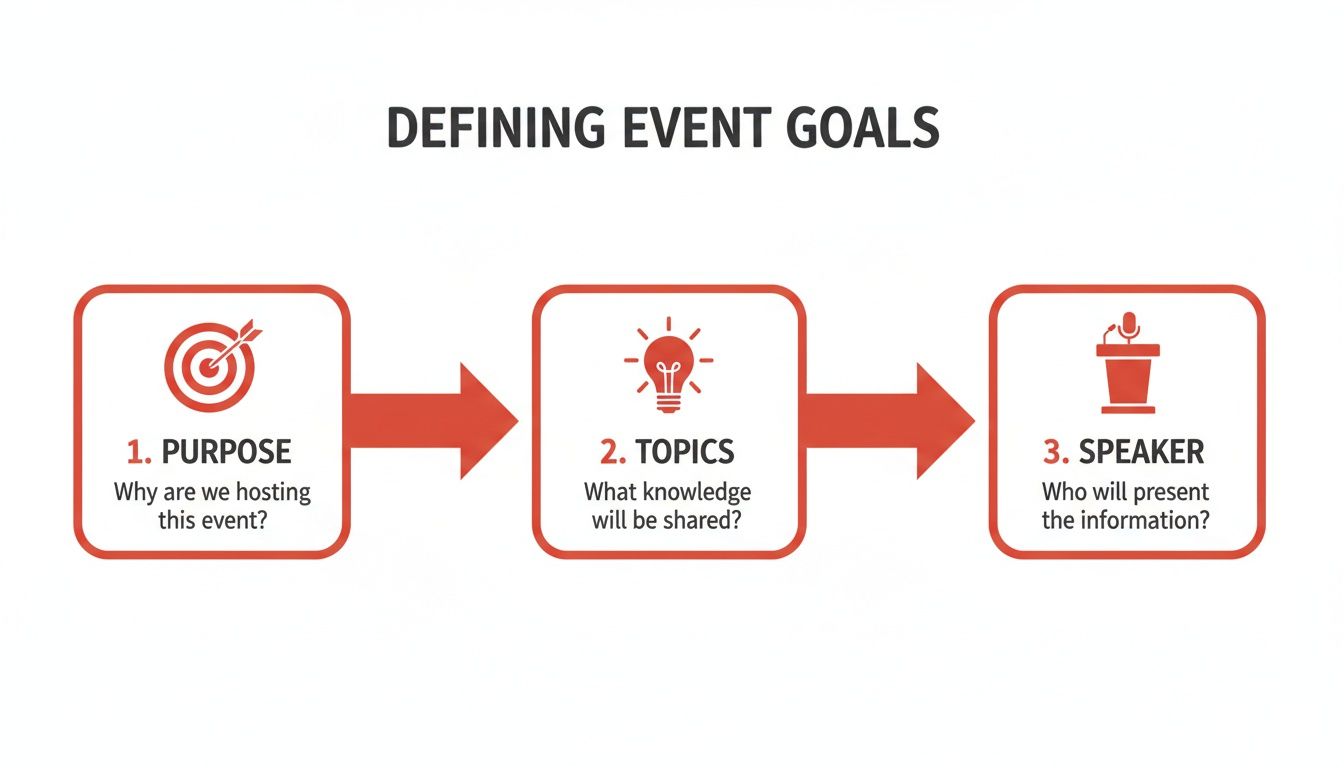
As you can see, choosing the right speaker is the critical final piece that rests on the foundation of your event's goals.
Connecting with Your Specific Audience
Finally, you have to consider if the speaker can connect with your audience. A talk that brings down the house for a room of CFOs could easily miss the mark with your sales team or engineers. The best speakers are chameleons—they can tweak their language, tone, and examples to resonate with the specific group in front of them.
This skill is more critical than ever. We're seeing a huge spike in demand for specialized finance speakers who can demystify economic data, especially for industries in high-growth areas like AI-driven fintech, where annual potential can reach 15-20%. The most requested speakers right now are those who can connect Wall Street analysis to Main Street reality, explaining how big economic cycles create tangible opportunities for businesses that are ready. This trend shows a clear preference for specialists who can translate complex topics for everyone from HR leaders to the C-suite.
When you're talking to a potential speaker, ask them directly how they would tailor their message for your audience. A true partner will fire back with insightful questions about your team’s financial savvy, their biggest pain points, and what motivates them. That dialogue is a great sign they’re committed to delivering real value, ensuring your investment pays off.
You've found the perfect finance speaker. Now for the most important part: the brief.
Hiring a top-tier speaker is only half the job. The real magic happens when you equip them with a phenomenal brief. A well-crafted briefing document is your secret weapon, turning a standard speech into a custom-built, high-impact experience that actually connects with your team.
Think of it as the strategic blueprint for your event's success. It’s your chance to lay out your company's current reality, what you need this event to achieve, and precisely what you want your audience to take away. Without this context, even the most seasoned finance pro is flying blind, left with no choice but to deliver their generic stump speech.
A generic brief gets you a generic talk. A detailed, thoughtful brief turns your speaker into an expert extension of your own team.
From Information to Insight: The Heart of the Brief
Your briefing doc needs to be more than just logistics. Sure, the date, time, and venue are essential, but the real value is in painting a vivid picture of your audience and your business. This is where you hand over the raw materials the speaker will use to build a truly relevant narrative.
What does your team do all day? What are their biggest headaches? Are they a room full of CFOs who live and breathe P&L statements, or a sales team that just needs to grasp the big-picture economic trends without getting lost in the weeds?
A great brief doesn't just list facts; it tells a story. It should convey the mood in the room before the speaker even steps on stage. Is the team celebrating a record quarter, or are they nervous about market volatility? That emotional context is pure gold for a speaker.
Giving them this level of detail allows them to weave in company-specific anecdotes, industry data, and language that feels natural to your people. It’s the difference between a speaker who talks at your audience and one who speaks with them.
Building Your Comprehensive Speaker Brief
To make sure nothing slips through the cracks, break your brief down into clear sections. Every bit of information helps the speaker connect their expertise to your specific world. The goal is to eliminate all the guesswork on their end.
Here are the non-negotiables to include for any finance speaker you book:
- Company Overview: Give them the quick-and-dirty on what your company does, its mission, and where it sits in the market right now. Mention recent wins, current challenges, and any big industry shifts that are keeping your leadership up at night.
- Event Details: Don't just list the date. Explain the event's theme and its purpose (e.g., annual sales kickoff, leadership offsite). Show them where their session fits into the bigger picture of the day.
- Audience Profile: This is absolutely critical. Detail their roles, seniority, and—most importantly—their comfort level with financial topics. A talk for accountants is worlds away from one for marketing managers.
- Your Core Objectives: What needs to happen after the applause dies down? Be specific. Are you trying to motivate the sales team for the next quarter, get everyone aligned on a new financial strategy, or spark some fresh thinking?
- Key Takeaways: List the 3-5 things you absolutely need the audience to remember and act on. This helps the speaker laser-focus their content on what matters most to you.
This structured approach ensures your speaker arrives fully prepared. And if one of your goals is to improve how your team discusses numbers internally, you can explore tools like a financial communication coach to build on the momentum from the talk.
A Sample Briefing Checklist
To make this super practical, I’ve put together a table that outlines all the must-have info. Think of it as your pre-flight checklist before sending the brief—it ensures you've provided a complete picture so your finance speaker can deliver maximum impact.
Essential Elements of a Speaker Brief
A checklist of critical information to provide your finance speaker for a fully customized and impactful presentation.
| Section | What to Include | Why It Matters |
|---|---|---|
| Event Background | Event name, theme, and overall goal. What is the "why" behind this gathering? | Gives the speaker context for the entire event, not just their session. |
| Audience Demographics | Job titles, seniority, team size, age range, and financial expertise level. | Allows the speaker to tailor their language, humor, and examples to the room. |
| Business Context | Your company's recent performance, key challenges, and strategic priorities. | Helps the speaker align their message with your most pressing business needs. |
| Desired Outcomes | What should the audience think, feel, and do after the presentation? | Moves beyond vague goals to define specific, measurable changes in mindset or behavior. |
| Logistical Details | Session length, Q&A time, AV setup, and dress code. | Ensures the speaker is fully prepared for the practical aspects of the delivery. |
By taking the time to build a thorough and insightful brief, you're not just hiring a speaker—you're co-creating a key moment for your company. This collaborative effort is the best guarantee that the content will be spot-on, the delivery will be powerful, and the impact will stick around long after the event is over.
Choosing Between a Keynote and a Workshop
Selecting the right format for your finance speaker is just as important as picking the right person. Are you looking for a high-energy keynote that leaves everyone inspired, or a hands-on workshop that builds practical skills? This decision will shape how your audience engages with the content and what they take away from the experience.
It's a strategic choice. You're not just booking a time slot; you're designing an experience.

Think of it this way: are you trying to light a spark or teach your team how to build the fire? Each format has a distinct purpose. Getting this right is what makes your investment in a top-tier finance speaker pays off in engagement and real-world application.
When to Choose a Keynote Speech
A keynote is all about delivering a powerful message to a large crowd. It's your best bet when you need to energize the room, share a big-picture vision, or set a forward-thinking tone for your entire event. Speakers on finance use the keynote stage to turn complex economic trends and market data into compelling stories that motivate and align everyone.
A keynote works wonders for:
- Kickstarting an Event: Opening a sales kickoff or annual summit with a dynamic financial outlook gets everyone on the same page and fired up for what's ahead.
- Inspiring a Broad Audience: When attendees come from different departments and have varying levels of financial expertise, a keynote provides a high-level, universally powerful message.
- Introducing a New Vision: A finance expert can add serious weight to a major company announcement—like a new growth strategy or M&A—making it feel both exciting and achievable.
For example, a keynote speaker can kick off your annual company meeting with a talk on economic resilience. They can use powerful stories to show how your team can transform market volatility into a competitive edge. The goal isn't deep technical training; it's about inspiration and alignment. If you want to dig deeper into this format, check out our guide on what a keynote speech is and how it drives impact.
When a Workshop Is the Smarter Move
Workshops, on the other hand, are about depth, interaction, and real-world application. This format is designed for smaller groups where the goal is tangible skill-building, collaborative problem-solving, and deep learning. You trade the broad reach of a keynote for focused, measurable outcomes.
A workshop is the perfect fit when you need to:
- Develop Specific Skills: Picture your leadership team learning financial modeling, or your product managers running through a forecasting exercise for a new launch.
- Build Team Collaboration: A great workshop can use a financial case study as a team-building exercise, getting people from different departments to communicate and solve problems together.
- Solve a Specific Business Problem: You can bring in a specialist to facilitate a session aimed at cracking a real-world challenge, like improving cash flow or evaluating a potential acquisition.
A workshop transforms passive listeners into active participants. The value isn't just in the information presented by the speaker, but in the discussions, exercises, and "aha" moments that happen among your team members.
This format has become incredibly valuable. As corporate events increasingly focus on purpose-driven sessions that combine finance trends with emerging AI, the demand for specialists has grown threefold compared to generalists. These builder-experts are helping teams turn volatility into performance gains—whether it's for sales teams at SKOs or tech leads at AI workshops, they deliver applied insights in both keynote and workshop formats.
The choice comes down to your primary goal: do you want to inspire the many or upskill the few? Answering that question will point you directly to the format that will make your finance speaker a true success.
How to Measure the ROI of Your Finance Speaker
So, you’ve brought in a fantastic finance speaker. The event went off without a hitch, and the audience loved it. But when the applause fades, the real question emerges: Was it worth it? Justifying the expense of a high-impact speaker means you need to show real, tangible business value, not just positive vibes.
Measuring the return on your investment is about connecting the dots between the speaker's message and concrete outcomes for your business. The best way to do this is with a two-pronged approach. You'll want to look at the hard numbers—the quantitative metrics—but also capture the shifts in mindset and strategy, which is the qualitative feedback. This combination gives you the full story of the speaker's impact and helps you prove the long-term value to your leadership team.
Tracking the Hard Numbers
Quantitative ROI gives you the concrete data that speaks directly to the bottom line. These are the measurable, objective signs that show the speaker’s session led to specific actions and results. To get this right, you need to think about measurement before the event even starts.
First, establish a baseline. If your speaker is covering a new sales strategy tied to economic trends, you need to know your team's current sales figures. This creates a clear before-and-after picture.
Here are a few powerful metrics you can track:
- Adoption Rates: Did the speaker introduce a new financial tool or process? Track how many employees or teams start using it within the first 30-60 days. A high adoption rate is a great early indicator of impact.
- Performance Metrics: Keep an eye on the KPIs that are directly related to the speaker's topic. For a sales team, you might track conversion rates against the market forecasts the speaker discussed. For an operations team, it could be measuring cost savings from a new efficiency method.
- Financial Confidence Surveys: Send a quick survey before and after the event, asking attendees to rate their confidence on key financial topics from 1 to 10. A noticeable jump in these scores is solid proof the talk was effective.
The goal isn't just to pay fewer taxes; the goal is profit. The same principle applies here. The goal of measuring ROI isn't just to justify a past expense; it's to confirm that the investment is driving your company toward greater profitability and strategic strength.
Capturing the "Aha!" Moments
Numbers are essential, but they don't tell the whole story. Qualitative feedback helps you understand the "why" behind the data. It captures those essential shifts in thinking, sparks in collaboration, and moments of strategic alignment that are just as valuable. These insights often reveal the lasting cultural impact of a truly great speaker.
This kind of data is gathered by listening and observing. It’s less about spreadsheets and more about conversations.
Try these methods to collect qualitative insights:
- Post-Event Focus Groups: A week or two after the event, get a small group of attendees together for an informal chat. Ask open-ended questions like, "What was the one big idea you took away from the session?" or "How have you started using that idea in your daily work?"
- Manager Check-Ins: Give managers a heads-up to discuss the speaker's key points in their team meetings. Ask them to share how their teams are weaving the new concepts into their projects and conversations.
- Keep an Ear to the Ground: Pay attention to what's being said in your company's chat channels or team huddles. Are people referencing the speaker's ideas or using new terminology? When the language of the talk starts showing up organically, you know it's had a lasting impact.
By blending these two approaches, you can build a powerful case that proves the value of your event. For example, you could show that a 25% jump in financial confidence (quantitative) led to three new departmental projects aimed at improving efficiency (qualitative). This combination tells a compelling story to stakeholders. A great presentation can inspire new ways of thinking across the board, much like a powerful leadership keynote speaker can shift the entire company culture. It shows that hiring the right finance expert isn't just a cost—it's a smart investment in your company's future.
Questions We Hear All the Time About Hiring Finance Speakers
Even if you've been planning events for years, booking a finance speaker can feel like a whole different ballgame. It's a niche field, and getting it right really matters. To cut through the noise, I've pulled together some of the most common questions we get from clients, along with the straight-up, practical answers you need.
The idea here is to help you feel confident you're making the right moves and finding someone who will genuinely connect with your audience and hit your event goals.
How Far in Advance Should I Really Be Booking?
Honestly, timing is critical. If you've got your heart set on a specific, high-demand finance expert, you need to start the conversation 6 to 12 months out. This is especially true if your event date is locked in. These folks have schedules jam-packed with keynotes, board meetings, and other commitments that get booked up fast.
Now, if you have some wiggle room on your dates or you're planning a virtual event, you might get away with a 3-to-6-month lead time. But my advice? Always plan ahead. It’s the best way to lock in your top choice and save yourself the stress of a last-minute scramble.
Can a Finance Pro Actually Speak to a Non-Finance Audience?
Yes, and this is the secret sauce that separates a decent speaker from an unforgettable one. The absolute best finance speakers are brilliant storytellers. They have a rare talent for taking dense, complex topics—like market trends or economic data—and spinning them into clear, compelling stories that resonate with everyone.
The trick is being crystal clear in your speaker brief. Tell them exactly who is in the room and what their level of financial know-how is. This allows a great speaker to ditch the jargon and use analogies and examples that connect with everyone, from your sales team to your engineers.
When you nail this part of the brief, you're setting the speaker up to deliver a talk that’s insightful without being intimidating, and inspiring without being dumbed down.
What’s a Realistic Budget for a Top-Tier Finance Speaker?
Speaker fees in finance are all over the map. The final number really comes down to the speaker's name recognition, how in-demand they are, and what you’re asking them to do.
Here’s a general idea of what to expect:
- A keynote from a big-name financial innovator or market guru can run anywhere from $25,000 to $75,000+.
- Interactive workshops or half-day training sessions are often priced differently, since they require more prep and hands-on involvement.
It helps to stop thinking of this as a cost and start seeing it as an investment. You're paying for a specific business outcome—whether that’s firing up your sales team, getting your leadership on the same page, or giving your clients real, actionable advice. The fee typically covers their prep time, the content customization, and the lasting impact they'll have on your team.
Okay, I’ve Booked a Speaker. Now What?
Once the contract is signed, the real work begins. The process usually kicks off with a deep-dive call between your team and the speaker. This is where you'll walk through the brief together, and they'll ask a ton of questions to get a true feel for your audience, your challenges, and what you want to achieve.
From there, the speaker starts crafting a presentation built just for you. A good process will manage this entire collaboration, making sure communication is flowing, you get to review the content ahead of time, and everything runs smoothly on the day. It's a collaborative effort that ensures there are no surprises when the speaker steps on stage.
At Silicon Valley Speakers, we don’t just find speakers; we connect you with the builders, inventors, and visionaries who have been in the trenches. Our finance experts bring real-world insights, not just theory. Discover more about our story-first approach and find the perfect voice for your next event at https://svsb.ai.