Bringing a motivational speaker into your corporate event is a strategic move, not a slot to fill on the agenda. The best corporate event speakers earn their fee before they say a word on stage, through the prep work and audience research that turn one keynote into months of changed behavior. Corporate events already claim 30.12% of the professional speaking industry's revenue, and the companies driving that number aren't booking entertainment. They're booking someone who can change how a room thinks about Monday morning.
Why top companies invest in motivational speakers
In the corporate world, an event is never just an event. It's a tool for launching a product, realigning a sales force, or building a leadership team that actually trusts each other. That's why hiring the right motivational speakers for corporate events has gone from a nice-to-have to a line item planners defend to finance. A generic corporate event speaker reads from a deck of universal platitudes; the ones worth the fee build the talk around your specific room.
The reason is credibility. When someone who has actually built a company, medaled at the Olympics, or shipped a product used by millions takes the stage, the room listens differently than it does to an internal memo.
A real-world scenario
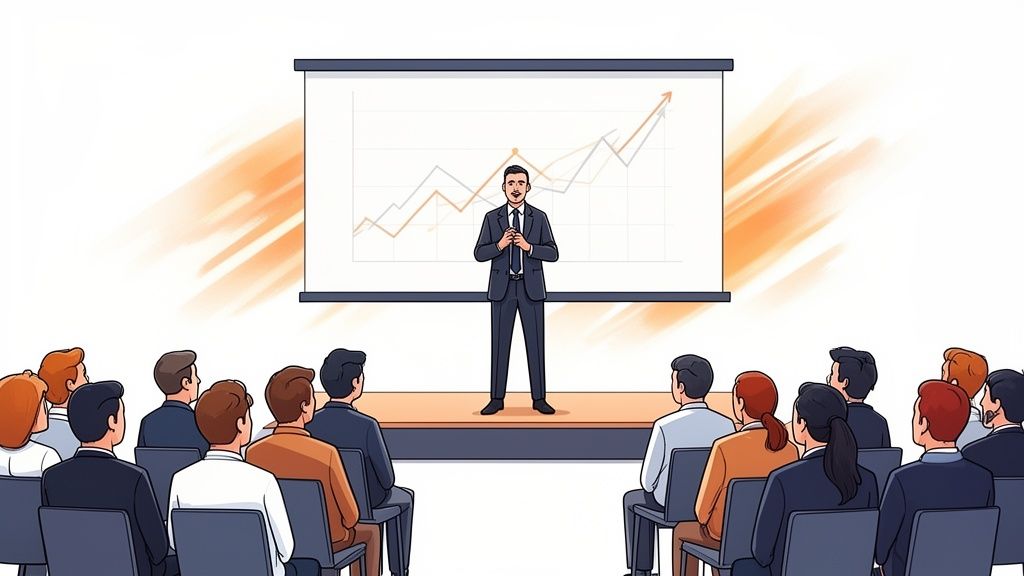
Picture a mid-sized tech company planning its annual sales kickoff. The past year was rough: market shifts and a restructure later, the sales team is tired and half-checked-out from the new comp plan.
A slide deck on quota math isn't going to fix that. So instead of another executive-led session, the planner books Shannon Rowbury, the first American woman to medal in the Olympic 1500-meter race, to open the kickoff.
The biggest — and most expensive — mistake I see event planners make is measuring a keynote's success by the length of the standing ovation. Applause is nice, but it's not a business metric. Real success is what your team does differently on Monday morning.
From inspiration to actionable outcomes
Rowbury doesn't show up with a canned speech about winning. She works with the leadership team beforehand to understand the specific burnout and skepticism in the room, then builds her keynote around it. She draws a direct line from the discipline of Olympic training to the daily habits that drive sales. The new comp plan stops being a hurdle and starts being the next race.
The team leaves with more energy than they walked in with. The comp-plan objections that would have eaten the first team meeting of the quarter don't materialize, because the speaker already reframed them. And the sales leader gets a shared reference point ("remember what Shannon said about the third lap") that outlasts the event itself.
This is exactly why companies planning motivational speakers for corporate events treat the booking as a business decision, not an entertainment budget line. If you want to see what that looks like structurally, our guide to transformational leadership breaks down the mechanics a speaker like Rowbury is putting to work on stage.
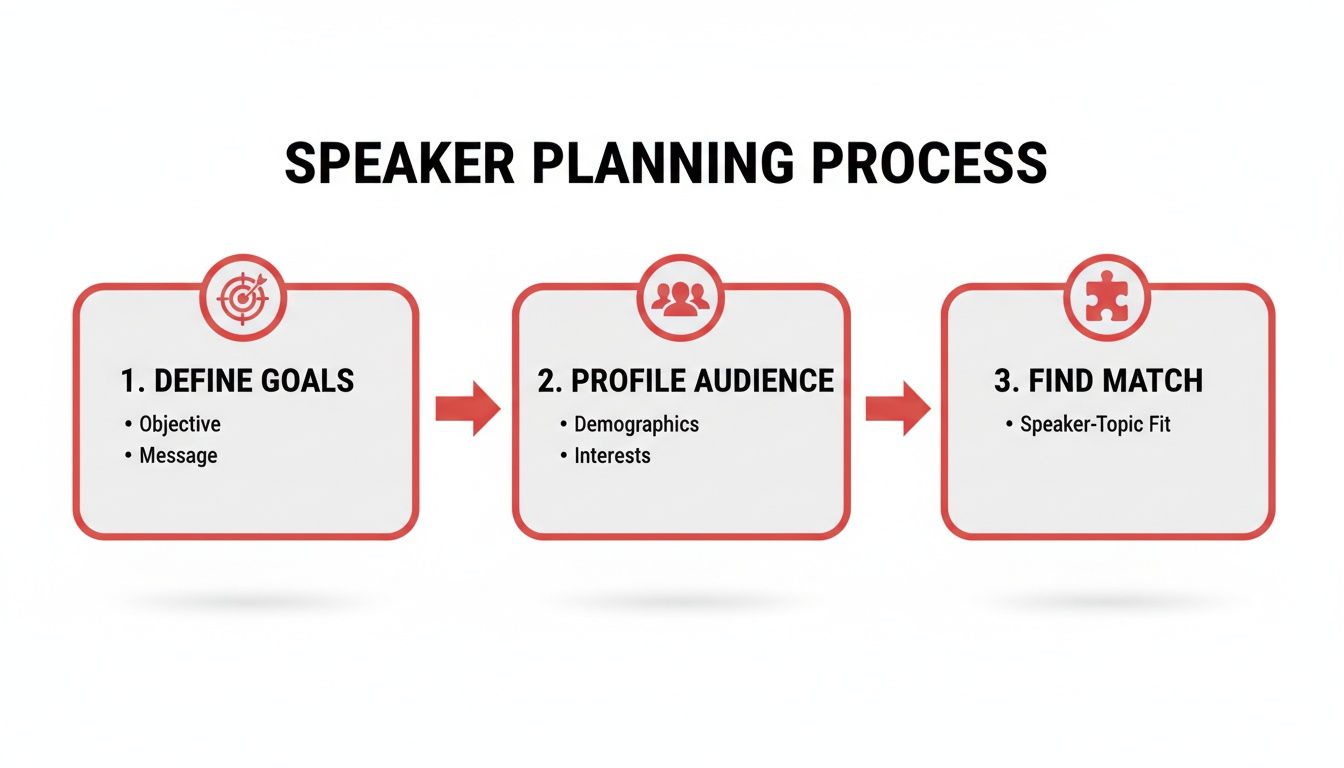
First things first: what's your event's "why"?
Before you search for a speaker, answer one question: why are you doing this? A great speaker is a strategic investment aimed at a specific outcome. Skip that step and you might book a fantastic performer whose message evaporates the moment people leave the room.
So what does success look like when the event is over? Are you trying to reignite a team after a hard quarter? Get everyone aligned on a new company vision? Push your product team out of its routine?
Having a clear purpose turns a vague search for "a good speaker" into a focused search for the right speaker for your specific problem.
Nail down your core message
Once you have the high-level goal, sharpen it into one idea you want every person in the room to remember.
| Goal | Core message |
|---|---|
| Boost sales team morale | "Resilience is our secret weapon; every 'no' gets us closer to a 'yes.'" |
| Spark real innovation | "The future belongs to those who question the present." |
| Develop stronger leaders | "Great leaders don't build followers. They build more leaders." |
With a message this clear, briefing a speaker becomes simple: you're giving them a precise target instead of a vague vibe. For how a strong opening sets that target up, see our guide on what a keynote actually does for your event.
Match the speaker's expertise to the goal, with real people
A general "motivational" speaker is the wrong hire if your goal is specific. Most lists of corporate event speakers online rank by fame, not fit. Here's how SVSB matches speaker expertise to event goals, using speakers actually on our roster, not archetypes:
| Event goal | Speaker profile | On our roster |
|---|---|---|
| Inspire innovation | Founder who built the thing everyone now takes for granted | Adam Cheyer, co-creator of Siri, on 40 years of building at the edge of AI |
| Improve leadership | Someone who has made real decisions under real pressure | Nicole Malachowski, first woman Thunderbird pilot and former White House adviser |
| Boost sales/performance | Peak-performance athlete who can translate discipline into daily habits | Shannon Rowbury, Olympic 1500m medalist |
| Navigate uncertainty | Someone who has operated at the edge and can name what actually helps | Matthew Spence, four-time finisher of the 29029 Everesting Challenge |
| Technical / AI fluency | A working researcher who can run a hands-on session, not just talk about AI | Bryan McCann, Anthropic researcher and unicorn founder |
A speaker whose lived experience actually mirrors your event's theme creates an immediate connection with the audience. A generic "motivational speaker" search doesn't get you there. Matching by goal does.
Know your audience, really know them
The message is only half the equation. A talk built for a room of C-suite executives will miss a room of new software engineers, and vice versa.
Build an audience profile that goes past job titles: who's actually in the room, what's their current state of mind (worried about a re-org, excited about a launch, burned out from a long project), what are their day-to-day struggles, and what do they need to hear right now: reassurance, a push to take risks, or practical tools?
Research from Mordor Intelligence backs up why this matching matters: 70% of employed Americans say presentation skills are critical to their success, which is a large part of why corporate events already account for that 30.12% share of speaking-industry revenue mentioned above.
What do company event speakers actually cost?
This is the question every planner asks and most articles dodge. Search "corporate event speakers" or search "motivational speakers for corporate events," and you land on the same question asked two different ways: what does this actually cost? Here's what the range actually looks like, using public pricing from our own roster as anchors.
On the lower end, speakers with a strong story and a specific niche start around $10,000. Two speakers on the SVSB roster list publicly at exactly that floor: Shannon Rowbury and Matthew Spence, the Everesting endurance speaker from the table above. Established keynote speakers with a track record of Fortune 500 stages typically run $25,000 to $75,000. At the top of the market (co-founders of category-defining companies, bestselling authors, household names) fees move to "inquire," because they're negotiated per date and per exclusivity; Adam Cheyer's Siri pedigree puts him in that inquire-only tier.
The fee is the headline number, but it's rarely the full cost. Audience size and format move the number too: a 20-minute keynote to 200 people costs less than a half-day workshop with breakouts for the same speaker, because the second format takes more of their time and more prep. A complete budget also covers business-class travel and ground transportation (plan for the speaker to arrive the day before), a per diem, and (if you're asking for a custom workbook or branded slide deck) a materials fee on top of the base rate. Ask for an itemized breakdown up front so there are no surprises two weeks out.
How to find and vet the right speaker for your event
You've nailed down your event's purpose. Now comes finding the speaker to bring it to life, not by scrolling an endless directory, but by running a focused search for a partner who will help you hit a specific business goal.
The best speakers act like strategic collaborators. They take time to understand your audience and your challenges before they write a word of the talk. That collaborative habit is what separates a good speech from one people are still quoting six months later.
Look beyond the sizzle reel
A speaker's sizzle reel is a highlight clip built to show the best jokes and the loudest applause. It's useful for a feel of stage presence, but it rarely tells the whole story.
A slick, highly-edited sizzle reel is pure marketing. Before you book, ask to see a long-form, unedited video of the speaker delivering a full keynote start to finish.
A strong reel earns a spot on the shortlist. It shouldn't be the reason you sign the contract.
Your corporate event speaker vetting checklist
On the discovery call, dig into three things that reveal whether a speaker is a real partner or a vendor checking a box.
- Audience fit: have they spoken to groups with similar roles and the same day-to-day pain points? A speaker who's a hit with C-suite executives might not fit a room full of software engineers.
- Content customization: what's their process for tailoring the message? A great speaker insists on deep-dive calls to work your company's language and current challenges into the talk.
- How they define a win: do they care about the behavioral change you want after the event, or just the applause at the end?
Questions to ask every potential speaker
"Can you share an example of when you worked with an audience like ours? What were their key challenges, and how did you address them?" This tests real experience. Listen for how specifically they describe diagnosing an audience's needs.
"Walk me through your briefing process. Who do you need to talk to so your message is on target?" A top-tier speaker wants to connect with your leaders and maybe a few future attendees. If they only ask for a one-page summary, expect a generic, off-the-shelf talk.
"Beyond the keynote, how do you help the message stick?" This opens the door to follow-up materials, workshops, or extended Q&A that make the keynote's impact last past the event.
"How do you handle a tough question or a sudden dip in the room's energy?" An experienced speaker reads the room and pivots on the spot, turning a disruption into the moment people remember.
For a faster way to connect with speakers matched to your event's theme and audience, our speaker discovery engine surfaces curated options based on what you're actually trying to accomplish.
Getting the details right: budgets, contracts, and logistics
Once you've picked a speaker, the real work starts: the contract and the logistics that make an event run smoothly. This is the stage that determines whether your speaker walks on stage prepared or scrambling.
The speaker contract: your blueprint for the engagement
A contract spells out every deliverable and responsibility so both sides know exactly what they signed up for. Review these clauses closely:
- Deliverables: does the fee cover a 60-minute keynote? Is Q&A included? Will the speaker join a VIP meet-and-greet or sit on a panel? Get it in writing.
- Payment schedule: industry standard is a 50% deposit to lock the date, with the remaining 50% due on or before event day.
- Technical rider: the speaker's AV needs: a lavalier mic, a specific projector, a confidence monitor.
- Cancellation policy: know the terms on both sides if the event gets postponed or canceled.
85% of event planners report being optimistic about the year ahead, and 66% say they're working with bigger budgets, which means more competition for the speakers worth booking. Lock in dates early.
A practical timeline for a smooth engagement
Booking motivational speakers for corporate events is a project of its own. Here's a timeline that holds up in practice:
- 6-12 months out: check availability and get a ballpark fee quote.
- 5-10 months out: finalize terms, sign the contract, pay the deposit.
- 1-2 months out: the briefing call: a deep-dive between the speaker and your internal stakeholders to align on goals and content.
- 2-4 weeks out: book flights and hotels, share the final agenda and travel itinerary.
- 1 week out: a final check-in call to confirm details.
- Event day: arrive early, run the AV check, assign a dedicated point of contact.
- 1-2 days post-event: send a thank-you and process the final payment.
Maximizing your speaker's impact beyond the stage
A great keynote is the start of a conversation, not the end of one. The real return from booking motivational speakers for corporate events comes from the momentum you build after they've left the building.
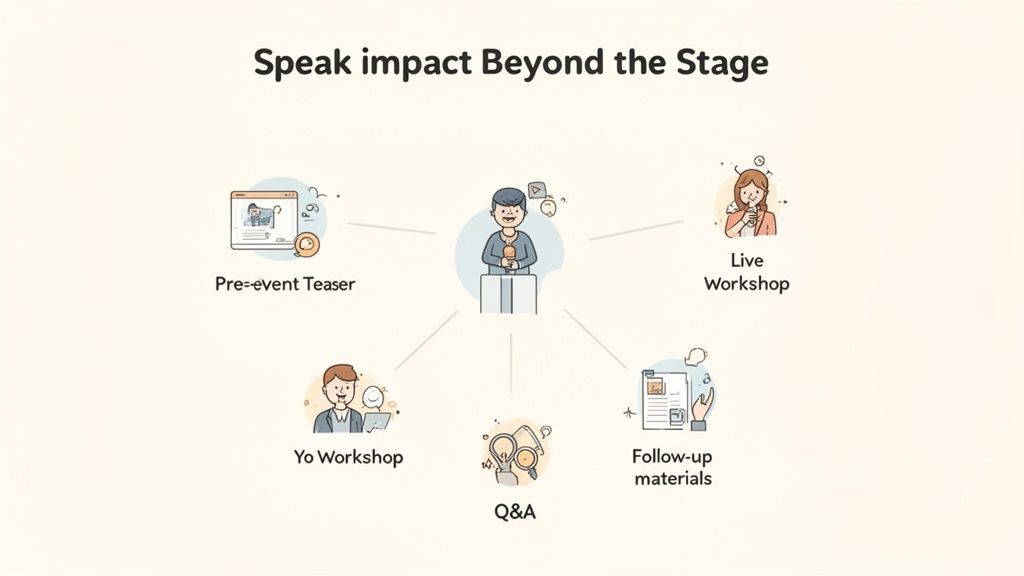
Before the event: building anticipation
Post a short clip of your speaker or a specific quote to your internal Slack or Teams channel, framed around a challenge your team is actually facing. Run a quick, anonymous survey asking about people's biggest professional hurdles, then share the raw results with your speaker. That's what lets them skip the canned material and speak to real problems in the room.
During the event: integrating the message
Give a real introduction. Skip the bio recitation and spend a minute on why this specific person is here and what you want the team to take from it. That primes the audience to listen for the right things.
Plan the Q&A. Have a few seed questions ready that connect the speaker's ideas directly to your company's current projects.
The minutes just before and after a keynote are where the work happens. A real introduction sets up the "why." A well-run Q&A turns the "what" into the "how." Don't leave either to chance.
After the event: turning inspiration into action
A standing ovation is nice. Changed behavior is what moves the needle.
Work with your speaker to put together a one-page summary of their key points, a short list of recommended reading, or a brief follow-up video, and get it into your team's hands within 24 hours while the energy is still there. For deeper impact, book the speaker for a half-day or full-day workshop with smaller groups: a keynote inspires, a workshop equips people to actually practice the new skill. Turn the best quotes into graphics for internal channels or discussion prompts for your next team meeting, so the ideas don't die the day after the event.
The professional speaking industry is valued at nearly $2 billion, and companies whose teams communicate well outperform their peers financially by 3.5x. Thinking beyond the stage is how you turn a speaker booking into that kind of return.
Answering your top questions about hiring a motivational speaker
How far in advance should I book a speaker?
For in-demand speakers (AI pioneers, bestselling authors, Olympic athletes) start the conversation 6 to 12 months out, especially for a fixed-date event like a sales kickoff or leadership summit. That runway gives the speaker time to customize content properly. On a tighter timeline of 3 to 4 months, still reach out: schedules open up, and it's always worth asking.
How much does a corporate event motivational speaker cost?
Plan on $10,000 to $25,000 for a strong niche speaker, $25,000 to $75,000 for an established keynote name, and inquire-only pricing above that for marquee names. Add travel and per diem on top of the base fee, plus a materials fee if you want custom workbooks or slides. See the full breakdown above.
What's the real difference between an event keynote speaker and a workshop facilitator?
An event keynote speaker delivers a big-picture, high-energy talk to your full audience, usually built around a single 60-minute slot, meant to set the tone and spark new ideas. A workshop facilitator works with a smaller group hands-on. The goal is a practical framework people can actually use back at their desk, not just a moment of inspiration.
How do we actually measure the ROI of a speaker?
Start with the goal you set before you booked. Planning a sales kickoff? Track pipeline growth, quota attainment, or how fast the team adopts a new sales tool in the following quarter. Running a leadership retreat? Use post-event surveys to measure shifts in alignment or trust. Running an innovation summit? Count new project ideas submitted through a portal, or track progress on a specific R&D challenge. Pair that hard data with anonymous qualitative feedback on morale and engagement. Together they tell the full ROI story.
Can we get the speaker to customize their content for our company?
Yes, and you should insist on it. Customization is what separates a professional from someone giving the same talk on repeat. A great speaker schedules pre-event calls to learn your company's language and your team's actual challenges. Shannon Rowbury frames her resilience story very differently for a sales team facing burnout than for an engineering team on a tight deadline. That deep-dive process is what makes the content feel built for your room specifically.
What makes someone one of the best corporate event speakers?
Credentials get a speaker onto the shortlist. Preparation is what gets them booked again. The corporate event speakers who get rebooked are the ones who ask what's actually going on in the room before they write a word of the talk; Shannon Rowbury builds a different version of her Olympic story for a burned-out sales team than for a team under a deadline crunch. Fame without that prep work is a sizzle reel. The fee you're paying is for the version built for your room.
At Silicon Valley Speakers, we connect you with the people who have actually built the future, not just talked about it. Our roster is practitioners who deliver more than a speech.