
An educational motivational speaker isn't just there to inspire; they're an industry expert who turns their real-world success into practical, skill-based lessons for your team. Think of them as accomplished innovators, founders, and leaders who deliver concrete takeaways your people can use right away. Their mission is to educate, equip, and empower—not just provide a fleeting boost of motivation.
The Shift From Inspiration to Actionable Expertise
When you hear "motivational speaker," you might picture someone full of energy, delivering feel-good quotes. While a dose of inspiration has its place, today's organizations need more. They need substance that lasts long after the event ends. This is exactly where an educational motivational speaker makes their mark.
These aren't just professional speakers; they're proven practitioners first. Imagine your sales team learning about resilience from an Olympic medalist who then built a successful company. Or picture your executives learning innovation frameworks from a tech founder who genuinely disrupted an entire market. That’s the critical difference.
This infographic breaks down their unique approach, focusing on the core attributes that set them apart.
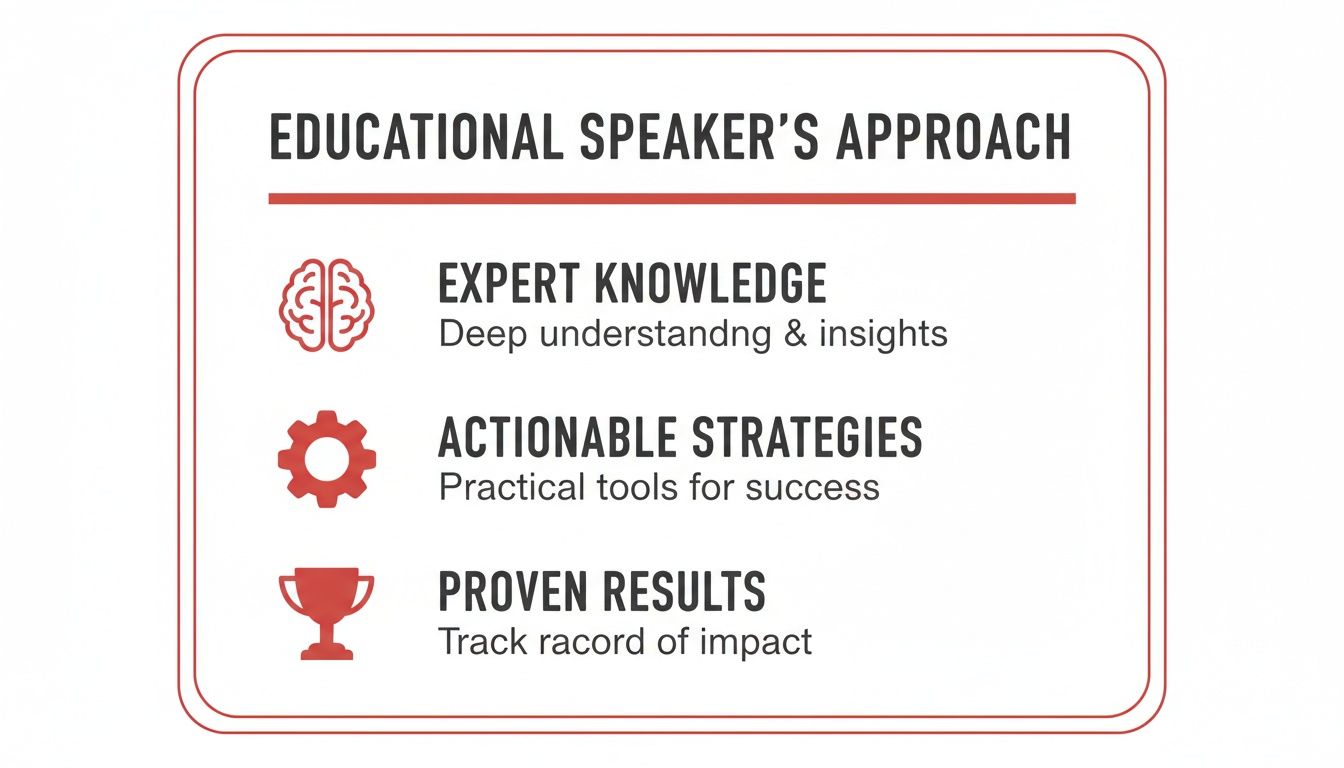
As you can see, it all starts with deep expertise. That foundation allows them to share actionable strategies that lead to real, measurable results for your teams.
To really understand the distinction, it helps to see a side-by-side comparison.
Educational vs Traditional Motivational Speaker
| Attribute | Traditional Motivational Speaker | Educational Motivational Speaker |
|---|---|---|
| Primary Goal | Inspire and motivate through storytelling and emotion. | Educate and empower with practical skills and knowledge. |
| Core Content | General life lessons, personal stories of overcoming adversity. | Specific frameworks, industry insights, and actionable techniques. |
| Speaker's Background | Often a professional speaker by trade. | A proven expert, innovator, or leader from a specific field. |
| Audience Takeaway | A temporary feeling of inspiration and positivity. | Tangible skills, new mindsets, and a clear plan of action. |
| Event ROI | Hard to measure; focused on morale. | Measurable through skill adoption and performance improvement. |
The table makes it clear: one focuses on a feeling, the other on a function. Both have value, but for driving business results, the educational speaker offers a more direct path.
More Than a Storyteller—An Expert Practitioner
The real power of an educational speaker comes from their lived experience. They don't just talk about leadership theories; they share the scars and successes from their own journey building a company or navigating a high-stakes environment.
Their presentations skillfully weave compelling stories with practical, evidence-based content. This mix is essential for keeping adults engaged and helping them retain what they learn.
- Focus on Tangible Skills: They teach specific methods or mindsets that your team can literally apply the next day at work.
- Deep Industry Knowledge: Their advice is rooted in current market realities, which makes it immediately relevant and valuable.
- Customized Content: A true expert will dig in to understand your organization’s unique challenges and tailor their message accordingly, whether it's for a sales kickoff (SKO), a leadership retreat, or an all-hands meeting.
The most impactful speakers I've seen are the ones who can turn their personal breakthroughs into a playbook anyone can use. They build a bridge from their story to your team's next chapter.
The Growing Demand for Real-World Knowledge
This move toward speakers with substance is backed by hard numbers. The global professional speaker market, valued at USD 4 billion in 2024, is expected to hit USD 5.8 billion by 2031. A huge driver of this growth is the corporate demand for speakers who can truly educate.
What's more, data shows that companies with strong communication and learning cultures financially outperform their peers by 3.5 times. This makes a clear business case for investing in speakers who can actually lift your team's capabilities. If you're curious, you can read more about the growth of the professional speaker market and the data behind it.
Bringing in an educational motivational speaker is an investment in your people's growth. It shows you're committed to giving them practical tools for success, not just a temporary high. Instead of a fleeting moment of inspiration, you get a solid foundation of knowledge that can drive real business outcomes.
Connecting a Speaker's Expertise to Your Event Goals
Before you even think about searching for an educational motivational speaker, you have to get crystal clear on what success looks like for your event. The first, most essential step is moving beyond a vague desire for "inspiration" and toward a speaker who can deliver real, measurable value.
This all starts by getting concrete answers from your key stakeholders. Are you trying to fire up the sales team for a new product launch? Do you need to get your executive board aligned on a new AI strategy? Or is the goal to build a more resilient and innovative culture? Each of these goals demands a totally different kind of expert.
Pinpoint Your Core Objective
To find the right speaker, you need to uncover the real reason you're bringing in an outsider. Generic goals lead to generic talks. Specific objectives, on the other hand, set up a powerful, tailored experience that actually sticks.
Start by sitting down with your leadership and asking some direct questions:
- What specific action do we want the audience to take after this keynote?
- What’s the single most important feeling or mindset we want them to leave with?
- Which business problem is this event designed to solve?
- If this event is a huge success, what will have changed for our team three months from now?
The answers you get become your North Star. Instead of just looking for someone who sounds inspiring, you'll be searching for an expert who can solve a specific problem for your team.
Shifting your mindset from a generic desire for 'motivation' to a clear objective, like 'arming our sales team with three new AI-powered prospecting techniques,' is the most critical step in the entire process. It transforms your search from a guessing game into a strategic investment.
This kind of clarity acts as a powerful filter. It instantly narrows your options to speakers whose real-world experience directly aligns with the outcome you need, ensuring you find someone who delivers a functional toolkit, not just a memorable speech.
Match Expertise to Your Event's Purpose
Once you’ve nailed down your core objective, you can start matching specific types of speakers to your event. Getting this right creates a powerful synergy between the message and the moment, making the content land with real impact.
Let's look at a few common scenarios:
- For a Sales Kickoff (SKO): Your goal is to boost sales performance and resilience. Instead of a general rah-rah speech, find an expert who has actually built high-performing teams, maybe an Olympic medalist who is now a business leader. Their stories of discipline and grit are grounded in experience your sales reps can apply directly to hitting their targets.
- For a Leadership Offsite: Here, the objective might be to spark innovation or navigate market disruption. A visionary tech founder or a leading AI pioneer is a perfect fit. They can give your executives concrete frameworks for thinking about the future and making bold decisions.
- For a Company-Wide Meeting: If you're trying to build a more collaborative culture, look for a speaker who specializes in team dynamics or organizational psychology. They can provide practical, actionable tools for improving communication and trust across the entire company.
This matching process is what drives real change. It ensures the speaker's content isn't just relevant, but deeply resonant with the specific audience in the room.
The market for professional speakers is set to grow significantly by 2029, a trend driven by the increasing demand for specialized knowledge at corporate events. For event planners and L&D leaders, this just emphasizes the importance of finding proven innovators. After all, companies with strong communication practices have been shown to outperform their peers financially by 3.5 times. The right speaker isn't an expense; it's a direct investment in your bottom line. You can read more about the future trends of motivational speaking and see how the right expert can help you hit your goals.
How to Vet and Select the Right Speaker
Choosing the right educational motivational speaker for your event goes way beyond watching a slick, two-minute highlight reel. That reel is pure marketing—it’s designed to show you their best moments. To make a smart decision, you need to see the full picture. Speakers like Mo Tiwari — Staff Research Scientist at Google, ex-OpenAI, Stanford PhD with 20+ peer-reviewed AI papers — or Shannon Rowbury — a three-time Olympian who built the Medalist Mindset performance program — pair real credentials with the storytelling chops that move audiences.
The only way to do that is to get your hands on a full-length, unedited speaking video. This is non-negotiable. A sizzle reel is a trailer; the full video is the actual movie.
As you watch, try not to focus solely on the speaker. Look at the audience. Are they leaning in, taking notes, and laughing at the right times? Or are their eyes glued to their phones? The audience’s reaction is the most honest review you’ll ever get of a speaker's ability to truly connect.
Look Beyond the Stage Presence
A charismatic stage presence is great, but it’s just one piece of the puzzle. The real value comes from the clarity and practicality of their message. As you watch their full talk, ask yourself a few key questions:
- Is the message crystal clear? A great speaker can take big, complex ideas and make them simple and memorable.
- Are the takeaways actionable? Does the speaker give your team concrete steps, tools, or a framework they can put to work the very next day?
- How do they handle Q&A? This is where you see their true expertise. Watch how they handle unexpected questions—it reveals their depth of knowledge and ability to think on their feet.
An expert with real-world accomplishments will ground their insights in experience, not just theory. Their answers during Q&A should come from a deep well of knowledge because they’ve actually done the work they’re talking about.
A highlight reel shows you the what—the applause, the big punchlines. A full video shows you the how—how they build an argument, how they hold a room's attention for 60 minutes, and how they deliver real substance. You're investing in the "how."
Essential Questions for the Discovery Call
Once a speaker passes the video test, it’s time for a discovery call. This isn't just a formality. It’s your chance to dig deeper and see if they’re the right partner for your event. This is where you find out how they customize their content and if they really get your audience.
Come prepared with specific questions that go beyond their topic. Here are a few must-asks:
- Walk me through your process for customizing a talk for our specific audience and event theme. A generic "Oh, I customize everything" is a red flag. You want to hear about a detailed process that includes pre-event calls, reviewing your materials, and maybe even interviewing a few of your team members.
- What’s your experience speaking to audiences in our industry? Or to similar roles like sales, engineering, or leadership? They should have specific examples ready and be able to speak your team’s language.
- How do you make sure your message leads to real outcomes, not just a temporary "motivation high"? A top-tier educational speaker will connect their content directly to business results and performance.
- Beyond the main speech, what other ways can you help reinforce the message? Do you offer workshops or follow-up sessions? This shows they're committed to making the learning stick.
To get a better sense of how different formats work, you can learn more about what makes an effective keynote presentation and how it differs from a workshop.
Finally, don’t ever skip the reference check. Ask for contacts from past events that had similar audiences and goals. When you call them, ask about the speaker's professionalism, how easy they were to work with, and—most importantly—what real impact the presentation had on their team. This final step gives you honest, third-party validation that you’re making a great choice.
How to Maximize Your Return on the Speaker Investment
The real value of an educational motivational speaker isn't just about their time on stage. A truly great engagement starts long before they arrive and keeps paying dividends well after the final applause. To get the most from your investment, you need a playbook that covers the entire lifecycle of the partnership.
Think of it less as a simple booking and more as a deep collaboration. Your goal is to weave the speaker's expertise into the very fabric of your event. This transforms their session from a standalone moment into a genuine catalyst for change. It all comes down to a thoughtful approach to briefing, structuring, and reinforcing their message.
Before the Event: The Briefing Blueprint
A top-tier speaker thrives on context. The more they understand about your audience, your business, and your specific goals, the more their message will hit home. A generic brief will get you a generic talk, so a detailed briefing is absolutely non-negotiable.
Your job is to arm the speaker with the insider knowledge they need to connect with your team on a personal level. This means going way beyond just high-level event themes.
Give them a comprehensive look inside your world:
- Who's in the Room?: Don't just say "sales team." Give them the real scoop on roles, seniority, the challenges they face daily, and what's keeping them up at night.
- Recent Wins and Current Hurdles: What are you celebrating? What roadblocks are you trying to smash through? This helps the speaker tie their message directly to your team's current reality.
- Your Internal Language: Every company has its own acronyms and project code names. Sharing these allows the speaker to talk with your team, not at them. It’s a small detail that builds instant credibility.
Your speaker is an expert in their field, but you are the expert on your team. The pre-event briefing is where you merge those two worlds to create something truly powerful. It’s the single most important step in guaranteeing a high-impact session.
During the Event: Structuring for Impact
How you structure the speaker's time should directly map to what you want to achieve. A 60-minute keynote is fantastic for inspiring a large crowd and planting big ideas. A smaller, more intimate workshop, on the other hand, is built for hands-on skill-building and real interaction.
Let’s look at two of the most common formats:
| Format Type | Best For | Key Characteristics |
|---|---|---|
| The Power Keynote (60-90 Mins) | Large audiences at SKOs, all-hands meetings, or customer conferences. | A compelling narrative arc that blends storytelling with actionable frameworks. Designed to energize, align, and set the tone. |
| The Immersion Workshop (Half/Full Day) | Smaller groups like leadership teams or specific departments. | Highly interactive, with exercises, breakout sessions, and Q&A. Focused on building specific skills and solving real problems. |
Even the most brilliant content has to fight a biological battle—the human attention span. This is where a great speaker’s delivery and structure make all the difference. We know that audiences can forget up to 90% of what they hear within 30 minutes. But here's the good news: storytelling can boost retention by 65%, and strong visuals make a presentation 43% more persuasive. This is why a true pro doesn't just lecture; they weave stories, use powerful visuals, and create interactive moments that make their message stick. To learn more, you can explore more public speaking insights and statistics.
After the Event: Keeping the Momentum Going
The talk is over, but the real work is just beginning. The days and weeks that follow are a critical window to lock in the speaker's message and turn that spark of inspiration into action. Without a follow-up plan, even the most amazing session can fade into a pleasant memory.
Here are a few proven ways to keep the momentum alive:
- Speaker-Led Follow-Up: Ask the speaker to record a short, personal video reinforcing their main point or answering questions that came up after the session. It’s a powerful touch.
- Curated Resource Hub: Work with the speaker to pull together a simple landing page with links to books, articles, or tools that build on their talk.
- Internal Huddles: Schedule short team meetings focused on one thing: how can we apply one or two key takeaways to a project we're working on right now?
- Pulse Surveys: A week or so after the event, send a quick survey. Ask what concepts resonated most and what specific actions they plan to take.
When you plan your speaker engagement as a three-part journey, you get so much more than a one-off speech. You create a powerful learning experience that drives real behavior change and delivers a massive return on your investment. You can streamline this entire process by using tools like our speaker run of show generator to ensure every detail is covered from start to finish.
Measuring the Real Impact of Your Speaker
So, the speaker got a standing ovation. That's fantastic, but how do you actually prove to your leadership that the investment paid off? The warm, fuzzy feeling is great, but it won't show up on a balance sheet. To justify the expense, you have to move past simply asking if people "liked" the session.
The trick is to think about measurement before you even book the speaker. You need a game plan that combines qualitative feedback—what people thought and felt—with hard, quantitative data that points to real change. This is how you shift the conversation from a subjective "good session" to a clear, objective business outcome.
Moving Beyond Smile Sheets
The classic post-event survey—those "smile sheets"—are a starting point, but they barely scratch the surface. A five-star rating doesn't tell you if anyone will actually do anything differently. Real impact is about behavior change, not just a temporary mood boost.
To get at the real story, you need to ask better questions. Instead of "Did you enjoy the speaker?" try asking something specific and open-ended:
- "What's one actionable idea from the session you plan to use in your work this month?"
- "Which concept challenged your thinking the most, and why?"
These kinds of questions give you a direct window into which messages truly hit home.
Another great tip is to keep an eye on your internal communication channels. Are people talking about the speaker's ideas on Slack or Teams? A sudden burst of conversation around a new framework or skill is a fantastic sign that the content has stuck and is starting to take root in your company culture.
Setting Measurable KPIs Before the Event
The most powerful way to show ROI is to tie the speaker’s talk to specific, measurable Key Performance Indicators (KPIs). This isn't something you do after the fact; it has to be part of the initial planning. Sit down with your stakeholders and ask, "What does success look like in numbers?"
Here are a few practical examples of what you could track:
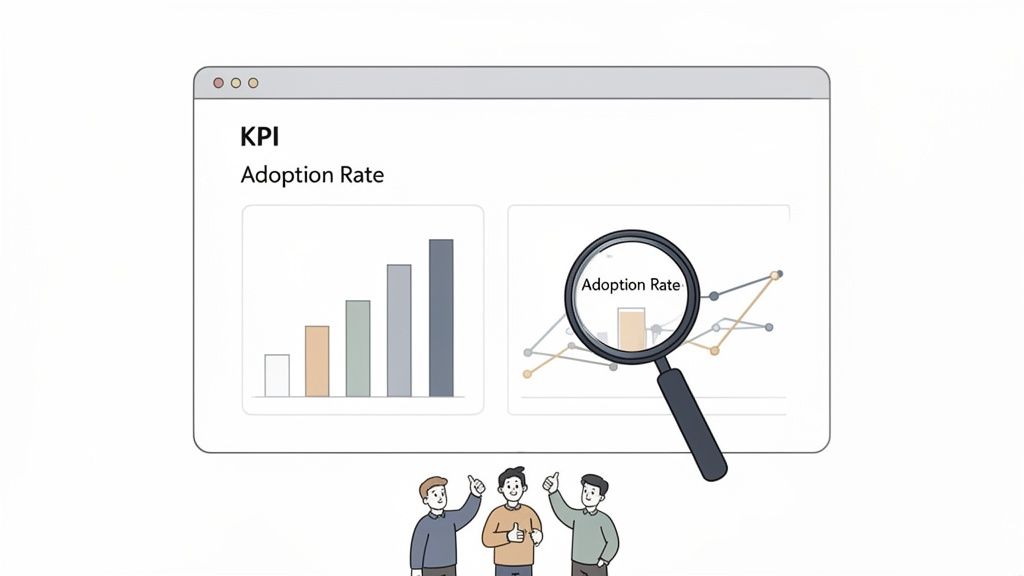
- Process Adoption Rate: If the speaker introduces a new sales methodology, how many reps start using it in the first 30 days? Even a 25% adoption rate can lead to major improvements.
- Productivity Metrics: For a tech team, you could measure the average time it takes to resolve support tickets or complete a coding sprint before and after a workshop on new tools.
- Follow-Up Engagement: Was the keynote a kickoff for a larger training program? Track the sign-up and completion rates for the follow-up courses. High numbers show the speaker successfully sparked interest.
Defining your KPIs upfront is how you prove value. It transforms the speaker engagement from a line-item expense into a strategic investment tied directly to business goals. Without this step, you're just measuring applause.
To truly connect the dots for leadership, you need to show how the speaker's expertise directly influences these numbers. For organizations aiming to build stronger leaders who can drive these kinds of results, you might be interested in our guide on what makes a powerful leadership keynote speaker.
To help structure this, you can use a simple framework.
ROI Measurement Framework for Speakers
This table provides a clear structure for tracking the impact of your speaker, ensuring you have both qualitative and quantitative data to present to stakeholders.
| Metric Type | Example Metric | How to Measure | Tied to Goal |
|---|---|---|---|
| Qualitative | Session Relevance | Post-event survey question: "How relevant was this topic to your daily work?" (Scale 1-5) | Employee Skill Development |
| Qualitative | Key Takeaway Application | Open-ended survey question: "What is one thing you will implement from this session?" | Behavior Change |
| Quantitative | New Tool Adoption | Track logins or usage of a new software introduced by the speaker. | Increased Efficiency |
| Quantitative | Sales Performance | Monitor sales cycle length or close rates pre- and post-session. | Revenue Growth |
| Quantitative | Project Completion Time | Measure average project lifecycle before and after a productivity workshop. | Improved Productivity |
By thinking through these metrics from the start, you'll have a solid plan for measuring what matters.
With a clear measurement plan, you can report on your event with confidence. You’ll be able to show not just that your team was inspired, but that they were armed with new skills that are actively improving performance and moving the business forward. That data-backed story is what truly proves the power of a great educational motivational speaker.
Common Questions About Hiring a Speaker
When you're thinking about bringing in an outside speaker, a lot of practical questions pop up. From budgets and booking windows to content, getting the logistics ironed out is what makes an event run smoothly. Let's walk through some of the most common questions event planners ask.
Getting these details right from the start helps you avoid headaches down the road and ensures you find a partner who will make your event truly memorable.
How Much Does an Expert Speaker Cost?
Speaker fees are all over the map, and it really comes down to their reputation, real-world track record, and how much you need them to customize their material. It’s a real investment, so it helps to know what you’re paying for.
For a true expert—someone who’s pioneered an AI technology, sold a company, or translated world-class athletic success into business leadership—a standard one-hour keynote will typically run between $25,000 and $75,000, plus travel. You're not just paying for an hour on stage; you're paying for their hard-won expertise and the credibility they bring to your team.
If you’re looking for more hands-on engagement, like a half-day or full-day workshop, the fee will naturally be higher to reflect the deeper time commitment and preparation involved.
Try not to think of it as a cost, but as an investment in your people. The return you get from a small bump in sales performance, a fresh wave of innovation, or a more motivated team can easily eclipse the initial fee.
How Far in Advance Should I Book a Speaker?
For top-tier experts, especially in hot fields like AI, you really need to plan ahead. Their calendars fill up fast with corporate keynotes, board meetings, and their own business commitments.
My advice? Try to book your educational motivational speaker 6 to 12 months in advance. This is especially critical if you're planning for a major annual event like your Sales Kickoff (SKO) or a leadership summit where the date is non-negotiable.
Booking early gives you a few major advantages:
- You lock in your first-choice speaker for your exact date.
- You get plenty of time for deep-dive briefing calls and preparation.
- The speaker has a long runway to tailor their content to your specific goals.
- It takes the stress out of contract negotiations and travel logistics.
Honestly, starting the search a year out for a flagship event is one of the smartest things you can do.
Can the Speaker Customize Their Talk for Our Company?
Not only can they, but they absolutely should. This is what separates a great speaker from a good one. A true professional has zero interest in delivering a generic, canned speech. They'll insist on digging into your company's world.
During the briefing calls, a genuine expert will want to know everything:
- Your company culture, including the internal lingo and acronyms everyone uses.
- Your recent wins and the roadblocks your teams are facing right now.
- The core theme and goals for the event.
- What’s happening in your industry and who your key competitors are.
They then masterfully weave these details into their talk. When a speaker uses your internal project names or references a specific challenge your team just overcame, the message lands with incredible force. It feels personal and relevant. That’s how you turn a speech into an experience that actually drives action.
At Silicon Valley Speakers, we connect you with the builders, inventors, and visionaries who deliver tangible outcomes for your team. Find the perfect expert to energize your next event by exploring our curated roster of speakers.