
If you need to hire a keynote speaker for an upcoming event, the process has a shape — and skipping steps is how planners end up with a polished performer who says nothing their audience remembers by Tuesday. I run Silicon Valley Speakers and place keynote speakers full-time. This is the process I'd walk you through over coffee: what it costs, where to find the right person, what to ask, and how to close the deal without overpaying.
Short on time? Browse the keynote speakers for hire roster for topics and fee ranges, or send us your brief at svsb.ai/book-a-speaker and skip straight to a curated shortlist.
The four-step shape of a good hiring process
Before going deep on any one part, here's the whole arc.
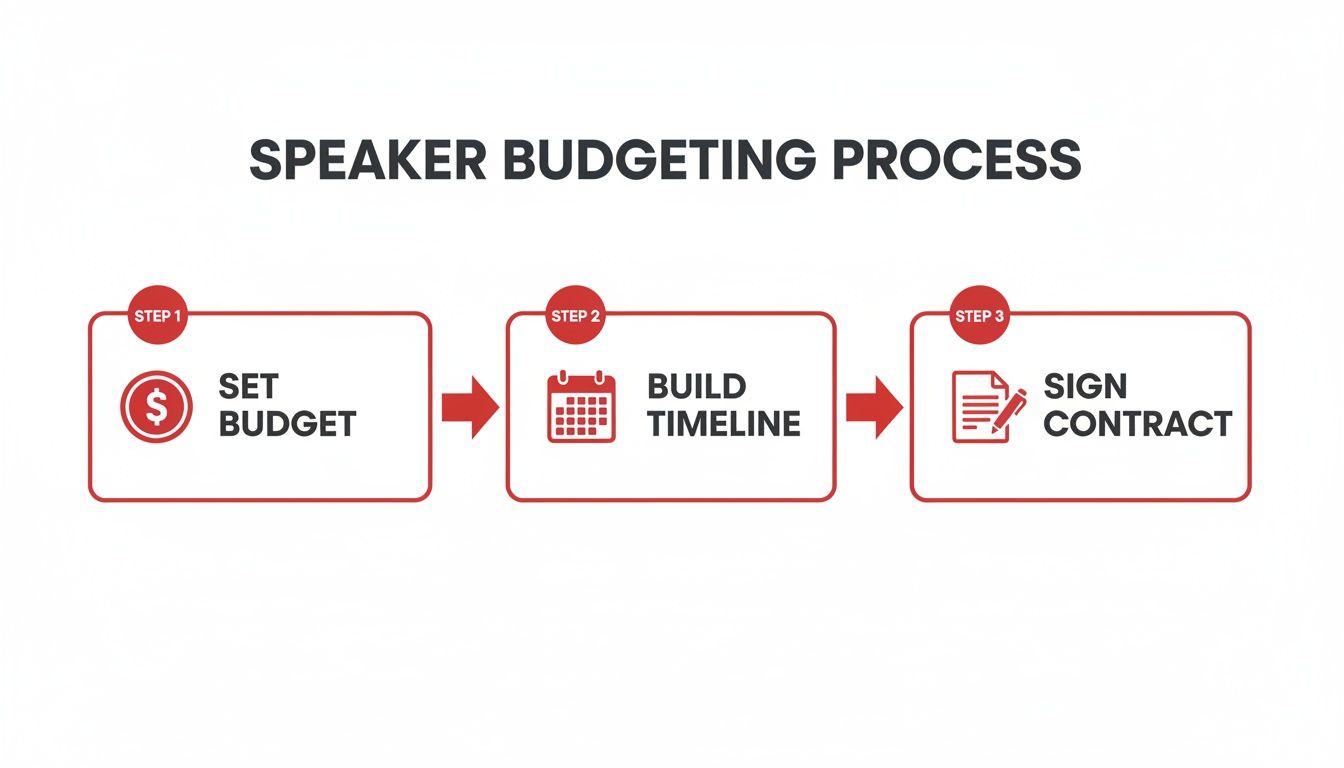
- Set an all-in budget — fee plus travel. Most corporate bookings land between $15,000 and $40,000 all-in.
- Write a one-page brief — audience, goal, event date, format. The brief is what separates strong candidates from generic pitches.
- Vet on unedited footage and a real customization process, not sizzle reels. Ask what they'll change about the talk for your room.
- Book 6 to 12 months out, sign a contract that spells out fee, travel, IP, recording rights, and cancellation.
Everything below expands each step with the specifics that actually matter.
What it costs to hire a keynote speaker in 2026
The first question every event planner asks me is the price. Fair — it's the line item your finance team will circle. Keynote speaker fees in 2026 run from a few thousand dollars to well past six figures, and the number is driven by demand, track record, and how recognizable the name is. Here's the honest map of where speakers land by tier.
| Tier | Typical 2026 fee | Who you get |
|---|---|---|
| Emerging / niche expert | $5,000 – $15,000 | Rising operators, first-time authors, strong regional draws. Often the best value if their story fits your room. |
| Established professional | $15,000 – $40,000 | Proven keynote track record, a book or two, national recognition in a category. The most-booked range for corporate events. |
| Recognized thought leader | $40,000 – $75,000 | Bestselling authors, executives, and category-defining founders your audience already knows by name. |
| Celebrity / marquee | $75,000 – $250,000+ | Household names, world leaders, iconic athletes. The fee buys the headline and the press as much as the talk. |
A higher fee does not promise a better outcome for your event. An emerging speaker whose experience maps exactly to your audience will beat a marquee name giving a recycled talk. And the fee is rarely the whole bill.
What corporate planners actually pay in 2026
The tier table above shows ceilings. The median is lower than most bureaus admit. Talkadot's 2026 State of the Speaking Industry report — built on more than a million verified audience surveys — puts the market-wide median keynote fee at $2,500, with the 75th percentile at $5,000 and the 90th percentile at $10,000. Corporate buyers pay more: the median corporate engagement lands near $4,500, associations near $3,215, nonprofits near $2,450.
That gap between the tier table and the median is worth reading twice. Most planners overpay because they anchor on the marquee-tier headline. If you have a $10K–$25K budget, you're in the most-booked corporate range — you're not settling.
What's actually inside a speaker's fee
When you get a quote, ask what it covers before you compare it to anything. Here's what's usually bundled — and what gets billed on top.
- The keynote fee: the speaker's time plus the custom talk they prepare for your audience.
- Travel: almost always separate unless you negotiate an all-inclusive rate. Expect business-class airfare on longer flights.
- Lodging and ground transport: a hotel for one or two nights, plus airport pickups and rides to the venue.
- Pre-event collaboration: the briefing calls a good speaker does to nail your message. Strong speakers build this in; weak ones skip it.
Always ask for the all-in number — fee plus expenses. That figure is your real budget line. I've watched planners fall for a speaker fee and get blindsided by travel more times than I can count.
A virtual keynote typically runs 10–50% below the in-person fee, which makes it a real lever when your budget is tight. Recent industry data shows 47% of event planners in the US and Canada have under $10,000 to spend on a speaker, and 41% rank staying within budget as their top priority.
Where to look once you know what you need
To skip straight to a roster, our keynote speakers for hire page lists every speaker we represent with their topics and fee ranges. The rest of this section is about narrowing that list down to the one who fits your room.
There are three real paths to finding keynote speakers for hire, and most planners use more than one.
Your own research. Roughly 56% of business leaders who booked AI speakers found them through direct online research. You search by topic, watch footage, and reach out cold. It costs nothing but your time, and the time adds up fast on a short timeline.
Open speaker marketplaces. Large databases let you filter thousands of names by topic and fee. Good for breadth, weak on judgment — nobody on the other end knows whether a speaker will land with your specific room.
A speaker bureau. About 26% of planners book through a bureau, and the reason is judgment, not just a roster. A good bureau knows each speaker's style, their sweet spot, and the rooms where they struggle — and steers you away before you sign. The trade-off is you're working through an intermediary; the upside is you skip dozens of hours of cold vetting.
If you want to search a curated set rather than a 10,000-name catalog, our Speaker Discovery Engine is built to match you with operators and builders. You can also browse the full roster of AI keynote speakers, leadership speakers, and innovation speakers directly.
What separates a keynote speaker for hire from a generalist speaker
Not every professional speaker is the right keynote speaker for hire. The word "keynote" means something specific: a single talk that sets the defining theme of your entire event. It's not breakout content, not a panel spot, not a workshop. The keynote speaker has to carry the weight of the room's attention for 45–75 minutes and leave everyone oriented around one idea they didn't have when they walked in.
A true keynote speaker for hire has three things a generalist often doesn't:
A proprietary framework. Not a list of tips — an original way of thinking about a problem that your audience can use the next day. The best keynote speakers have a named framework or method they developed from real experience, not assembled from other people's research.
Stage presence for a cold room. A corporate audience didn't choose to be there. They're on their phones, skeptical of speaker budgets, and waiting to see if this is worth the next hour. A keynote speaker for hire has learned to read that energy and move through it — that skill takes years and a specific kind of reps that a workshop facilitator or panel moderator doesn't accumulate at the same rate.
A track record of pre-event collaboration. The speakers who get rebooked have a defined process for learning your organization before they write a word. They schedule calls with your leadership, review your company's recent news, and adjust their examples to match your team's actual situation. Ask about this process on your vetting call — the answer tells you almost everything.
Define what you actually need before you shortlist
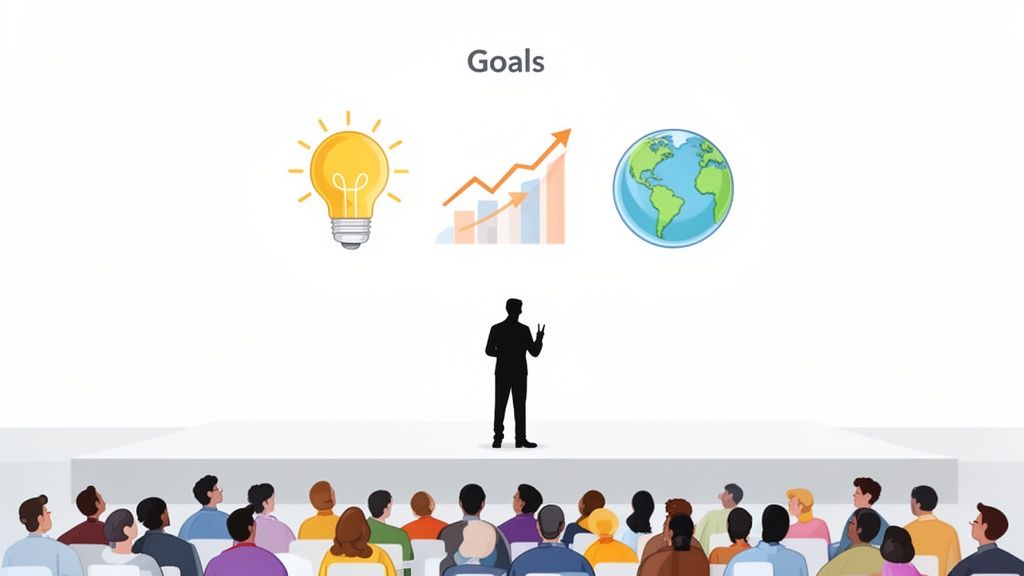
Before you look at a single name, get clear on the goal — and "inspire the team" isn't specific enough. A great keynote is a catalyst for a defined change. The whole process of hiring a speaker who delivers value starts with one question.
What do you want your audience to do differently after the applause fades?
Your job is not to hire a motivational speaker. Your job is to hire a business catalyst — someone who shifts how your team thinks and changes the trajectory of your year.
Pinpoint the change you're after
The more precise the goal, the easier the match. A few examples:
- Firing up a sales team: you want a new collaborative, account-based selling model adopted, not generic energy.
- Equipping leadership: you want execs walking out with frameworks for leading through uncertainty.
- Unifying a workforce: you want a global team rallied around a new mission at your annual kickoff.
- Driving technical adoption: you want an expert who makes AI land so your engineers are eager to use new tools.
If you want to dig into what separates a good speech from a great one, our piece on what makes a keynote successful goes deeper.
Understand the room
Once the goal is set, study the people in the seats. A talk that captivates a C-suite will fall flat with a room of junior engineers. Get specific about their roles, their daily frustrations, their level of expertise, and the emotional tone of the event — celebratory, anxious, exhausted. A strong speaker meets the room where it is and moves it where you need it to go.
Hiring keynote speakers for corporate events
Corporate events carry constraints that public conferences don't, and they change who you hire. The audience is captive — there because their employer told them to be — so the speaker has to earn attention rather than assume it. The message has to connect to live company goals, not float as standalone inspiration. A sales kickoff, a leadership offsite, and a customer conference each want a different keynote speaker even when the topic looks identical on paper.
A few patterns that hold across corporate bookings:
- Sales kickoffs (SKOs) want a speaker who opens with energy and ties their story to execution under pressure — someone who shipped through uncertainty, not a theorist.
- Leadership summits and offsites want depth and a frame that survives the Q&A from senior people who have heard every cliché.
- Customer and user conferences want a name with enough pull to drive registrations, paired with substance your customers will quote later.
- Annual all-hands and town halls want a speaker who can unify a mixed-seniority room around one idea.
For a builder audience, a founder who took an impossible product to scale tends to outperform a pure motivational act. After a keynote on the future of AI from Adam Cheyer, the co-creator of Siri, you can follow with a moderated fireside chat where your leaders pressure-test his frameworks against your own product roadmap. An Olympic medalist and leadership voice like Shannon Rowbury can follow a keynote on resilience with a hands-on session for your managers.
Types of keynote speakers to consider
Most planners narrow the search by category before they narrow it by name. The buckets that come up in almost every brief:
- Technology and AI speakers — founders, researchers, and operators who make hard technical shifts land for a non-technical room. Best fit for customer conferences, engineering all-hands, and any event where the CEO wants the org to actually adopt AI tools rather than talk about them.
- Business and leadership speakers — executives, founders, and authors with frameworks for scaling, culture, or leading through change. Best fit for leadership summits and SKOs.
- Innovation and future-of-work speakers — practitioners who lived a real transformation and can teach the pattern. Best fit for strategy offsites and industry conferences.
- Motivational and resilience speakers — athletes, veterans, and people who came back from something hard. Best fit for annual kickoffs and celebration events. The good ones tie the story to a concrete business behavior; the weak ones stop at inspiration.
- Industry-specific speakers — deep experts in healthcare, biotech, fintech, or your vertical. Best fit for customer conferences where credibility with your buyers matters as much as stage skill.
Find and vet the right speaker
You know the goal, the room, and the budget. Now comes the part that separates a memorable booking from a regret: vetting. Start with a tight speaker brief — your audience, your goals, your theme on one page. A sharp brief attracts speakers who are already fired up about your vision instead of treating it as another gig.
Look for a practitioner, not a performer
The circuit is full of polished orators with great timing and a slick deck. A round of applause is not a business result. You want a practitioner — someone who lived the lessons they're sharing. Did they build a company from scratch? Lead a team through a make-or-break crisis? Invent something that changed an industry? That hard-won experience gives a talk an authenticity no amount of theory can fake, and an audience can tell the difference inside five minutes.
Go past the sizzle reel
Sizzle reels are marketing — cut to the best punchlines and the loudest ovations. They tell you a speaker's energy and almost nothing about their substance.
A standing ovation is wonderful, but it is not a business outcome. Always ask to see unedited, long-form footage of a full keynote to a live audience. That's the only way to know whether they can hold a room for 60 minutes without an editor's help.
The vetting-call questions that work
Once you have a shortlist, the vetting call is your moment of truth. These are the questions I ask every time:
- "What's your process for customizing a talk for our audience and theme?" A strong speaker lights up here and walks you through their research. A canned answer is a red flag.
- "Given our goals, what core message would land hardest with our team?" This tests whether they can connect their expertise to your outcome.
- "Tell me about a time you had to adapt a talk on the fly." Things go sideways at events; you need someone who won't be rattled.
- "How do you like to partner with us before the event?" Listen for "briefing calls" and "collaboration." You want a partner, not a drop-in act.
Red flags that should end the conversation
A few things that mean the speaker is wrong for you, no matter how impressive the reel:
- They won't customize the talk. If they push a fixed keynote, you're renting a recording.
- They dodge the reference check or only offer testimonials from event planners, not audience members or company leaders.
- All their footage is short, edited, or from paid marketing panels. No full-length keynote video means no real evidence.
- They quote a fee before hearing your goals. A pro asks questions first.
- They talk more about their bestseller list than your audience.
Negotiate contracts and run the logistics
You found the right speaker. A verbal yes isn't enough — get it in writing. A clear contract protects both sides and turns the conversation into a commitment.
Read the speaker agreement carefully
A professional contract shouldn't be a mystery. Here's what to check every time:
- The fee: the total keynote fee, stated plainly.
- Payment schedule: a 50% deposit to hold the date is standard, with the balance due on or before the event.
- Travel and lodging: who books and pays for flights, ground transport, and the hotel — usually the client.
- Intellectual property: the speaker almost always keeps the rights to their material.
- Recording rights: spell out exactly how you may use footage — internal only, or public marketing.
- Cancellation: the financial terms if either side cancels or postpones. Know these before you sign.
If you want the deeper version of this, our event-pro tools hub includes a contract auditor built for exactly this read-through.
The logistics checkpoints that matter
Assign one point of contact for the speaker so nothing gets lost in a thread. Then get three things right. Travel: book early, send the itinerary for approval, arrange a car for pickups, and share an on-site schedule with soundcheck, meals, and downtime. A/V: ask about mic preference and laptop early, collect slides a week out so your team can test them, and run a mandatory tech check before the audience arrives. The pre-event briefing call: a week or two out, deliver your story-first brief and let the speaker ask questions. That final alignment is what turns a good keynote into one people quote for months. You can build your full prep schedule with our event planning timeline generator.
When to start: the hiring timeline
The best speakers are booked 6 to 12 months out. Rush it and your options shrink and your leverage disappears. Here's a timeline you can adjust to your event's size.
| Milestone | Before the event | Key actions |
|---|---|---|
| Research & outreach | 8–12 months | Define goals, set budget, build a longlist, start inquiries. |
| Vetting & shortlisting | 6–8 months | Review materials, run vetting calls with your top 3–5, check references. |
| Negotiation & contract | 4–6 months | Pick your speaker, negotiate terms, sign. |
| Collaboration & promo | 2–4 months | Hold briefing calls, start promoting the speaker to build excitement. |
| Final logistics | 1–2 months | Confirm travel, A/V, and on-site logistics. Send the final story-first brief. |
For a smaller internal meeting or regional event, a 3 to 6-month window can work. Earlier is always the smarter play.
Make the most of the speaker
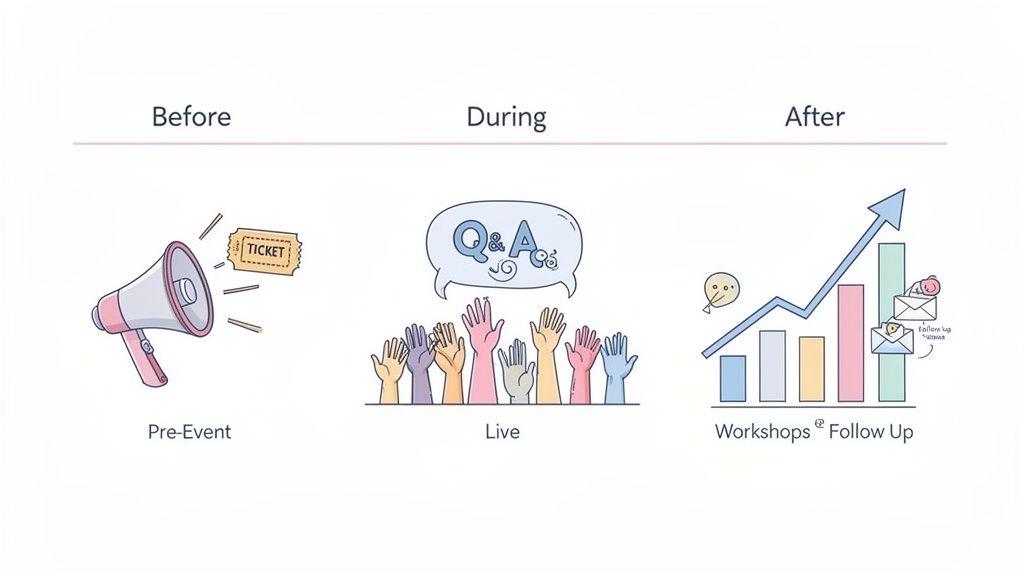
Hiring a keynote speaker is a real investment, and the value isn't capped at the 60 minutes on stage. Treat the booking as an arc that starts weeks before the event and pays off long after the room clears.
Build buzz before they arrive
Your speaker is a marketing asset. Start the announcement four to six weeks out with quote graphics and short video teasers, always tagging the speaker so they reshare to their own network. Send a dedicated email with their headshot and a line on why their message matters right now, and use internal channels like Slack to frame the talk against current company goals.
Deepen the connection during the event
On the day, shift from promotion to participation. A great keynote feels like a conversation, so build in interaction — live polling to read the room, a book signing if they're an author, or an exclusive meet-and-greet for top clients and key stakeholders. Those high-touch moments are what attendees remember.
Turn inspiration into action afterward
The real measure of success is what happens back at the office on Monday. Research on keynote results shows 88% of attendees report a more positive state of mind, 84% report greater inspiration, and 78% report heightened determination after a strong keynote. Capitalize on that with an add-on fireside chat or executive Q&A, and always send a post-event survey asking the two questions that matter: "What was your single biggest takeaway?" and "What one action will you take?"
Measure the ROI
Your leadership will want proof the spend was worth it. Blend the soft and the hard numbers and tie both back to your original goal.
On the qualitative side, post-event surveys are your best signal. Skip "did you like the speaker?" and ask about message resonance on a 1–10 scale, inspiration to act, and the single most important takeaway. When specific phrases from the talk start showing up in the answers, you have proof the message stuck.
On the quantitative side, decide the metric before the event, based on the action you want. A few that work:
- Tool and process adoption: the percentage of employees who log into the new platform or finish the training the speaker introduced. A 25% lift is an undeniable win.
- Sales performance: for an SKO, track outbound calls, new deals opened, or sales-cycle length in the quarter after.
- Internal engagement: open rates on follow-up emails, views of the keynote recording, sign-ups for a related workshop.
Pair the survey feedback with the hard data and you've built a strong case for the booking — and the credibility to make a stronger one next time.
Why hire through Silicon Valley Speakers
We're a boutique bureau, not a 10,000-name catalog. Every speaker on our roster is someone we've watched on stage, briefed for a client, or worked with directly. When you send us a brief, you get a curated shortlist of three to five speakers whose stories match your outcome — not a search filter.
What that means in practice:
- Every recommendation is a speaker we can call by first name and vouch for personally.
- We handle the contracting, the travel booking, and the pre-event brief so your team stays focused on the event.
- Our fee is a bureau commission on the speaker's rate — same all-in cost as booking direct, without the vetting hours.
- If the first shortlist misses, we course-correct in the same day. Boutique means we actually pick up the phone.
Frequently asked questions about hiring a keynote speaker
How much does it cost to hire a keynote speaker?
In 2026, keynote speaker fees run roughly $5,000–$15,000 for emerging and niche experts, $15,000–$40,000 for established professionals (the most-booked corporate range), $40,000–$75,000 for recognized thought leaders, and $75,000–$250,000+ for celebrity and marquee names. Those are the bands Silicon Valley Speakers quotes against across roughly 40 placements a year. The fee is driven by demand, track record, and recognition. Budget the all-in number — fee plus travel, lodging, and ground transport — not just the headline figure, and expect a virtual keynote to run 10–50% below the in-person fee.
Where can I find keynote speakers for hire?
Start with the Silicon Valley Speakers keynote speakers for hire roster, which lists topics and fee ranges for every speaker we represent. Beyond that, three paths: your own online research (about 56% of leaders find AI speakers this way), open speaker marketplaces that filter thousands of names by topic and fee, or a speaker bureau (about 26% of planners) that adds judgment and handles vetting, contracting, and logistics. Most planners combine direct research with a bureau for the shortlist. You can search a curated set on our Speaker Discovery Engine.
How far in advance should I book a keynote speaker?
For a major annual conference or high-stakes event, book 6 to 12 months in advance. The best speakers fill their calendars more than a year out, and the runway also gives you time to vet, negotiate, and weave the speaker into your marketing. A smaller internal or regional event can sometimes work on a 3 to 6-month window, but earlier is always safer. The 6-to-12-month runway is what Silicon Valley Speakers plans against for annual conferences.
What's the difference between a speaker bureau and booking direct?
Booking direct means you do the scouting and negotiating yourself, usually at the same fee, and many speakers can only be booked through a bureau or their own management. A bureau acts as a strategic partner: it manages contracting, negotiation, and logistics, and its real value is a curated roster plus knowing each speaker's style and sweet spot. At Silicon Valley Speakers we work with a select group of builders like Adam Cheyer and Shannon Rowbury, so we can tell you in advance how their stories will land with your specific room.
How do I hire a keynote speaker for a corporate event?
Start with the business outcome you want, then match the speaker to the format. An SKO wants energy tied to execution; a leadership summit wants depth that survives senior Q&A; a customer conference wants enough name pull to drive registrations plus real substance. Write a one-page brief, vet on unedited footage and a real customization process, lock an all-in budget, and sign a contract that covers fee, travel, IP, recording rights, and cancellation. Browse speakers by event-fit topic — AI, leadership, or innovation — to start your shortlist.
Can I ask a speaker to customize their presentation?
You should expect it from any professional. A one-size-fits-all speech is a red flag — a sign the speaker isn't invested in your event. A strong speaker will insist on customizing to your theme, audience, and goals, and will schedule briefing calls with your leadership to learn your world before they write a word.
How do I hire a virtual keynote speaker?
Same process as an in-person booking, with three tweaks. Confirm the speaker's home studio setup — good camera, wired mic, lit backdrop — before you sign. Build in a mandatory tech check the day before with your platform (Zoom, Hopin, on24, whatever you're running). And expect the fee to land 10–50% below the in-person rate, since travel and stage time drop out.
Related: What is a keynote, Conference keynote speakers, Plan a corporate event
Ready to hire a keynote speaker who delivers a real result for your next event? Send us your brief — audience, goal, date — and we'll come back with a curated shortlist of three to five speakers whose stories match your outcome. Start at svsb.ai/book-a-speaker or browse our full speaker roster.