
You're planning a leadership keynote, a manager workshop, or an annual meeting session. The brief says the same thing every time. People want a leader who feels real. Not polished to the point of fiction. Not so guarded that nobody knows what they stand for.
But that raises the practical question. What is authentic leadership, exactly?
For many teams, this gets muddy fast. One executive thinks it means being candid. Another thinks it means showing vulnerability. A third hears “authentic” and assumes it's just a softer word for charisma. None of those definitions are complete enough to guide hiring, development, or event programming.
That's why this topic matters. If you're an event planner, HR leader, or business executive, you don't need another vague leadership slogan. You need a model you can recognize in real behavior, build into workshops, and translate into better team performance. Authentic leadership is useful because it gives you a way to evaluate whether a leader's words, decisions, and conduct line up under pressure.
A busy events team sees this up close. When plans shift, budgets tighten, speakers cancel, or stakeholders disagree, people don't trust the loudest person in the room. They trust the person whose judgment feels steady, whose message doesn't change by audience, and who can explain hard calls without hiding behind spin. That's the practical heart of authentic leadership.
Beyond the Buzzword What Authentic Leadership Really Means
A familiar scene plays out in many organizations. A product launch is slipping, deadlines are tight, and the team can tell leadership is holding something back. The manager delivers polished updates, but they are so generic that people start writing their own story about what is really happening. Trust weakens before results do.
Now compare that with a leader who says, “Here's what we know, here's what we don't know, here's what I'm weighing, and here's the principle guiding my decision.” That response does not dump every private detail on the team. It gives people a clear frame for understanding what is happening and why.
That is the starting point. Authentic leadership is not a performance style or a personality type. It is the practice of keeping values, decisions, and behavior in sync, especially when pressure rises.
For a busy event planner, the easiest analogy is brand consistency. A conference promises one experience in the invitation, a different one on stage, and a third in the breakout rooms. Attendees notice the mismatch immediately. Leadership works the same way. When a leader's message, methods, and motives line up, people experience coherence. When they do not, people feel friction, even if they cannot name it on the spot.
Practical rule: If people can predict your principles, they are more likely to trust your decisions.
That predictability has real organizational value. It helps teams interpret hard calls faster, reduces second-guessing, and gives employees a steadier basis for action. It also makes authentic leadership more than a personal virtue. It becomes a strategic asset you can identify, develop, and feature in executive keynotes, manager training, and leadership workshops.
What people often get wrong
The term gets fuzzy when people reduce it to surface behavior. One leader is labeled authentic because she is outspoken. Another gets the label because he is informal and dislikes corporate language. Those signals can feel genuine, but they do not tell you whether the person leads from a clear set of values.
A blunt leader can still be inconsistent. A warm leader can still avoid accountability. A vulnerable speaker can still dodge difficult facts when stakes are high.
A better test is more demanding. Does this leader understand what they stand for? Do they examine their blind spots instead of defending them? Do they weigh other perspectives before deciding? Do their actions match the principles they claim to hold?
Those questions are far more useful than asking whether someone “feels real” in the room.
Why organizations pay attention to it
Modern teams work across functions, time zones, and shifting levels of uncertainty. Under those conditions, employees rarely have perfect information. They read cues instead, watching for consistency, fairness, and whether leaders explain decisions truthfully when the answer is unpopular.
That is why authentic leadership belongs in business strategy, not just culture language. It shapes how people respond to change, how much trust a team can preserve under stress, and whether leadership development efforts produce speakers and managers who can hold a room without sounding scripted.
For organizations that invest in events, this point is especially practical. A keynote on authentic leadership should not stop at inspiration. It should help the audience recognize the behaviors behind the term, see how those behaviors affect team performance, and leave with a standard they can use in hiring, coaching, and internal communication.
The Four Pillars of Authentic Leadership
Academic research tends to define authentic leadership through four core dimensions: self-awareness, relational transparency, balanced processing, and an internalized moral perspective. In a study covering employees across 15 departments in a South Carolina manufacturing facility, researchers found that authentic leadership was a significant predictor of employee retention, and the study emphasized that no single dimension alone explained retention, which suggests the model works as a broader system rather than one standout trait, as reported in the Journal of Business Administration Online study on authentic leadership and retention.
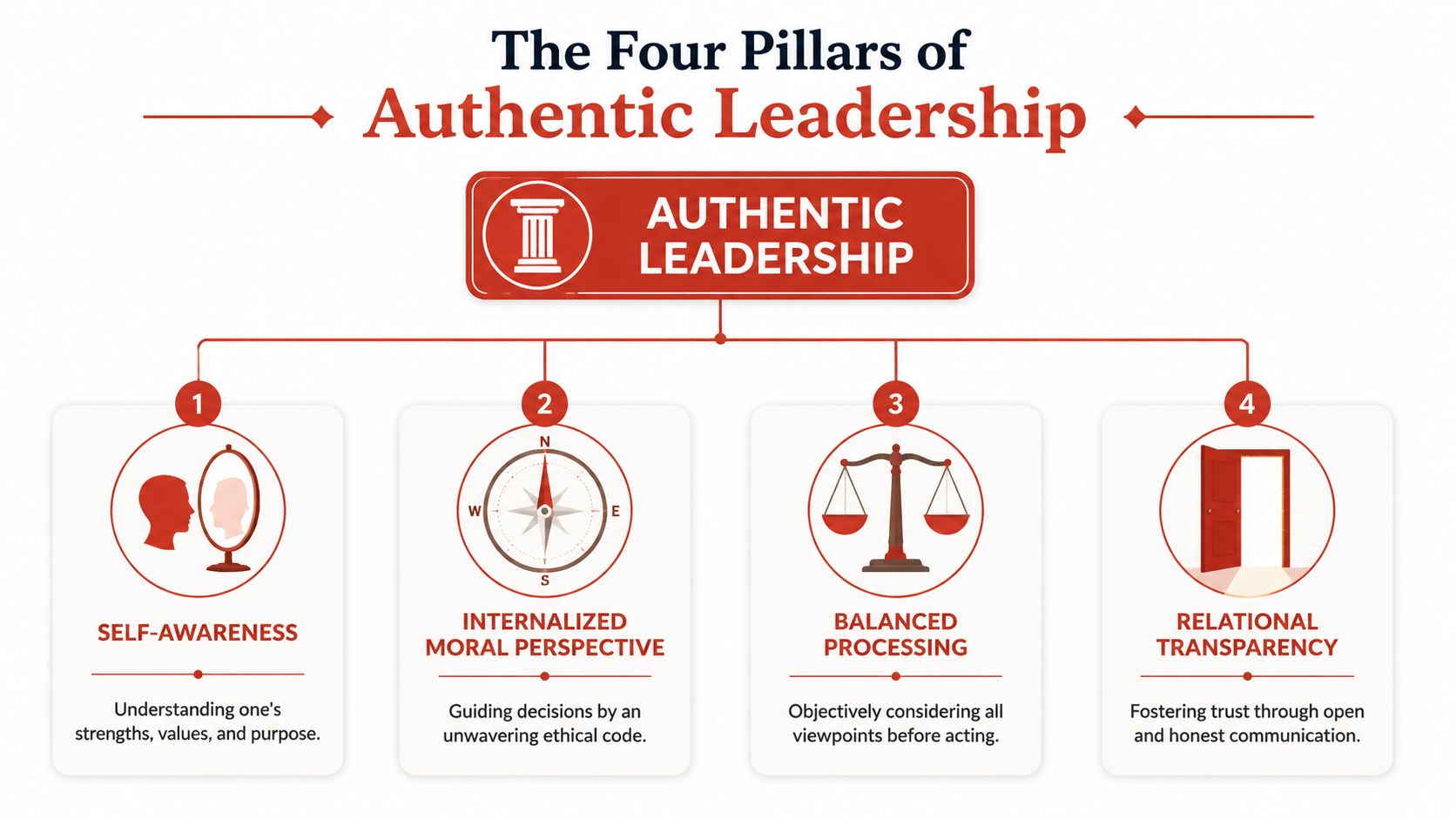
Think of these pillars like the operating system behind a strong event. You need a clear objective, honest communication, good inputs, and reliable decision criteria. If one breaks, the whole experience suffers.
Self-awareness
Self-awareness is the leader's internal compass. It means knowing your strengths, your limits, your triggers, your values, and the effect you have on other people.
A simple event analogy helps: a skilled moderator knows when they're adding energy and when they're taking up too much room. They can read themselves while reading the room. Leaders need the same capacity.
Without self-awareness, even good intentions go sideways. A manager may think they're being decisive when the team experiences them as dismissive. Or they may think they're being calm when others read them as detached.
Relational transparency
Relational transparency is honest, appropriate openness. It doesn't mean saying everything. It means people don't have to guess where you stand or decode a hidden agenda.
Here's a concrete example. A department head tells the team, “I'm choosing option B. Not because it's easier, but because it protects client trust. I know it creates extra work, and I want to hear where that plays out badly operationally.” That's transparent and bounded. It gives context without turning leadership into group therapy.
Teams don't need a leader to narrate every emotion. They need a leader whose communication matches reality.
Balanced processing
Balanced processing is the most overlooked pillar. It means the leader actively considers multiple viewpoints before making a decision, including views they may not like.
In event terms, this is the difference between locking a program based on executive preference alone and pressure-testing it with sales, customer success, production, and audience feedback first. You don't have to make a democratic decision every time. You do have to consider the evidence fairly.
Internalized moral perspective
This pillar is about principle. A leader with an internalized moral perspective doesn't improvise their ethics based on convenience, optics, or hierarchy. They use an internal standard.
Think of it as the event planner's absolute essentials. You may adjust the agenda, venue flow, or budget allocation, but you don't compromise attendee safety, factual accuracy, or basic fairness. Leaders need the same sort of true north.
Why the pillars work together
A useful way to remember the model is this:
| Pillar | Simple analogy | Leadership question |
|---|---|---|
| Self-awareness | Compass | Do I know myself accurately? |
| Relational transparency | Clear glass | Do people know where I stand? |
| Balanced processing | Mixing board | Have I listened to the full signal? |
| Internalized moral perspective | Rulebook | Am I acting from principle? |
A leader who has transparency without self-awareness may be open but chaotic. A leader with principles but no balanced processing may be rigid. The power comes from the combination.
The Measurable Benefits for Your Organization
Leadership language often gets fluffy at the exact moment an executive team wants evidence. Authentic leadership is one of those areas where the conversation doesn't need to stay abstract.
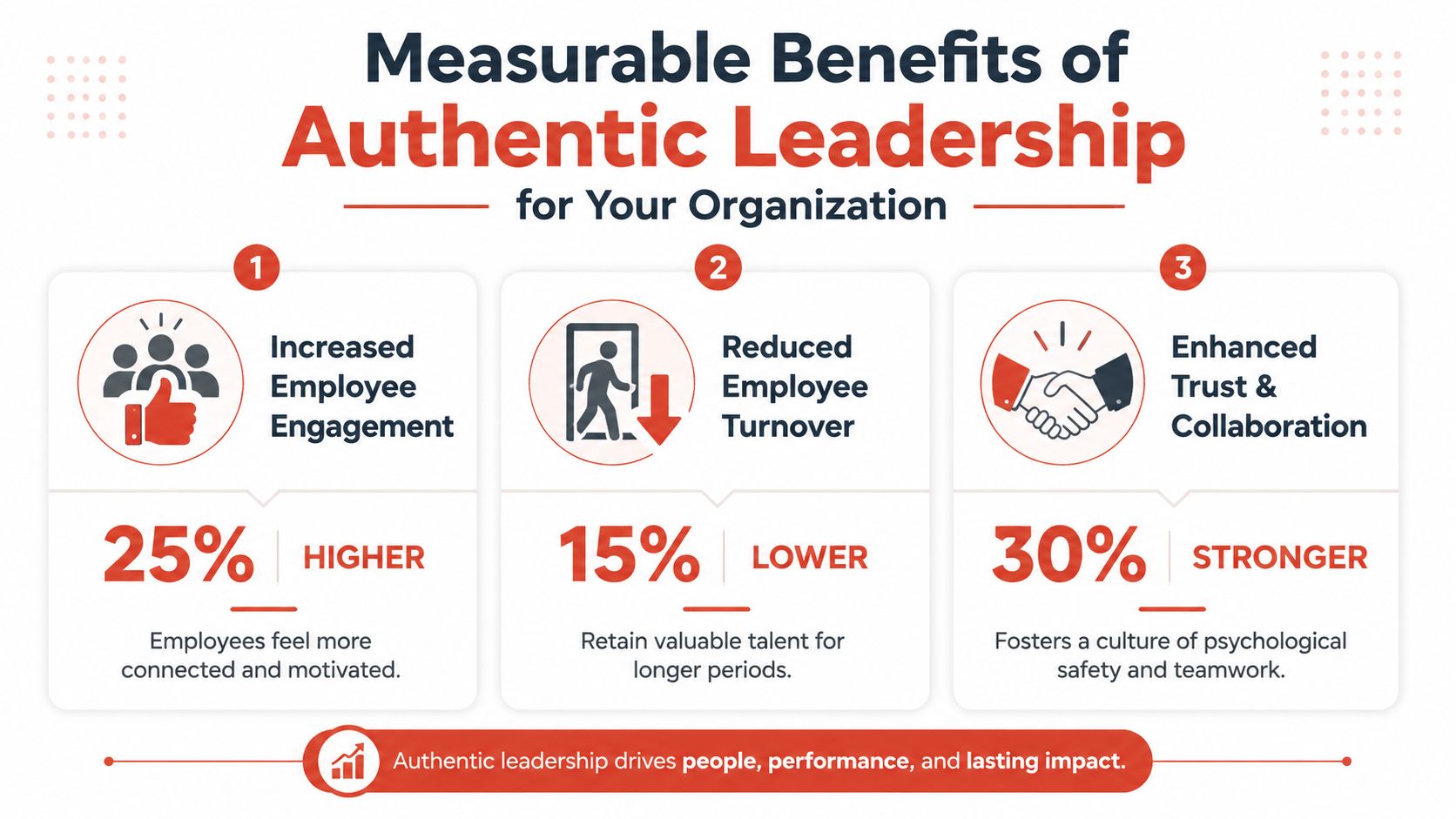
A 2024 peer-reviewed study found that follower-level authentic leadership was associated with higher average work engagement (B = .30, 95% CI [.08, .51]) and lower emotional irritation (B = −.21, 95% CI [−.38, −.04]), while team-level authentic leadership showed an even stronger link to team work engagement (B = .48, 95% CI [.18, .77]). The same source also noted that a workplace survey found 93% of respondents said being authentic at work is important, and 52% said it is extremely important, according to this 2024 research on authentic leadership, engagement, and emotional irritation.
What those findings mean in plain English
You don't need to be a researcher to use this. The practical reading is straightforward.
- Higher engagement: People are more likely to bring energy and attention to the work when leadership feels credible.
- Less emotional strain: Teams experience less irritation when leaders communicate and decide in ways that feel consistent and trustworthy.
- Stronger team effect: The pattern isn't only individual. It shows up at the team level too.
That matters for any organization running cross-functional work, customer-facing programs, or high-stakes internal initiatives. It also matters for conference programming. Leadership themes that resonate most with audiences usually connect personal behavior to business outcomes. Authentic leadership does that cleanly.
Here's another practical lens. If your company is working on culture and engagement, it helps to pair leadership content with execution habits. For planners or HR teams building a broader people strategy, insights from Excel Wellbeing Solutions offer a useful companion resource because they focus on the day-to-day practices that make engagement efforts feel real instead of symbolic.
This short video adds useful context on how the idea shows up in practice.
Why organizations care
A good leadership topic earns agenda space when it helps with a real problem. Authentic leadership can support several.
| Organizational need | Why authentic leadership helps |
|---|---|
| Keeping people engaged | Leaders communicate with more consistency and credibility |
| Reducing team friction | Decisions feel less arbitrary and less politically driven |
| Improving manager quality | The model gives observable behaviors, not vague ideals |
| Designing better events | The topic works in keynotes, workshops, and leadership offsites |
If your audience is tired of generic inspiration, choose topics that connect behavior to measurable workforce outcomes.
Beyond Just Be Yourself A Critical Distinction
The most misleading version of this concept sounds harmless. “Just be yourself.”
That advice works fine for choosing a speaking style. It fails badly as a leadership standard.
Recent academic synthesis makes this distinction sharper. Authentic leadership includes self-awareness, transparency, and balanced processing, shared decision making, and moral or ethical courage. That matters because merely being “true to yourself” can become an excuse for unchecked impulses, as outlined in this academic synthesis on authentic leadership and its overlooked dimensions.
Authentic doesn't mean unfiltered
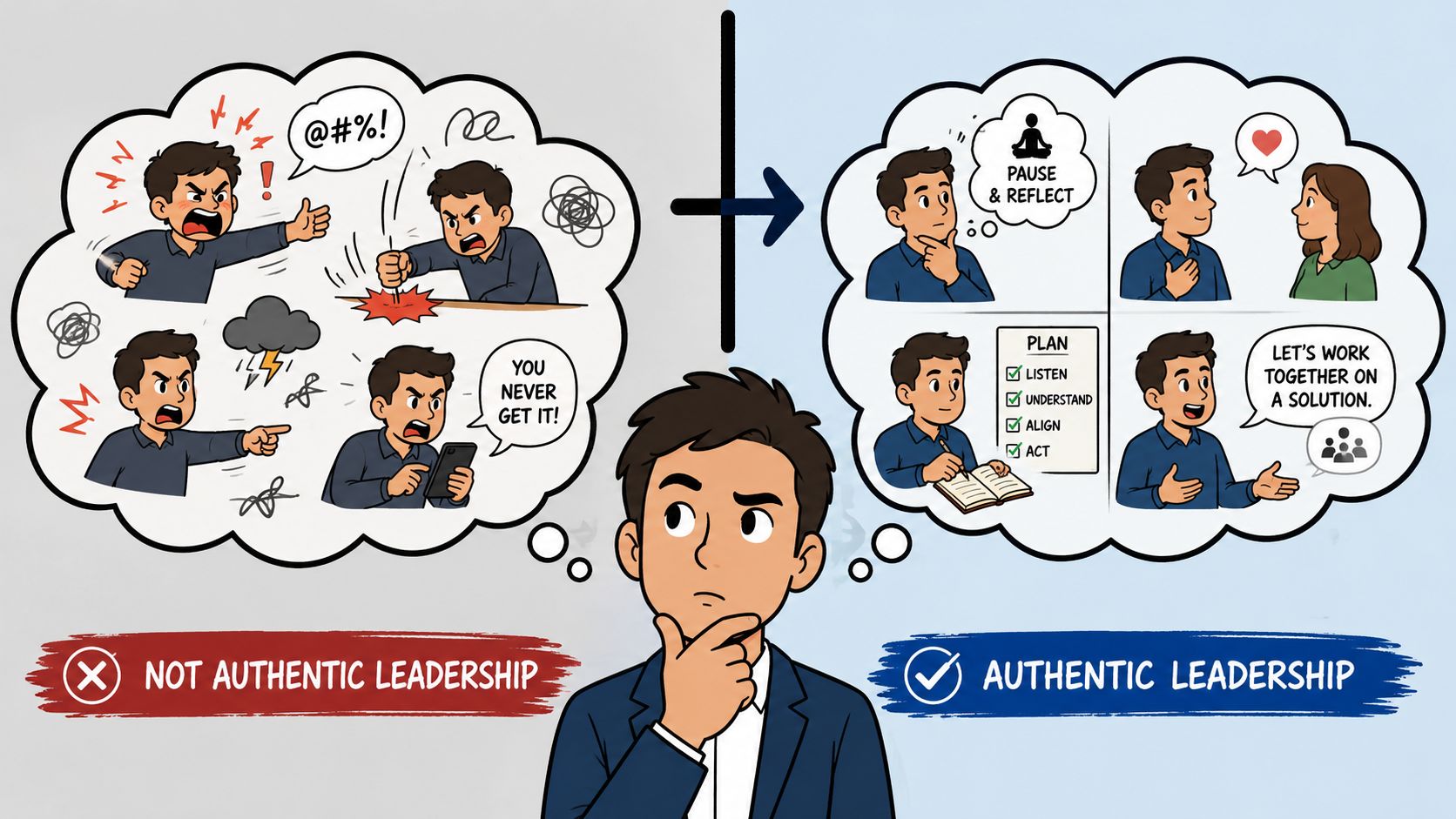
Some leaders confuse honesty with immediacy. They say the first thing they think, call it candor, and expect applause for being real. But unprocessed emotion isn't leadership. It's leakage.
A useful test is this. After a difficult conversation, does the other person feel clear and respected, even if they didn't get what they wanted? If yes, you may be seeing authentic leadership. If they feel blindsided, diminished, or used as a target for someone else's frustration, that's not authenticity. That's poor self-management.
The difference between expression and discipline
This distinction is especially important for technical leaders, founders, and executives under pressure. Those roles reward strong opinions. But strong opinions become more valuable when paired with fair-minded review.
Here's a simple comparison:
- Unchecked self-expression: “I'm just being honest. This idea is bad.”
- Authentic leadership: “I don't support this direction, and here's why. I may be missing something, so I want the strongest case for it before we decide.”
The second version doesn't hide the leader's view. It shows discipline around it.
Authentic leaders don't remove the filter. They improve the filter.
That's one reason authentic leadership is easy to confuse with nearby concepts. If you're comparing styles, this overview of transformational leadership is useful because it highlights how inspiration and change leadership differ from the deeper question of value-behavior alignment.
Where this shows up at events
You can hear the difference in keynotes immediately. Weak talks on authenticity drift into self-expression stories with no decision framework. Strong talks show how a leader handled competing priorities, took in hard feedback, made a principled call, and communicated it clearly.
That's the version audiences can use on Monday morning.
How to Develop Authentic Leaders in Your Team
A planning meeting goes sideways. The deadline is close, one department wants speed, another wants accuracy, and the team lead gives a polished answer that sounds reasonable but avoids the essential tradeoff. Everyone leaves with action items, few leave with confidence.
That is the development problem.
Authentic leaders give teams something sturdier than confidence theater. They make it easier for people to understand what matters, how decisions get made, and what standard will hold when pressure rises. For organizations, that is not a personality bonus. It is an operating advantage that improves trust inside the team and makes leadership more credible when you feature it in keynotes, manager workshops, and internal events.
Start with reflection that produces usable answers
Reflection helps only when it produces patterns a leader can act on. A journal full of vague insights will not change how someone runs a difficult meeting.
Use prompts that force clear answers:
- Values under pressure: What principle do I claim to hold, and where do I drop it when speed, politics, or convenience enter the picture?
- Impact blind spot: How do I believe I come across in meetings, and how do other people experience me?
- Decision pattern: When I make a fast call, which input do I tend to ignore?
This works like reviewing event footage after a live show. In the moment, the production can feel smooth. On replay, you notice the missed cue, the unclear handoff, the moment the audience energy dipped. Leaders need that same kind of replay if they want to close the distance between intention and impact.
Build feedback into the operating rhythm
Many managers are sincere. Sincerity is not the same as accuracy.
What they need are reliable mirrors. The easiest way to build them is to attach feedback to real work, not abstract personality discussions.
- After-action reviews: Ask, “What did I miss? Where was I unclear? What assumption shaped my call?”
- Small-circle feedback: Create a short list of peers or direct reports who can challenge the leader's self-story without political fallout.
- Recurring check-ins: Use brief feedback moments after presentations, hiring calls, budget decisions, or team conflicts.
For teams building leadership capability through retreats or internal learning sessions, resources on event planning leadership can help turn these practices into workshop formats people can use.
Practice decisions before the high-stakes moment
Pressure does not create character on the spot. It reveals the habits already there.
That is why scenario work is so effective. It lets leaders rehearse judgment before the actual cost arrives. A short exercise in a staff meeting can do more than a polished lecture because it forces people to choose between competing goods, not just agree with leadership principles in theory.
| Scenario | Authentic leadership question |
|---|---|
| A top performer acts badly | Which value matters more than short-term output? |
| A launch date is at risk | How transparent should we be, and with whom? |
| Two stakeholders want different outcomes | Have I weighed both perspectives fairly before deciding? |
This is also where the organizational angle becomes practical. If you want authentic leadership to show up on stage at your annual meeting, it has to be rehearsed off stage first. The strongest keynote speakers and workshop leaders are often the managers who have already practiced explaining hard calls with clarity and restraint.
Teach transparency with boundaries
Relational transparency does not mean saying everything. It means saying enough that people can follow the logic of the decision and trust the intent behind it.
A useful rule is simple. Leaders should explain four things:
- What they decided
- Why they decided it
- What tradeoffs they considered
- What remains uncertain
That structure is especially helpful for busy managers because it gives them a repeatable script. It is also helpful for event planners shaping leadership sessions. Audiences do not need a speaker to overshare. They need a speaker who can walk them through a real decision in a way that is candid, disciplined, and useful.
If you are building a formal learning path, these leadership development program examples can help you turn those habits into repeatable sessions.
Bringing Authentic Leadership to Your Next Event
A lot of leadership content sounds good in a brochure and disappears by lunch. Authentic leadership tends to land better because audiences can test it against their own daily experience. They know what it feels like to work for someone consistent. They also know what it feels like to work for someone performative.
That makes authentic leadership a strong event theme when the goal is more than motivation. It works best when you want attendees to leave with a sharper lens for trust, decision-making, and team culture.
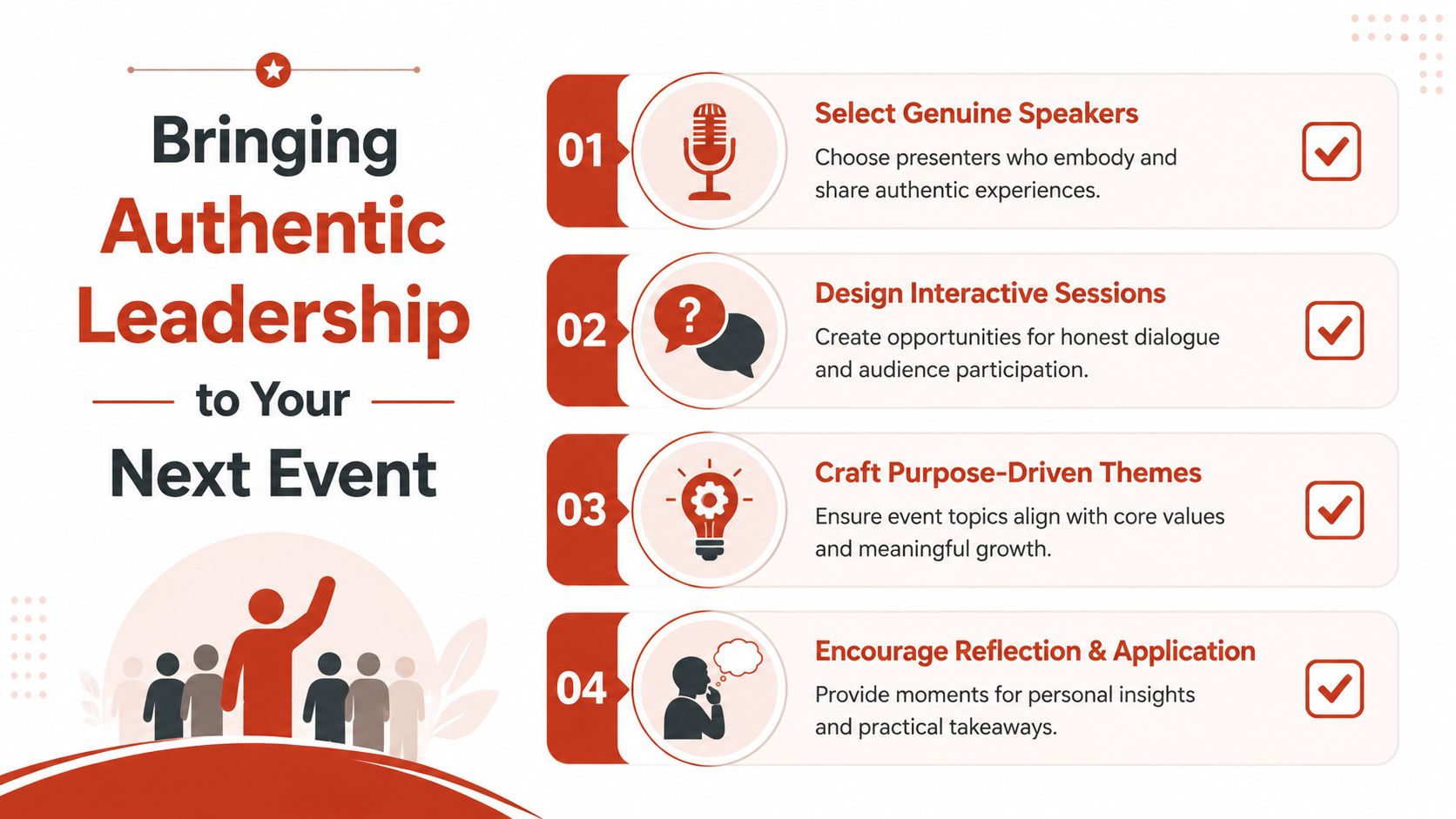
Choose speakers with earned credibility
The strongest speakers on this topic usually aren't just polished communicators. They've led through setbacks, tradeoffs, scrutiny, or reinvention. Their stories have friction in them.
Look for speakers who can answer questions like these:
- What did you believe, and how was that tested?
- What hard decision cost you something in the short term?
- How did you handle feedback that challenged your self-image?
An Olympic athlete, for example, can speak powerfully about self-awareness, resilience, and values under pressure because the stakes are visible and the feedback is immediate. Founders, inventors, and builders can do the same when they talk candidly about failed bets, ethical choices, and leadership lessons learned in real operating environments.
Design sessions that invite participation
A keynote can open the conversation, but the concept gets traction when people work with it.
Consider formats like:
- Leader reflection labs: Small groups discuss a difficult call they made and which pillar was weakest.
- Decision case workshops: Teams examine a scenario and identify the tension between transparency, fairness, and speed.
- Manager roundtables: Leaders compare where they think they're authentic versus where they may merely be habitual.
A strong event doesn't just describe authentic leadership. It lets the audience practice recognizing it.
Build the theme into the full event experience
If the event message is authenticity but the actual program feels stage-managed and evasive, the idea collapses. Alignment matters here too.
That means matching theme and format:
- Give room for audience questions.
- Use moderators who can probe, not just praise.
- Ask speakers for stories with tension, not just success highlights.
- Include reflection time so people can convert ideas into action.
If you're shaping a broader meeting strategy, this guide on how to plan a corporate event is a helpful planning companion because it connects content choices to audience outcomes.
Conclusion Leading with Real and Lasting Impact
Authentic leadership isn't a branding exercise. It's the ongoing practice of making your behavior match your values, especially when the situation gets messy. That's why the idea keeps showing up in serious leadership conversations. It gives people a way to judge trustworthiness in action, not just admire it in theory.
The model becomes more useful when you stop treating it like a personality trait. The four pillars show that authentic leadership involves self-knowledge, honest communication, fair consideration of different views, and decisions grounded in principle. Those aren't soft extras. They shape whether teams believe a leader, follow a leader, and stay with a leader.
For organizations, the value is practical. You can develop it, observe it, and design training around it. You can also bring it to life in events that move beyond generic inspiration and help people think more clearly about how leadership works.
For event planners, that's the opportunity. An authentic leadership keynote or workshop isn't just a feel-good agenda item. Done well, it becomes a tool for better conversations across the organization. It helps managers lead with more credibility, gives teams a stronger language for trust, and turns leadership development into something people can recognize in real decisions.
The most effective leaders aren't perfect, and they aren't performing perfection. They're readable, principled, and consistent enough that people know where they stand. In a workplace full of noise, that kind of leadership has lasting value.
If you're planning a keynote, offsite, or leadership workshop and want speakers who can talk about authenticity through real-world building, invention, resilience, and performance, Silicon Valley Speakers offers a curated roster of leaders who've done the work, not just talked about it.