You booked the venue. The agenda is tight. The speakers are strong. Sales wants meetings. Leadership wants buzz. Then the event happens, people clap, a few posts go live, and by the next week you're being asked the uncomfortable question: what did PR do?
That's where most event teams get stuck. They treat public relations for events like a launch task instead of a business function. Someone drafts a press release, someone emails a media list, someone posts a few speaker graphics, and everyone hopes attention follows.
Hope isn't a strategy. Good event PR creates a narrative before the event, helps the right people show up, shapes what outsiders believe while the event is happening, and gives you proof afterward that the event moved something important.
Why Your Event Needs More Than Just Publicity
A lot of events are well produced and poorly amplified. The room looks great, the keynote lands, customers have useful conversations, but almost none of that turns into durable market signal. That gap is usually not a logistics problem. It's a communications problem.
Public relations for events should sit next to programming, audience development, and executive alignment. If it's treated as a last-mile promotion task, it usually becomes a checklist. Press release. Social posts. Maybe a few outreach emails. That approach can create activity, but it rarely creates meaningful results.
Publicity gets attention. PR builds meaning
Publicity asks, “How do we get people to notice this event?”
Strategic PR asks bigger questions:
- What reputation are we trying to build
- Which stakeholders matter most
- What messages need third-party validation
- How will this event support demand, trust, recruiting, partnerships, or executive visibility
That distinction matters because a corporate event is rarely just an event. It's usually part of a broader go-to-market motion, internal change effort, customer retention strategy, or brand positioning play.
Practical rule: If your event PR plan can't explain why this event matters to someone who isn't attending, the plan isn't ready.
The common failure point happens after the event
Most advice on public relations for events focuses on pre-event tactics. It tells you how to announce, pitch, and promote. The weak spot is measurement. As The Event Planner Expo notes in its discussion of event PR advantages, a major underserved issue is the post-event measurement problem, especially proving whether PR contributed to pipeline, reputation, or stakeholder trust.
That's the key pressure point for corporate planners. Budget owners don't want a scrapbook of coverage. They want evidence that communications supported business outcomes.
What actually changes when PR becomes strategic
When teams make that shift, their planning changes fast.
- They define outcomes first: They stop asking for “more press” and start asking for the right audience, right message, and right conversion path.
- They build one core story: Every press note, speaker intro, executive talking point, and sponsor asset points back to the same narrative.
- They plan for proof early: They decide before launch how they'll connect PR activity to coverage quality, traffic, engagement, and leads.
That's the difference between an event people enjoyed and an event the business can justify repeating.
Laying the Foundation for a Successful PR Campaign
Most event PR problems start before outreach. Teams move too quickly into asset production without deciding what they're solving for. The cleanest fix is to use a professional process.
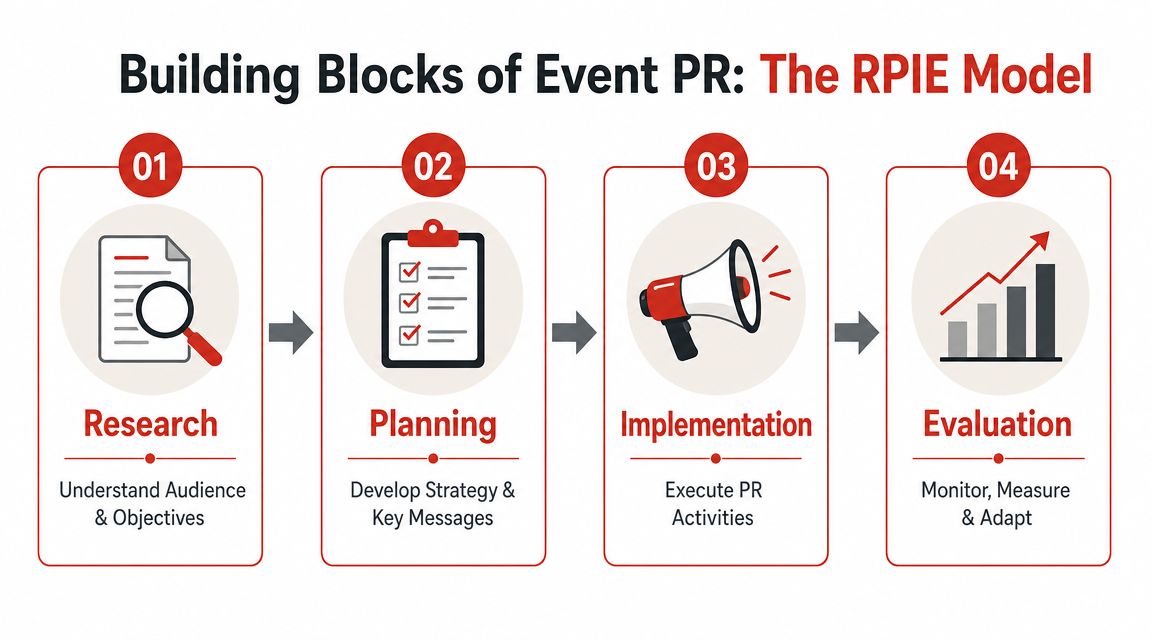
A disciplined event PR workflow should follow the RPIE sequence: research, planning, implementation, and evaluation. PRNEWS.IO's overview of the four-step public relations process explains the logic clearly. Start with research, set SMART objectives in planning, execute with targeted tactics, and evaluate against benchmarks you set in advance.
Research before messaging
Research sounds basic, but teams often neglect the hard work involved. They already know the event date and topic, so they assume they know the story. Often they don't.
Before writing anything, answer these questions:
- Who are the priority audiences: Reporters, analysts, prospects, customers, partners, recruits, internal leaders, or community stakeholders?
- What do they already believe: Are you reinforcing momentum, correcting confusion, or introducing something new?
- What's newsworthy: The event itself, the speaker lineup, a product announcement, proprietary insight, a customer gathering, or executive access?
- What are the constraints: Quiet periods, legal review, sponsor approvals, embargoes, or internal politics?
This step changes the campaign. A customer summit aimed at retention should not sound like a product launch. An executive offsite should not be pitched like a public conference. A thought leadership forum with strong subject matter experts may be better served by interview opportunities than by broad event promotion.
Planning means setting measurable objectives
Good plans use SMART objectives because vague intentions create vague reporting. “Raise awareness” is not useful. “Earn qualified coverage around our AI leadership theme and drive traffic to the registration or recap page” is much closer to something a team can execute.
A useful event PR plan usually defines objectives in three layers:
Business objective
What the organization wants the event to support. This could be sales conversations, customer trust, partner visibility, employer brand, or executive authority.Communications objective
What perception or action PR should influence. Examples include stronger message pull-through, more executive interview opportunities, or broader reach into a specific trade audience.Measurement objective
What signals will prove movement. This should connect to reporting later, not sit in a strategy document untouched.
Research should shape the story, not just decorate it.
Build one narrative spine
Once objectives are clear, define a message hierarchy. Most event teams create too many messages and end up with none.
Use a simple structure:
| Message layer | What it should answer |
|---|---|
| Core narrative | Why this event matters now |
| Proof points | Why the audience should believe you |
| Audience variants | How the message changes for media, customers, sponsors, and internal stakeholders |
| Call to action | What each audience should do next |
That narrative spine should feed every asset that follows: press materials, speaker briefs, moderator prompts, social copy, executive talking points, sponsor guidance, and post-event recap content.
If the messaging can't survive simplification, it won't survive media handling.
Building Your Essential Media Outreach Toolkit
Once the strategy is set, build the toolkit, prioritizing quality over volume. A bloated media list and a generic press release create the illusion of work, but they don't help journalists decide quickly why they should care.
That matters because media outreach is crowded. PR Lab's 2025 industry statistics roundup reports that the average journalist response rate to PR pitches is 3.43%, and PR professionals typically pitch 31 journalists to secure a single response. Those numbers are a blunt reminder that event PR works best when your outreach is selective, relevant, and easy to use.
What belongs in the toolkit
At minimum, prepare these assets before outreach starts:
- Press release with a real angle: Lead with the news value, not event housekeeping. If you want a useful model, PressBeat's advice on event press releases is a practical reference for structuring an announcement around what's newsworthy.
- Media kit: Include approved logos, high-resolution images, speaker headshots, company boilerplate, event overview, and contact details.
- Speaker bios that can survive copy-paste: Journalists and producers need short, clear bios, not career memoirs.
- Executive talking points: Especially important if your leadership team may take interviews on-site.
- Fact sheet: Dates, location, themes, session highlights, and approved language around announcements.
- Social asset folder: Quote cards, banners, short clips, and prewritten copy for speakers, sponsors, and internal teams.
Precision beats blast emails
A targeted list outperforms a large weak list almost every time. Build outreach around fit.
Segment by relevance:
- Trade media: Best when the event advances a category conversation.
- Local business press: Useful if the event has economic, executive, or community significance in the host market.
- Industry newsletters and podcasters: Often more interested in expert access than in event logistics.
- Creators and niche commentators: Helpful when your event includes strong personalities or demonstrable expertise.
What doesn't work is pitching everyone the same angle. A reporter covering enterprise software doesn't want the same intro as a local editor looking for city business activity or a creator interested in your keynote guest.
Sample Event PR Timeline
| Timeframe | Key PR Activities |
|---|---|
| 12 weeks out | Finalize event narrative, confirm speakers, identify news hooks, draft media list |
| 10 weeks out | Build press kit, collect headshots and bios, prepare spokesperson briefing notes |
| 8 weeks out | Draft and approve press release, develop sponsor and speaker promotion assets |
| 6 weeks out | Begin priority outreach to selected media, podcasts, and industry newsletters |
| 4 weeks out | Confirm interview windows, tighten on-site media logistics, refresh social calendar |
| 2 weeks out | Re-pitch priority contacts, distribute final event details, prepare briefing sheets |
| Event week | Run media confirmations, circulate live updates, manage spokespeople and content capture |
| Post-event | Send recap materials, follow up on interviews, compile coverage and performance data |
A usable media kit reduces friction. That's often the difference between interest and silence.
Activating Speakers and Sponsors for Maximum Reach
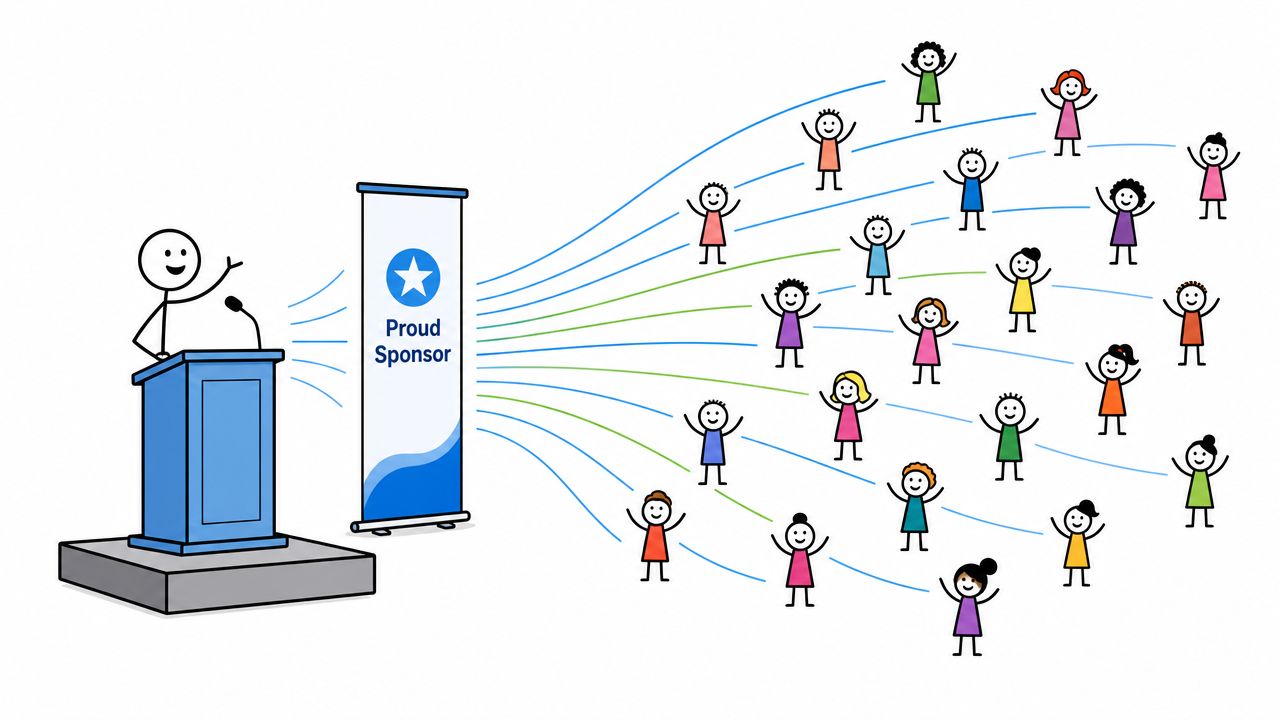
The strongest event PR plans don't rely on the organizer's channels alone. They turn speakers and sponsors into distribution partners. That matters because third-party credibility travels farther than brand copy.
Recent PR industry data show that 63.8% of PR campaigns in 2025 include influencer collaboration as a core strategy, according to the BLS-linked event PR briefing in the provided verified data. In the event context, that often includes expert speakers, recognizable founders, athlete leaders, and trusted partners.
Treat speakers like story assets, not agenda fillers
A speaker is valuable long before they walk on stage. The best ones give you multiple PR angles if you package them correctly.
Consider a few common event examples:
- An AI pioneer who helped build technology used by millions can support media interviews about adoption, product design, and what leaders still misunderstand about AI.
- A patent-holding founder can anchor stories about innovation, resilience, and building in uncertain markets.
- An Olympic medalist can give a business audience a credible lens on pressure, preparation, recovery, and team performance.
None of those stories should be reduced to “featured keynote announced.” The smarter play is to pull out one or two timely themes and offer those themes to the right outlets, partners, and communities.
A good speaker strategy also improves attendance marketing. If you're refining that part of your event mix, this guide on what makes a keynote speaker valuable for business events is a useful framing tool.
Give them a mini toolkit they'll actually use
Most speakers and sponsors are willing to help. Most aren't going to invent your campaign for you.
Provide a lightweight package:
- A one-page messaging brief: Event purpose, audience, approved positioning, and what to emphasize.
- Ready-to-post social copy: Different versions for LinkedIn, internal newsletters, and partner channels.
- Simple visual assets: Headshots, quote graphics, session banners, and short teaser clips.
- Interview guidance: Topics to lean into, topics to avoid, and who coordinates requests.
That support matters because busy executives, founders, and partners will promote what's easy to share.
After the event starts, use recorded moments to extend reach.
Sponsors need narrative roles too
Sponsors get underused in event PR. Teams put logos on landing pages and stop there.
A better model is to assign each sponsor a role in the event story. One partner may represent market validation. Another may reinforce innovation. Another may bring customer proof. When those roles are clear, it becomes much easier to co-create announcements, short interviews, social clips, and recap content that feels substantive instead of transactional.
Executing Flawless On-Site Media Logistics
On-site PR fails when the event team is reactive. Reporters arrive and nobody knows where they should go. A speaker is available, but no one has confirmed the interview slot. The best quote of the day happens on stage, and nobody captures it cleanly.
Strong event PR operations feel almost invisible because the basics are handled in advance.
Run the room like a newsroom support desk
If media, creators, or executive guests are attending, give them a defined experience.
Use this on-site checklist:
- Dedicated check-in point: Make it obvious where media and VIPs should report.
- Named PR lead: One person owns intake, changes, and problem-solving.
- Interview grid: Schedule who speaks to whom, when, and where.
- Quiet space: Journalists and spokespeople need somewhere usable for quick recordings or short interviews.
- Asset access: Keep headshots, bios, fact sheets, and approved visuals in one shared folder.
- Rapid approvals path: If a quote or detail needs sign-off, know exactly who can clear it.
For speaker timing and handoffs, tools help. A simple run-of-show system prevents the kind of backstage confusion that spills into missed media moments. This speaker run of show generator for event professionals is a practical example of the kind of planning asset worth using.
Capture moments with intent
Not every moment deserves amplification. Some do.
Prioritize:
- Strong quotes from stage
- Executive soundbites
- Audience reaction in the room
- Backstage interactions with speakers or sponsors
- Visual proof of scale, energy, and relevance
The event team should never ask, “Did anyone get that?” after the best moment already passed.
Make journalists' jobs easier
This sounds obvious, but it's often the missing piece. Reporters don't need more enthusiasm. They need access, speed, and clarity.
If something changes, tell them early. If a speaker is running late, offer a workaround. If a major announcement is about to happen, make sure they have the right context before they file. The teams that earn stronger post-event coverage usually aren't louder on-site. They're better organized.
Measuring PR Success and Proving Event ROI
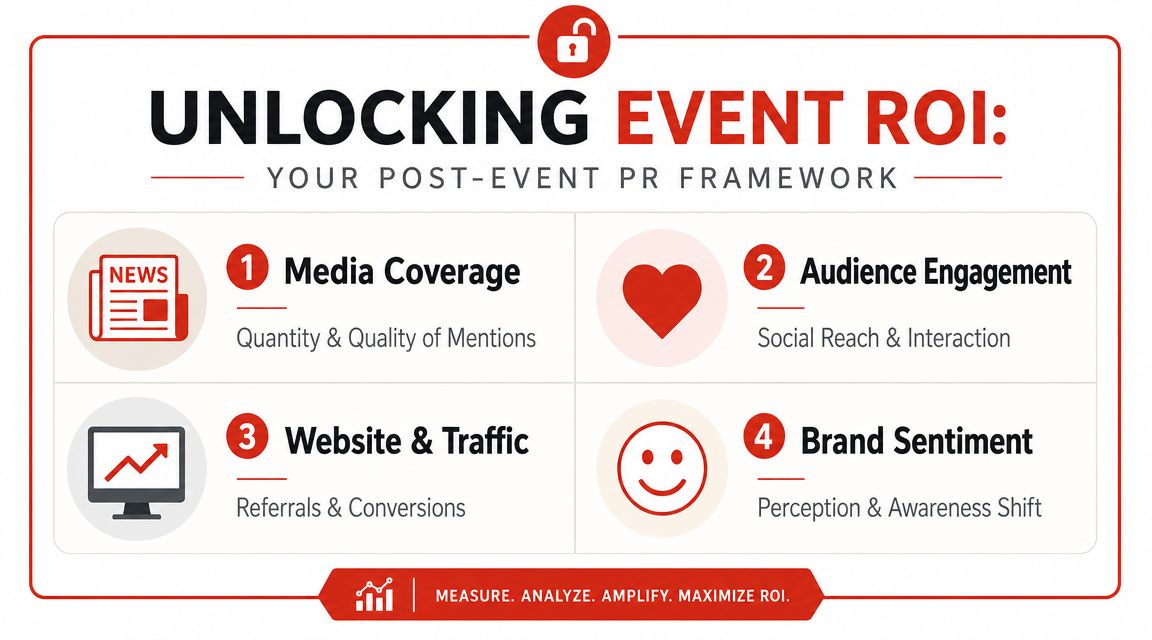
This is the section often necessary but rarely executed properly. Once the event ends, counting clips isn't enough. You need a way to show whether public relations for events changed visibility, perception, engagement, or demand in a way the business can understand.
The strongest framework is straightforward. Define a baseline before launch, choose your tools early, review both quantitative and qualitative outcomes, turn findings into action, and test again. The Lardbucket public relations process chapter lays out that logic and points to useful KPIs such as media mentions, share of voice, website traffic, social engagement, and lead generation.
Start with the baseline, not the recap
A post-event report is only persuasive if it compares outcomes against something real. Before launch, decide what “normal” looks like.
That baseline might include:
- Current media visibility: How often your company, leaders, or event themes appear before the campaign starts
- Existing traffic patterns: Especially to registration pages, speaker pages, or announcement pages
- Social engagement norms: What typical interaction looks like on your main channels
- Lead flow benchmarks: What your pipeline or inquiry volume looks like without the event push
Without that baseline, almost any post-event number can sound positive and prove very little.
Evaluate quality, not just quantity
Not all coverage is equal. Ten weak mentions can matter less than one strong article that accurately carries your message.
Review media outcomes through a few lenses:
| KPI area | What to look for |
|---|---|
| Media mentions | Did coverage happen in the outlets that matter to your audience |
| Message pull-through | Did reporters and commentators repeat the themes you wanted associated with the event |
| Share of voice | Did your event dominate the conversation you intended to own |
| Website traffic | Did PR activity send people to the pages tied to registration, recap, or conversion |
| Social engagement | Did the event create interaction beyond your existing audience |
| Lead generation | Did communications support identifiable demand or follow-up opportunities |
Many teams miss the mark. They report outputs, not outcomes. “We issued a release” is an output. “Our priority message showed up in the right conversations and drove relevant traffic” is an outcome.
Tie PR activity to business questions leaders actually ask
Your internal audience for reporting usually includes someone from leadership, marketing, sales, or finance. They're not asking whether the PR team worked hard. They're asking whether communications helped the event perform.
Frame results around their questions:
- Did this improve event relevance in the market
- Did our speakers and executives gain authority
- Did the right people engage before, during, or after the event
- Did PR support pipeline, partnerships, recruiting, or customer trust
- What should we repeat or stop doing next time
A clean report should connect campaign activity to those questions directly.
Measurement lens: If your recap only lists activities, leadership will treat PR as overhead. If it shows movement against business questions, PR becomes part of strategy.
Build a recap your stakeholders will read
The best post-event report is short at the top and detailed underneath. Start with an executive summary, then support it with evidence.
A practical structure looks like this:
Objectives and benchmarks
What success was supposed to look like.What happened
Coverage, content performance, stakeholder engagement, and on-site wins.Business impact indicators
Traffic, leads, meeting requests, sentiment signals, or other agreed KPIs.Insights
Which messages landed, which channels worked, and which assets underperformed.Recommended actions
What to change before the next event.
If you need a broader planning lens for connecting event design and post-event reporting, this guide on how to plan a corporate event is a useful companion.
What works and what doesn't
Here's the blunt version.
What works
- Setting benchmarks before outreach starts
- Building one coherent narrative across PR, content, speakers, and sponsors
- Tracking both hard signals and qualitative message pull-through
- Using post-event reporting to improve the next event, not just justify the last one
What doesn't
- Treating media mentions as the only measure
- Pitching broad lists with generic language
- Waiting until after the event to decide what ROI means
- Sending a recap deck full of screenshots and no analysis
That's the difference between PR that looks busy and PR that earns budget.
If you want an event to create more than a moment, the speaker strategy matters as much as the media plan. Silicon Valley Speakers helps organizations book proven builders, inventors, and leaders whose stories give events stronger narratives, better audience engagement, and more useful PR angles before, during, and after the program.
Related speaker rosters
Browse innovation keynote speakers available for 2026 events.