Your team is still closing business, but something feels off. Pipeline reviews are quiet. Reps do the work, log the activity, join the calls, and then disappear. The floor has no buzz. Slack has no energy. Wins get a thumbs-up emoji and then everyone moves on.
That’s usually the moment leaders reach for the usual fixes. Run a contest, order lunch, put up a leaderboard, hand out a bigger gift card. Those things can create a short spike, but they rarely solve the underlying issue. If you’re serious about how to motivate a sales team, you have to treat motivation as an operating system, not an event.
The strongest teams don’t stay energized because they have louder managers or better slogans. They stay energized because leadership builds a repeatable environment where people know what matters, feel progress, get coached in a way that matches their needs, and reconnect to purpose before burnout takes over. If you want consistent selling energy, you need a system.
Beyond Quotas and Pizza Parties
A lot of sales teams don’t have a performance problem at first. They have an energy problem.
You see it in subtle ways. Top reps become more transactional. Mid-performers stop pushing for stretch deals. Managers spend more time chasing updates than developing people. The team may still hit quota for a quarter or two because the market, installed base, or a few big accounts carry them. But the culture is already slipping.
I’ve seen this most often in tech companies after a strong run. The team survives on momentum from the last launch, the last conference, or the last hiring wave. Then the work gets harder. Deals slow down. More stakeholders show up in every cycle. Reps start protecting their time and their confidence. Suddenly, the old motivation tactics look shallow.
Motivation isn't a perk. It's the structure that keeps effort meaningful when deals stall and pressure rises.
That’s why pizza parties almost never fix the underlying issue. Neither does public hype with no follow-through. People don’t stay motivated because management creates a brief burst of noise. They stay motivated because the day-to-day experience of selling feels fair, focused, and winnable.
If you’re trying to reset your approach, it helps to zoom out and compare your current habits against a broader guide to team motivation. The best principles apply across functions, but sales needs sharper diagnosis because motivation problems often hide behind activity.
The practical shift is simple. Stop asking, “How do I get them fired up this week?” Start asking, “What in our environment is draining belief, and what system will restore it?” That question leads to better management decisions, better coaching, and stronger teams over time.
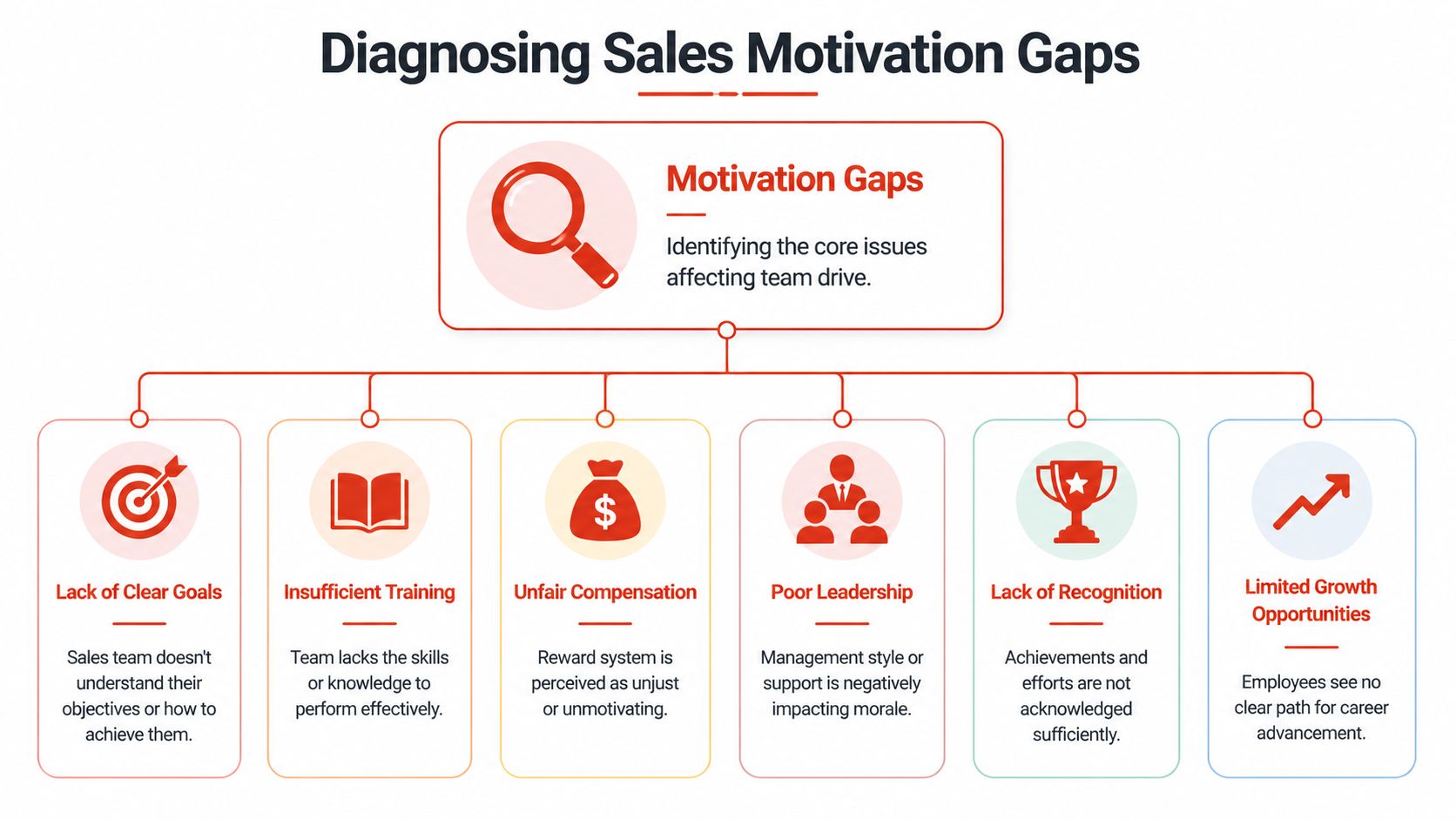
Diagnosing Your Team's Motivation Gaps
Most leaders misread motivation because they start with symptoms. Low call energy, sloppy CRM hygiene, weak discovery, more excuses. Those are visible, but they don’t tell you why the person is off.
The fastest way to get this wrong is to treat the whole team the same. One rep needs skill development. A second wants a clearer growth path. A third is capable but checked out, and a fourth is trying hard and failing because your process is muddy. If you apply one blanket fix, you waste time and usually demotivate the wrong people.
A better approach is the skill-will matrix. Research highlighted by Salesforce recommends segmenting teams into four quadrants, and notes that 77% of reps report maximum satisfaction from focused one-on-one coaching in this context of individualized support and segmentation (Salesforce guidance on sales motivation). That matters because untargeted coaching often feels like noise.
Read the four quadrants correctly
The matrix is simple. You assess each rep on two dimensions.
| Quadrant | What it looks like | What they need |
|---|---|---|
| High skill, high will | Consistent execution, strong judgment, wants more responsibility | Autonomy, stretch assignments, visibility |
| Low skill, high will | Works hard, receptive to feedback, inconsistent execution | Training, repetition, clear process |
| High skill, low will | Can sell, knows the market, effort comes and goes | Accountability, recognition, honest reset |
| Low skill, low will | Weak execution and low commitment | Direct performance management |
This isn’t a labeling exercise. It’s a leadership filter.
A senior AE who’s missing numbers may still belong in the high-skill category if their deal strategy is sharp and their customer conversations are strong. A new SDR with high energy and poor qualification discipline may be low skill, high will. The intervention should match the diagnosis.
Use real personas, not vague impressions
I like to map reps into practical archetypes because managers remember stories better than spreadsheets.
- Stars are your high skill, high will reps. They don’t need you hovering over every deal. They need room to lead, mentor, and influence.
- Learners are low skill, high will. These reps are often the best long-term bets if you coach them with patience.
- Stalwarts are high skill, low will. They know how to do the job, but something has gone flat.
- Underperformers sit in low skill, low will. Waiting too long with this group hurts everyone else.
The biggest management mistake is over-investing in the wrong person for the wrong reason. Leaders often spend emotional energy on the most vocal rep, not the one with the clearest path to improvement.
Practical rule: If a rep leaves your one-on-one with encouragement but no changed behavior, you probably coached the mood instead of the issue.
Ask better questions in one-on-ones
You don’t diagnose motivation from dashboard data alone. You diagnose it in conversation.
Use questions that reveal whether the problem is confidence, clarity, capability, or commitment:
- On clarity: “What part of your target feels most controllable right now?”
- On skill: “Where in the sales cycle do you feel least prepared?”
- On motivation: “What part of the job has felt less rewarding lately?”
- On friction: “What’s taking energy away from selling?”
- On growth: “What would make this quarter feel like progress even before the final number?”
Those answers tell you more than asking, “What’s blocking your deals?” over and over.
A rep who says they don’t know how to run a second meeting has a skill problem. A rep who says they no longer see how this role leads anywhere has a motivation problem. A rep who says every opportunity feels like starting over may be reacting to a process problem. Diagnose the environment too.
Watch for bias in your diagnosis
Managers skew their read of motivation in predictable ways.
- Recent performance bias: You overvalue the last two weeks and ignore the last six months.
- Personality bias: You assume the loud rep is motivated and the quiet rep isn’t.
- Similarity bias: You coach people the way you liked being coached.
- Hero bias: You keep protecting a formerly great rep because of past results.
Good diagnosis requires evidence from call reviews, pipeline movement, peer feedback, and repeated one-on-ones. If you need a broader framework for keeping people involved once you’ve identified the issue, this perspective on how to engage employees is useful because it forces leaders to look beyond compensation alone.
What your diagnosis should produce
At the end of this exercise, you should have a page for each rep with three things:
- Their current quadrant
- The likely root cause of low or uneven motivation
- The specific management move you’ll make over the next month
That’s when motivation stops being a vague culture topic and becomes something you can lead.
Building Your Internal Motivation Toolkit
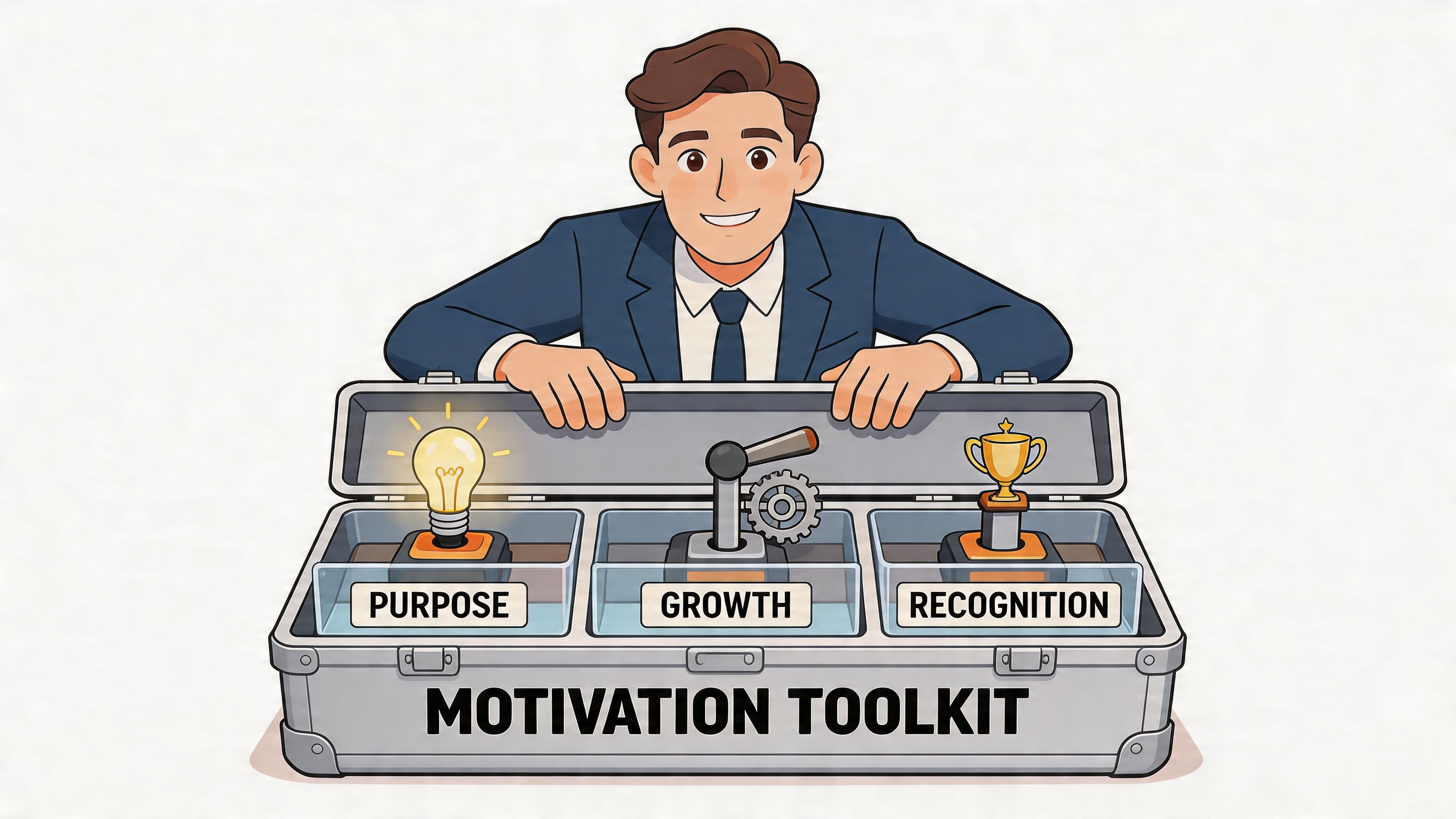
Once you know why energy is dropping, you can start fixing it with tools that change behavior. Most sales leaders rely too heavily on one lever. Usually compensation. That creates a brittle system.
The better approach combines incentives, recognition, and coaching. Each one works differently: incentives create urgency, recognition reinforces identity, and coaching builds confidence and skill. Use all three together and you get a much stronger result than you would from any one lever on its own.
Incentives that wake up the middle of the team
A lot of incentive plans are built for the top few reps. That’s a mistake. Your biggest performance lift usually comes from the broad middle.
BI Worldwide reports that well-designed goal-based incentive programs can boost sales performance among middle performers by 56.3% (BI Worldwide on sales team motivation). That’s a strong reminder that motivation improves when people see a meaningful challenge and a credible path to achievement.
What works better than random contests:
- Tiered targets: Reward progress across multiple levels so more reps stay engaged.
- Short-cycle sprints: Use focused windows around a specific behavior or deal stage.
- Clear win conditions: Reps should know exactly what counts and what doesn’t.
- Balanced rewards: Mix money with recognition, visibility, or experience-based rewards.
What usually fails:
- Winner-take-all contests: The same names dominate, everyone else checks out.
- Complex rules: If reps need a spreadsheet to understand the game, motivation drops.
- Activity-only prizes: Rewarding busyness teaches the wrong lesson.
A good SPIF doesn’t just say, “Do more.” It says, “This specific behavior matters right now, and we’ll recognize progress clearly.”
Recognition that feels earned
Recognition is one of the most underused tools in sales because many leaders make it too generic. “Great job” doesn’t motivate anyone for long. It’s vague, easy to ignore, and often disconnected from what you want repeated.
Recognition works when it is specific, timely, and tied to a behavior that reflects how your team should sell.
Try recognition in these forms:
- Private recognition for growth: Tell a rep exactly what they improved and why it matters.
- Public recognition for model behavior: Highlight a discovery call, account plan, or save on a stuck deal.
- Peer recognition: Let reps call out teammates for support on complex opportunities.
- Manager recognition tied to values: Praise the work in a way that reinforces your standard.
For example, don’t say, “Nice win.” Say, “You slowed the deal down, got legal involved early, and kept the champion engaged. That’s why it closed cleanly.” That teaches while it praises.
The best recognition names the behavior so clearly that the rest of the team knows what good looks like.
Recognition also shouldn’t be limited to closed-won deals. In enterprise tech sales, some of the most important motivational moments happen earlier. A rep earns executive alignment at a tough account. An SDR breaks into a strategic logo after weeks of disciplined outreach. A new AE runs their first strong mutual action plan. Those moments matter because they build belief.
Coaching that matches the person in front of you
Coaching is where many motivation systems either come alive or collapse. Reps don’t need more meetings. They need coaching that changes how they think and sell.
That’s also why generic one-on-ones fail. If every meeting covers forecast, tasks, and one generic pep talk, don’t expect motivation to improve. Your coaching should look different for each quadrant in the matrix.
For Stars
Give them room. Ask them to lead part of a deal review, mentor newer reps, or test a new outbound motion. They stay motivated when the role keeps expanding.
For Learners
Teach one selling move at a time. Work on discovery questions, objection handling, or next-step setting. Don’t drown them in ten fixes at once.
For Stalwarts
Be direct. Acknowledge their capability and confront the drift. Sometimes these reps need a reset around standards, career direction, or ownership.
For Underperformers
Keep it crisp and documented. Define the required change, support the effort, and avoid pretending a morale talk is a performance plan.
Here’s a simple coaching rhythm that works well in SaaS and enterprise sales teams:
- Review one real deal
- Identify one controllable behavior
- Practice that behavior
- Set one commitment for the week
- Follow up fast
If you want structure around those conversations, a dedicated coaching platform can help managers keep feedback consistent without turning coaching into admin work.
A short training clip can also be useful when managers need a reset on coaching and motivation basics:
Build a cadence, not a campaign
Motivation sticks when your team can predict the support system. That means regularity.
A practical weekly cadence might look like this:
| Moment | Purpose |
|---|---|
| Monday team huddle | Set focus and reinforce what matters this week |
| Midweek one-on-ones | Coach individual blockers and progress |
| Deal review | Improve judgment and create shared learning |
| Friday recognition | Close the loop on effort, wins, and progress |
This doesn’t need to be elaborate. It needs to be reliable. Reps lose energy when leadership support feels random.
If you’re trying to figure out how to motivate a sales team long term, the answer usually lives not in one big push, but in a steady operating rhythm that keeps challenge, appreciation, and development in balance.
Using Events and Speakers to Reignite Purpose
Internal systems carry the day-to-day load. They don’t always lift a team out of a rut by themselves.
Sales is repetitive work. Even strong teams can get trapped in the mechanics of pipeline, forecast calls, procurement delays, and renewal pressure. When that happens, the issue isn’t always tactical. Sometimes the team has lost contact with the larger reason the work matters.
That’s where events and outside voices can help. Not as entertainment or filler for an SKO agenda, but as a deliberate reset.

The strongest evidence for this comes from leadership itself. Objective Management Group analysis highlighted by Unbound Growth found that sales managers with strong motivating skills produce salespeople who perform 17% stronger than average, and that the impact is compounded with coaching for a 39% performance uplift. The same analysis notes that top salespeople are 80% intrinsically driven (Unbound Growth on how managers motivate salespeople). That matters because a well-chosen event or keynote can strengthen the exact drivers managers often struggle to create on their own: purpose, curiosity, and ambition.
Why outside voices work when internal messages stop landing
Your team hears from leaders all the time. Quarterly goals, product updates, forecast pressure, strategic priorities. Even when those messages are correct, familiarity can dull their impact.
An external speaker changes the listening dynamic. People pay attention differently when the messenger brings lived experience from building something difficult, surviving pressure, or seeing the future early. That credibility can reopen a conversation your team had stopped hearing.
In practice, there are a few moments when this works especially well:
- At an SKO after a hard year, when the team needs belief more than hype
- Before a major product push, when sellers need to understand the bigger story
- During a reorganization, when uncertainty is draining conviction
- At a leadership offsite, when managers need fresh language for coaching and culture
The mistake is choosing a speaker based on celebrity alone. Relevance matters more than fame.
Match the message to the moment
A sales event should solve a leadership problem. Start there.
If your team is selling into AI transformation, an innovation-focused speaker can help reps understand the customer context more thoroughly and sell with more conviction. If the issue is resilience after a punishing quarter, a peak-performance voice often works better because the team needs language for discipline, recovery, and composure. If the business is shifting fast, the right speaker can help reframe change as a challenge worth stepping into.
Here’s a simple way to think about speaker fit:
| Team moment | Useful speaker archetype | Likely motivational outcome |
|---|---|---|
| Innovation push | Builder, inventor, AI pioneer | Curiosity and strategic confidence |
| Pressure and burnout | Elite athlete, peak performer | Resilience and focus |
| Leadership reset | Operator, founder, transformation leader | Ownership and clarity |
| Culture drift | Story-driven visionary | Shared purpose and pride |
A team selling transformation software, for example, may respond strongly to an innovation pioneer who can explain how breakthrough products get built. That doesn’t just inspire. It gives reps sharper language with customers. A team dragging through a long fiscal year may respond better to someone who has operated at the edge of performance and can speak credibly about discipline under pressure.
A great keynote doesn't replace leadership. It gives leadership better material to work with after the event ends.
Turn the event into a motivation system
Most companies waste the motivational value of events because they treat them as one-off moments. The keynote happens, people clap, and then everyone goes back to the same habits.
You get far more value when the event is wrapped with clear follow-through:
- Set the theme before the event so the team knows why this message matters now.
- Brief managers in advance so they can connect the keynote to team conversations.
- Pull out a few specific ideas to reinforce in pipeline reviews and one-on-ones.
- Create discussion prompts for teams to translate inspiration into action.
- Tie the message to current priorities so it becomes practical, not abstract.
This is especially important for SKOs and annual meetings. The event should launch a leadership narrative, not just fill a slot on the agenda. If you’re designing that kind of program, this guide on how to plan a corporate event is a useful planning reference because the structure around the speaker matters almost as much as the speaker.
When leaders ask how to motivate a sales team that feels flat, I rarely suggest one more contest first. I look at whether the team still believes their work matters. A strong event, built around the right message and followed by real management reinforcement, can restore that belief faster than almost anything else.
Measuring Impact and Aligning Metrics
If your motivation strategy is working, you should see it in behavior before you see it in revenue. That’s where many teams get stuck. They launch new incentives, add recognition, improve coaching, and then keep measuring the same weak metrics.
The core problem is simple. Sales teams get demotivated when the scoreboard rewards effort that doesn’t clearly connect to progress. Reps know the difference between meaningful work and activity theater.
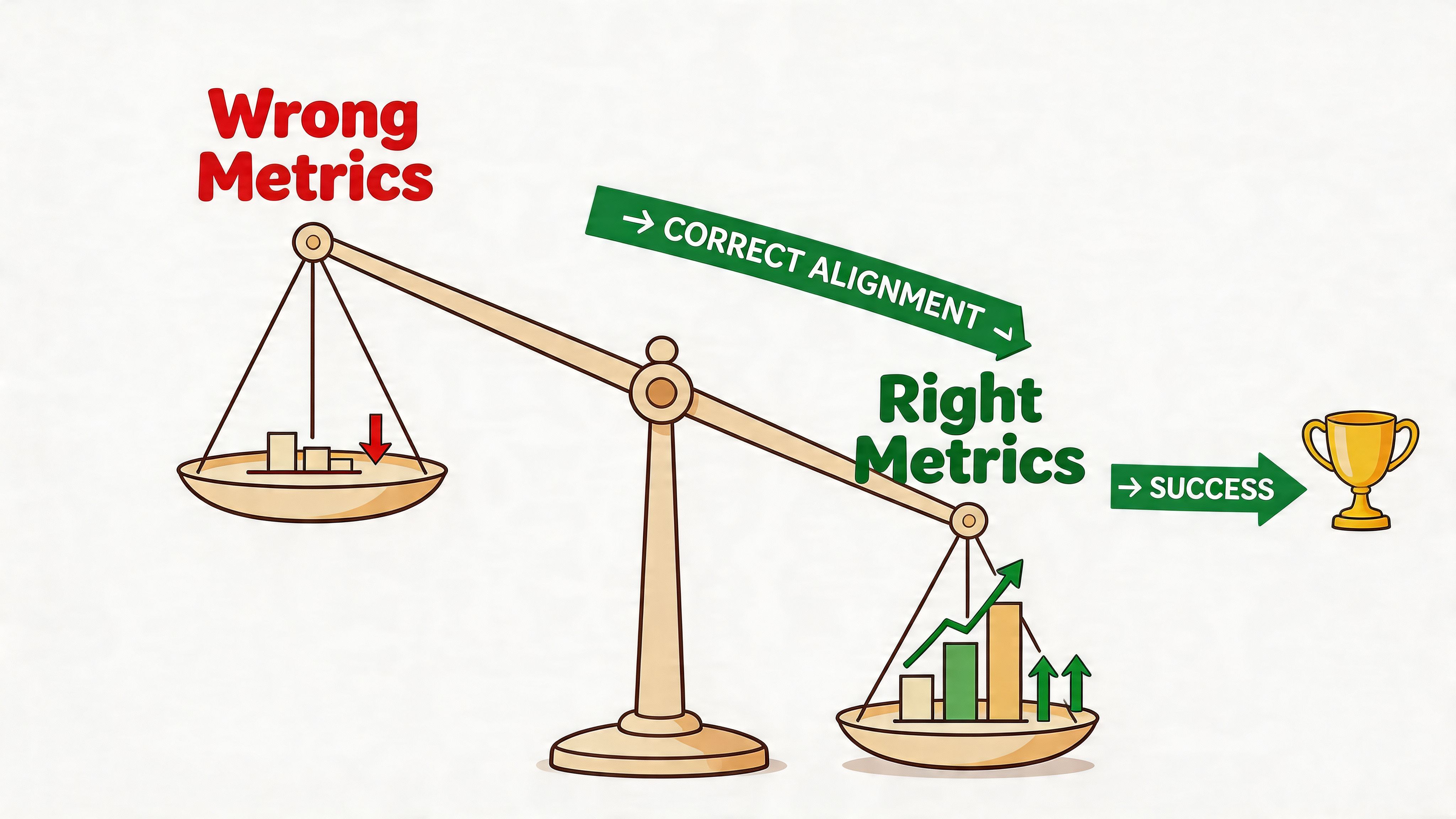
Challenger points to the right shift here. Sales motivation fails when managers reward activity instead of outcomes, and the better model is moving from measures like “X calls per day” to pipeline progression targets such as moving leads to the next stage. When reps can see dashboards that connect changed behavior to actual sales results, positive reinforcement gets stronger (Challenger on motivating a sales team).
Stop over-rewarding visible effort
Activity metrics aren’t useless. Calls, emails, meetings, and follow-up speed can all matter. The problem starts when they become the primary story.
A rep can hit a call target and still create no real pipeline. Another rep can run fewer but better conversations and produce stronger opportunities. If your dashboard treats those people the same, your team will eventually game the system.
Common examples of weak motivation metrics:
- Call volume without conversion context
- Meetings booked without qualification quality
- Demo count without next-step progression
- CRM updates without deal movement
Those metrics are easy to track, but they don’t create belief. They often create compliance.
Measure movement that reps can influence
The strongest motivation dashboards show progress through the funnel in a way that reps can control and understand. That’s what makes them energizing.
Better options usually sound like this:
| Weak metric | Better metric |
|---|---|
| Calls made | Qualified conversations created |
| Meetings held | Opportunities advanced to next stage |
| Proposals sent | Stakeholder alignment before proposal |
| Pipeline added | Pipeline added that matches ideal criteria |
This matters in complex tech sales because the job isn’t just generating motion. It’s creating the right motion.
A strong dashboard should let a rep answer three questions quickly:
- What changed this week?
- What behavior contributed to that change?
- What should I do next?
If the dashboard can’t answer those questions, it won’t motivate. It will just report.
Audit your current scoreboards
Most sales orgs don’t need more metrics. They need fewer, better ones.
Run a quick audit with your managers:
- List every metric shown to reps weekly
- Mark which ones reflect effort only
- Mark which ones reflect meaningful progression
- Remove or downgrade vanity indicators
- Highlight the handful that predict better selling
Then test the language in team meetings. If managers keep praising raw volume while saying they care about quality, the system is still misaligned.
For teams trying to build a clearer performance culture, this piece on how to improve team performance can help leaders connect metrics, expectations, and coaching more tightly.
When a rep can see that one better discovery habit led to one better stage conversion, motivation becomes more durable because progress feels earned and visible.
That’s the core target. Not just measurement for management. Measurement that helps the rep believe their actions matter.
Leading Through Change and Uncertainty
A lot of sales advice assumes a stable environment. It assumes the product is clear and that neither the market nor the team structure is moving. That’s not how most tech companies operate.
Teams deal with product pivots, pricing changes, new leadership, territory shifts, tighter budgets, and new buyer scrutiny. In those moments, motivation doesn’t usually drop because people suddenly became lazy. It drops because the ground feels less solid, and leadership keeps communicating in fragments.
The standard response is to push harder on execution. More activity, more urgency, more inspection. That often makes things worse. When people think change is arbitrary, pressure feels like punishment.
A better approach is narrative. Vouris argues that to motivate teams through uncertainty, leaders need to articulate “the why behind this change,” “why us,” and “what this means for them,” because narrative gives people context they can process and act on (Vouris on motivating a sales team when sales were down).
Build the story before you push the plan
Most change communication is too operational. A new segment, new rules, new expectations. That tells people what changed, but not how to make sense of it.
A stronger leader story answers five questions in plain language:
- Why is this change happening now
- Why are we the team to take it on
- What does success look like on the other side
- What does this change mean for each role
- How can we exceed expectations during the shift
That doesn’t mean sugarcoating. It means reducing ambiguity.
Here’s the difference in practice:
| Weak change message | Strong change message |
|---|---|
| “We’re realigning territories effective Monday.” | “We’re changing territory coverage because buyer concentration shifted, and the old model is slowing our response in key accounts.” |
| “You need to focus on the new product line.” | “This product line matters because customers are consolidating vendors, and this gives us a stronger story in executive conversations.” |
People can handle hard news. What they struggle with is unclear meaning.
Keep repeating the same core story
During change, leaders often think they’ve explained enough after one all-hands. They haven’t. Reps are trying to sell, manage deals, and protect income at the same time. They need repetition.
Use the same narrative in multiple places:
- Team meetings
- One-on-ones
- Forecast calls
- Manager huddles
- Internal enablement materials
If the CRO says one thing, frontline managers say another, and product marketing says a third, motivation erodes fast. Consistency is part of emotional stability.
Sales teams don't just need new instructions during change. They need a story that makes effort feel rational again.
Narrative won’t remove uncertainty. It will reduce confusion. And when people understand the reason for the shift and their role in it, they’re much more likely to stay engaged through the hard middle of change.
Conclusion From Manager to Motivator
The job isn’t to keep a sales team hyped up. The job is to build conditions where people can do hard work with clarity, belief, and momentum.
That starts with diagnosis. Not every rep is demotivated for the same reason. Then it moves into disciplined execution. Better incentives, better recognition, better coaching, and better metrics. On top of that, strong leaders know when the team needs a larger reset around purpose, whether that comes through an event, a keynote, or a sharper internal narrative during change.
That’s the key shift in how to motivate a sales team. You stop acting like a manager who enforces activity and start acting like a leader who designs an environment. A good environment makes effort feel visible. It makes improvement feel possible. It makes pressure feel purposeful instead of random.
If your team feels flat today, don’t try to fix everything at once. Pick one rep segment, one broken management habit, or one metric that’s teaching the wrong behavior. Improve that first. Motivation grows when leadership becomes more precise.
If you’re planning an SKO, leadership offsite, annual meeting, or customer event and want a keynote that reconnects teams to purpose, Silicon Valley Speakers helps organizations bring in builders, inventors, and peak performers whose stories create lasting energy, not just a moment of applause.