
If you want to know how to engage employees, you have to think beyond company picnics and satisfaction surveys. True engagement is about building a deep sense of commitment and motivation. It’s about building a place where people feel valued, see their contribution, and are genuinely all-in on the company's success. But before you can even think about solutions, you have to get real about the cost of doing nothing.
The True Cost of a Disengaged Team
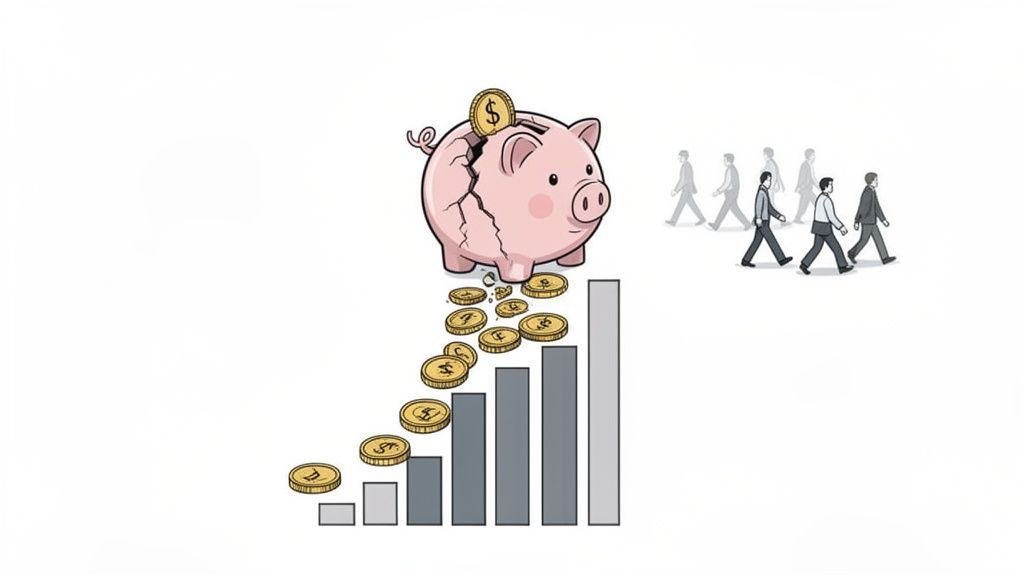
We often talk about engagement in terms of morale and culture. Those are important, absolutely. But the conversation needs to start with a much harsher reality: a disengaged team is a massive financial leak in your organization.
Ignoring the problem is far, far more expensive than fixing it.
When people are "checked out," the damage isn't contained. It ripples through every part of the business. Productivity tanks, new ideas dry up, and the quality of your customer service takes a nosedive. These aren't just fluffy concepts; they show up as real dollars and cents on your P&L.
The Staggering Numbers Behind the Crisis
Recent data shows just how bad things have gotten. Globally, only 21% of workers reported feeling engaged in 2024. The picture in the U.S. is even bleaker, with engagement hitting a 10-year low of just 31%. That widespread apathy costs the global economy an estimated $438 billion every year in lost productivity. For a deeper dive, check out the full workplace report findings.
This isn't just a "big company" problem. For any business, those numbers represent a huge, untapped reserve of potential.
The gap between where engagement is today and where it could be is a massive competitive disadvantage. Closing that gap isn't just about making people happier—it's about unlocking productivity and innovation that are currently sitting dormant in your teams.
It's More Than Just Lost Productivity
The financial hit from disengagement goes way beyond a simple drop in output. You have to look at the hidden costs that quietly drain your budget:
- Sky-High Turnover: Unhappy employees leave. The cost to find, hire, and onboard their replacement can be anywhere from half to double their annual salary. Ouch.
- More "Sick" Days: Actively disengaged people have higher rates of absenteeism. This disrupts projects, overloads their engaged coworkers, and grinds everything to a halt.
- Innovation Goes Missing: A checked-out employee isn't going to give you that "discretionary effort." They won't stay late to crack a tough problem or speak up with a high-impact idea. They do the bare minimum, and your company misses out.
- Safety Problems: In roles that involve physical work, disengaged employees have far more safety incidents. This leads to higher insurance premiums and potential legal headaches.
How to Build Your Business Case for Action
This is your starting point. Before you can pitch a single workshop or plan one offsite, you have to build a rock-solid business case. You need to frame this issue not as a fluffy HR initiative, but as a core business strategy.
When you walk into a leadership meeting and talk about financial risk and opportunity cost, the entire conversation changes. It’s no longer a question of, "Can we afford to invest in engagement?"
Instead, the real question becomes, "Can we really afford not to?" This is how you get the budget, the buy-in, and the green light to build a program that actually delivers a return.
Figuring Out What's Really Going On
Before you can build an engagement program that actually works, you have to play detective. Throwing generic pizza parties or wellness apps at your team is like trying to fix a car without opening the hood—you're just guessing. To make a real impact, you first need to uncover the specific, nagging issues causing people to check out.
This diagnostic work is, without a doubt, the most important part of the whole process. It’s where you stop making assumptions and start gathering real evidence. The goal is to find the root cause, not just slap a band-aid on the symptoms.
Move Beyond the Annual Survey
Let's be honest: the old-school, massive annual engagement survey is broken. By the time you've waded through the data, it's already stale. The problems you found might have already morphed into something else entirely.
A much smarter approach is to get a real-time pulse on your organization. This means using a mix of a few different tools.
Pulse Surveys: Think of these as quick, frequent check-ins. Sending short surveys monthly or quarterly on specific topics gives you a continuous stream of data. They're fast for employees to fill out and let you spot trends before they become major problems.
Confidential Focus Groups: While surveys tell you what is happening, focus groups tell you why. These small, professionally-facilitated discussions are gold. They give employees a safe space to share their real experiences and add the much-needed context behind the numbers.
Manager Feedback Sessions: Your frontline managers are your eyes and ears on the ground. They see and hear things that will never show up on a survey. Setting up regular, structured sessions to get their honest observations is essential for getting the full picture.
I've found the real magic happens when you combine these methods. A surprising dip in a pulse survey score can be explored in a focus group, and you can validate what you learn by talking to managers. It creates a complete feedback loop.
Asking the Right Questions
The quality of your insights comes down to the quality of your questions. If you ask generic questions, you'll get generic, unhelpful answers. You want to dig into the core drivers of engagement—things like leadership, career paths, and recognition.
Strong leadership is a huge piece of the puzzle. When people trust their leaders and have a clear sense of direction, engagement naturally follows. To dig deeper, you can explore the principles of what makes a transformational leader and see how those traits are showing up—or not showing up—in your organization.
To get you started, here are a few questions I’ve seen work well to get beneath the surface. You can use them in your surveys or as prompts for focus group discussions.
Engagement Driver Diagnostic Questions
Use these sample questions in your pulse surveys or focus groups to diagnose issues across key engagement drivers.
| Engagement Driver | Sample Diagnostic Question |
|---|---|
| Leadership Trust | "Do you feel that leadership is transparent about company performance and decisions?" |
| Career Growth | "Do you see a clear path for professional development for yourself at this company?" |
| Recognition | "Do you feel that your contributions are regularly and genuinely recognized?" |
| Team Connection | "Do you feel a strong sense of belonging and connection with your immediate team members?" |
| Work-Life Balance | "Does your workload allow you to disconnect and maintain a healthy life outside of work?" |
These questions are designed to move beyond a simple "yes" or "no" and encourage more thoughtful responses that reveal the true state of employee sentiment.
Finding the Patterns in the Data
Collecting all this information is just the first step. The real work starts when you analyze it for meaningful patterns. Whatever you do, don't just look at the overall company score—that number hides all the interesting details.
The most powerful insights come from slicing the data. Look for big differences between:
- Departments: Is the engineering team thriving while the sales team is struggling? That points to a localized issue, probably tied to a specific manager or unique job pressures.
- Location or Work Style: Compare the engagement of your fully remote staff to your in-office teams. If you see a gap, it might mean your remote work policies or communication channels need a second look.
- Tenure: How do new hires feel after 90 days compared to employees who have been with you for 3 years? If engagement nosedives after the two-year mark, you might have a problem with long-term growth opportunities.
This level of detail is what allows you to pinpoint exactly where the fires are. Instead of launching a generic, company-wide program that misses the mark, you can design sharp, targeted solutions for the teams that need them most. That focused approach is how you create real, lasting change.
Okay, you've done the detective work. You’ve dug into the surveys and focus groups, and you have a solid diagnosis of what’s causing the engagement gaps in your company. Now for the fun part: moving from insight to impact.
This is where we start designing an event-driven program. But let's be clear—we're not just planning parties. We're creating strategic experiences, each one designed to tackle a specific problem you've uncovered. A great event can be the fastest way to rebuild trust, spark a wave of new ideas, or simply forge the human connections that have worn thin.
Before you start booking venues, always anchor your strategy in that initial diagnostic work. I find it helpful to think of it in three simple phases.
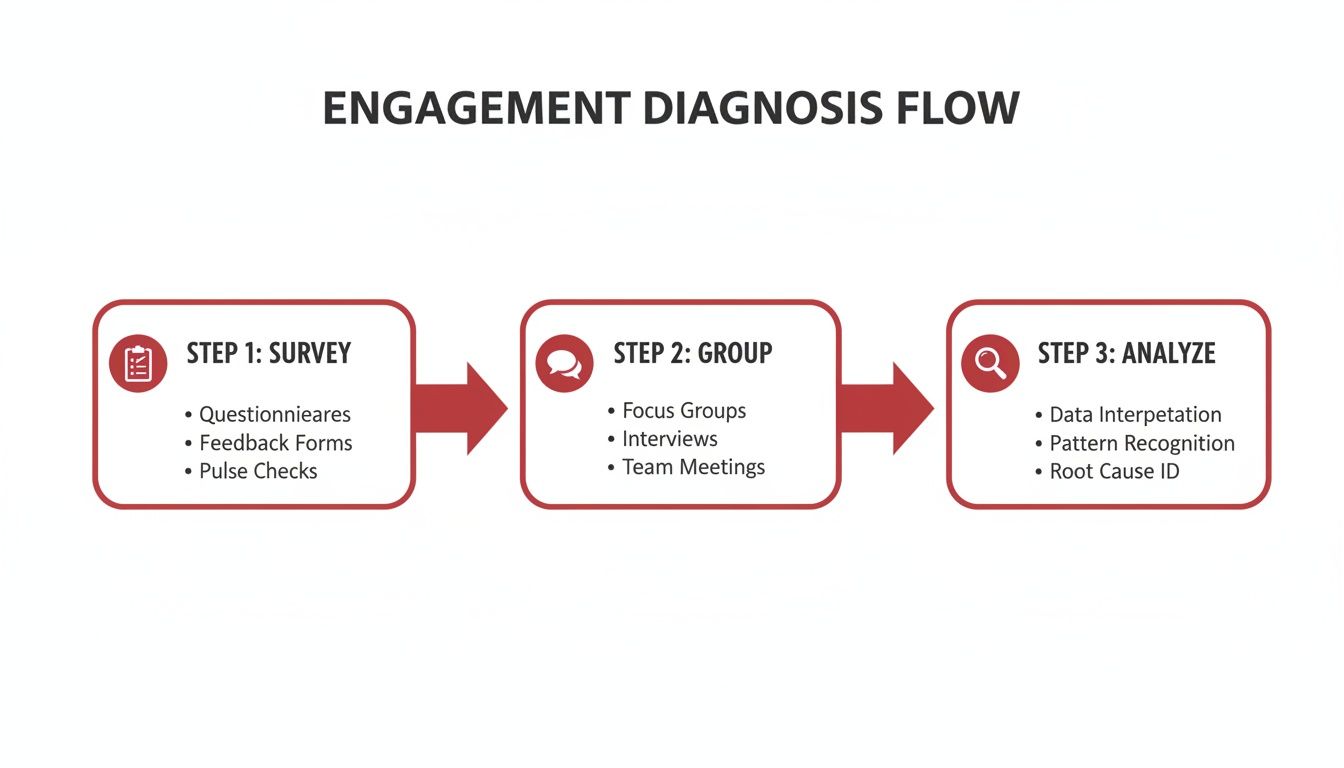
It all starts with listening. Once you have that feedback, you can build events that actually solve real problems.
Designing Events With A Clear "Why"
Every single gathering on your calendar, from a small team offsite to a company-wide all-hands, needs a purpose. If you can't answer the question, "What engagement problem are we solving with this?" then you're at risk of planning a fun day out that has zero lasting value.
Think in terms of cause and effect:
Are your pulse surveys showing that people feel disconnected from the company’s mission? A transparent, quarterly town hall is your solution for bridging that gap.
Is your top-performing sales team looking completely burnt out after a brutal year? An exclusive leadership offsite focused on rest, recognition, and strategy is the reset they need.
Has collaboration between departments fallen off a cliff? A series of hands-on, skill-building workshops that force different teams to solve a problem together can break down those silos fast.
When you think this way, your event calendar stops being a random list of activities and becomes a cohesive, strategic program. Each event builds on the last, addressing a specific need and moving the needle on your key engagement metrics.
Key Events and Their Strategic Roles
Different events pull different levers. Knowing which one to use, and when, is what separates a good program from a great one. Once you learn how to plan a corporate event with this strategic mindset, you unlock its real power.
Town Halls and All-Hands Meetings
Think of these as your direct line for building alignment and transparency. A well-run all-hands is a dialogue, not a monologue. The agenda needs a candid business update from the C-suite, a genuine celebration of team and individual wins, and—most importantly—a huge chunk of time for an open Q&A. This is how you prove that leadership is listening and that decisions aren't just being made in a black box.
Leadership Offsites
When you need your senior team to do deep strategic thinking and strengthen their own bonds, getting them offsite is non-negotiable. These gatherings create the time and space for leaders to detach from the daily whirlwind, wrestle with the big challenges, and reconnect as a united front. A great agenda will mix heavy strategic planning with experiences designed to build trust and shared purpose.
Workshops for Skill Building and Connection
Workshops are your precision tools. If your diagnostics pointed to a weak spot in management skills or a drought of innovative thinking, a targeted, hands-on workshop delivers tangible results. They’re also fantastic for breaking down departmental silos by putting people who rarely interact in the same room for a shared learning experience.
The Power of an External Voice
Here’s a pro tip: strategically bringing an external keynote speaker into these events can be a powerful catalyst. The right speaker does more than just fill a time slot; they bring a fresh perspective that can jolt a team out of stale thinking and offer the dose of inspiration needed to see old problems in a new light.
Just imagine these scenarios:
- To Spark Innovation: Your engineering team is feeling stagnant. Bringing in a true pioneer like Adam Cheyer, the creator of Siri, for a keynote can reignite their inventive spirit and show them what's truly possible.
- To Build Resilience: Your sales team is up against tough market headwinds. A keynote from an Olympic athlete like Shannon Rowbury on peak performance can give them practical, tested tools for staying motivated under pressure.
- To Drive a Culture of Invention: You want everyone in the company to be a more creative problem-solver. A speaker like inventor Zach Rattner, who holds patents and has built products from scratch, can demystify the innovation process for the whole organization.
I once worked with an engineering team that was completely demoralized after a string of tough project setbacks. We brought in a tech innovator for a half-day workshop. It wasn't just about new coding techniques; the speaker’s stories of his own failures and eventual breakthroughs completely reframed how the team viewed their own challenges. It sparked a new wave of energy that revitalized their entire roadmap.
Of course, a single event isn't a magic bullet. Sustaining that energy requires ongoing effort, especially recognition. If you need some fresh ideas, check out these effective employee recognition program examples to see what’s working for other companies. With global engagement at a dismal 21%, the opportunity is massive. The best organizations prove what's possible, achieving engagement rates of 70%—more than 3x the global average.
Keeping the Momentum Going All Year
That incredible buzz you feel after a high-energy keynote or a fantastic offsite? It’s powerful, but it's also temporary. Without a real plan, that initial spark will fade, and you'll be right back where you started.
The real secret to keeping employees engaged for the long haul is turning those big, inspiring moments into small, everyday habits. Lasting change doesn’t come from a one-off event; it’s the result of a consistent, year-round commitment. It's about shifting from occasional highs to building a culture where engagement is just how things are done.
Make Recognition Specific and Personal
One of the best ways to keep the momentum going is through recognition, but a generic "good job" just doesn't cut it. In fact, vague praise can feel hollow and even backfire. For recognition to actually mean something, it has to be specific and personal.
Think about the difference between these two approaches:
- Weak Recognition: "Thanks for your hard work on the project, Sarah."
- Strong Recognition: "Sarah, thank you for staying late to fix that critical bug before the launch. Your extra effort saved us from a major client headache and kept the whole timeline on track."
That level of detail shows you're actually paying attention. It’s not just a compliment; it’s a powerful validation of that person’s specific value to the team.
Let Peers Celebrate Each Other
While recognition from leaders is essential, some of the most meaningful praise comes directly from colleagues. Setting up a system for peer-to-peer appreciation creates a space for people to celebrate each other’s wins in the moment. This can be as simple as a dedicated Slack channel or a more formal platform.
This builds a culture of gratitude from the ground up. It strengthens the bonds between teammates, which are often the first things to weaken in remote or hybrid environments. When people feel seen and valued by their peers, it creates a powerful sense of belonging.
These programs are so effective because the recognition is immediate and authentic. A teammate’s real-time shout-out for helping with a tough problem often means more than a formal award given out months later.
Invest in Growth with Mentorship Programs
People are far more likely to stay engaged when they can see a clear path forward at the company. A structured mentorship program is a fantastic way to prove you’re invested in their long-term career, not just their immediate to-do list.
Pairing junior employees with senior leaders gives them invaluable guidance and helps them learn to navigate the organization. It’s also a great opportunity for your senior staff to develop their own leadership skills and give back. It’s a win-win that shows a genuine commitment to helping your people grow. If you're looking for more ways to build connection, you can also explore how to find a compelling theme for your next meeting that naturally encourages people to interact.
Train Your Managers to Be Engagement Champions
At the end of the day, your frontline managers have the biggest impact on an employee's daily experience. An inspiring CEO can't make up for a bad boss. That’s why it’s absolutely critical to train your managers on the skills they need to keep their teams engaged.
This means training them on the fundamentals:
- Giving effective feedback—both positive and constructive.
- Running inclusive meetings where every voice is heard.
- Checking in on well-being, focusing on the person, not just the project.
- Sincerely recognizing and celebrating their team’s successes.
This matters even more for remote and hybrid teams. Managers need to be intentional about creating connection. Virtual coffee chats can replace spontaneous office conversations, and structured check-ins that start with "How are you really doing?" show you care about your team as people first.
Measuring the ROI of Your Engagement Efforts
 So, you’ve put in the work. You’ve planned the events, run the workshops, and the initial feedback is great. But then comes the question every leader eventually asks: "Was it worth it?"
To get continued support and budget, you need an answer that goes beyond feel-good stories. You have to connect your engagement program to tangible business results. It’s all about proving a clear return on investment (ROI) and showing how happy employees create a healthier bottom line.
Establish Your Baseline First
Here’s a step people often skip in their excitement to get started: you have to know where you're starting from. Before you launch a single new initiative, take a snapshot of your key business metrics.
This pre-program baseline is your "before" picture. It's the benchmark you'll measure all future progress against. For example, if your employee turnover was 18% last year, that's your starting point. Without it, proving you made a difference is nearly impossible.
Go Beyond Survey Scores
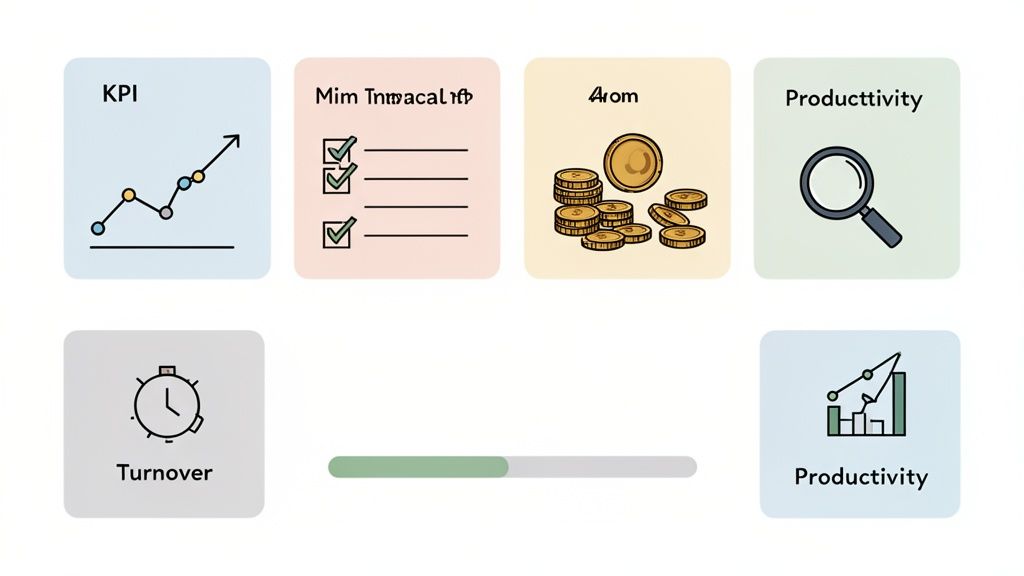
Engagement survey scores are a good pulse check, but they don't always grab a CFO's attention. To make a truly compelling case, you need to connect your efforts to the operational and financial metrics your leadership team obsesses over. It’s about learning the language of the business and understanding the principles of measuring event ROI for your entire program.
To do this effectively, you need to track the right data.
Key Metrics for Measuring Engagement ROI
The table below breaks down the most impactful metrics to track. These are the numbers that directly tie your people-focused initiatives to the company's performance.
| Metric Category | Specific Metric to Track | Business Impact |
|---|---|---|
| Retention & Turnover | Employee Turnover Rate (Voluntary) | Reduced costs for recruitment, hiring, and training new employees. |
| Productivity & Performance | Sales Quota Attainment, Project Completion Rates, Customer Satisfaction Scores (CSAT) | Higher output, improved quality, and better customer experiences. |
| Presence & Health | Absenteeism Rate | Increased daily productivity and reduced strain on team members covering for others. |
| Advocacy & Sentiment | Employee Net Promoter Score (eNPS) | Stronger employer brand, easier recruitment, and a more positive internal culture. |
By focusing on these areas, you start building a powerful, data-backed story that demonstrates the real value of investing in your people.
This is how you shift the conversation from, "We think people are happier," to, "Our program correlated with a 5% decrease in turnover and a 10% increase in sales quota attainment." That's a language every executive understands.
Build Your Engagement Dashboard
Don't just collect this data—share it. A simple, visual dashboard is the perfect tool for keeping leaders in the loop. You don't need a fancy BI tool; a clean spreadsheet or a single slide updated quarterly can work wonders.
This dashboard becomes your single source of truth, clearly linking your actions to their outcomes.
Sample Engagement ROI Dashboard
Here’s a straightforward template you can adapt. By tracking these metrics quarterly and annually, you can show clear trend lines over time.
| Metric | Baseline (Pre-Program) | Q1 | Q2 | Q3 | Q4 | Year-End Change |
|---|---|---|---|---|---|---|
| Employee Turnover Rate | 18% | 17% | 15% | 14% | 13% | -5% |
| Absenteeism Rate | 4.2% | 4.0% | 3.8% | 3.5% | 3.3% | -0.9% |
| Sales Quota Attainment | 65% | 68% | 72% | 75% | 78% | +13% |
| eNPS Score | +15 | +20 | +28 | +35 | +42 | +27 pts |
When you present the data this way, you create a compelling narrative. You’re no longer just running programs; you’re a strategic partner directly influencing key business goals. This is how you prove your impact and secure the investment you need to keep the momentum going.
Answering Your Toughest Employee Engagement Questions
Once you start mapping out your engagement strategy, the real-world questions and roadblocks always start to surface. Let’s be honest, figuring out how to engage employees is often about knowing what to do when things get tricky. Here are some straight-talking answers to the questions I hear most often.
How Much Should We Really Be Budgeting for This?
Everyone wants a magic number, but the truth is, your budget will hinge on your company's size, what you’re trying to fix, and the tactics you choose. A better way to think about this is to stop seeing it as a cost and start seeing it as an investment with a clear return.
For example, let's say you've calculated that low morale is costing your company $50,000 a year in turnover. Suddenly, investing $10,000 in a targeted offsite and a new recognition program doesn't sound like an expense—it sounds like a smart business decision with a potential 5x ROI.
If you're just starting out, think small and focused. Run a pilot program with a single department. Measure the results, show the impact, and use that data to build an undeniable case for a bigger budget next year.
A huge mistake is viewing engagement spending as a "cost." Frame it as what it is: an investment in keeping your best people, boosting productivity, and protecting the bottom line. The cost of doing nothing is almost always higher.
Do We Genuinely Need to Hire an Outside Speaker?
Not always, but bringing in an external expert can be an incredibly powerful move when the stakes are high. An outside voice offers a fresh perspective that cuts through the noise of internal politics and day-to-day familiarity. They bring instant credibility and can energize a room in a way an internal leader, no matter how respected, often can't.
Think about hiring a speaker for those key moments where you absolutely need to make an impact:
- Inspiring a reset after a tough quarter or a big reorganization.
- Introducing a big, complex new idea, like how AI will reshape your industry.
- Creating a truly memorable experience for a major event like a sales kickoff or annual leadership retreat.
For instance, having an inventor like Zach Rattner speak can make the abstract concept of innovation feel real and achievable for everyone, not just your R&D department.
How Do We Get a Skeptical Leadership Team on Board?
Look, skeptical leaders are wired to respond to data, not just feel-good initiatives. You have to stop pitching engagement with the "it's the right thing to do" angle and start speaking their language: the language of business results.
Build a business case they can't ignore. Use the same ROI thinking we talked about with budgeting and connect your proposed engagement plan directly to the metrics that keep them up at night:
- Employee Turnover Costs
- Productivity Numbers
- Customer Satisfaction (CSAT) Scores
Show them the numbers. Present your plan as a strategic solution to a tangible business problem. Arm yourself with baseline data, clear goals, and a solid plan for tracking the financial impact. When you frame engagement as a key driver of business performance, even the toughest skeptics will start to listen.
At Silicon Valley Speakers, we connect you with the builders, inventors, and visionaries who don't just talk—they inspire real action and deliver tangible outcomes for your team. Find the perfect voice to energize your next event by exploring our exclusive roster of keynote speakers.