
Before you can build a high-performing team, you need a blueprint. This isn't about chasing vague benchmarks or buzzwords; it's about getting brutally honest about where you are right now and defining what success actually looks like for your team.
The most critical piece of this puzzle? The leader. Your influence is the single biggest factor in creating an environment where people can truly do their best work.
Start by Defining Your Team's Blueprint for Success
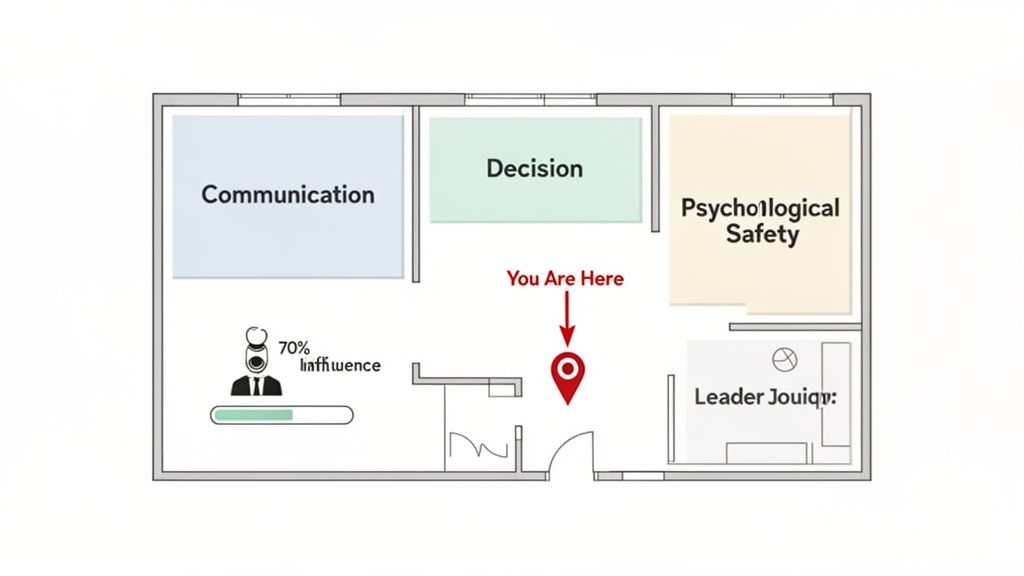
I've seen so many leaders jump straight into implementing new processes or tools, hoping for a quick fix. But you can't build a skyscraper on a shaky foundation. The first step is always to draw a "you are here" map.
This means taking a hard look at your team's reality. How does information really flow? Is communication open and honest, or do things get stuck in silos? How are decisions made? Is it a top-down mandate, or is there a clear, collaborative process? Answering these questions gives you a baseline to build from.
The Leader Is the Linchpin of Performance
The data on this is overwhelming. After studying over 183,000 teams for three decades, Gallup found that the manager single-handedly accounts for a staggering 70% of the variance in team engagement. Let that sink in.
Your direct influence largely determines whether your team soars or stalls. In fact, teams in the top quartile of engagement are 23% more profitable and see 18% more productivity in sales. Your ability to build psychological safety and clarity isn't just a "nice-to-have"—it directly impacts the bottom line.
Know the Difference: Are You a Group or a Team?
To build a truly high-performing team, you have to understand a fundamental distinction. A group is just a collection of individuals working in parallel, often with separate goals. A real team is a single, cohesive unit driven by a shared purpose.
A team is a cohesive unit aligned around a shared purpose. Team members depend on one another, support each other, and take both individual and collective ownership of outcomes. Their success is intertwined—when one person wins, the whole team does.
This isn't just semantics. Groups can be efficient for individual tasks, but they lack the magic ingredient—synergy—needed for real innovation and complex problem-solving. If you want that synergy, you have to intentionally design high-performance teams by creating structures for collaboration and mutual accountability.
Take an Honest Look at Your Current State
Now for the first truly actionable step: a candid self-assessment. This isn't about assigning blame. It's about identifying what's working so you can double down on it, and pinpointing the dysfunctions that are holding you back.
This quick table can help you get a pulse on where your team stands today. Be honest with your ratings.
Initial Team Performance Assessment
| Performance Pillar | Low Performance Indicator | High Performance Indicator |
|---|---|---|
| Communication | Information is siloed; feedback is rare or feared. | Information flows freely; constructive feedback is the norm. |
| Psychological Safety | People are afraid to admit mistakes or challenge ideas. | Team members feel safe to be vulnerable and take risks. |
| Decision-Making | Decisions are slow, unclear, or dictated from the top. | A clear, understood process exists for timely decisions. |
| Role Clarity | Responsibilities are vague; people aren't sure who owns what. | Everyone knows their role and how it connects to the team's goals. |
Once you have a clearer picture, you can start making targeted improvements.
Your personal leadership style is the thread that runs through all of this. For instance, the core ideas of transformational leadership—inspiring and motivating people toward a shared vision—are incredibly powerful here. You can learn more in our guide on what is transformational leadership to see how those principles apply.
By evaluating these pillars honestly, you create the blueprint you need to build a team that doesn't just meet expectations, but shatters them.
Finding and Welcoming Top Talent
You can't build an exceptional team with a mediocre hiring process. It's that simple. The work starts long before anyone’s first day, with a recruiting mindset that looks past just filling a seat. You aren’t just looking for someone who can do the job; you’re looking for someone who will make everyone around them better.
This means you have to get intentional about how you hire. Stop just matching keywords on a resume and start looking for people with different backgrounds and ways of thinking. This kind of cognitive diversity is what sparks real innovation and keeps your team from falling into the trap of groupthink. Two builder-leaders on our roster who can speak to this from first-hand experience: Adam Cheyer (co-creator of Siri, built and led Apple's Siri server-side engineering team after the acquisition; later VP of AI Experience at Airbnb) and Chris Barton (founder of Shazam, hired the team that built the technology MIT and Stanford experts said was impossible).
Hire for Character, Not Just Credentials
Sure, you have to confirm they have the technical chops. That’s table stakes. But the real magic happens when you start digging into the soft skills that separate a good employee from a great teammate—things like resilience, a genuine desire to learn, and the ability to collaborate without ego.
Here are a few practical ways to design your interviews to uncover these traits:
- Behavioral Questions: Ask for real stories, not hypotheticals. A question like, "Tell me about a time a project went completely off the rails. What part did you play, and what did you do to try and fix it?" will tell you more than any abstract scenario.
- Collaborative Exercises: Give the candidate a small, real-world task and have them work on it with a couple of your current team members for 30 minutes. Watch how they listen, how they contribute, and whether they help move the group toward a solution.
- Mindset Probes: You want people who are curious and driven. Ask something like, "What's a new skill you've taught yourself recently, and what was your process?" This gives you a window into their initiative and passion for growth.
This isn’t just a nice idea; it’s what the best organizations do. They build their teams with intention from the very start.
A Deloitte survey shows high-performing teams have broader skills (59% vs 26%), intentionally hire for diverse experiences (48% vs 16%), and are three times more likely to empower employees to shape their own roles. Coupled with McKinsey’s finding that top teams are 1.9 times more likely to see above-median financial performance when united on a vision, the business case is clear.
By focusing on these attributes, you’re laying the foundation for a team that can achieve and sustain excellence.
Onboard for Impact With a 90-Day Plan
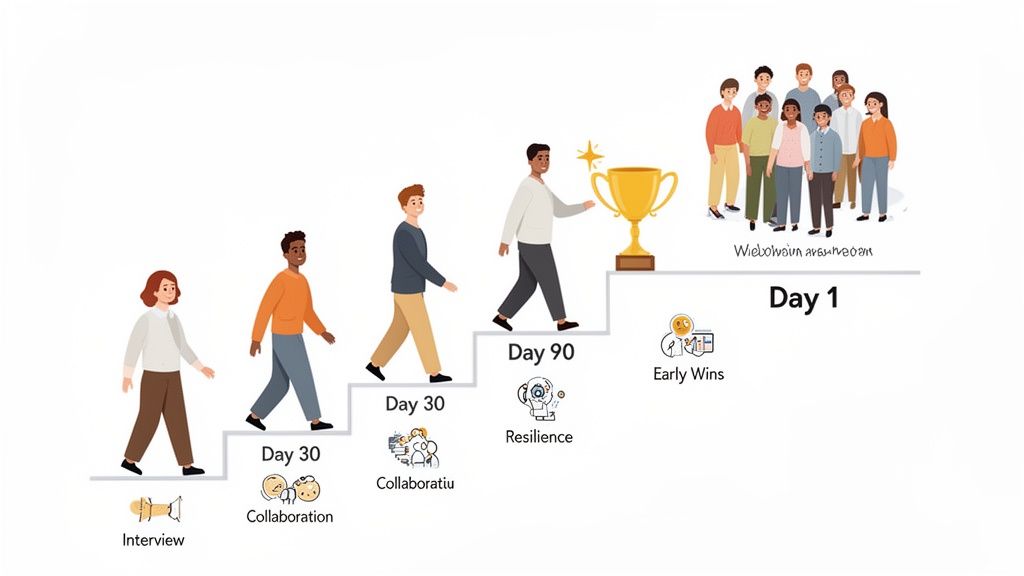
You've found the right person. Now the clock starts ticking. A weak onboarding experience can leave a new hire feeling disconnected and unproductive for months. A great one, on the other hand, gets them contributing and feeling like part of the team in weeks. A 90-day plan is the best tool I've found for this.
The First 30 Days: Connection and Clarity
This first month is all about getting them grounded. The goal is for them to build relationships and understand the lay of the land, not to move mountains.
- Give them an "onboarding buddy" who isn't their manager—someone they can ask the "stupid" questions.
- Set up short intro meetings with everyone on the immediate team.
- Make their role, their key performance indicators (KPIs), and the purpose behind their work crystal clear.
- Give them a small, low-risk project so they can score an early win and build confidence.
Days 31-60: Contribution and Feedback
Now that they have their bearings, it's time to shift focus toward making a more meaningful impact.
- Move them onto a more substantial project with clear goals.
- Lock in a weekly one-on-one to create a steady rhythm of feedback and coaching.
- Ask them to identify one process or workflow they think could be better. This empowers them to start thinking critically and take ownership.
Days 61-90: Ownership and Autonomy
By the three-month mark, your new hire should feel ready to take the reins.
- Let them take the lead on a small project or run a team meeting.
- Hold a formal 90-day review to talk about their progress, set goals for the next quarter, and—just as importantly—get their feedback on the onboarding process itself.
- Creating this kind of supportive structure is a hallmark of great leadership. If you're looking to build out your own management toolkit, you might find some useful ideas in these leadership development program examples.
This deliberate approach turns onboarding from a bureaucratic checklist into a strategic advantage, building confidence and accelerating a new hire’s journey to becoming a core part of your high-performing team.
Set Clear Goals That Create a Unified Direction
A team without a shared destination isn't really a team at all—it's just a group of people working on separate things. To build a truly high-performing team, you have to channel all that individual effort toward a common purpose. This is where a solid goal-setting framework, like Objectives and Key Results (OKRs), makes all the difference.
OKRs create a clear line of sight from the day-to-day work all the way up to the company's biggest goals. The structure is simple: the Objective is the big, inspiring "what" you're trying to achieve. The Key Results are the measurable outcomes that tell you "how" you’ll know you got there.
Craft Goals That Actually Inspire Action
Let's be honest, most corporate goals are dry and uninspiring. They feel disconnected from the real work. An effective objective does more than just assign a task; it gives the work meaning. It answers the "Why does this matter?" question for every single person on your team.
For instance, ditch a bland objective like "Improve the website." Instead, frame it as a mission: "Deliver a World-Class User Experience That Customers Love." See the difference? One is a chore, the other is a challenge the team can get excited about.
This process really boils down to three core ideas: inspiring a mission, defining how you'll measure success, and making sure everyone is pulling in the same direction.
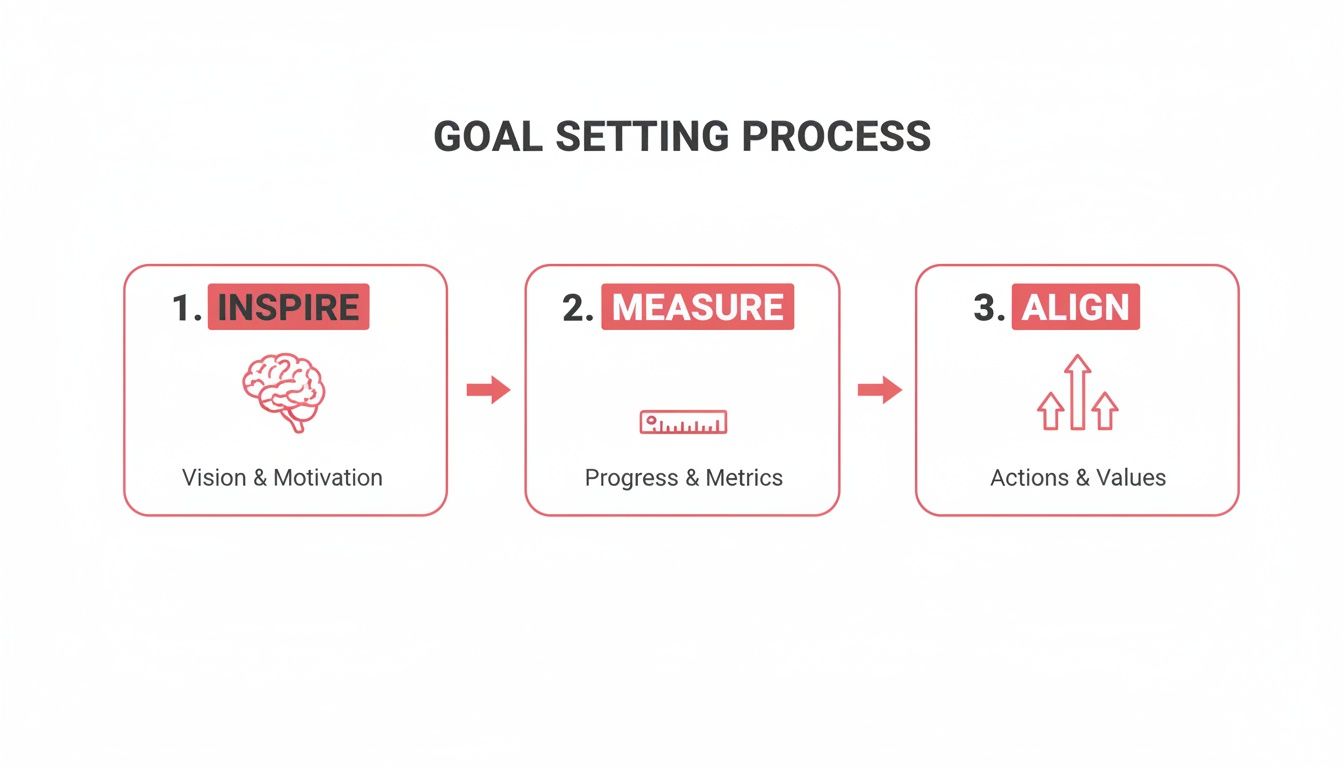
This simple flow is the engine that drives high-performance teams forward.
Go From Vague Ideas to Measurable Outcomes
An inspiring objective is a great start, but you need concrete Key Results (KRs) to bring it to life. Good KRs measure outcomes, not activities. "Launch three new features" is an activity. "Increase user engagement by 15%" is an outcome. Big difference.
Let's stick with our objective: "Deliver a World-Class User Experience That Customers Love." Solid Key Results might look like this:
- Increase the Customer Satisfaction (CSAT) score from 80 to 92.
- Reduce the user-reported bug rate by 50%.
- Achieve a 2-second average page load time.
These metrics are black and white. At the end of the quarter, you either hit them, or you didn't. Using a framework like SMART goals for performance management is a great way to make sure your KRs are always clear and measurable.
High-performing teams are 63% more likely than underperformers to have goals that are clearly articulated and widely understood. This isn't just a nice-to-have; it's the mechanism that allows autonomy and alignment to exist at the same time.
When everyone knows the score, they can make smart decisions on their own without needing constant hand-holding. This builds incredible speed and ownership.
A Real-World OKR Example
Picture a company gearing up to launch a new mobile app. If every department sets its own disconnected goals, you get chaos. Instead, they use OKRs to align everyone's efforts.
Company Objective: Successfully Launch Our Flagship Mobile App in Q3
- Engineering Team KR: Achieve 99.9% crash-free sessions in the first 30 days.
- Marketing Team KR: Drive 50,000 app downloads through targeted campaigns.
- Sales Team KR: Secure 10 enterprise pilot customers for the new app.
See how it all connects? Engineering’s focus on stability allows Marketing to promote a reliable app, which helps Sales secure pilots with confident customers. Each team's success directly contributes to the others.
Common Goal-Setting Mistakes to Avoid
Even with a great framework, it's easy to get goal-setting wrong. From my experience, here are the biggest pitfalls to watch out for:
Setting Too Many Goals: Don't do it. Stick to 2-3 big objectives per quarter. If you spread your team's focus too thin, you guarantee nothing gets the attention it needs to succeed.
Forgetting to Track Progress: Goals set in January and ignored until March are completely useless. Make progress a topic in your weekly meetings. A simple, "How are we tracking against our KRs?" is all it takes to keep them top-of-mind.
Cascading Instead of Aligning: Don't just push goals down from the top. The magic happens when you give teams the company's direction and empower them to set their own OKRs. This bottom-up contribution creates a powerful sense of ownership that you just can't fake.
4. Design the Rituals That Drive Performance
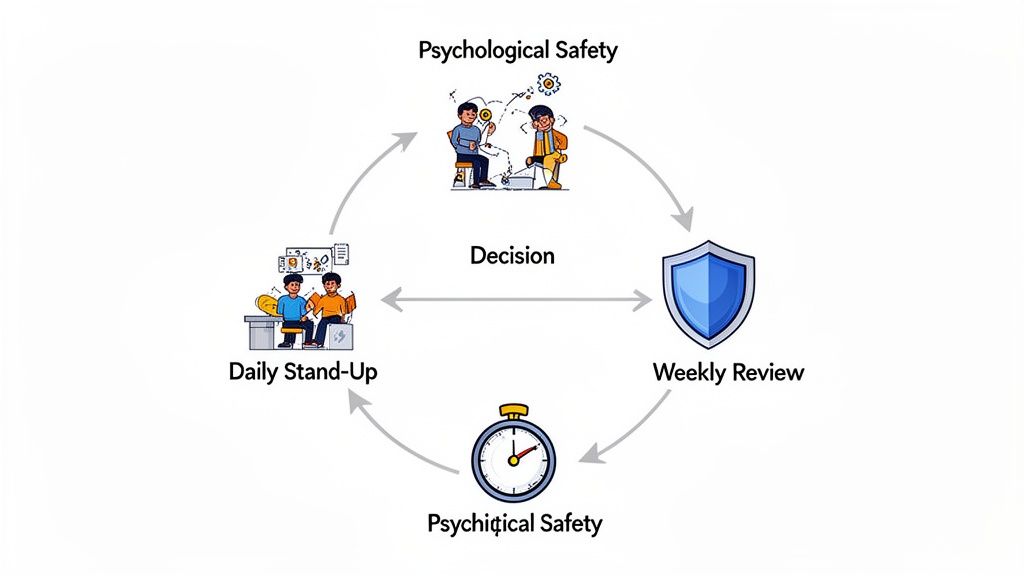
Consistent high performance is never a happy accident. It’s the direct result of intentional design. Think of it as building an operating system for your team—a set of reliable structures for communication, feedback, and decision-making that allows talent to thrive.
Without this system, even the most promising teams can fall into chaos. You'll see calendars packed with pointless meetings, a lack of clarity on who owns what, and a culture where no one feels safe enough to speak up. The goal is to replace that dysfunction with trust and momentum. It's a bigger problem than you might think; research shows a shocking 75% of cross-functional teams are dysfunctional. On the flip side, data from AIIR Consulting reveals that 37% of employees stick around because they love their team, proving just how critical these internal systems are.
Turn Your Meetings From Drains to Drivers
Most teams are drowning in meetings that accomplish nothing. A high-performance team, however, guards its time fiercely. Every meeting on the calendar should be seen as an investment, not a tax on productivity.
Start with a simple audit. Look at your recurring meetings and ask a blunt question for each one: "What is the specific, tangible outcome here?" If there isn't a clear answer, that meeting either needs a major overhaul or it needs to be deleted entirely.
At a minimum, you need to nail two core meeting types:
The Daily Stand-Up (15 minutes, tops): This isn't a status report for the boss. It's a quick-fire sync for the team to align and tackle blockers. Each person answers three simple questions: What did I get done yesterday? What’s my focus today? What’s standing in my way? That's it. The goal is visibility and rapid problem-solving.
The Weekly Tactical (60 minutes): This is your weekly checkpoint to review progress against your goals. The conversation should revolve around results and roadblocks. This is not the time for sprawling strategic debates—keep those separate to maintain focus.
Here’s a simple agenda I’ve used to keep our weekly tactical meetings sharp and productive.
Sample Weekly High-Performance Team Meeting Agenda
This 60-minute agenda helps keep the team focused on results, roadblocks, and recognition.
| Time (Mins) | Agenda Item | Purpose |
|---|---|---|
| 5 | Check-in & Wins | Start on a positive note. Share one personal or professional win from the week. |
| 10 | Scorecard Review | Quickly review the key metrics (OKRs). Are we on track? Where are the red flags? |
| 30 | Identify & Solve Issues | Discuss and resolve the most critical roadblocks. This is the core of the meeting. |
| 10 | Next Actions | Clarify who is doing what by when. Every action item needs a clear owner. |
| 5 | Wrap-up & Recognition | End with a quick summary and call out a team member who went above and beyond. |
This structure creates a predictable rhythm that the team can rely on, ensuring your time together is spent on work that actually moves the needle.
A great meeting leaves everyone feeling energized and clear on what's next. A bad meeting just leaves them drained and confused. The difference usually comes down to having a clear agenda and a facilitator who isn't afraid to keep things on track.
Build a Culture of Continuous Feedback
If you're waiting for an annual review to give feedback, you're already too late. In top teams, feedback is a daily, low-stakes habit, not a formal, once-a-year event. For this to work, you need a foundation of psychological safety—the shared belief that it’s okay to admit mistakes, ask for help, or challenge an idea without fear of blame.
As a leader, you have to model this behavior. Start by asking for feedback on your own performance and be transparent about your missteps. This signals that vulnerability is a strength. When you cultivate a Medalist Mindset, feedback stops feeling like criticism and becomes a tool for everyone to get better, together.
Here’s how to start weaving feedback into your team’s daily routine:
- Praise in Public: When you see great work, shout it out in a team channel or at the start of a meeting. Be specific about what they did and the impact it had.
- Critique in Private: Corrective feedback is best handled one-on-one. It preserves the person's dignity and creates a safe space for a real conversation.
- Make it a Two-Way Street: Regularly ask your team, "What’s one thing I could do differently to make your job easier?" This single question can radically improve your effectiveness as a leader.
Make It Clear How Decisions Get Made
Nothing kills momentum faster than ambiguity around decision-making. When people are unsure who has the final say, projects stall, and frustration builds. The fix is to be explicit about how a decision will be made before you start the discussion.
Not every decision needs a full team consensus. In fact, most don't. Sometimes, one person just needs to make the call. The key is transparency.
Consider using one of these models and telling the team which one you're using:
- Leader Decides: You make the final call. This is best for urgent or low-impact decisions where speed is essential.
- Leader Decides with Input: You gather ideas and perspectives from the team but retain the final say. This is perfect for complex issues where you need diverse viewpoints.
- Consensus: Everyone on the team must agree. Use this model very sparingly, and only for massive, hard-to-reverse decisions.
By defining the rules of engagement upfront, you build the trust and speed your team needs to not just perform, but to consistently outperform everyone else.
Coaching Your Team for Continuous Improvement
A high-performing team isn't a finished product. It's a living, breathing thing that needs constant nurturing to keep growing. As a leader, your biggest opportunity for impact is to shift your mindset from manager to coach—someone who is obsessed with the development of every single person on the team.
This isn't about micromanaging tasks. It's about nurturing talent for the long game.
When you get this right, you move past one-off training days and build a culture where learning is just part of the job. Skill development becomes a shared responsibility, and that’s when you unlock your team’s true potential for peak performance.
From Manager to Coach
Making the switch from manager to coach is one of the most powerful things you can do. A manager directs work, but a coach develops people. It means getting into a rhythm of real coaching conversations that play to individual strengths, tackle challenges, and line up with what people want for their careers.
In practice, this completely changes your one-on-one meetings. They stop being status updates and start becoming forward-looking development sessions. You'll find yourself asking less of, "What did you get done?" and more of, "What are you learning?" and "How can I help you grow?"
This approach shows you see your team members as people with their own ambitions, not just cogs in a machine. And the results speak for themselves. Organizations with a strong coaching culture are reportedly twice as likely to have high employee engagement and retention.
Adopt an Elite Athlete's Mindset
The best teams in business operate a lot like elite sports teams. Think about what it takes for an Olympic athlete like Shannon Rowbury to succeed. She didn't stumble into becoming a world-class runner; her success was built on deliberate practice, resilience, and a relentless focus on getting a little bit better every day.
We can bring these same ideas into our own teams:
- Deliberate Practice: This is about working smart, not just hard. Pick one specific skill an employee wants to improve—maybe it's presenting to executives or writing cleaner code. Then, create low-stakes opportunities for them to practice that exact skill and get immediate feedback.
- Resilience: Every team hits roadblocks. A coaching mindset helps you frame these moments as learning opportunities instead of failures. After a project goes sideways, your job is to lead the debrief and ask, "What did we learn, and how do we use that next time?"
- Marginal Gains: Big wins are almost always the result of many small improvements. Help your team find those 1% gains in their daily work. It could be a slightly more efficient workflow or a better way to kick off a client call.
An athlete has a coach to push them, hold them accountable, and point out their blind spots. Your team needs you to be that person. Your job is to create an environment where striving to be better is the default.
By adopting this mindset, you help your team build the mental and operational muscle to perform when it really counts.
Run Skill-Building Workshops
While one-on-one coaching is perfect for individual growth, group workshops are your secret weapon for leveling up the team's collective skills. These aren't your typical corporate training sessions. They should be interactive, hands-on experiences designed to solve a real problem.
Focus on a skill that will make a big difference for your team right now. For example, if your team is great at execution but struggles to come up with new ideas, a workshop on creative problem-solving could be the unlock. The key is to make it practical and immediately useful.
Here's a sample agenda for a half-day workshop focused on that very topic.
Sample Workshop Agenda: Creative Problem-Solving
| Time (Mins) | Activity | Objective |
|---|---|---|
| 15 | Warm-up | A fun, unconventional icebreaker to get people out of their analytical heads. |
| 45 | Deconstructing the Box | A group discussion on the common assumptions and mental blocks that kill creativity. |
| 60 | Ideation Toolkit | Teach and practice 2-3 simple brainstorming techniques (like Round Robin or SCAMPER). |
| 75 | Real-World Challenge | Break into small groups to apply the new techniques to a current, real-life business problem. |
| 30 | Pitch & Feedback | Each group presents their best idea, followed by constructive feedback from everyone. |
This kind of structured session ensures the team leaves not just with new information, but with the confidence to actually use it. By consistently investing in your team’s skills, you build a resilient, adaptable unit that's ready for whatever comes next.
Common Questions (and Real Answers) on Building a Great Team
Even the best-laid plans run into roadblocks. When you're in the trenches building a team, new questions and challenges pop up constantly. Here are some of the most common ones I hear from leaders, along with straight-to-the-point answers based on what actually works.
If I Can Only Focus on One Thing, What's the Most Important Factor?
So many things contribute to a high-performing team, but if you have to pick one, it all comes back to the manager. Nothing else even comes close. A great manager isn't just a boss; they're a coach who is genuinely invested in their people.
They obsess over making sure expectations are crystal clear, they find ways to let people work within their strengths, and most importantly, they build psychological safety so people aren't afraid to speak up, take risks, or fail.
Before you spend a dime on new software or a fancy initiative, look at your leaders. Are they equipped and supported? Giving them the training and freedom they need is the highest-leverage investment you can make. Even the most brilliant people will burn out or walk away under a bad manager.
How Do I Know if My Team Is Actually High-Performing?
It’s tempting to just look at the numbers, but that only tells half the story. Hitting targets is great, but if your team is a toxic, burnt-out mess, you don't have a high-performing team—you have a temporary success story with a high price tag. You need to measure both the "what" and the "how."
Outcome Metrics: These are the hard numbers you report up the chain. Think sales productivity, customer satisfaction scores (CSAT/NPS), hitting project deadlines and budgets, or overall profitability. These are your results.
Behavioral Metrics: These measure the health and sustainability of your team's culture. Are people engaged? Do they trust each other? Use team effectiveness surveys to get a pulse on communication and psychological safety. Keep an eye on employee engagement scores and, of course, how many people are choosing to leave.
A truly great team nails both. They deliver fantastic results while building a positive culture that people are excited to be a part of.
My Team Seems Checked Out. What's the First Thing I Should Do?
When you notice disengagement, the absolute first thing you must do is listen and diagnose. Don't jump to conclusions or roll out a solution. Disengagement is a symptom, not the disease. Your job is to find the root cause.
The best way to do this is to schedule one-on-one "stay interviews." These aren't performance reviews; they're informal chats designed to understand what it's like to be them right now.
Ask open-ended questions like, "What does a great day at work look like for you?" or "What are the biggest things getting in your way right now?" And the most critical question of all: "What's one thing I could do differently to better support you?"
Pay attention to the patterns that emerge. Usually, the problem boils down to a few core issues: goals are fuzzy, people don't feel seen or valued, or they're constantly hitting frustrating roadblocks. Once you know what the real problems are, you can work with the team to fix them. That collaboration alone helps build back engagement.
How Can I Do This With a Tight Budget?
You don’t need a huge budget to build a phenomenal team. In fact, some of the most powerful drivers of high performance are completely free—they just require your time and intention.
Forget expensive perks and focus on the fundamentals first. Start by creating radical clarity. Get the team together to build a charter that outlines your purpose, how you’ll treat each other, and your ground rules. When people know the why and the how, they can move forward with confidence.
Next, make consistent recognition a non-negotiable ritual. It doesn't have to be a bonus. A specific, timely "thank you" in a team meeting or a public shout-out in Slack can do wonders. It makes people feel seen.
Commit to a coaching rhythm. Block off time every single week for one-on-ones, and protect that time fiercely. This isn’t for status updates; it’s for talking about their growth, their challenges, and their careers.
Finally, learn to let go and delegate true ownership. Trust your people with meaningful projects from start to finish. Autonomy is one of the most powerful motivators there is, and it costs nothing.
Ready to inspire your team with a voice that has been there and done that? Silicon Valley Speakers connects you with world-class innovators, leaders, and pioneers who can energize your next event. Find your speaker and bring a story of true peak performance to your organization.