
You're staring at the version of the event brief that keeps circulating in Slack, and it still doesn't feel usable. The venue is asking for detail, the speaker wants context, finance wants a budget range, and the team keeps treating the document like a formality instead of the thing that should keep everyone aligned.
A strong event brief template fixes that because it turns scattered planning into one working document. The useful version is not a creative summary. It is the place where purpose, audience, budget, roles, risks, logistics, and success metrics live together, so nobody has to guess what matters later.
That's why the best briefs read more like operating instructions than marketing copy. For a useful framing on how event outcomes connect to business value, the guide to corporate event ROI is a solid companion read, especially if you're trying to connect event planning with measurable outcomes.
Why Most Event Briefs End Up Unread
The failure usually starts before the first draft is even shared. Someone writes a long brief, drops it into a folder, and assumes the job is done. By the time the speaker, venue, and internal stakeholders open it, the document is already out of sync with the decisions being made.
A brief gets ignored when it looks like a summary instead of a tool. The field names may be there, but the answers are vague, the audience is too broad, and the success criteria are either missing or impossible to check after the event. That creates the exact kind of confusion that forces people to make last-minute calls from memory instead of from a shared plan.
What a strong brief actually does
A working brief acts as a single source of truth across creative, logistics, and evaluation. It's where the team can see the event purpose, the target audience, the timeline, the roles, and the KPI targets in one place, which matters more than whether the language sounds polished. That is why modern templates increasingly include attendance, engagement, lead generation, and post-event actions, not just date and venue, because the brief now needs to support both execution and measurement.
For corporate teams, that shift matters. Executive meetings, sales kickoffs, customer conferences, and leadership workshops all pull in different stakeholders, and each group reads the brief for something slightly different. A planner may need venue and access details, while a speaker producer needs run-of-show timing and AV, and finance needs a budget frame that can support supplier quotes.
Practical rule: If a field can't help someone make a decision, book a supplier, or judge success later, it probably belongs somewhere else.
That's why a brief shouldn't be treated like a one-time memo. It should stay visible, get updated, and be used to keep the project grounded. If you want a planning companion that sits closer to the execution side, the corporate event planning guide at Silicon Valley Speakers fits naturally alongside this approach.
The Event Brief Template Field by Field
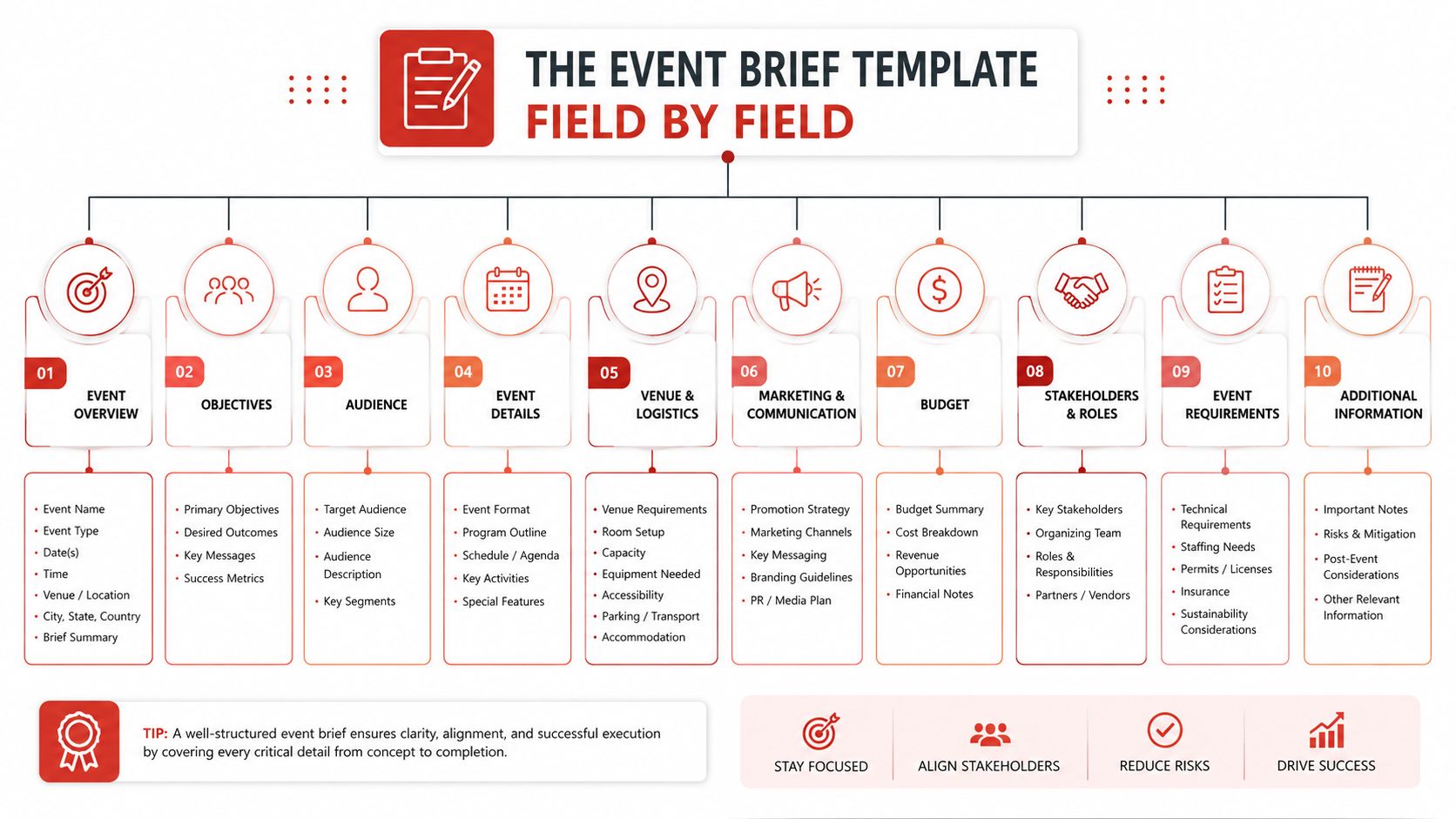
A usable brief starts with the decision that matters most, then adds the details that support it. The order matters because it keeps the document tied to outcomes instead of turning into a notes dump that no one uses.
Start with the objective and the success measure
Write one sentence that says why the event exists, then attach a measurable success criterion to it. That can be attendance rate, session completion, post-event conversion, or another concrete result that fits the event type. If you cannot tell whether the event succeeded after it ends, the objective is unfinished.
Add the audience and delivery constraints
Name the audience in a way that helps planning, not just targeting. “Senior leaders” is too thin on its own, because the content, tone, and format can change depending on whether the room is made up of sales leaders, technical managers, or external customers. You also note format, venue, accessibility needs, and any red lines that would limit the experience.
Capture the run of show and speaker needs
The schedule belongs in the brief because the speaker cannot work from a title alone. Include the session flow, length, transitions, and anything that changes how the speaker prepares, including panel format, fireside chat setup, or workshop interaction. If the event includes a keynote, that section should also clarify whether the speaker is there to inspire, teach, sell, or help the audience make a decision.
That speaker handoff is where many templates stop too early. A brief used for procurement and alignment should carry enough detail for a bureau or speaker team to judge fit, not just availability, and Silicon Valley Speakers leans on story-first matching at that stage so the conversation starts with audience needs, not a generic topic match.
Lock down production, budget, ownership, and risk
A brief gets operational once it starts naming AV, staging, technical needs, budget range, owners, and risks. Add the people responsible for content, marketing, and operations, then document what could derail the plan and who handles escalation. After the event, the same brief should support reporting against the metrics you set at the beginning, so the document carries the event from idea through evaluation.
The detailed template from the speaker run-of-show generator works well when you need the speaker handoff to match the planning document.
Here's the visual shorthand I use when I am pressure-testing a draft with a team:
| Field | Good answer looks like | Why it matters |
|---|---|---|
| Objective | One sentence | Prevents vague scope |
| Success measure | Measurable outcome | Makes review possible |
| Audience | Specific attendee profile | Shapes content and format |
| Format and venue | Live, virtual, or hybrid, plus location | Sets delivery constraints |
| Run of show | Timing and transitions | Keeps execution clean |
| Speaker needs | Topic, tone, role | Improves prep quality |
| Budget | Range and major drivers | Supports quoting |
| Owners | Named leads | Prevents dropped tasks |
| Risks | Real blockers and escalation | Reduces surprises |
| KPIs | Post-event measures | Ties planning to results |
Keep the brief short enough that a vendor can read it fast, but complete enough that they can quote against it without chasing you for basics.
Four Sample Briefs You Can Adapt Today
The same template works across very different corporate events, but only if the fields are filled with the right level of specificity. A keynote at a customer conference doesn't need the same emphasis as an internal AI workshop, even if both use the same brief structure.
| Sample | Primary Objective | Format | Headline Speaker Need |
|---|---|---|---|
| Customer conference keynote | Shape the event message and drive post-event momentum | Live keynote in a conference program | A speaker who can anchor the theme with a strong story |
| AI workshop for a product team | Build practical understanding and adoption | Hands-on internal workshop | An operator who can teach, not just inspire |
| Sales kickoff with keynote | Align the team around goals and energy | Multi-day meeting with a featured session | A high-energy voice that can connect to performance |
| Leadership offsite fireside chat | Support reflection, alignment, and decision-making | Small-group offsite conversation | A thoughtful moderator-friendly speaker with depth |
Tech keynote for a customer conference
The objective is usually to help attendees understand where the company is headed and why that matters. The audience is a mix of customers, prospects, and internal teams, so the brief has to make the message clear enough that the speaker can tie the product story to a bigger market point. The best version also specifies whether the keynote should open the event, reinforce a launch, or serve as the emotional center of the program.
AI workshop for a product team
The objective is practical adoption, not applause. That means the brief should emphasize the team's current skill level, the workflows they use, and the outcomes the workshop should support after everyone leaves the room. If the session is meant to support an internal capability shift, the speaker needs to know that this is a working session, not a polished keynote.
Sales kickoff with a featured keynote
This brief should name the business objective in plain language and tie it to the energy the room needs. Sales teams remember whether a speaker helped sharpen the message, raise confidence, and make the coming quarter feel possible. The strongest draft also makes the speaker's role clear inside the larger program, because a keynote at an SKO doesn't work the same way as a closing plenary or a breakouts-only event.
Leadership offsite built around a fireside chat
The brief should point toward reflection, not performance. A good fireside-chat brief gives context on leadership dynamics, the decisions on the table, and the tone the executive team wants in the room. That keeps the conversation from turning into a loose interview and helps the speaker show up with stories that fit the moment.
Speaker Team Checklist for the Final Week
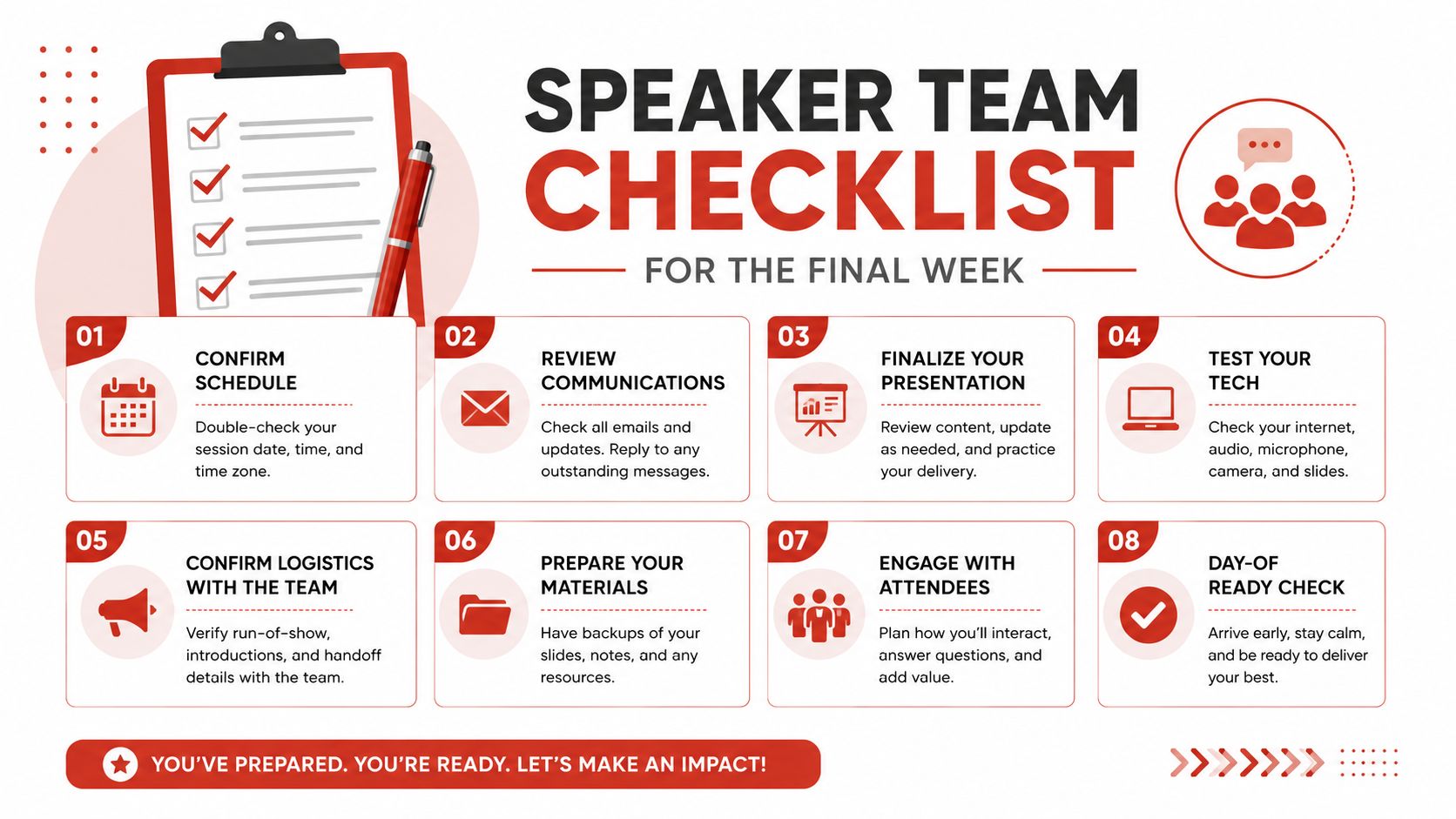
The final week is where an event brief stops being a planning artifact and becomes a working handoff. By then, the speaker team does not need more theory, they need the parts they can use immediately, the run-of-show, the AV contact, the approval path, and the constraints that keep everyone aligned.
The last-mile checklist that prevents misses
- Confirm the objective: The speaker and producer both need the event's primary goal and the one outcome that matters most.
- Verify the audience profile: Industry, seniority, mindset, and any special sensitivities should be spelled out.
- Check the timing: Arrival, sound check, session start, transition, and exit should all be mapped.
- Review AV and stage specs: Mic type, confidence monitor, clicker, lighting, and walk-on conditions need confirmation.
- Lock content approvals: Slides, talking points, and any sensitive references need sign-off before the speaker arrives.
- Flag accessibility needs: Captions, mobility access, room setup, and support needs belong in the handoff.
- Set dress and travel expectations: The speaker team should know what to wear, when to arrive, and who greets them.
- Plan follow-up: Post-event files, recordings, and thank-you steps need owners, not assumptions.
The strongest final-week handoff starts with a brief that already names owners and constraints, so the producer is not forced to reconstruct the plan from email threads. It also helps when the speaker team builds the session flow from a structured tool like this run-of-show resource, because the checklist in the final week is the last layer of the same operating document. That is the point many templates miss, the brief is not a creative summary, it is the living procurement and alignment file that keeps the right speaker, the right room, and the right delivery conditions pointed in the same direction.
Common Pitfalls and How to Dodge Them
Bad briefs tend to fail for the same reasons: vague objectives, broad audience descriptions, missing budgets, and risks treated as an afterthought. Once those gaps show up, the brief stops guiding decisions and becomes a document people skim before asking follow-up questions anyway.
The fixes that hold up
A better brief starts with tighter language. If the objective sounds like “engage customers” or “support leadership,” keep going until the team can point to a specific outcome later. Strong brief templates put success measures near the top of the document because the producer, speaker, and supplier all need the same target before they make trade-offs.
The audience section needs the same discipline. “Senior leaders” sounds specific until you have to shape content, choose a speaker, or plan the room experience. A real audience profile includes role, context, and any sensitivities that affect delivery, because those details change how the session should be built.
Budget is where a lot of briefs break down. Leaving it blank pushes decisions into email threads, and that is where scope creep starts. Venue and vendor quoting also goes sideways when the brief leaves out the practical details suppliers need, such as format, date and time, guest count, layout preference, and budget range.
A brief should help a supplier price the job, not force them to guess what the job is.
The most useful habit is to front-load stakeholder discovery before the brief is locked. Short conversations with people in marketing, finance, operations, and the program team surface conflicts early, which makes the final brief more realistic and easier to defend. That matters even more when the event includes hybrid elements, accessibility needs, or multiple approval layers. It also keeps the speaker briefing grounded in the story the room needs, which is where a story-first matching process like Silicon Valley Speakers uses can save time before outreach starts.
What to stop doing
- Stop writing vague goals: Replace mood language with a measurable outcome.
- Stop hiding budget pressure: Put range in the document early.
- Stop burying risks: List them where people will read them.
- Stop treating the brief as a creative summary: Make it usable for procurement, execution, speaker matching, and reporting.
If you use the template as a living operational document, the event team spends less time decoding intent and more time delivering the event.
Briefing a Speaker Bureau for the Right Match
A finished brief should make speaker matching faster, not noisier. The best handoff tells the bureau what the room needs, what the speaker must accomplish, and which stories will land with that audience. That's where a curated bureau beats a sprawling directory, because the conversation can start with fit instead of volume.
Silicon Valley Speakers uses a focused, story-first matching approach, which makes the brief especially important. Instead of asking for a generic inspirational voice, share the must-haves from the brief, the audience's real context, and the business outcome the session has to support. If you're booking around leadership, the speaker profile at this leadership keynote speaker page is a useful example of how theme, audience, and story can line up before outreach even starts.
What to send with the brief
- The event objective: Say what success looks like in plain language.
- The audience reality: Share who's in the room and what they care about.
- The tone and role: Clarify whether the speaker should energize, teach, challenge, or unify.
- The story angle: Identify the kind of breakthrough or lived experience that needs to connect.
- The practical constraints: Include format, timing, and any technical or travel needs.
A focused roster is useful because it shortens the match conversation. You're not asking someone to sort through a huge list of generic bios. You're asking for a speaker whose actual track record fits the room, which is a better way to protect the quality of a high-stakes event.
Silicon Valley Speakers is one option for that kind of booking process, since it connects event teams with keynote speakers and offers interactive workshop formats as well. The value of the brief here is simple. The clearer the handoff, the easier it is to land a speaker whose story supports the event instead of just filling a slot.
If you want your next brief to work, use it to align stakeholders, sharpen procurement, and make speaker selection easier from the start. Visit Silicon Valley Speakers to see how a story-first matching process can translate a solid brief into a speaker who fits the room and the business goal.
If the brief is written and the speaker slot is still open, three on our roster map cleanly to the sample briefs above: Adam Cheyer for a tech keynote at a customer conference, Dr. Maya Ackerman for an AI workshop, and Shannon Rowbury for a sales kickoff or all-hands.