
Think of a company workshop not as another meeting, but as a dedicated space for your team to roll up their sleeves and get things done. It’s less about one-way lectures and more about hands-on problem-solving, skill-building, and collaborative breakthroughs. If you have not yet picked the session, our corporate workshop ideas guide lays out 12 formats with durations and fees; this guide covers how to run whichever one you choose.
Why Company Workshops Are a Strategic Investment
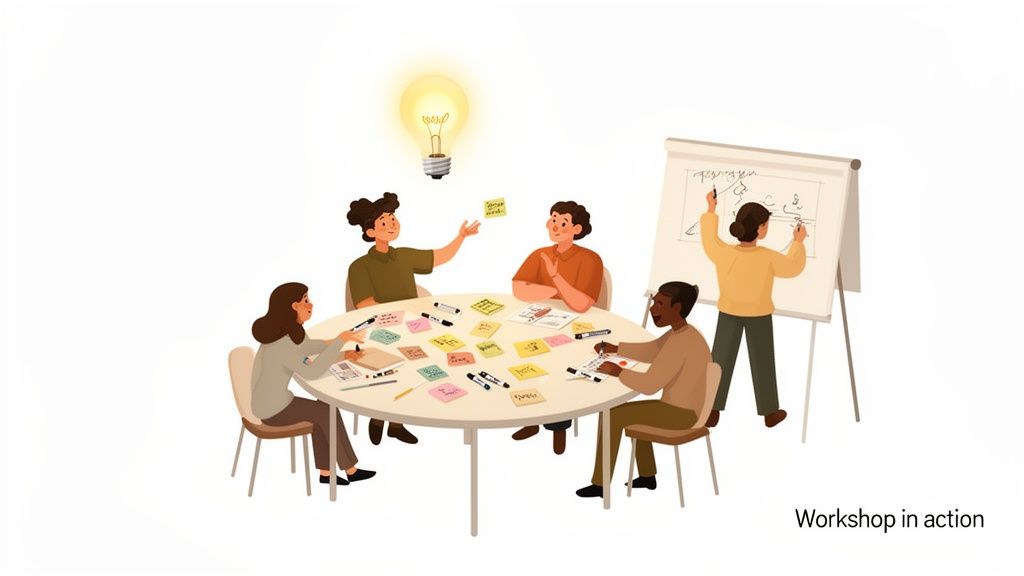
Let’s be honest. The word "workshop" can sometimes make people groan. They picture a stuffy room and an interruption to their "real work." But that's because they've likely been in a bad one.
A truly effective company workshop is the complete opposite. It’s a dynamic, focused session where theory gets put into practice. It’s where your team doesn't just hear about a new strategy, they actually start building it.
From Passive Learning to Active Doing
Think about the difference between watching a cooking show and actually being in the kitchen. A typical seminar is like the show—you passively absorb information. A workshop gets your team into the kitchen, chopping vegetables and working together to create something new.
This hands-on approach is what makes the experience—and the lessons—stick. When people are actively involved, engagement naturally goes up. A good workshop provides the structure for that to happen, making sure every person in the room has a chance to contribute.
A well-designed workshop connects people to each other and to the topic at hand. It lowers the barrier for participation, making it easier for team members to contribute their ideas and build skills collaboratively.
This active environment delivers real, immediate benefits:
- Tangible Skill Building: People learn by doing. They can practice a new sales pitch, get comfortable with new software, or work through a real leadership challenge right there in the room.
- Stronger Team Bonds: Working together on a shared task builds a sense of camaraderie and trust that’s hard to replicate in day-to-day work.
- Sparked Creativity: Pulling people out of their normal routine gives them the mental space to think differently, sparking fresh ideas and innovative solutions.
A Direct Investment in Your People
At the end of the day, a workshop is a powerful investment in your company’s most important asset: your people. Giving employees dedicated time to grow their skills and connect with colleagues shows them that you’re invested in their development.
That investment pays off in so many ways—from higher productivity and better morale to a more resilient and creative company culture. When you empower your people, you’re fueling the future of your business.
The Rapid Growth of Corporate Training
It’s impossible to ignore: corporate training is growing at an incredible pace, and for a very good reason. For a long time, many companies treated employee development as a nice-to-have, a perk they’d get to when they had extra time or budget. That’s simply not the case anymore. It's now a core business strategy for any company that wants to stay competitive.
The world just moves too fast to stand still. Technology is constantly changing, customer demands are always shifting, and the fight to attract and keep great people is fiercer than ever. Companies that get this know that investing in their own people is the single most reliable way to build a team that can handle whatever comes next.
Why the Investment in Training Is Skyrocketing
You don't have to take my word for it—the numbers tell a truly staggering story. The global corporate training market isn’t just growing; it's exploding. We're seeing a massive, worldwide commitment from businesses of all sizes to help their teams get better.
Just look at the market valuation. It was pegged at roughly USD 358 billion in 2026 and is on track to hit an incredible USD 740 billion by 2035. That’s a compound annual growth rate (CAGR) of about 8.94%, which shows this is a serious, long-term focus on talent. You can dig into the specifics in the full corporate training market analysis.
This kind of growth only happens when leaders see a clear, undeniable connection between training and bottom-line results. They are earmarking huge budgets for programs that deliver real improvements in performance, creativity, and keeping their best people from walking out the door.
Investing in your people is no longer optional. It's how you build a competitive advantage that can't be easily copied: a highly skilled, motivated, and deeply engaged team.
Company Workshops as a Primary Tool for Growth
So, where is all this money going? A huge chunk of it is being funneled directly into company workshops. Unlike watching a pre-recorded video or sitting through a generic seminar, workshops are active, hands-on, and focused. They’ve become the go-to tool for organizations trying to solve specific problems and jump on new opportunities.
More and more, companies are bringing in expert facilitators to run these sessions, and it makes perfect sense when you see why:
- Targeted Skill Building: A great workshop can be designed to fix a very specific skill gap, whether it's in leadership, a technical area, or soft skills like communication.
- Faster Learning: When people are immersed and actually doing things, they learn and retain information much faster than just listening to a lecture.
- Strengthening Culture: Getting teams together for a shared experience does more than just teach a skill—it reinforces the company culture and gets everyone pulling in the same direction.
This deliberate spending on expert-led company workshops shows that the business world has had a major realization. To get your teams ready for the future, you need more than just information. You need powerful, engaging experiences. As the business world gets even more complex, you can bet that the demand for high-quality corporate training will only keep climbing.
Choosing the Right Workshop for Your Business Goals
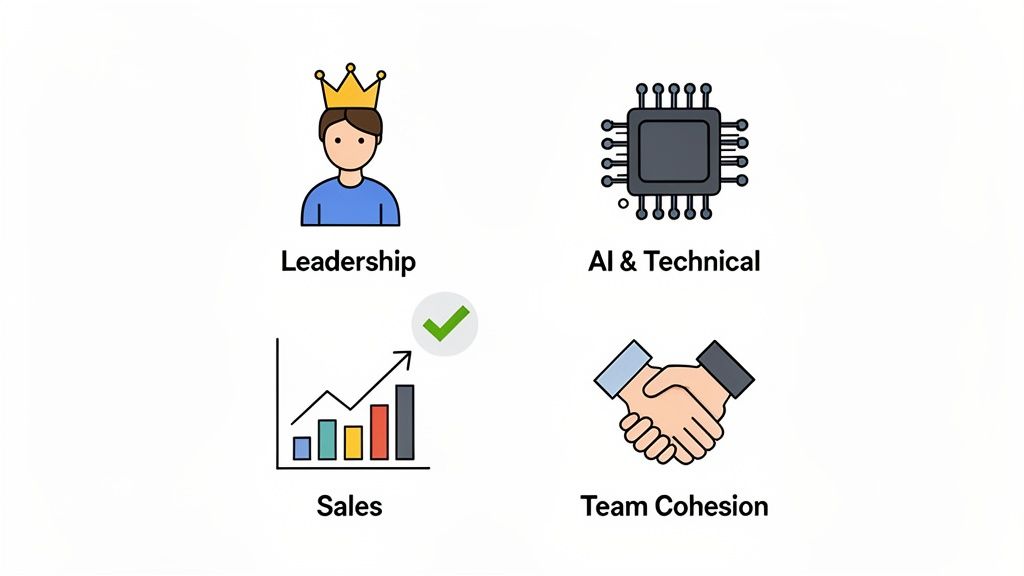
Picking the right company workshop is a lot like being a good doctor—you have to diagnose the problem before you write a prescription. A generic, one-size-fits-all session rarely fixes a specific business challenge. To see a real return on your event, you have to connect the workshop's content directly to what your organization is trying to accomplish. On the SVSB roster, speakers who actively offer workshops include Dr. Maya Ackerman (Awakening the Creative Spark in the AI Era), Drue Kataoka (Visual AI Skills & Tools), and Zach Rattner (From Pilot to Production: How to Launch and Lead an AI Initiative). Each was designed for a different audience — creative teams, executives, and product/innovation leads respectively.
The first step is always to ask, "What outcome do we actually need?" Are you trying to groom your next generation of leaders? Maybe you need to get your team up to speed on new technology. Or perhaps the goal is to fire up the sales team or just get everyone to communicate better. Each of these goals calls for a very different kind of workshop.
Leadership Development Workshops
You can't just expect people to become great leaders by promoting them. Leadership is a skill, and like any skill, it has to be learned and practiced. These workshops are designed to give your managers and executives the tools they need to guide their teams, navigate tough calls, and inspire people to do their best work.
A truly effective program skips the dry theory and jumps straight into real-world practice. Participants work on things like giving feedback that actually helps, managing conflict constructively, and creating a culture where people feel safe to speak up. When you invest in your leaders, you’re investing in the long-term health of your entire company.
A leader's real job is to create an environment where people can bring their A-game without fear. The right workshop builds the confidence and skill to build that kind of culture, which always leads to better engagement and people sticking around longer.
AI and Technical Skills Workshops
Technology doesn’t slow down for anyone, and keeping your team's technical skills sharp isn't just a "nice-to-have" anymore—it's essential for survival. Technical workshops, especially on topics like artificial intelligence, are your best bet for staying in the game. These sessions are all about making complex subjects understandable and giving people hands-on experience.
An "AI for Leaders" workshop, for instance, isn't going to teach your executives how to code. The point is to help them spot strategic ways to use AI, grasp the ethical side of it, and guide their people through big tech changes. For your more technical staff, these company workshops offer a full breakdown of new tools and methods so they can build and run modern systems effectively.
Sales Enablement and Performance Workshops
Your sales team is the growth engine of your company. Sales enablement workshops give that engine a much-needed tune-up. These sessions go way beyond just reviewing product features; they focus on the mindset, strategies, and skills that make the difference between an average salesperson and a top performer.
These workshops usually hit on a few key areas:
- Building a Peak Performance Mindset: Training on resilience, focus, and the mental toughness needed to handle rejection and stay motivated.
- Mastering the Sales Process: Honing practical skills in finding new customers, telling a compelling story, negotiating, and closing the deal.
- Adopting New Tools: Hands-on training with CRM software and other sales tech to make the team more efficient and data-driven.
When your sales team feels confident, prepared, and has the right tools, revenue growth tends to follow.
Team Building and Cohesion Workshops
A team isn’t just a list of names on an org chart. Real teamwork is built on trust, open communication, and a shared goal. Team-building workshops are specifically structured to strengthen those connections in a way that actually sticks.
Forget the awkward icebreakers and trust falls. Good team workshops today are about solving problems together and using activities that show how the team really operates under pressure. By helping people understand each other's communication styles and strengths, you can break down departmental silos and improve how everyone works together long after the workshop is over.
To see how these different programs come to life, you can explore a variety of expert-led programs by learning more about our hands-on workshops.
Matching Workshop Types to Business Objectives
Choosing the perfect workshop starts with a clear understanding of what you want to achieve. Not all workshops are created equal, and the best fit depends entirely on your specific business objective and which employees you're targeting.
This table is designed to be a quick reference guide, connecting common workshop types to the results they deliver and the audiences they serve best. Use it to find the training that will make the biggest impact on your organization.
| Workshop Type | Primary Business Outcome | Ideal Audience | Example Focus |
|---|---|---|---|
| Leadership Development | Stronger management, improved decision-making, and higher employee retention. | New managers, high-potential employees, and senior executives. | Conflict resolution, strategic thinking, and coaching skills. |
| AI & Technical Skills | Increased innovation, improved efficiency, and a competitive edge. | All employees, from leadership (strategic) to technical teams (hands-on). | "AI for Business Leaders" or "Python for Data Analysis." |
| Sales Enablement | Increased revenue, shorter sales cycles, and a more motivated sales force. | Sales representatives, account managers, and sales leaders. | Advanced negotiation tactics, CRM mastery, and value-based selling. |
| Team Building & Cohesion | Better cross-functional collaboration, reduced conflict, and a stronger company culture. | Intact teams, new project groups, or entire departments. | Communication styles (e.g., DiSC), collaborative problem-solving. |
By using this framework, you can move from simply "hosting an event" to making a strategic investment in your people and your business goals. A well-chosen workshop doesn't just teach skills—it solves problems.
Your Step-by-Step Workshop Planning Blueprint
A truly great workshop doesn’t just fall into place—it's built with purpose. Think of it like a blueprint for a house; you wouldn’t just start hammering nails and hope for the best. This is your blueprint for planning a workshop that actually gets results.
Following a clear plan means every decision you make, from the budget to the final agenda, is deliberate. It’s how you turn a simple meeting into an experience that delivers real value and makes your investment of time and money count.
Step 1: Define Your Workshop Objectives
Before you book a room or send a single email, you have to answer one simple, critical question: “What problem are we trying to solve?” Your answer to this will shape everything that follows. Vague goals like “improving morale” just won’t cut it.
You need to get specific and set goals you can actually measure.
Instead of: “Boost sales.”
Try: “Increase the average deal size by 15% in the next quarter by training the sales team on value-based selling techniques.”
Instead of: “Improve teamwork.”
Try: “Reduce cross-departmental project delays by 25% by training teams on a new collaborative project management framework.”
Think of these clear objectives as your North Star. They’ll guide your content, help you find the right facilitator, and, most importantly, tell you if the workshop was a genuine success.
Step 2: Identify and Understand Your Audience
Once you know what you want to accomplish, you need to figure out who you’re talking to. The roles, experience, and day-to-day challenges of your participants should completely dictate the content and tone of the workshop.
A workshop on AI for senior executives, for instance, should be all about strategy, ethics, and business impact. The same topic for a group of software engineers needs to get into the technical nitty-gritty of tools and code. Never assume you know what they need—just ask. A quick pre-workshop survey is a fantastic way to uncover their biggest pain points and expectations.
Step 3: Set a Realistic Budget
Your budget is the practical framework that defines what’s possible. It’s so much more than just the speaker’s fee, and mapping it out early on will save you from major headaches down the road.
Be sure to account for all the key moving parts:
- Facilitator and Speaker Fees: The cost for the expert leading the session.
- Venue and Catering: Room rental, food, and drinks for any in-person event.
- Technology and Software: Platform licenses, better cameras, or good microphones for virtual and hybrid setups.
- Materials and Supplies: Workbooks, handouts, and any other resources, physical or digital.
- Travel and Accommodation: For your facilitator and any participants who need to fly in.
Laying out a detailed budget helps you avoid surprises and make smart choices. You might realize that a highly-focused virtual workshop is a much better use of your funds than a scaled-back in-person event. For a full rundown of potential costs, our event planning checklist has you covered.
Step 4: Choose the Right Workshop Format
With your goals, audience, and budget locked in, you can finally pick the right format. Each one has its own strengths, and the best choice depends entirely on what you’re trying to achieve.
- In-Person Workshops: Nothing beats being in the same room for building deep connections and tackling sensitive topics. The energy is perfect for hands-on collaboration and strengthening team bonds.
- Virtual Workshops: These offer amazing flexibility and are much easier on the budget. They’re perfect for bringing teams together from all over the world for shorter, more focused skill-building sessions.
- Hybrid Workshops: By mixing in-person and remote attendees, you get the best of both worlds. This format expands your reach but requires some serious tech planning to make sure everyone feels equally included.
A critical barrier to workshop success is employee participation. Professionals often struggle to justify time away from daily tasks, which leads to low engagement. This highlights the need for high-impact, time-efficient workshops that deliver concentrated value and respect participants' demanding schedules. To find out more about this trend, you can read the full research on the corporate training market.
This challenge really drives home how important it is to pick a format that fits how your team actually works. A sharp, well-run virtual session might get way more buy-in than a full-day event that pulls everyone from their responsibilities. By following this blueprint, you stop just hosting an event and start designing an experience that truly delivers.
How to Design an Engaging Workshop Agenda
The difference between a good workshop and a truly great one often boils down to a single document: the agenda. A well-crafted agenda is so much more than a schedule. It's the story that guides your participants, turning passive listening into an active, collaborative experience.
A weak agenda just lists topics and times. A strong one tells a story with a clear beginning, middle, and end, where each part builds on the last. The trick is to stop thinking about what you need to cover and start thinking about what you want your attendees to do and feel every step of the way.
But before you even start scripting the day, you need a solid foundation. This simple workflow shows you exactly where to start.
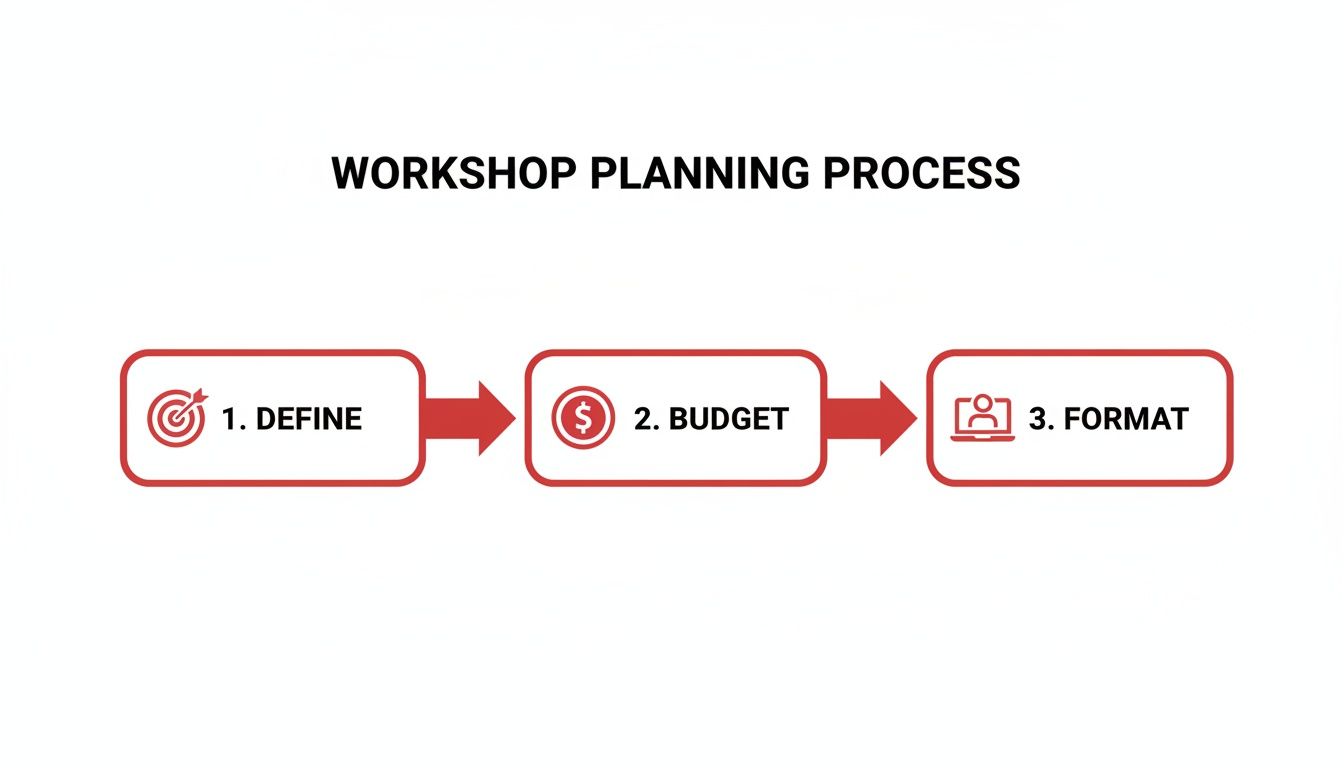
As you can see, defining your goals, locking in a budget, and picking a format are the non-negotiable first steps. Only then can you start mapping out the actual agenda.
Start with a Powerful Opener
The first 15 minutes of any company workshop set the entire mood. It's tempting to use those classic, get-to-know-you icebreakers, but they can often make people feel awkward and put on the spot. A much better approach is to use an opening activity that immediately connects people to the workshop's theme and to each other.
The right opener breaks down barriers and makes it feel safe for everyone to jump in later. Research actually shows that a relevant, low-pressure icebreaker makes people way more likely to participate throughout the day.
Here are a few simple ideas that work every time:
- The Anti-Problem: Instead of asking for the perfect solution, ask, "What would be the absolute worst way to solve this problem?" It's fun, takes the pressure off, and gets creative ideas flowing in an unexpected way.
- Draw Toast: A classic for a reason. Ask everyone to draw the steps for making toast. You'll get a huge variety of answers, which perfectly shows how differently we all view the same simple process. It's a great lead-in for collaboration.
- One-Word Goal: Have each person share just one word describing what they hope to get from the session. It's quick, focused, and gives you a real-time pulse check on the room's expectations.
Balance Learning with Doing
The heart of your agenda needs a healthy mix of learning and applying. Long lectures are a surefire way to see eyes glaze over. A great rule I always follow is the 20/80 principle: 20% presentation and 80% participation.
This means that for every block of time the facilitator spends sharing new concepts, you should plan a much longer block for attendees to roll up their sleeves and work with that information.
The goal of a workshop isn't just to transfer knowledge; it's to build skills. And skills are only built through practice. An agenda that prioritizes doing over listening is an agenda designed for real impact.
Weave In Interactive Formats
To keep the energy up and appeal to different learning styles, you have to mix up your formats. Relying on just one activity, like a big group discussion, gets old fast. A varied agenda keeps people engaged and makes the whole experience feel dynamic.
To give you an idea of how this looks in practice, here is a sample agenda for a half-day leadership workshop. Notice how the schedule intentionally moves between different types of activities to keep participants engaged for the full 4 hours.
Sample Half-Day Leadership Workshop Agenda
| Time Slot | Activity | Objective |
|---|---|---|
| 9:00 - 9:15 AM | Welcome & "One-Word Goal" Opener | Set a positive tone and align on individual goals for the session. |
| 9:15 - 9:45 AM | Presentation: The Coaching Mindset | Introduce the core concepts of effective leadership coaching. |
| 9:45 - 10:30 AM | Breakout Session 1: Real-World Scenarios | Apply the coaching mindset to solve a shared leadership challenge in small groups. |
| 10:30 - 10:45 AM | Group Share-Out & Discussion | Report key findings from breakouts and identify common themes. |
| 10:45 - 11:00 AM | Coffee Break | Provide a short break for networking and re-energizing. |
| 11:00 - 11:45 AM | Role-Playing: Difficult Conversations | Practice new communication techniques in a safe, structured environment. |
| 11:45 AM - 12:00 PM | Individual Action Planning & Closing | Commit to one specific action to implement and wrap up the session. |
As you build out your own agenda, think about incorporating a few of these proven formats:
- Breakout Sessions: Small groups are perfect for digging into a problem. Give each one a specific question to answer or task to complete, then bring everyone back to share the best ideas.
- Expert Q&A: A dedicated time for Q&A lets participants get answers to their specific, burning questions. It makes the content immediately relevant to their world.
- Role-Playing Scenarios: For skills like sales, feedback, or leadership, role-playing is invaluable. It lets people practice new behaviors without real-world pressure.
Building a detailed agenda and run of show can feel like a lot of work, but having that minute-by-minute plan is what makes an event run smoothly. For a great tool to help you structure your timeline, check out our free Speaker Run of Show Generator and make your planning a whole lot easier.
Measuring the True Impact of Your Workshop
So, the workshop is over. Everyone leaves smiling, and the feedback forms are glowing. But how do you know if you actually moved the needle? While it's nice that everyone had a good time, positive vibes don't prove the investment was worthwhile.
To show the real value of a company workshop, you have to dig deeper. You need a way to measure a genuine return on investment (ROI) by looking at both the human feedback and the hard data. It’s all about building a clear, evidence-based story that connects the dots between the training day and tangible business results. That's how you justify the budget and build a strong case for future programs.
Looking Beyond Satisfaction Surveys
The first shift in thinking is to move from asking, "Did you enjoy it?" to asking, "What can you do now that you couldn't do before?" This requires a much more thoughtful approach that zeroes in on actual skill development and behavior change.
Your measurement strategy should be a toolkit, not a single form, to capture the full story.
- Pre- and Post-Workshop Assessments: These are your best friends for proving learning happened. A quick quiz or a short scenario-based challenge before the workshop sets a baseline. Giving the same assessment afterward gives you undeniable proof that skills have improved.
- Follow-Up Surveys (30-60 Days Later): A survey right after the event captures the initial excitement. The real test is checking in a month or two later. Are people actually using the new frameworks? Are managers applying the coaching skills they learned? This is where you see if the training stuck.
The most powerful data shows that the lessons didn't just stay in the conference room. True success is when new skills and behaviors are woven into the fabric of daily work, leading to real, measurable improvements.
Connecting Training to Business Metrics
The strongest proof of a workshop's worth is its impact on key business numbers. This is where those objectives you set during the planning phase become so important. When you tie the workshop's goals to specific business outcomes from the start, you create a direct line between the training and its financial value.
For example, let's say you just ran a sales enablement workshop. Now it's time to watch the data.
- Sales Performance: For the next quarter, keep a close eye on metrics like average deal size, the length of the sales cycle, and close rates. Seeing a 10% jump in close rates among the attendees is a story you can take straight to leadership.
- Project Completion Rates: If your workshop was about project management or collaboration, check the data. Are projects getting finished faster? Are there fewer snags and revisions?
- Employee Retention: For workshops focused on leadership or team culture, monitor voluntary turnover rates in the departments of the managers who attended. A noticeable dip in turnover is a clear win for everyone.
When you gather this kind of evidence, you completely change the conversation around training. It stops being an expense and starts being seen for what it is: a strategic investment. You’ll have everything you need to show executives that a high-quality company workshop isn't just a line item—it's a direct driver of growth.
Common Questions About Company Workshops
When you get down to the brass tacks of planning a workshop, a few key questions always come up. Here are the straight-to-the-point answers we give event planners and HR leaders when they're in the final stages of organizing a great workshop.
How Much Should a Company Workshop Cost?
Alright, let's talk numbers. The cost can swing quite a bit, but your main line items will be the facilitator's fee and any related expenses. For a top-tier expert leading a half-day session, you can expect fees to land anywhere from a few thousand to over ten thousand dollars. This really depends on their reputation and how specialized the topic is.
But the speaker fee isn't the whole story. You'll also need to budget for:
- Venue and Catering: If you're hosting in person, this can be a major chunk of your budget.
- Technology: For any virtual or hybrid event, think about platform licenses, cameras, and microphones.
- Materials: This could be anything from digital workbooks to printed handouts for your team.
Getting your budget locked down early helps you make smart decisions without any last-minute financial surprises.
Don't think of your workshop budget as just another expense. See it as an investment. The right facilitator solves a real business problem, and that return on investment will dwarf the initial cost.
How Long Should a Workshop Be?
The perfect length is all about your goals. We've found that shorter, high-impact sessions almost always beat out long, drawn-out events.
- Half-Day (3-4 hours): This is the sweet spot for most topics. It gives you enough time to really dig in and practice a new skill, but not so long that people start checking their watches.
- Full-Day (6-8 hours): Save these for the big stuff—like in-depth strategic planning or complex new software rollouts where your team needs a lot of time for breakout sessions and hands-on work.
- Multi-Day: This format is perfect for intensive leadership retreats or when you're aiming for a complete team skill transformation.
It's always better to have a shorter workshop that leaves everyone energized and inspired than a long one that just fizzles out.
How Do I Choose the Right Facilitator?
Picking the right facilitator is probably the most critical decision you'll make. Don't just get wowed by a long resume. Instead, focus on their real-world experience. The best facilitators aren't just good speakers; they're practitioners who have been in the trenches and have actually solved the problems they're teaching.
Ask them for case studies. Ask for concrete examples of how their workshops helped other companies achieve their goals. A great facilitator should be able to connect their content directly to your business goals, making every minute of the session feel relevant and immediately useful for your team.
At Silicon Valley Speakers, we don't just represent speakers—we connect you with the visionaries and builders who have shaped industries. They deliver hands-on, high-impact workshops designed to solve your company's most pressing challenges. Explore our speakers and book your workshop today.