
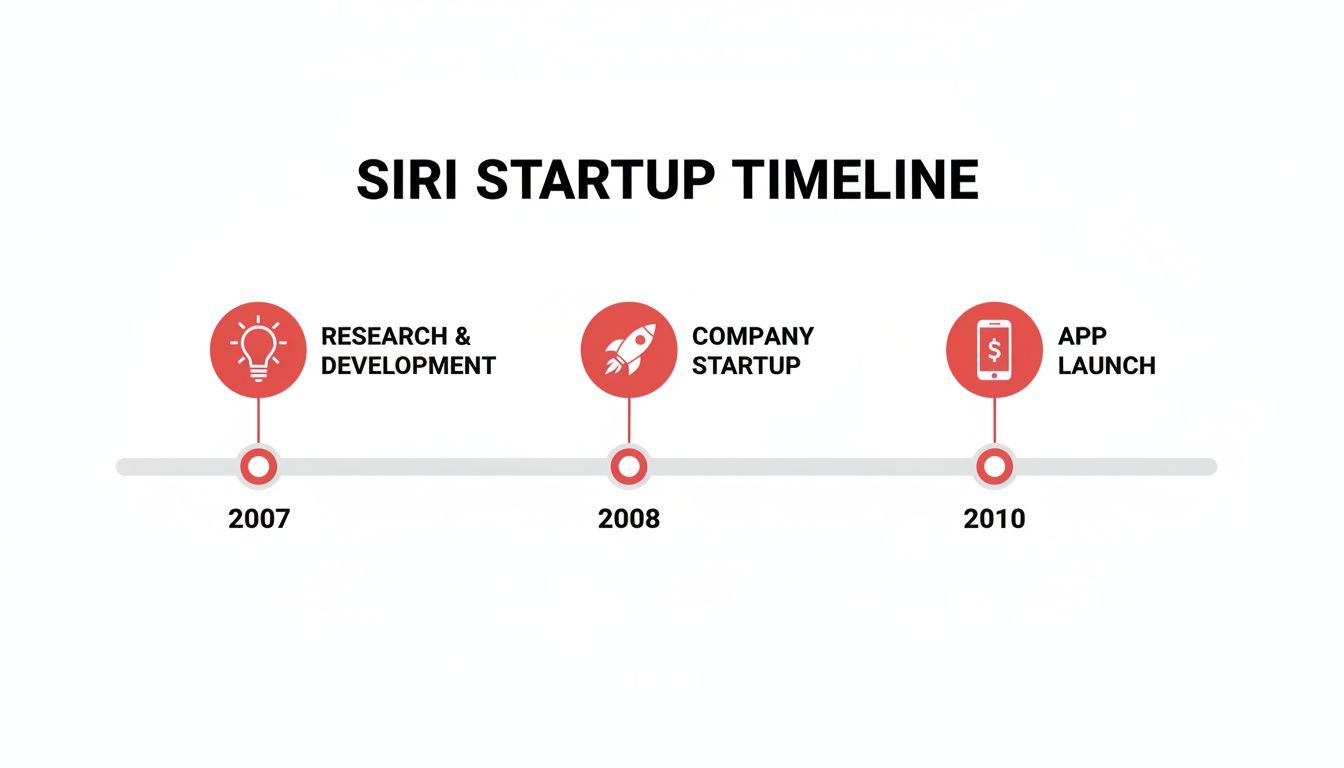
Siri was created by Adam Cheyer, Dag Kittlaus, and Tom Gruber. Whether you ask who made Siri or who invented it, those are the three names. They founded Siri Inc. in 2007 as a spin-off from SRI International, shipped a standalone iPhone app in February 2010, and sold the company to Apple two months later for a reported $200 million. Siri launched as the headline feature of the iPhone 4S on October 14, 2011.
Most people assume Apple invented Siri. Apple bought it. The technology was already five years old by the time it shipped on an iPhone, and it came out of one of the largest AI research projects the US government had ever funded.
Here is the actual story.
Who created Siri?
Adam Cheyer, Dag Kittlaus, and Tom Gruber created Siri. Cheyer engineered the AI that worked out what you were asking for. Gruber designed the conversation so it felt like talking to a person instead of typing a command. Kittlaus ran the company, raised the money, and picked the name. They incorporated Siri Inc. in 2007 as a spin-off from SRI International and put the first version on the App Store in February 2010.
Who invented Siri?
The same three people, though the invention predates the company by four years. Siri's core technology came out of CALO, a DARPA-funded research program that ran from 2003 to 2008 across 25 institutions, with Cheyer as Chief Architect at SRI International. Kittlaus and Gruber joined him to turn that research into something a consumer would actually use. Apple's part came later — it acquired Siri Inc. in April 2010 for a reported $200 million and shipped the result on the iPhone 4S.
The three founders
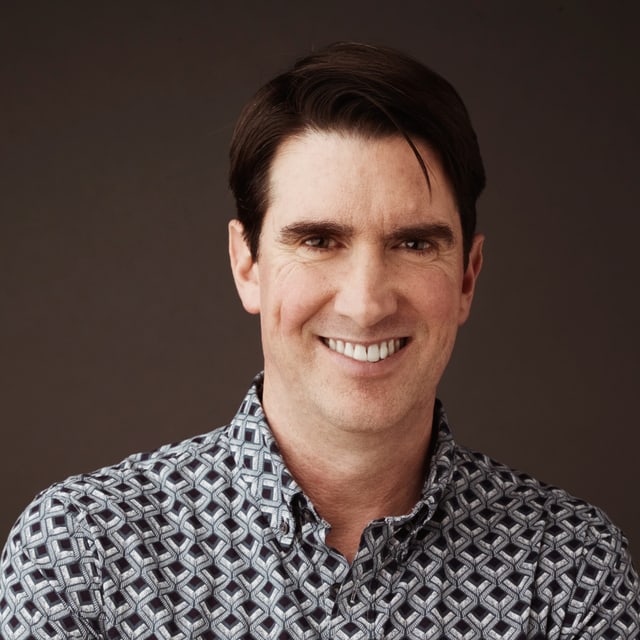
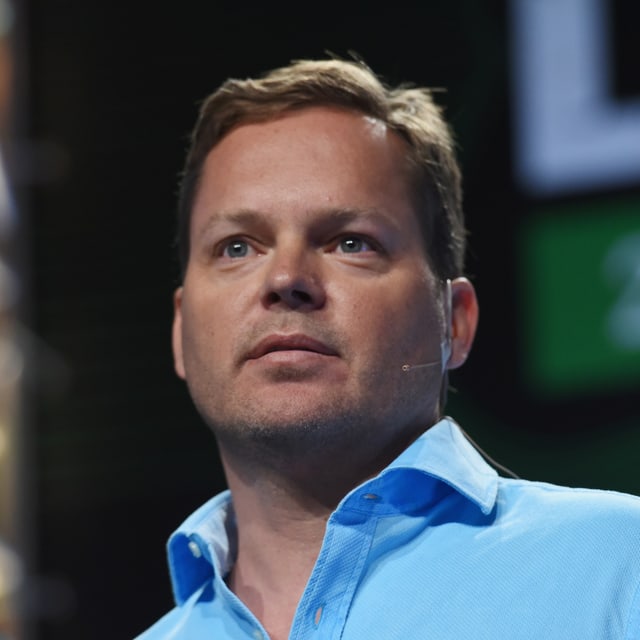

Each founder owned a different part of the original Siri app.
| Founder | Role | What they did |
|---|---|---|
| Adam Cheyer | Co-founder, VP of Engineering | Engineered the AI system that made Siri actually work. Came directly from leading CALO's architecture at SRI International. |
| Dag Kittlaus | Co-founder, CEO | Commercial vision, fundraising, partnerships. Norwegian roots — chose the name "Siri" after a former colleague he admired. |
| Tom Gruber | Co-founder, Head of Design | Made it feel like a person you could talk to instead of a command line. The user-experience layer that turned a research demo into a consumer product. |
Cheyer's engineering, Kittlaus's business sense, and Gruber's design instincts were what got Apple's attention. None of the three would have shipped the original Siri app alone.
The DARPA project that became Siri
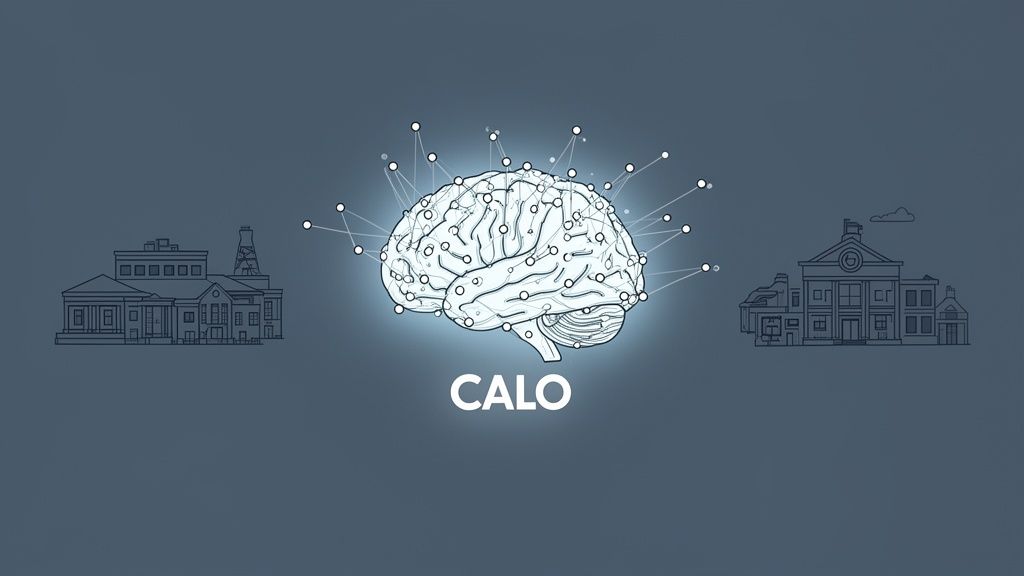
Before the iPhone, Siri's core ideas were being tested in CALO — short for Cognitive Assistant that Learns and Organizes. DARPA funded it. The goal was a personal AI that could help military commanders cut through information overload in the field. CALO ran from 2003 to 2008 with a budget over $150 million, making it one of the largest AI investments of its era.
CALO pulled together 25 research institutions and dozens of AI subsystems — natural language, planning, reasoning, learning, knowledge representation. Each institution was world-class at one piece. The hard part was making the pieces work together.
Adam Cheyer was the architect for that integration. As Chief Architect at SRI International, his job was to wire the disparate AI systems into a single working assistant. The project hit its annual milestones, demonstrated real utility in unstructured environments, and proved the underlying claim: a proactive, learning assistant could move from research into production.
That proof of concept is what gave the founders the conviction to spin out.
When was Siri created?
There are three answers depending on what you mean by "created."
2003 — research began. CALO, the DARPA project Siri's technology came out of, kicked off at SRI International. Adam Cheyer led the engineering integration that would later become the Siri brain.
2007 — Siri Inc. was founded. Cheyer, Kittlaus, and Gruber spun the work out of SRI as a commercial company. This is the year most historians cite when they say "Siri was created in 2007."
February 2010 — the consumer app launched. The first version of Siri shipped on the iOS App Store as a standalone app, two years before Apple bought the company and rebuilt it into the iPhone.
When people ask "when was Siri invented," the most accurate single date is 2007, the year the standalone company started building the consumer product.
From research project to startup
CALO was a government-funded research project. It wasn't a product. To bring the technology to consumers, the team had to leave SRI, raise venture capital, and rebuild the system as a shippable app.
Cheyer, Kittlaus, and Gruber did exactly that. They started Siri Inc. in 2007 and spent two years compressing CALO's 25-institution architecture into a single iPhone app. The mission was narrow: turn the messy, complex AI into something a regular person would use to book a dinner reservation or a concert ticket.
The result shipped on the iOS App Store in February 2010. It was a real product, not a demo. Out of the gate, the original Siri app could connect to OpenTable, StubHub, MovieTickets, and a dozen other services. You could ask it to book dinner at a specific restaurant for a specific time, and it would do it. That kind of voice agent — one that actually got things done — was rare in 2010 and is still rare today.
The app got immediate attention. One of the people paying attention was Steve Jobs.
The Apple acquisition
A single meeting was enough. Steve Jobs saw the original Siri app, understood what it was, and wanted Apple to own it. His vision was bigger than a standalone consumer app — he wanted Siri built directly into the iPhone.
On April 28, 2010, Apple bought Siri Inc. for a reported $200 million. Adam Cheyer and most of the team moved to Apple, where Cheyer became Director of Engineering. They had eighteen months to take an app designed for thousands of users and rebuild it for hundreds of millions on launch day.
Cheyer's team had to redesign the backend for global scale, support a wide range of accents and languages, and lock in the integrations that would make Siri useful at the moment it shipped. The work happened mostly in private. Apple announced nothing publicly between the acquisition and the launch.
On October 14, 2011, the iPhone 4S shipped with Siri as its headline feature. AI assistants stopped being a research curiosity and became something millions of people used the same week.
For most of the public, the question "who made Siri?" got the simple answer: Apple. The longer answer — DARPA, SRI, the three founders, the standalone app — got compressed out of the story.
Who owns Siri now?
Apple has owned Siri since April 28, 2010. The original company, Siri Inc., no longer exists as a standalone entity. Apple absorbed the team, the technology, and the brand, and rebuilt the product as a system feature of iOS starting with the iPhone 4S in October 2011.
Siri now runs on more than two billion active Apple devices — iPhones, iPads, Macs, Apple Watches, Apple TVs, AirPods, and HomePods. None of the three original founders still work at Apple. Kittlaus and Cheyer left in 2011 and 2012 respectively to start Viv Labs. Tom Gruber stayed the longest before leaving in 2018.
What Adam Cheyer did after Siri
Siri wasn't a one-off for Cheyer. After Apple, he co-founded:
- Viv Labs — a more powerful, more open AI assistant that aimed past Siri's limitations. Samsung acquired Viv to become the brain behind Bixby, now on 500+ million devices.
- Sentient Technologies — a massively distributed machine-learning company applied to finance and biomedical research. Acquired by Cognizant.
- GamePlanner.AI — AI tools for decision-making. Acquired by Airbnb as their first acquisition as a public company.
He's also a founding member of Change.org, holds 50 patents, and most recently led AI Experience at Airbnb.
The pattern — build, ship, exit, build again — is unusual at any technical level. It is rare at Cheyer's level of AI depth.
Watch Adam tell the story himself
Book Adam Cheyer for your AI keynote
Silicon Valley Speakers is run by Adam's son, Noah Cheyer. If you're planning an event where the audience can tell the difference between a builder and a pundit, visit Adam's speaker page to see how he tailors his keynote for your audience.
Common questions about Siri's creation
Did Steve Jobs create Siri?
No. The startup Siri Inc., founded by Adam Cheyer, Dag Kittlaus, and Tom Gruber, created Siri. Steve Jobs saw the original app on the App Store, recognized what it was, and drove Apple's acquisition in 2010 — but the technology and the team that built it came from outside Apple.
What company owns Siri?
Apple Inc. has owned Siri since April 28, 2010, when it bought the original company Siri Inc. for a reported $200 million. Siri now operates as a built-in feature across all major Apple devices.
What does the name "Siri" mean?
Dag Kittlaus chose the name. He has Norwegian roots, and "Siri" is a short form of the Old Norse name Sigrid — meaning roughly "beautiful woman who leads you to victory." It was also the name of a former colleague Kittlaus admired. The name was meant to be short, easy to say, and brand-friendly — not an acronym.
Are Siri's original creators still at Apple?
No. All three founders left Apple within a few years of the acquisition. Adam Cheyer co-founded Viv Labs (sold to Samsung as Bixby) and several more AI companies. Dag Kittlaus left to start Viv alongside him. Tom Gruber stayed at Apple longer before leaving in 2018.
What was CALO?
CALO stood for "Cognitive Assistant that Learns and Organizes." It was a $150 million DARPA project that ran from 2003 to 2008 across 25 research institutions, led on the engineering side by Adam Cheyer at SRI International. Its goal was a personal AI assistant for military commanders. Most of the foundational technology behind Siri came out of CALO.
Was the original Siri app available on the App Store?
Yes — for about two months, from February to April 2010. Apple bought Siri Inc. on April 28, 2010, and the standalone app eventually disappeared. Siri returned to the public on October 14, 2011, built into the iPhone 4S.
Related: How to find and hire a keynote speaker for your next event, Top AI keynote speakers for 2026 corporate events.
Want the person who built it on your stage?
Adam Cheyer, who co-created Siri, now keynotes on what shipping the world's most recognized AI assistant taught him about building under uncertainty. Check Adam Cheyer's keynote availability with Silicon Valley Speakers.