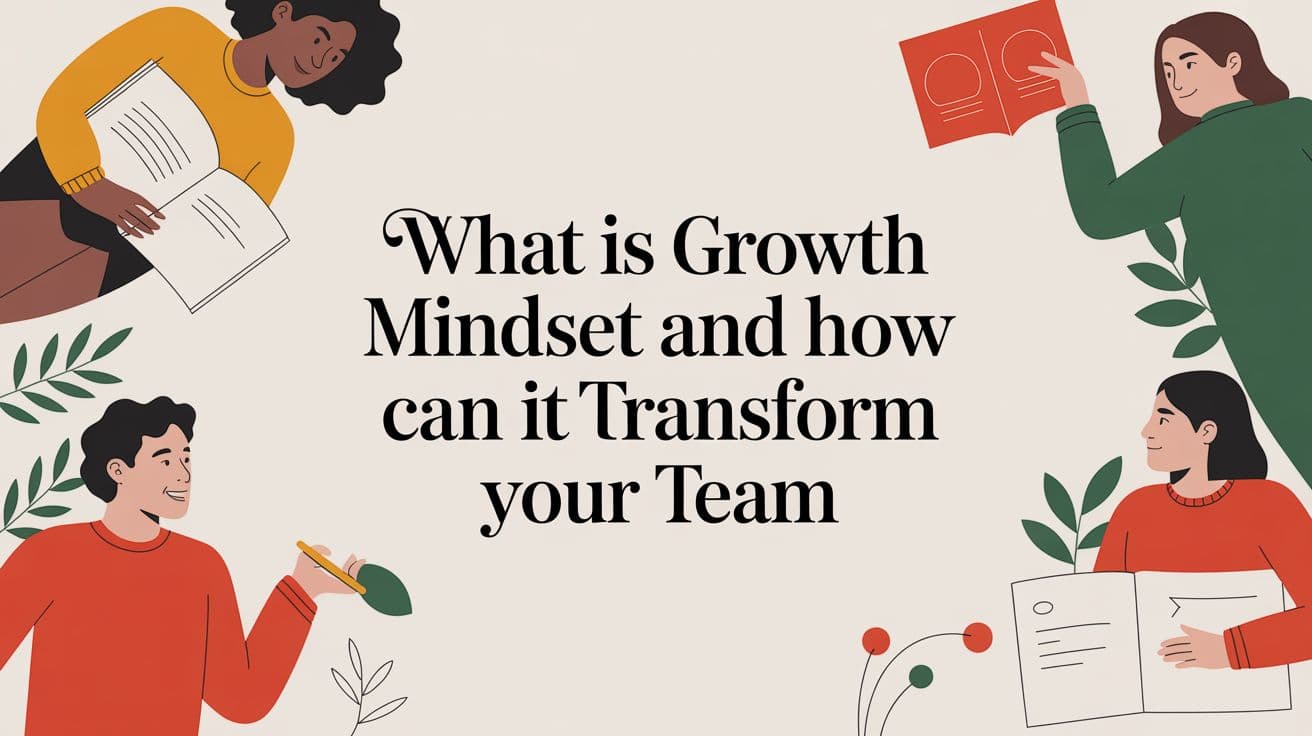
At its core, a growth mindset is the simple, powerful belief that your abilities aren't set in stone. It’s the understanding that you can develop your intelligence and talents through dedication, smart strategies, and learning from your mistakes.
Think of it like building muscle at the gym—the more you work at it, the stronger you get.
What Is a Growth Mindset Really?
The whole idea, which comes from years of research, boils down to one simple but profound shift in thinking. It’s the difference between saying "I can't do this" and "I can't do this yet."
That one little word, yet, changes everything. It reframes a dead end as a pathway forward. It turns a statement of permanent failure into a temporary state on a journey of improvement.
Learning to ride a bike is a perfect real-world example. Nobody is born a cyclist. You wobble, you fall, and you get a few scrapes along the way. Each attempt, whether you succeed or stumble, is actually building new connections in your brain. Someone with a growth mindset views a tough business challenge—like mastering a new software or launching into an unfamiliar market—the exact same way. The struggle isn't a red flag showing you're not good enough; it's just part of the process.
The Two Core Mindsets
This theory really highlights two opposite ways we can look at our own capabilities. To make it crystal clear, let's break down the differences between a growth mindset and its counterpart, a fixed mindset.
Growth Mindset vs. Fixed Mindset at a Glance
This table shows just how differently these two mindsets operate in our daily thoughts and actions.
| Aspect | Growth Mindset (The Belief in 'Yet') | Fixed Mindset (The Belief in 'Is') |
|---|---|---|
| Core Belief | Intelligence and skills can be developed. | Intelligence and skills are innate, fixed traits. |
| Challenges | Embraced as opportunities to grow. | Avoided to prevent revealing weaknesses. |
| Effort | Seen as the path to mastery. | Seen as fruitless; if you need effort, you lack talent. |
| Feedback | Welcomed as a source of learning. | Taken personally and often ignored. |
| Setbacks | Viewed as wake-up calls to work harder or try new strategies. | Blamed on others or seen as proof of inability. |
| Success of Others | Inspiring and a source of lessons. | Threatening and a source of insecurity. |
As you can see, the perspective you hold has a massive impact on your behavior, resilience, and ultimate success.
The difference between these two mindsets isn't just a fun psychological theory; it has very real consequences for any team. Imagine a sales department misses its quarterly target.
A team stuck in a fixed mindset might think, "Well, we're just not natural sellers," or "This product is a dud." They'd likely feel defeated and dread the next quarter, expecting the same outcome.
But a team with a growth mindset would approach it totally differently. They’d be asking, "Okay, what can we learn here? Which of our strategies fell flat? What new approaches can we test drive next month?" They see the missed goal not as a final judgment, but as valuable feedback to make them better.
A growth mindset isn't about simply having a positive attitude. It’s a framework for active engagement, where you believe your own effort and learning strategies directly lead to improvement and development.
This is exactly why leaders need to get a handle on what a growth mindset truly is. It's not a soft skill or a nice-to-have. It's the strategic bedrock for building adaptable, resilient teams that don't just survive change but actually get better because of it. When you encourage this belief, you’re giving your people permission to learn, fail, and grow—turning every challenge into a launchpad for what's next.
The Business Case for a Growth Mindset
So, we’ve covered the basics of a growth mindset. But for any leader, the real question is simple: what’s the ROI? It’s one thing to talk about a nice-to-have principle, but it’s another thing entirely to build a core business strategy around it. The proof, as they say, is in the pudding—and the data shows that a growth mindset isn't a soft perk. It’s a powerful driver for a real competitive edge.
When your teams truly believe their skills can be developed, their entire approach to work changes. They stop just checking boxes and start hunting for ways to improve a process, crack a tough problem, or invent something new. This shift has a direct line to productivity, engagement, and your company's ability to stay ahead of the curve.
This image paints a clear picture of the difference between teams stuck in a fixed mindset and those who embrace growth.
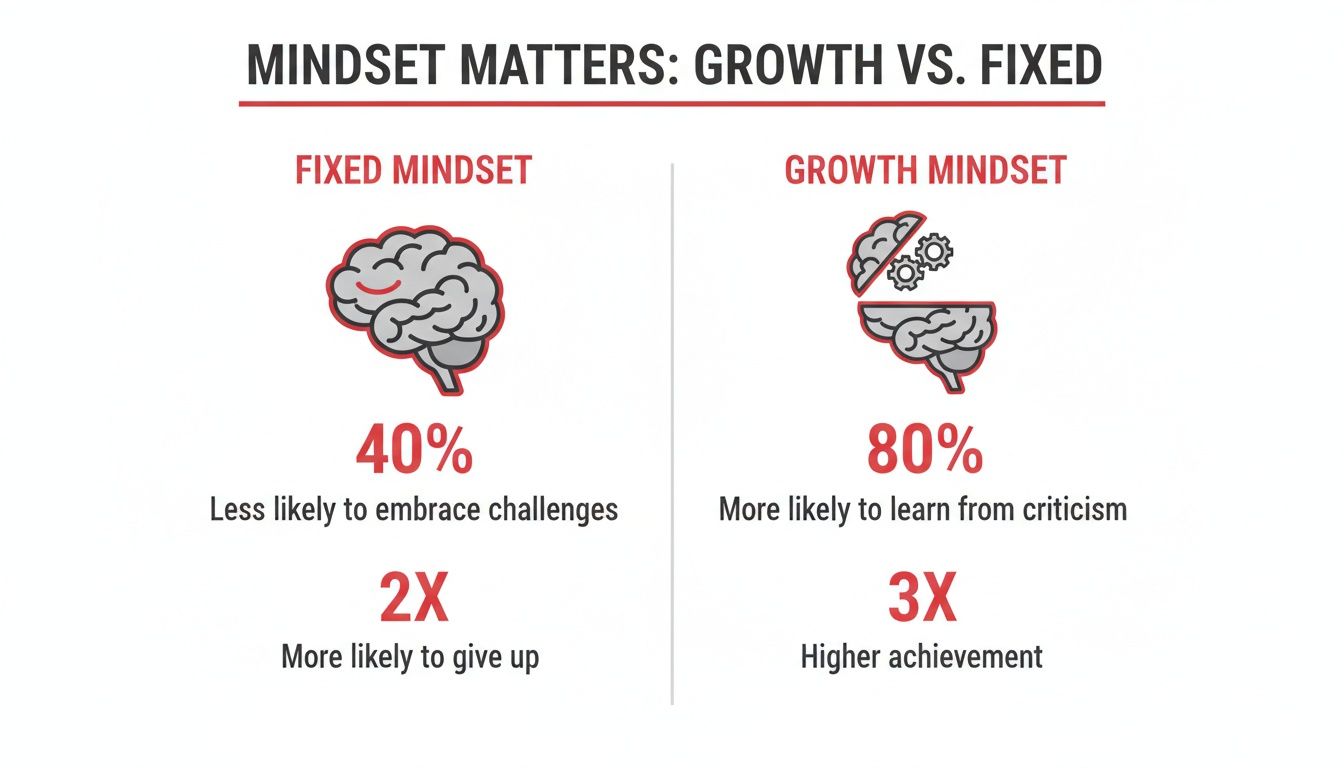
The contrast is stark. A culture built on growth leads to higher achievement and a willingness to actually use feedback, two things every organization needs to thrive long-term.
Driving Profitability and Performance
Organizations that get this right consistently report better financial results and higher productivity. When people feel safe enough to take smart risks and learn from what goes wrong, they’re far more likely to stumble upon new revenue streams or find clever efficiencies. This is where the business case really clicks.
And there’s hard data to back this up. The TalentLMS Growth Mindset in the Workplace 2026 Report found that a massive 80% of companies say that building a growth mindset culture directly improves their bottom line. It doesn’t stop there: 64% of those organizations see higher productivity, and 58% point to better employee engagement.
A growth mindset culture transforms setbacks from roadblocks into data points for improvement, creating a cycle of continuous learning that directly fuels business growth.
This creates a much more resilient workforce. A failed project isn't seen as a waste of money; it's an investment in learning what doesn't work, which gets the team one step closer to what does. That’s the engine of real innovation.
Driving Innovation and Adaptability
In a market that changes on a dime, the ability to adapt isn’t just an advantage—it’s a basic requirement for survival. Companies with a fixed mindset culture often get stuck here, with teams that resist new tools or processes because the learning curve feels like a threat.
A growth mindset, on the other hand, creates the perfect environment for innovation to flourish.
- Psychological Safety: People are more willing to pitch new, even strange, ideas because the focus is on exploration, not on the fear of being wrong.
- Cross-Functional Collaboration: Teams become genuinely curious about what colleagues in other departments know, leading to creative solutions that break down silos.
- Embracing Challenges: Instead of playing it safe, teams actively seek out complex problems because they see them as chances to build new skills.
Think about a software company that finds a major bug after a product launch. In a growth-minded culture, the response isn't to point fingers. The team swarms the problem to find the root cause, documents what they learned, and builds better testing protocols for the future. They turn a potential crisis into a stronger product and a smarter team. This leadership style is a hallmark of high-performing organizations; you can learn more in our guide on what is transformational leadership.
This cultural foundation is what makes a company agile, resilient, and ready for whatever comes next.
Closing the Leadership Perception Gap
So, you’ve made the case for a growth mindset, and everyone seems on board. But then you hit a wall. It’s a common and incredibly frustrating one: leaders think they’re building a culture of growth, but their teams are seeing a totally different picture.
This gap between what leaders say and what employees actually experience is one of the biggest hurdles to making a growth mindset stick.
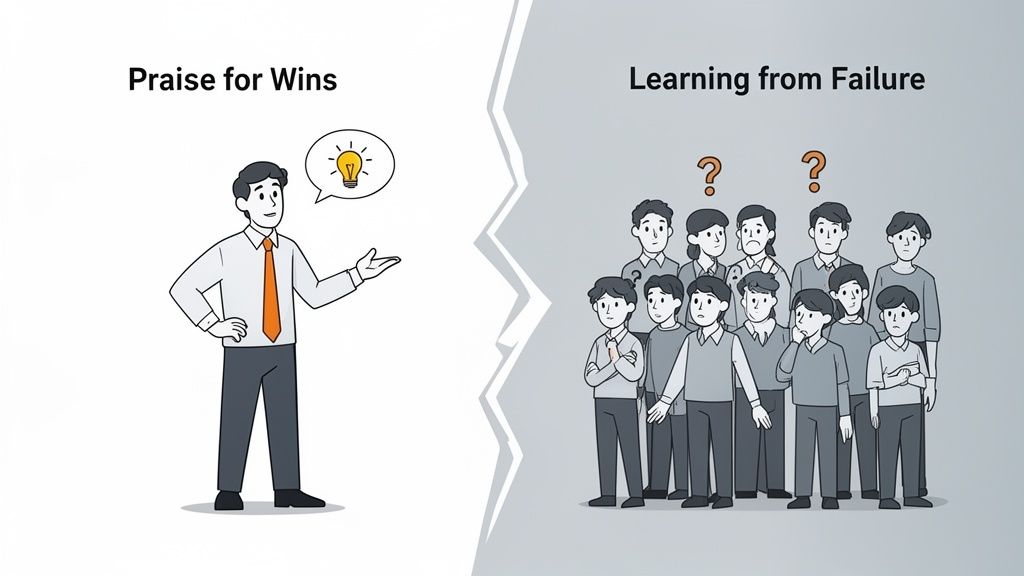
A leader might give a great speech about learning from failure. But if the only projects that get praise and rewards are the ones that succeed flawlessly, the real message is loud and clear: don't mess up. This creates a massive "say-do" gap, and any talk about growth mindset starts to sound like hollow corporate buzzwords.
Unpacking the Perception Disconnect
The numbers on this are pretty eye-opening. A recent study served up a major reality check: while a staggering 96% of executives believe they model a growth mindset, only 45% of their employees agree. You can dig into the details in the full growth mindset workplace report.
This isn't just a minor disagreement—it's a chasm that actively harms the culture. When people see a mismatch between words and actions, cynicism creeps in, and any new initiative is dead on arrival.
So, where does this disconnect come from? It's usually a combination of subtle but powerful signals:
- Rewarding Only Wins: When only successful projects get the spotlight, while failed experiments are quietly swept under the rug, it sends a powerful message that mistakes aren't really okay.
- Lack of Vulnerability: Leaders who never admit to their own mistakes or knowledge gaps create a culture of perfectionism. Nobody feels safe enough to be a work-in-progress, which is the very essence of a growth mindset.
- Punishing Smart Risks: If a team takes a well-reasoned risk that doesn't pan out and then faces blowback—like budget cuts or a stalled promotion—everyone else in the organization learns to play it safe.
Closing this gap means leaders have to stop just talking about a growth mindset and start living it in their daily actions.
How Leaders Can Authentically Walk the Talk
Showing you have a growth mindset isn’t about grand gestures. It's about the small, consistent, and intentional things you do every day. The goal is to make learning, effort, and bouncing back from setbacks visible to your whole team.
When leaders openly discuss their own struggles and what they're learning, they give their teams permission to do the same. This vulnerability is the key that unlocks psychological safety and true growth.
Here’s how leaders can start bridging that perception gap and prove they’re genuinely committed.
In Project Debriefs Instead of just asking, "What went right?" try shifting the focus. A leader who's walking the talk will ask questions like:
- "What was our single biggest lesson from this project, especially from the parts that didn't work?"
- "Where did we get stuck, and what new approaches did we have to come up with on the fly?"
- "If we could hit rewind and start this over, what would we do differently now?"
During Coaching Sessions Ditch feedback that sounds like a permanent label ("You're just not a strong presenter"). Instead, focus on the process and the effort. Try saying:
- "I saw you try a new tactic in that client meeting. Walk me through your thinking there."
- "That was a tough one. Let's break down the steps you took and see if we can find a different strategy for next time."
In Team Meetings Share your own "I don't know" moments. It's powerful for a leader to say, "This is new territory for me, too. I'm going to need to do some digging and will be leaning on your expertise here." That simple act of humility shows that leaders aren't expected to have all the answers—they're just the lead learners in the room.
Your Actionable Growth Mindset Playbook
Alright, let's get practical. Knowing the theory behind a growth mindset is one thing, but putting it into action is where you’ll see real change. This is your playbook for doing just that—a guide to move from the "what" and "why" to the "how."
This isn't about sprinkling a few new buzzwords into your meetings. It's about fundamentally rewiring how your teams learn, communicate, and approach challenges. The goal is to build an environment where curiosity and resilience aren't just encouraged; they're the default setting.
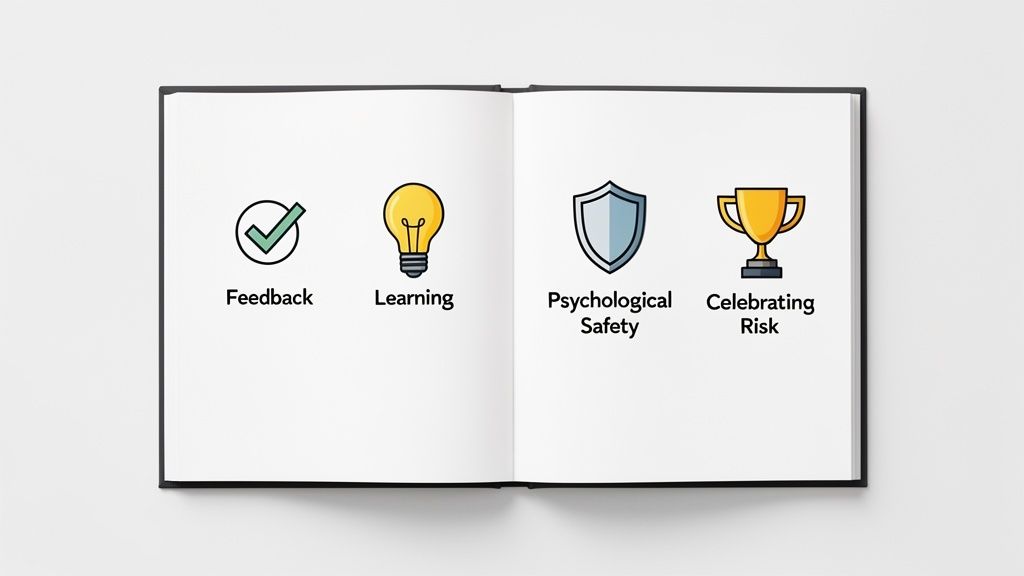
Overhaul Your Feedback Processes
If there’s one lever you can pull for immediate impact, it’s this: change how you talk about performance. Most traditional feedback centers on outcomes or fixed traits ("You're a natural leader!"), which only reinforces a fixed mindset. A growth-oriented approach, on the other hand, zeroes in on the process, the effort, and the strategies used to get there.
One of the most important things you can do is learn the art of giving feedback that fuels growth. Instead of saying, "This report missed the mark," you could try, "Let's walk through the data analysis together. What assumptions did we start with, and what other angles could we explore next time?" See the difference? The conversation shifts from judgment to collaborative problem-solving.
That small change has a huge ripple effect. It teaches people that their performance isn’t a fixed label but a direct result of their strategies—and strategies can always be improved.
Celebrate Intelligent Risks, Not Just Wins
Does your company only pop the champagne for flawless victories? If so, you're unintentionally teaching your people that failure is something to be feared and hidden. A true growth culture learns to publicly acknowledge and even celebrate the intelligent, well-reasoned risks that didn't quite pan out.
This isn't about rewarding carelessness. It's about recognizing when a team took a smart swing at a big goal, learned something valuable in the process, and shared those lessons with everyone.
Here are a few ways to get started:
- "Failure of the Month" Awards: In your next all-hands meeting, spotlight a project that failed but produced critical insights for the future.
- Learning-Focused Post-Mortems: Reframe project reviews away from "who's to blame?" and toward "what did we discover?"
- Leaders Go First: When leaders openly talk about their own past mistakes and what they learned, it gives everyone else permission to be imperfect, too.
A false growth mindset is when a company talks the talk—praising "learning" and "effort"—but only rewards perfect outcomes. Real adoption means changing your systems to make it safe to try, fail, and grow.
This approach builds the psychological safety that innovation depends on. It sends a clear signal that the learning process is valued just as much as the final result.
Build a Culture of Continuous Learning
A growth mindset can't survive without a steady diet of learning. It’s about creating a culture that shifts from "know-it-alls" to "learn-it-alls," where development is an ongoing part of the job, not a one-time training event.
The data backs this up. A huge 87% of senior leaders agree that ongoing learning is essential for a growth mindset culture, and 55% of companies are already implementing continuous training programs. The biggest roadblock? A significant 56% of executives say budget constraints get in the way, according to recent workplace findings from TalentLMS.
Even with a tight budget, you can make a real impact:
- Peer-to-Peer Learning: Start simple with "lunch and learn" sessions where employees can teach each other valuable skills.
- Mentorship Programs: Formalize knowledge sharing by pairing experienced team members with those eager to learn.
- Dedicated Learning Time: Encourage people to block off a few hours each month for self-directed learning, whether it's an online course, a webinar, or just catching up on industry articles.
When you weave these practices into your daily operations, you're showing a genuine investment in your people's long-term growth. For more tangible ways to get started, check out our guide on leadership skills workshop ideas to bring these concepts to your team.
Winning the War for Talent with a Growth Culture
In the fight for great people, your company's culture has become your secret weapon. It’s no longer about flashy perks. Today’s most sought-after professionals want something more meaningful: an environment where they can grow their skills, take on exciting challenges, and see a real future for themselves.
A culture built on a growth mindset is a natural magnet for this kind of talent.
It sends a clear message that your organization is a place to build a career, not just clock in for a job. This requires a modern playbook for culture and transformation that prioritizes learning and resilience. When you show people you’re invested in their development, you attract exactly the kind of driven individuals who will push your business forward.
Attracting Top Talent with a Growth Mindset
Your hiring process is your first chance to prove you walk the talk. It all starts with the way you write your job descriptions. Think less about rigid prerequisites and more about the opportunities for growth.
For instance, a fixed-mindset post might demand, "Must be an expert in Python." A growth-mindset version reframes it: "A great opportunity to expand your Python skills while solving complex data problems." That small change speaks directly to candidates who are hungry to learn, not just to prove what they already know.
The evidence is clear. In a recent workplace study on employee growth and retention, 89% of executives agreed that investing in their people is vital for attracting talent. And it’s not just talk—43% of companies are now actively promoting a growth mindset in their hiring strategies.
Weaving Growth into the Entire Talent Lifecycle
Getting them in the door is just the first step. To keep the best people, you have to infuse this growth-oriented thinking into their entire experience with your company.
During Interviews Go beyond the standard questions. Dig into a candidate’s curiosity and ability to bounce back from setbacks.
- "Tell me about a time you tried something and it didn't work out. What was the big takeaway?"
- "Walk me through how you learned a new skill from scratch for a previous role."
- "How do you keep up with what's changing in your field?"
In Onboarding The first 90 days are your make-or-break moment for setting the cultural tone. Don’t just drown new hires in paperwork and product demos.
- From day one, talk about what a growth mindset is and why it matters here.
- Pair them with a "learning buddy" or mentor to help them navigate the new environment.
- Set up initial projects as learning experiences, with check-ins that focus on progress and effort, not just perfect, immediate results.
When a new hire’s first experience is centered on learning and psychological safety, it reinforces that they’ve joined a company that invests in its people, not just their output.
This focus isn't just a "nice-to-have"—it's a powerful retention tool. When your employees feel like they are genuinely growing, they have little reason to look elsewhere. It’s a culture that helps you win and keep the very people who will shape your future. No wonder 80% of employees believe that people with a growth mindset will be the most valuable in the workplaces of tomorrow.
How Inspiring Speakers Can Ignite Change
Toolkits and training modules are great for building new habits in your organization. They give you the how. But real, lasting change often starts with a spark—a powerful story that provides the why. This is where bringing in an outside expert can make all the difference for your growth mindset initiative. Two speakers who embody this on our roster: Shannon Rowbury, a three-time Olympian and Olympic bronze medalist who built the Medalist Mindset program after years of literally training a growth-mindset reflex into her own performance, and Chris Barton, who built Shazam after MIT and Stanford experts said the technology was impossible — the textbook "yet" mindset in action.
Think about it. A single, incredible story of overcoming the odds, told by the person who actually lived it, can shift mindsets faster than a dozen training sessions. It’s the difference between reading a recipe and tasting the dish. When a keynote speaker embodies the very principles of a growth mindset, the concept stops being an abstract idea and becomes something real, relatable, and deeply motivating.
Bringing Growth Mindset to Life
Hearing the unfiltered journeys of innovators and top performers makes for an unforgettable learning experience. It takes the conversation out of the textbook and into the real world. When your team hears firsthand about the failures, the pivots, and the sheer effort behind a huge success, the whole idea of a growth mindset just clicks.
This approach has some powerful advantages:
- It Puts a Face to the Idea: A speaker's personal story makes resilience tangible. They become a living, breathing example of what it looks like to embrace challenges, learn from stumbles, and keep pushing forward.
- It Creates an Emotional Connection: Stories work on a human level. They can cut through the cynicism that sometimes surrounds corporate programs and speak directly to people's own hopes and fears.
- It Delivers Memorable Frameworks: A great speaker can boil down complex ideas into simple, sticky concepts that your team will remember and use long after the event is over.
When a world-class inventor explains how their biggest failure led to their greatest success, it reframes mistakes not as something to be feared, but as a necessary part of the innovation process. It gives everyone in the room permission to try, stumble, and grow.
From Inspiration to Action
The right speaker does more than just give a motivational talk; they act as a catalyst. Their story becomes a shared reference point for the entire company, creating a common language and a unified purpose for your growth mindset program. It’s a fantastic way to kick off a new initiative or re-energize a team that’s feeling stuck.
A compelling keynote can make the abstract feel personal and urgent. For any leader wanting to understand the full impact of an event like this, our guide on what is a keynote explains how these experiences are built for maximum impact.
Bringing in an outside voice is a strategic investment in your culture, not just a one-off morale boost. By showing your team what’s truly possible when you commit to learning, you light a fire of genuine belief. That belief is the fuel that will drive your growth mindset culture forward, turning a company-wide program into a personal mission for every single employee.
Your Growth Mindset Questions, Answered
So, you're bought into the idea of building a growth mindset culture. That’s a huge first step. But as soon as you start putting the wheels in motion, the real-world questions and roadblocks start popping up. It happens every time.
Let’s walk through some of the most common questions I hear from leaders who are navigating this exact shift.
How Can We Measure the ROI of a Growth Mindset Initiative?
This is usually the first question people ask, and for good reason. The thing is, you can't measure a cultural shift with a single, tidy metric on a dashboard. Instead, you need to look at a blend of indicators over time to see the story unfold.
Here’s what you should be tracking:
- Employee Retention: Are your best people sticking around? A culture where they can grow is a powerful incentive to stay.
- Internal Promotion Rates: Are you seeing more people move up within the company? This shows they’re developing new capabilities right where they are.
- Productivity on Key Projects: Look at projects that demand new skills or creative problem-solving. Are teams getting more efficient and delivering better results?
- Pulse Survey Scores: Keep an eye on metrics tied to psychological safety and employee engagement. These are canaries in the coal mine.
Give it about 12-18 months. You won't see a dramatic change overnight, but over that timeframe, you should start to see positive trends that paint a very clear picture of your return on investment.
What Is the Difference Between a Growth Mindset and a Positive Attitude?
This is a fantastic question, and the distinction is critical. A positive attitude is often passive—it’s the hope that things will turn out okay. A growth mindset, on the other hand, is all about action.
It’s not just wishful thinking. It’s the deep-seated belief that your effort and strategies are what drive results. Someone with a growth mindset doesn’t just cross their fingers and hope for the best after a failure. They dig in, figure out what went wrong, and come up with a new plan. It’s a proactive approach to getting better, not just a feeling.
A positive attitude hopes for a good outcome. A growth mindset creates a plan to achieve it, especially after a setback.
Our Team Is Full of Experts—Why Do They Need a Growth Mindset?
I’ve seen this one trip up a lot of companies. Expertise can sometimes be a double-edged sword, accidentally creating a fixed mindset. When you're "the expert," it can be terrifying to face a challenge that might reveal you don't know something. So, you start avoiding those new learning opportunities.
For a team of specialists, a growth mindset is what prevents their expertise from becoming stale. It’s the engine that helps them evolve from being a "know-it-all" to what Satya Nadella calls a "learn-it-all."
This shift encourages them to mentor junior colleagues, collaborate with different departments, and approach new technologies with curiosity instead of fear. A growth mindset is what ensures an expert today becomes an indispensable leader tomorrow.
At Silicon Valley Speakers, we know the people who live this every day—the innovators and visionaries who built their success on a foundation of growth mindset principles. They don’t just give a speech about resilience; they share the real stories of turning failure into world-changing success.
If you want to bring a truly powerful voice to your next event, start by exploring our exclusive roster of speakers at https://svsb.ai.