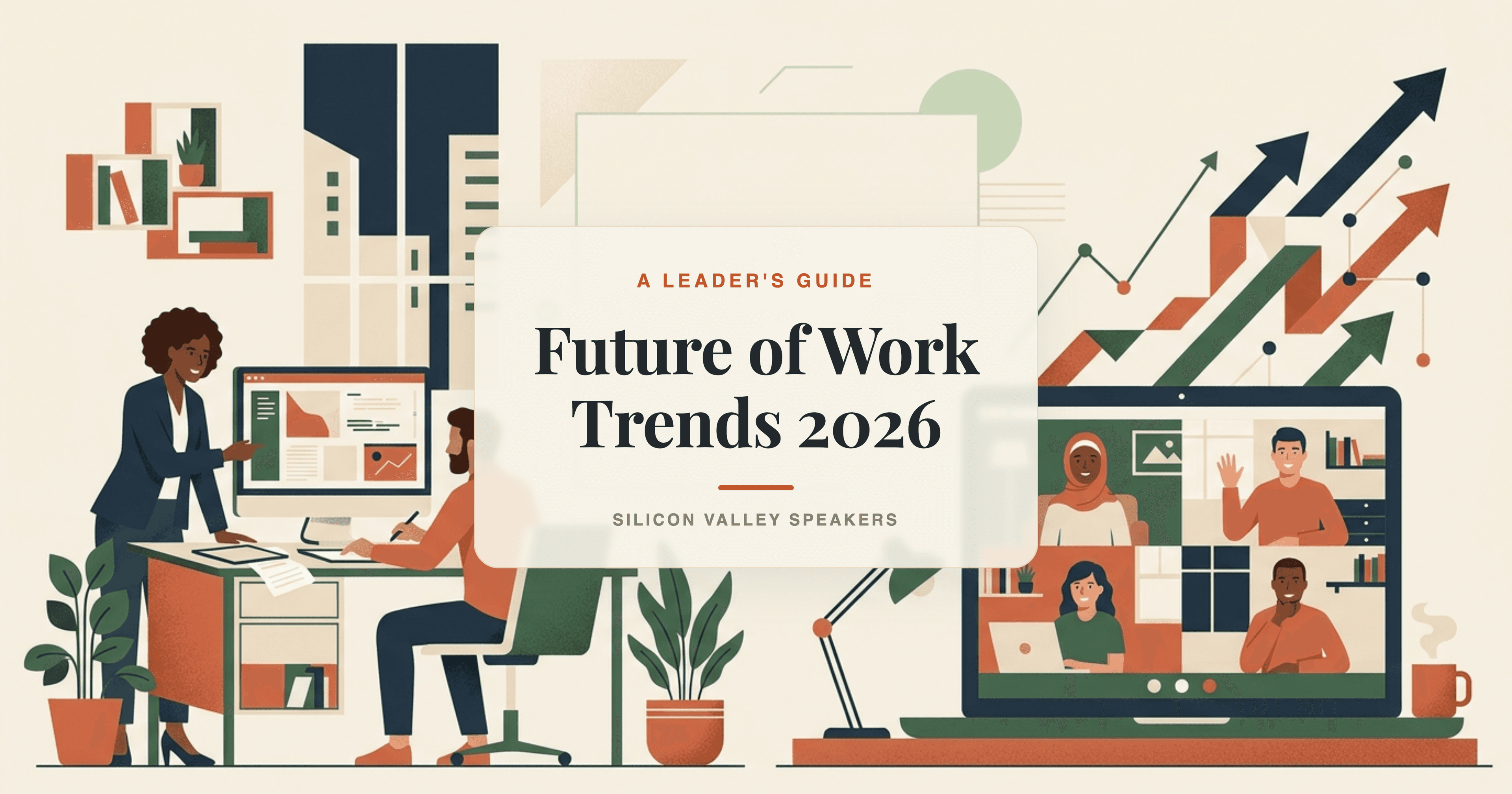
The future of work stopped being a forecast somewhere in 2026. AI moved out of pilot programs and into daily workflows, and the largest tech companies kept cutting the entry-level hiring that used to train the next generation of managers. For HR and L&D leaders planning next year's programs, 2027 is the year those changes have to show up in how work is organized.
The numbers from the past year point the same way. PwC found the average wage premium for AI skills reached 62% in 2026. Microsoft's 2026 Work Trend Index found that only 26% of AI users say their leadership is clearly aligned on AI. SignalFire reports new-grad hiring at the biggest tech companies is down roughly 65% from 2019, and Gallup has U.S. engagement stuck at 31%. None of these is alarming on its own. The harder problem is that they are happening at once, and the organizations moving fastest treat them as one redesign problem instead of separate policy issues.
Below is what changed in 2026 and the future of work trends that matter most for 2027, followed by how to design leadership programs and events that prepare people for the work they're moving into.
The short version for 2027:
- AI is moving from pilots to operating model, and most companies are still stuck in between.
- AI-linked layoffs ran ahead of measured AI results, and HR is managing the fallout.
- Entry-level hiring keeps shrinking at big tech, while AI-exposed junior roles now ask for senior skills.
- AI skills carry a 62% average wage premium, which makes skills data a hiring and promotion signal.
- Managers, more than individual employees, decide whether AI pays off.
- Hybrid work has settled into a stable pattern, but engagement hasn't recovered.
- Trust problems, from AI "workslop" to fake job candidates, are becoming workforce issues.
The great redesign: what 2026 actually changed
The phrase that still fits current future of work trends best is the great redesign. Fewer jobs vanished outright than the headlines suggested. What changed was the task mix inside jobs, as teams were rebuilt around workflows that combine people, software, automation and outside talent.
The labor-market outlook supports that view. The World Economic Forum's Future of Jobs Report 2025 digest expects structural change to touch 22% of today's jobs between 2025 and 2030: 170 million new roles created against 92 million displaced, a net gain of 78 million. It also expects workers to see 39% of their existing skill sets transformed or outdated over the same period. The people displaced and the people hired are rarely the same people, which is the harder management problem. Leaders have to decide which work stays human-led and which roles need a full redesign around AI.
That's why the most serious organizations have stopped asking how to respond to disruption. They ask more useful questions, such as which tasks are ripe for redesign so employees spend less time on coordination and more on judgment, and which skills managers and frontline supervisors now need.
Many leadership teams get stuck here. They feel the pressure from AI, remote work and changing talent expectations, but they address each issue separately: one team owns AI tools, another owns real estate, HR owns learning and internal communications owns culture. The workforce experiences all of it as one system, and the companies moving fastest plan it that way.
AI and jobs in 2027: from pilots to operating model
In 2026, AI at work moved from experimentation toward operating model design, and most companies ended up somewhere in the middle. Microsoft's 2026 Work Trend Index, which surveyed 20,000 workers who use AI across 10 countries, found that 66% say AI gives them more time for high-value work. Only 26% say their leadership is clearly and consistently aligned on AI. The central question for 2027 is which decisions stay with people and which tasks machines can handle faster.
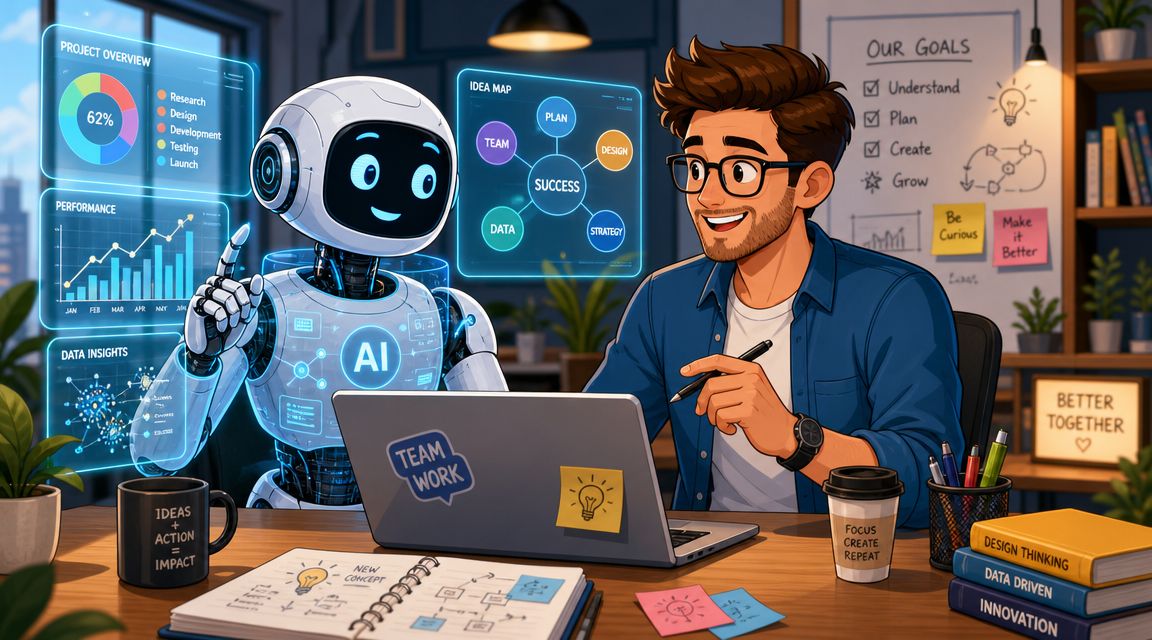
Results are lagging adoption. Gartner's 2026 future of work research found that only one in 50 AI initiatives delivers the step-change value CEOs are counting on. Gartner also predicts that over 40% of agentic AI projects will be canceled by the end of 2027, mostly over cost and unclear business value. Expect 2027 to be the year companies sort the AI projects that changed how work gets done from the ones that only looked good in a demo.
High-performing teams use AI to extend judgment across larger volumes of information and more routine decisions, and they keep the judgment itself with people. A commercial team may use AI to draft outreach while the account executive still decides tone and customer risk. A manager may use AI to summarize employee feedback, and still has to interpret nuance and respond credibly.
This changes the capability model. Employees now need practical fluency in evaluating AI output and choosing the right workflow for it, and that fluency belongs in every role that touches a workflow, well beyond data science. A checklist on what to look for in an AI keynote speaker can help teams pick sessions grounded in applied use cases instead of generic hype.
For L&D leaders, the implication is direct. Introductory awareness sessions stopped being enough in 2026. Internal programs need hands-on practice tied to real work: output evaluation, so employees catch weak reasoning or fabricated detail, and workflow judgment, so managers know where AI adds value and where a person needs to review it.
AI layoffs ran ahead of AI results
Layoffs attributed to AI dominated the 2026 headlines, but Gartner data shows fewer than 1% of AI-linked layoffs were due to actual productivity gains. Many companies cut first and planned to find the efficiency later. That leaves HR leaders in 2027 managing the fallout, from morale problems to the cost of rehiring skills they let go.
Gartner also names AI "workslop" as a top productivity drain: low-quality AI output that someone else has to spend hours fixing. Workslop is a quality-standards problem more than a tool problem. Teams that agree on what good AI-assisted work looks like, and who checks it, waste less time cleaning up after each other. Gartner reports that teams redesigning workflows with AI are twice as likely to exceed revenue goals, which makes process redesign a better 2027 investment than another round of tool licenses.
This is the ground Zach Rattner covers in his keynote "Why AI fails (and how to fix it)" and his workshop "From Pilot to Production." As CTO and co-founder of Yembo, he built an AI-powered virtual inspection platform now used in more than 20 countries.
The entry-level reckoning
One of the most consequential future of work trends of 2026 got less attention than it deserved. SignalFire's 2025 State of Talent report found new grads made up just 7% of Big Tech hires, with new-grad hiring down more than 50% from 2019. Its 2026 report found the decline had deepened, with new-grad and entry-level hiring down roughly 65% at the largest tech companies compared to 2019. AI now handles much of the work that used to train junior staff, including research, drafting, summarization and first-pass analysis.
The picture outside big tech is more mixed. PwC's 2026 Global AI Jobs Barometer found that AI-exposed entry-level roles in the U.S. are seven times more likely to require traditionally senior skills such as judgment and leadership. Openings for those roles have grown 35% since 2019, while other entry-level roles shrank 10%. The first rung of the ladder still exists in many places, but it now asks for skills juniors used to build on the job.
Meanwhile, employers still struggle to find experienced talent. ManpowerGroup's 2026 Talent Shortage Survey of more than 39,000 employers in 41 countries found 72% report hiring difficulty, down slightly from 74% a year earlier. Those two facts are connected, because the experienced talent of 2030 is the entry-level hire who doesn't get hired in 2027.
For leaders planning leadership programs and L&D investments, this raises a concrete question: how do people build the judgment that used to come from doing the low-level work? The organizations thinking clearly about it are redesigning early-career pathways with deliberate coaching and feedback loops that AI efficiency was quietly eliminating. In a keynote or fireside chat, Adam Cheyer, co-creator of Siri and former VP of AI Experience at Airbnb, often opens this conversation for leadership teams. He makes the case for where human judgment still compounds in ways AI can't replicate.
Skills as the operating system of work
Skills-based hiring kept gaining ground in 2026, and the pay data shows why. PwC's 2026 Global AI Jobs Barometer, built from more than a billion job ads across 27 countries, found the average wage premium for AI skills hit 62%, up from 57% the year before. Measured against 2018, the most AI-exposed companies grew headcount 52% against 36% for the least exposed, and grew wages 24% against 17%. For leadership programs, that's a hiring and promotion signal as much as a training one.
AI skills are also now the hardest to hire. ManpowerGroup's 2026 survey found AI skills have passed all others as the most difficult for employers to find globally, led by AI model and application development (20%) and AI literacy (19%).
The practical challenge is that "skills" in most organizations still means a list on a résumé or a tag in an HR system. The organizations doing this well build skill development into the job itself, on a weekly rhythm rather than in a quarterly course. That puts role redesign upstream of curriculum design.
Human skills gain value as AI takes over routine output. Maya Ackerman, a Santa Clara University professor, CEO of WaveAI and author of Creative Machines: AI, Art & Us (Wiley, 2025), runs a keynote and a hands-on workshop called "Awakening the Creative Spark in the AI Era" on using AI as a partner for new ideas.
For L&D planners, this reframes the ROI conversation. The useful question is whether the capability showed up in the work afterward, and satisfaction scores from the training day say little about that. Programs that build skills inside live workflows, with coaching that transfers back to the job, are where the measurable outcomes are.
Managers decide whether AI pays off
The 2026 data made one thing clear: AI results depend more on the organization than on the individual. Microsoft's Work Trend Index found that organizational factors such as manager support and culture account for 67% of AI's reported impact, more than twice the 32% explained by individual mindset and behavior. Among its most advanced AI users, 83% said their manager sets quality standards for AI work, against 57% of everyone else.
Gallup reaches a similar conclusion from the engagement side, finding that managers account for at least 70% of the variance in team engagement. Microsoft also found that 45% of AI users say it feels safer to stick to current goals than to redesign work with AI, a hesitation managers are best placed to remove. In 2027, manager development is where AI strategy and culture strategy meet.
Philip Lakin, Director of AI Transformation at Zapier, builds his sessions around this adoption problem. His keynote "The AI Transformation Playbook" draws on more than 1,000 hours in the field with enterprise AI leaders, and in his Practical AI Adoption Workshop every participant leaves with something they built during the session.
Hybrid work in 2027: flexibility is a baseline, engagement is still earned
Hybrid work stopped moving in 2026. The WFH Research Survey of Working Arrangements and Attitudes found that from September 2025 to August 2026, 12% of full-time U.S. employees were fully remote, 26% were hybrid and 62% worked fully on site. About 26% of paid workdays in July 2026 were work-from-home days, and employer plans hover around 1.3 to 1.5 home days per week, close to what workers have actually done since mid-2022.
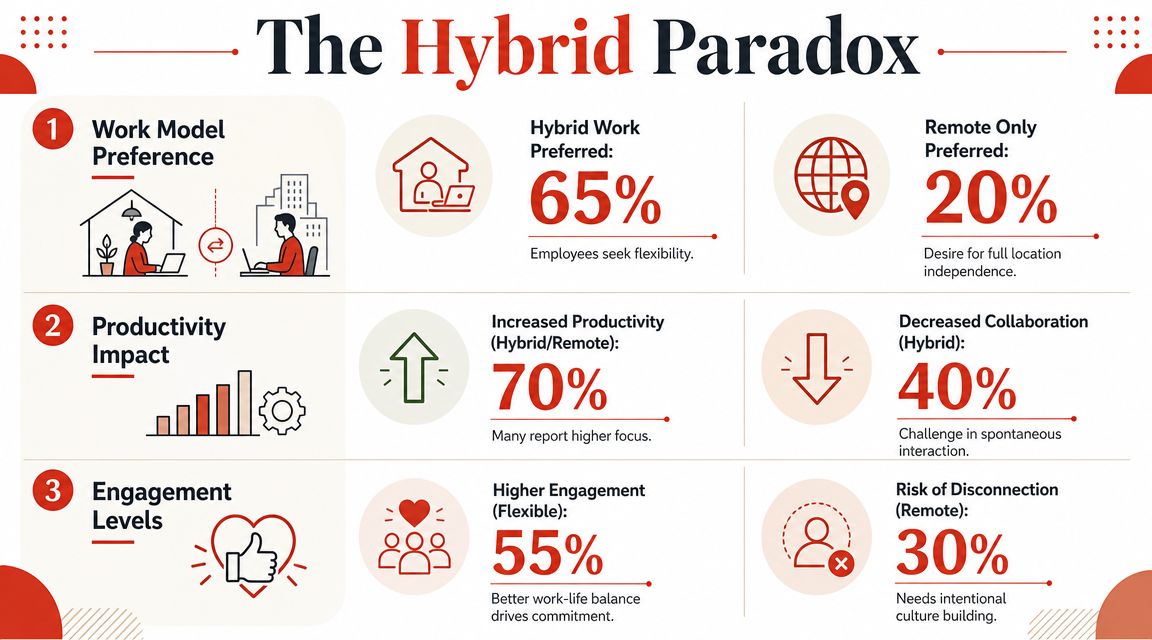
The harder question is whether flexibility is producing a better employee experience. Gallup puts U.S. employee engagement at 31% for 2025, unchanged as of May 2026, with 17% actively disengaged. Leaders should read those figures together. Employees still value flexibility, but flexibility by itself doesn't create trust or commitment.
Many companies over-indexed on location policy because it was visible and urgent. Employee experience is broader and harder to design well. It depends on manager quality, role clarity, workload design, social connection, growth opportunities, and whether in-person time has a clear purpose.
Four things now matter more than policy language. Manager routines need to be explicit, because check-ins and coaching cannot depend on hallway visibility. Meetings need a sharper reason to exist; if every conversation defaults to a calendar invite, hybrid work quickly becomes coordination drag. Onboarding needs planned social and cultural touchpoints, since scattered calls and chat threads won't build them. Workspaces need to support the work people come in to do, especially collaboration and coaching.
For teams revisiting the physical environment, Cubicle By Design offers a practical guide to hybrid work setup that connects workplace design to how employees split time between home and office.
Leadership retreats and internal learning programs are now part of the operating system for culture. A well-designed offsite can reset manager expectations and rebuild the shared context that hybrid work erodes between quarterly meetings. The strongest programs turn "engagement" into specific management behaviors and repeatable team practices.
A practical guide on how to engage employees in hybrid teams can support that work between live sessions.
Generalists and the fluid workforce
Fractional roles and project-based work kept spreading in 2026, and internal talent marketplaces now let employees take on projects outside their primary role. Workforce planning is moving away from fixed job descriptions toward how work actually gets done across projects and shifts.
That favors people who connect work across disciplines. Milly Tamati, founder of Generalist World, built a movement of more than 150,000 people around non-linear careers, and more than 37,000 people have taken her Generalist Archetype Quiz. Her keynote "The Generalist Advantage" argues that AI makes generalists more valuable, and her half-day workshop has teams take the quiz live and map their cross-functional value.
This also changes the deskless workforce challenge. A large share of the global workforce does not sit at a desk, yet future-of-work strategy is still often designed around office routines. In a warehouse, redesign centers on scheduling precision, safety and throughput. In healthcare, the pressure points are staffing flow and documentation burden. Those environments need workforce systems built for speed and frontline judgment, which a lighter version of office policy won't provide. Gartner's 2026 trends also flag a move from tech to the trades, citing a FlexJobs finding that 62% of workers would switch to a skilled trade for better pay and stability.
Trust becomes a workforce issue
Two of Gartner's 2026 future of work trends point to a trust problem that carries into 2027. Hiring has turned into an AI arms race between candidates and recruiters, and Gartner predicts that a quarter of candidate profiles could be fake by 2028. Insider threats and AI-assisted corporate espionage are also moving from fiction onto payrolls.
Gartner flags the mental toll of near-universal generative AI use, including stress and burnout, as a hidden cost of adoption. HR leaders who put wellbeing into the AI rollout plan with the same weight as training will keep more of the people they need.
What this means for event and leadership program design
Most companies don't need more awareness about future of work trends. They need better program design.
The old event model assumed that a strong keynote plus a good venue would drive alignment. If work is being redesigned across AI, flexibility, management and workforce composition, internal events need to function like capability-building interventions. The best programs create shared language and give leaders time to practice new decisions inside the same agenda.
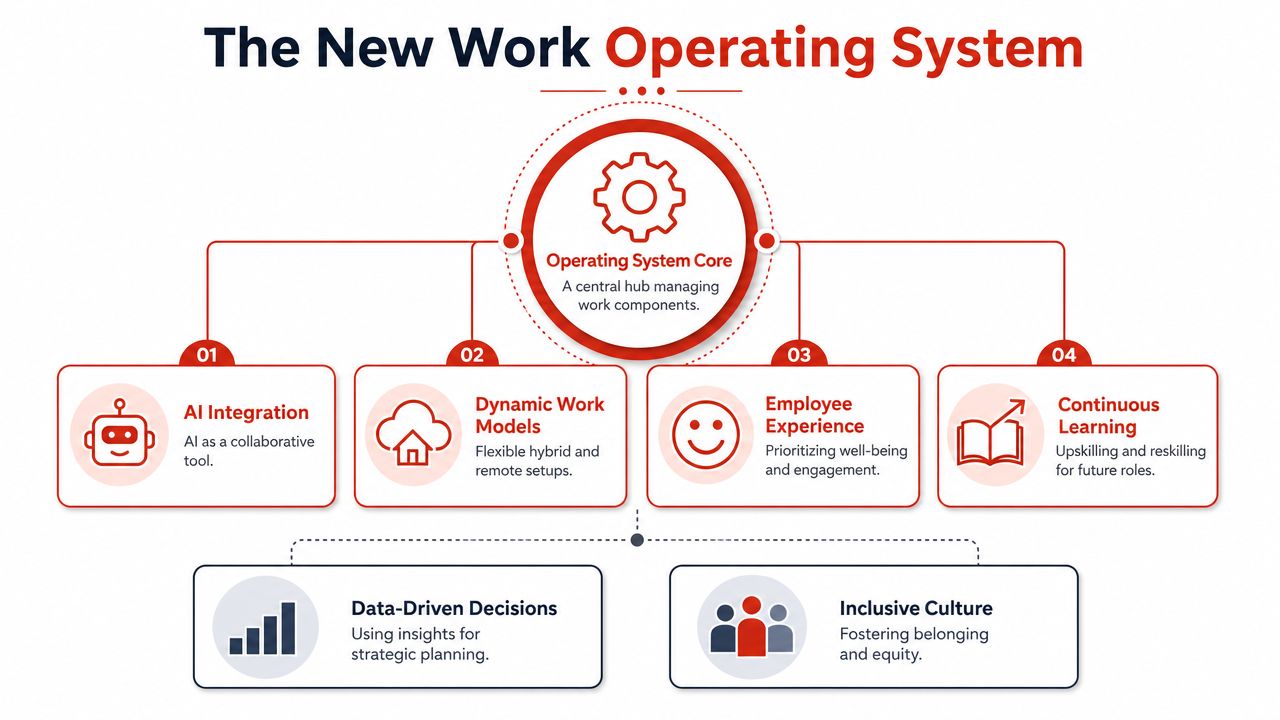
A generic "future of work" keynote often underperforms because the audience leaves with broad inspiration and no operating guidance. A better approach is to match the session type to the business problem. If AI adoption is uneven, run workflow clinics by function in place of a broad AI panel. If managers are struggling in hybrid teams, build a manager lab around coaching and accountability. If the entry-level pipeline is thinning, add a mentoring format that pairs senior staff with early-career hires. If workslop is piling up, run a session where each team agrees on its quality standards for AI-assisted work.
Speaker selection matters, and our future of work keynote speakers cover different problems:
- Human-AI collaboration: Adam Cheyer co-created Siri, which now runs on more than 2 billion Apple devices, and holds 50 patents in AI and conversational interfaces. He speaks in keynote, fireside chat and panel formats.
- Stalled AI adoption: Philip Lakin runs a 12-month embedded AI transformation program with enterprise partners at Zapier.
- Moving AI from pilot to production: Zach Rattner holds 30 granted U.S. patents and wrote Grow Up Fast: Lessons from an AI Startup.
- Generalist and cross-functional talent: Milly Tamati works as both keynote speaker and event MC, including a full day of panels she MC'd at SXSW London Global House.
- Creativity in the AI era: Maya Ackerman has more than 50 peer-reviewed publications and has spoken at the United Nations and Stanford.
The strongest internal events use formats that force application. Reverse mentoring sessions let junior employees show leaders how workflows are changing. Scenario labs put cross-functional groups on a live challenge such as AI governance or manager overload. Role redesign workshops have leaders map one role, identify low-value tasks and rebuild the work around judgment and automation. Quality-standards sessions get a team to agree on what good AI-assisted work looks like before anyone hits send.
For teams building more hands-on formats, corporate workshops for leadership and innovation offer a useful model for moving beyond passive sessions, and our playbook for future of work events covers agenda design in more detail.
A weak agenda is organized by broad themes. A strong agenda is organized by decisions leaders need to make. Instead of naming breakout sessions after themes like "AI" or "hybrid," frame them around actual choices: which work should be redesigned first, and what should managers do differently next quarter? That shift changes audience behavior, because people stop listening as spectators and start engaging as owners.
One question to ask before your next internal event
Audit your next major internal gathering. Look at the agenda for your next leadership offsite, all-hands, SKO, or manager summit and ask: does this program prepare people for the work they're moving into, or does it reinforce the work model they're leaving behind?
If the agenda is still heavy on updates and generic panels, redesign one part of it. Swap a panel for a workflow lab, or bring in a speaker who has built the future your teams are trying to understand.
For a look back at how these shifts showed up across the people agenda last year, this roundup of the biggest HR trends of 2026 is a useful companion read.
Frequently asked questions about the future of work in 2027
What are the biggest future of work trends for 2027?
The biggest future of work trends for 2027 are AI moving from pilots into everyday operations, a shrinking entry-level pipeline, skills-based hiring driven by a 62% average wage premium for AI skills (PwC), managers becoming the main driver of AI results, and hybrid work holding steady at roughly a quarter of U.S. paid workdays at home (WFH Research). Trust issues such as AI workslop and fake job candidates round out the list.
How is AI changing jobs heading into 2027?
AI is changing the task mix inside jobs faster than it is eliminating jobs outright. The World Economic Forum expects 170 million roles created and 92 million displaced between 2025 and 2030. The sharpest near-term effect is on entry-level work: SignalFire found new-grad hiring at the largest tech companies down roughly 65% from 2019. Gartner data shows fewer than 1% of AI-linked layoffs came from actual productivity gains, so many cuts ran ahead of results.
Is hybrid work still the norm in 2027?
Hybrid work is stable rather than growing. Between September 2025 and August 2026, 26% of full-time U.S. employees worked hybrid, 12% were fully remote and 62% were fully on site, according to WFH Research. Employers plan for about 1.3 to 1.5 home days per week, roughly what workers have actually done since mid-2022.
What workforce shifts should leaders prepare for in 2027?
Plan for fewer entry-level roles that demand more judgment, and for a tighter market for AI skills, which ManpowerGroup found are now the hardest for employers to find globally. Managers will need training to lead AI-assisted teams, since Microsoft found organizational factors explain 67% of AI's reported impact. Expect cuts to AI projects that ran on hype, too: Gartner predicts over 40% of agentic AI projects will be canceled by the end of 2027.
Which leaders are most associated with the future-of-work conversation?
Much of the research behind the conversation comes from the World Economic Forum's Future of Jobs Report, Gartner's annual future of work trends, Microsoft's Work Trend Index and the WFH Research team of Jose Maria Barrero, Nicholas Bloom, Shelby Buckman and Steven J. Davis. On stage, the speakers most useful to leadership teams tend to be operators who have built AI into real work, such as Adam Cheyer, Philip Lakin, Zach Rattner and Milly Tamati.
Who is a good future of work keynote speaker for a leadership offsite?
It depends on the problem the offsite needs to solve. For the big-picture view of where AI is taking work, Adam Cheyer co-created Siri, which now runs on more than 2 billion Apple devices. For stalled AI adoption, Philip Lakin of Zapier runs keynotes and hands-on workshops built on more than 1,000 hours with enterprise AI leaders. For moving AI from pilot to production, Zach Rattner draws on building Yembo, now used in more than 20 countries. Silicon Valley Speakers can match a speaker to your agenda, and you can compare options on our future of work speakers page.
Plan your 2027 future of work session
If you're planning a 2027 offsite or leadership program around AI or the future of work, Silicon Valley Speakers can help you find speakers and workshop leaders with real operating experience. We work with builders and operators who know how to turn workforce trends into sessions your audience will remember and act on. Browse our future of work speakers or tell us what your team is working through, and we'll suggest speakers who match the actual problem.