The note usually sounds simple at first. Plan this year's leadership offsite. Refresh the all-hands. Build a customer event around AI, hybrid work, or the future of leadership. Then the actual brief shows up underneath it. Make it matter.
That's the hard part with future of work events. People don't want another stage, another slide deck, or another panel where everyone says work is changing. They already know that. They want clarity: leaders want alignment, employees want signals they can trust, sales teams want practical direction. HR and L&D teams want something that improves capability, not just morale for a day.
The pressure is reasonable. Work is moving fast, and event teams are being asked to turn uncertainty into a shared experience that people can understand and act on.
Beyond Another Calendar Invite
If you're planning a future-focused event right now, you're not just filling space on the company calendar. You're helping people process change in public. That takes more than good production.
The urgency is real. By the period 2025 to 2030, structural labor-market transformation is projected to result in 22% of today's total jobs being created or destroyed, with a net growth of 7% or 78 million jobs globally, according to the World Economic Forum Future of Jobs Report 2025 digest. That kind of shift changes how leaders communicate, how teams learn, and what an internal or customer-facing event needs to accomplish.
A weak event treats this as a branding topic. A strong event treats it as an operating topic.
What planners get wrong
The most common mistake is confusing relevance with usefulness. A theme like “The Future of Work” sounds current, but it often produces a shapeless agenda. One keynote on AI, one panel on hybrid, one workshop on culture. Everyone leaves with notes, but no shared direction.
That doesn't happen because the event team missed a task. It happens because the event never answered one basic question: what should people believe, decide, or do differently when they walk out?
Practical rule: If your agenda could be swapped with another company's logo and still make sense, it's too generic.
What high-impact events actually do
The best future of work events do three jobs at once:
- They interpret change: They help the audience make sense of what's happening without drowning them in trend talk.
- They create alignment: They give leaders and teams a common language for priorities, risks, and next steps.
- They build confidence: They show people where they fit in the change, which matters more than hype.
That last point gets missed. An event can be bold without being abstract. In fact, the more change your audience is facing, the more grounded your event should feel. People don't need louder predictions. They need a clearer path.
Define Your Event's North Star
Most event problems start before the first speaker outreach email. They start when the event goal stays vague.
If the brief says “do something on the future of work,” stop there and sharpen it. An event can't inspire, align, train, reassure, and generate pipeline equally well. One of those can lead. The others can support.

Start with the decision you need
Before venue, format, or creative, identify the business decision sitting behind the event.
Use a short filter like this:
What change is already happening
Maybe your company is rolling out AI tools. Maybe your managers are struggling with hybrid team norms. Maybe your customer conference needs to reposition your brand around what comes next.
What gap exists today
Is the gap knowledge, confidence, alignment, or execution? Don't blur those together. They produce different agendas.
What the audience needs to leave with
A sales kickoff might need practical adoption. An executive offsite might need scenario alignment. A leadership retreat might need stronger conversations around trust, resilience, and role redesign.
Use scenario thinking early
A lot of event teams plan as if the event is separate from strategy. It isn't — it's one of the few moments where strategy gets translated into shared understanding across a room.
That's why scenario-building helps. The structured process is simple in practice. Scope the major trends affecting your organization. Envision a few plausible futures. Identify the uncertainty that matters most. Assess what those futures would mean for the business. Then test what signs would tell you which direction is becoming real.
There's a hard consequence for skipping that strategic gap check. A key pitfall in future of work strategy is neglecting gap analysis between current strategy and future scenarios, leading to 27% lower revenue growth in companies that fail to evaluate AI ROI regularly, as discussed in Workday's future of work trends article.
The event brief should reflect the strategy gap, not just the marketing theme.
Match the mission to the audience
A future of work event for first-line managers should not look like one for a board, and neither should look like a customer summit.
A simple way to pressure-test the fit is to write one sentence in this format:
| Audience | Core tension | Event mission |
|---|---|---|
| New managers | They're expected to lead change but don't have a playbook | Build confidence and practical leadership habits |
| Executives | They need alignment on future bets and workforce implications | Create shared strategic language and decisions |
| Sales teams | They hear AI messaging but need customer-ready stories | Turn broad change into usable positioning |
| Technical teams | They need depth, not slogans | Focus on workflows, use cases, and responsible adoption |
If you can't fill in that table cleanly, your event is still too broad.
Choose Themes and Formats That Resonate
Themes fail when they sound current but feel empty. “AI and the Future of Work” is a topic. It's not yet a program.
The themes that land with audiences connect technology to lived work. They answer practical questions. What skills are rising? What habits are becoming more valuable? What changes for leaders, managers, and teams? What does opportunity look like for people who aren't already in the room?
Build themes around real skill shifts
A useful agenda starts with the skills and behaviors the audience needs to discuss. The strongest source material points to a mix of technical and human capabilities. The World Economic Forum's 2025 report identifies AI and big data, networks and cybersecurity, and technological literacy as the top three fastest-growing skills, while resilience, flexibility, and agility are the most prominent skills differentiating growing from declining jobs, according to the WEF digest summary.
That tells planners something important. A future of work agenda shouldn't isolate technology from people. It should put them in the same conversation.
Better theme directions often look like this:
- From AI talk to AI judgment: How teams decide when automation helps and when human oversight matters more.
- From hybrid policy to collaboration design: How work gets coordinated across functions, time zones, and meetings.
- From resilience as a buzzword to resilience as a management skill: What leaders do when teams face continuous change.
- From talent pipelines to inclusive pathways: How organizations create access, training, and real opportunity.
For more inspiration on narrowing a broad concept into a sharper event angle, this piece on conference themes that create stronger audience connection is a useful reference point.
The missing theme most events ignore
A lot of future of work programming talks about disruption from the top down. It spends time on investment, efficiency, and leadership posture, but skips the harder question of who gets access to new opportunity.
That's a mistake.
When event content ignores economic inclusion, it usually ends up sounding polished but incomplete. Sessions should address training pathways, workforce access, mentorship, and how employers, educators, and community partners can shape real job readiness. This is especially important if your audience includes HR leaders, talent teams, public sector partners, or regional ecosystem builders.
If your event talks about transformation but never addresses access, it's describing change without addressing who benefits.
Match the format to the theme
Format is where planners either support the theme or undermine it. Some topics need a keynote. Others need a room with whiteboards and a skilled facilitator.
Here's a practical guide:
| Goal | Format that fits | Why it works |
|---|---|---|
| Create urgency and shared language | Keynote plus moderated conversation | Good for reframing big ideas quickly |
| Build manager capability | Workshop or half-day lab | People need practice, not just inspiration |
| Align senior leaders | Offsite or working session | Closed-room discussion supports real decisions |
| Surface inclusive pathways | Cross-sector panel plus breakout groups | Different stakeholders need to hear and challenge each other |
| Deepen customer trust | Case-led summit session | Buyers want applied examples, not abstractions |
A future of work event doesn't need more content. It needs the right shape for the outcome you want.
Curate Speakers and Experiences That Stick
The speaker choice usually determines whether the event feels alive or forgettable. Not the title on the bio. The story, the credibility, and whether the person has built something worth learning from.
That's why I'd take a builder over a polished generalist almost every time.
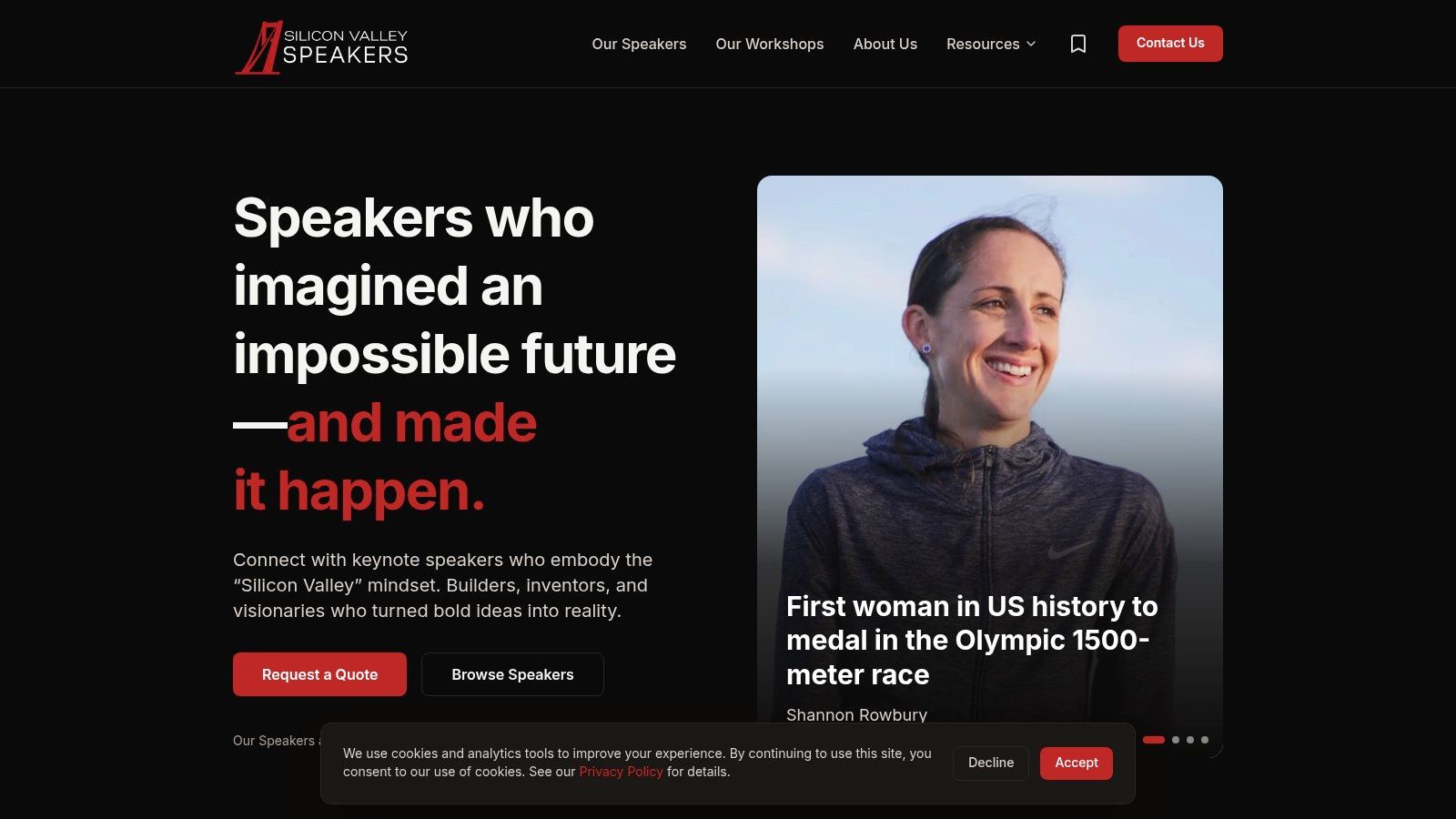
A future of work audience can spot recycled commentary fast. They don't need another speaker who summarizes headlines. They need someone who has faced the trade-offs directly. Someone who has built products, led teams through ambiguity, invented new systems, or changed how work happens in practice.
A speaker like Adam Cheyer works because the talk doesn't stop at “AI is important.” It goes into invention, judgment, setbacks, and what it takes to make a new interface real. That's the difference between information and narrative authority.
Choose speakers with operating depth
When you review speaker options, push past the surface.
Ask questions like:
What have they built
Product creation, company-building, major transformation work, original research, or high-stakes leadership all count.
What tension can they speak to with candor?
AI adoption versus trust, speed versus governance, innovation versus inclusion. Employees respond to nuance.
Can they teach, not just perform
Some speakers energize a room but leave no usable takeaway. Others can shift how people think and what they do next.
One practical option for teams looking at specialist talent is this future of work keynote speaker roster, which focuses on builders and operators rather than giant open-directory listings. That model tends to work well when you need a tighter fit between message and audience.
Don't stop at the keynote
Even a strong keynote fades if the rest of the event treats attendees like spectators.
The personalization standard has moved. In 2025, 81% of consumers express a preference for personalized event experiences, according to BizBash's corporate event trends coverage. For planners, that doesn't mean gimmicks. It means designing content pathways, session choices, and interaction points that feel relevant to different attendee groups.
Good experiential design often includes:
- Role-based breakouts: Managers, executives, technical leads, and customer-facing teams don't all need the same follow-up room.
- Structured Q&A: Let attendees submit questions in advance, then shape the discussion around what the room cares about.
- Facilitated networking: Give people a reason to connect. Shared prompts beat open mingling every time.
- Hands-on working sessions: If the topic is AI, redesign, or leadership, make people do something with the idea.
A memorable event usually has one strong stage moment and several smaller moments where attendees can place themselves inside the story.
Support speakers with better content tools
Many teams undercut strong speakers with weak visuals. Dense decks, generic templates, and last-minute edits drain energy from the room.
If your internal team is building supporting decks for moderators, breakout leads, or executive presenters, a practical resource is this guide on how to create a presentation with AI. It's useful when you need faster draft creation while still keeping a clear narrative arc and a consistent visual system.
Video can also help audiences connect with a speaker's style before the event or reinforce a message afterward.
What usually goes wrong
Speaker curation fails in predictable ways:
- The famous name with no fit: Recognition gets the booking approved, but the talk doesn't match the room.
- The panel with no point of view: Four smart people can still produce a flat session if nobody owns a clear tension.
- The experience layer added too late: Networking, workshops, and Q&A need design time. They can't be decorative extras.
When the speaker, format, and audience need line up, the event gains staying power. People remember the story because it helped them interpret their own work differently.
Build Your Event Logistics Timeline
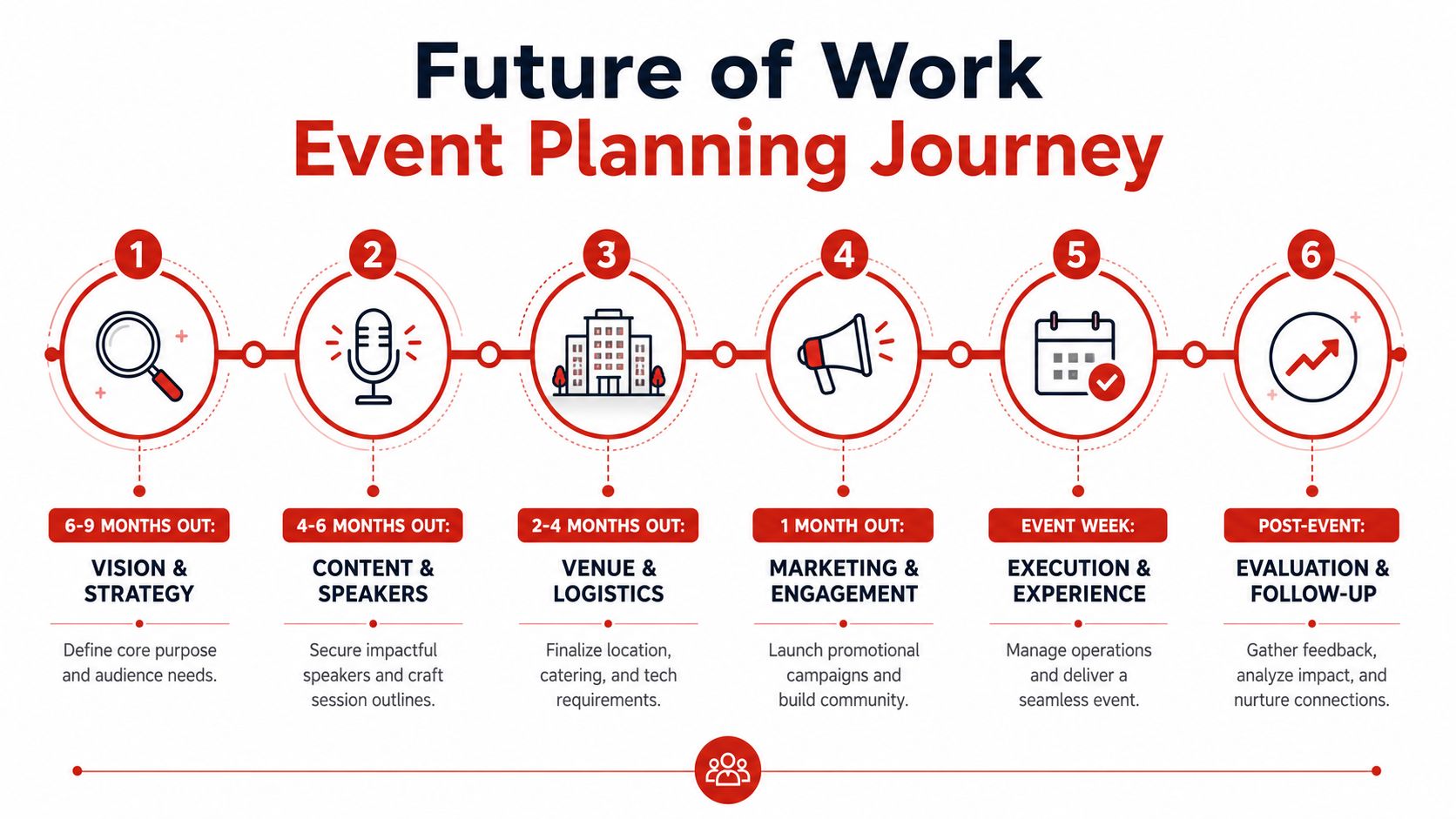
A strong concept can still fall apart in execution. Most event stress comes from dependencies that were obvious in hindsight. Speaker confirmation affects creative. Creative affects registration. Registration affects rooming, catering, and tech setup. If one piece slips, everything compresses.
That's why the timeline matters more than the checklist.
Work backward from the immovable points
Start with the items that can't move. Event date. venue hold. executive availability. keynote availability. platform decision for hybrid or virtual components.
Then build the schedule around those anchors, not around ideal sequencing.
A practical planning flow looks like this:
Early stage
Lock the event purpose, target audience, budget guardrails, and format. If a keynote speaker is central to the concept, secure that first.
Middle stage
Finalize session architecture, room formats, AV requirements, registration flow, and internal communications. This is also when content owners need deadlines, not vague reminders.
Late stage
Rehearsals, show calling, slide review, attendee messaging, seating logic, and contingency planning. If hybrid is involved, weak tech decisions become painfully visible.
Build the timeline around risk, not convenience
Planners often schedule by category. Content this week, marketing next week, operations later. Real events don't work that neatly.
Instead, plan around risk concentration. Ask which decisions create downstream work for multiple teams. Those belong earlier than seems necessary.
For example:
| Decision | Why it must happen early |
|---|---|
| Speaker confirmation | Affects marketing, agenda, budget, and executive buy-in |
| Tech platform choice | Shapes registration, engagement features, and production needs |
| Session format decisions | Determines room setup, facilitation, and content prep |
| Internal communication cadence | Drives attendance quality, not just volume |
If you want a faster way to map these dependencies, an event planning timeline generator for event professionals can help turn a broad event plan into a working sequence.
Plan the participant journey, not just the run of show
A run of show tells your team what happens when. A participant journey tells you what the event feels like.
That includes practical questions:
- Before the event: What does the invitation promise, and is that promise specific?
- At arrival: Do attendees understand where to go and why the day is structured this way?
- During sessions: Are there natural moments to ask questions, connect, and reflect?
- After sessions: Does the next step feel obvious?
The attendee experience usually breaks at handoff points. Registration to arrival. keynote to breakout. session to networking. Event to follow-up.
Future of work events need especially careful pacing because the topic can become mentally heavy. Alternate between high-level framing and applied sessions. Give people space to talk. Don't stack dense content blocks without a reset.
Keep the tech stack boring in the best way
For hybrid and virtual elements, reliability matters more than novelty. Use tools your team can support under pressure. If the audience needs polls, Q&A, breakout assignment, or content download, make sure those functions are clear and tested.
This is one place where planners get seduced by feature lists. Don't buy complexity you won't staff. The best tech stack is the one your producers, moderators, and attendees can use without friction.
Measure Impact and Prove Event ROI
If you only report attendance, satisfaction, and a few photos, leadership will treat the event as a nice moment. Not as a business tool.
That's avoidable. Event ROI gets easier to prove when measurement starts before the first invite goes out.
A structured approach already exists. A methodology for measuring event success includes pre-event KPI definition, real-time monitoring, and post-event analysis at 1 to 4 weeks and 3 to 12 months. Top-performing events achieve 85%+ participation rates and 3x higher networking outcomes, based on this event success measurement framework.
Measure in stages
The most useful reporting tracks impact across time, not just on event day.
A practical model:
Before the event
Define the KPIs that match the event mission. For a sales event, that might be pipeline movement or message adoption. For a leadership program, it might be manager confidence, workshop completion, or follow-up implementation.
During the event
Watch attendance by session, Q&A volume, workshop participation, and live feedback. These metrics help you catch weak rooms and adjust.
Immediately after
Send the survey while memory is fresh. Ask what changed, what was useful, and what people still need.
Short-term follow-up
Look at adoption signals in the next few weeks. Are teams using the ideas, language, or tools introduced at the event?
Longer-term follow-up
Connect the event to business movement where possible. That may include retention patterns, deal progression, or continued participation in training.
Use metrics leadership actually cares about
The event team may love engagement metrics. Leadership usually wants decision metrics.
A better reporting stack includes a mix:
- Participation quality: Who attended, which sessions held attention, and where interaction happened.
- Behavior signals: What teams did after the event. Downloads, workshop output, internal tool adoption, or manager follow-ups.
- Business outcomes: Pipeline movement, retention indicators, or capability-building milestones, depending on the event type.
For teams that want a practical companion resource, this guide for event organizers on ROI measurement is a helpful starting point for building a more disciplined reporting process.
Don't ask whether people liked the event until you've asked what the event was supposed to change.
What weak ROI reporting usually misses
The biggest miss is failing to establish a baseline. If you don't know the starting point, every post-event result is just a reaction, not evidence.
The second miss is waiting too long to decide what counts. By then, the data is fragmented, the surveys are generic, and the story to leadership is thin.
A future of work event should earn its budget the same way any strategic initiative does. By showing that it improved understanding, strengthened alignment, or moved people toward action.
If you're planning a future-facing offsite, summit, customer event, or internal leadership program, Silicon Valley Speakers is one resource for matching that brief with speakers who've built real breakthroughs in AI, innovation, and the future of work. The team focuses on a small roster of builders, inventors, and operators, which can be useful when you need a keynote or workshop leader whose story aligns closely with the outcome your event needs to drive.
Related speaker rosters
Browse future of work keynote speakers and AI keynote speakers available for 2026 events.