A launch is set for noon. Marketing has queued the announcement in HubSpot. Sales has prepped outreach in Salesforce. The product team is watching dashboards, and then a critical system fails. Error rates spike, Slack fills with theories, someone says delay, someone else says ship and patch. The room goes quiet for a beat, and everyone looks to the leader.
That moment is what is generally meant when discussing decision making under pressure. Not abstract strategy or a workshop exercise, but a live decision with incomplete information, conflicting opinions, and consequences that will be visible in minutes.
In tech companies, these moments show up everywhere. A founder has to decide whether to push a release or roll back. A sales leader has to respond when a competitor undercuts pricing in the final stage of a deal. An operations lead has to choose between speed and process during a customer-facing incident. The pressure feels different in each case, but the demand is the same. Make a call, clearly, and fast enough to matter.
What separates strong leaders isn't perfect prediction. It's the ability to keep the team thinking when stress is trying to shut that down. The good news is that this skill isn't mystical. It can be trained, practiced, and improved with the right models.
The Critical Moment That Defines a Leader
Pressure rarely announces itself politely. It arrives as a failed deployment, a board question you didn't expect, a customer escalation that hits during an already overloaded week. In those moments, leadership gets stripped down to its essentials.
A product launch failure is a useful example because it captures the trade-offs. If you delay, you protect user experience but absorb reputational and commercial fallout. If you proceed, you preserve momentum but risk compounding the problem in public. Either path costs something. The leader's job isn't to find a painless option. It's to choose the least damaging path that still serves the larger objective.
What people notice in a crisis
Teams don't just watch the decision itself. They watch how the decision gets made.
They notice whether the leader asks the right question. They notice whether debate turns into drift. They notice whether someone is trying to sound certain instead of getting clear. In high-pressure environments, people often mistake volume for authority and speed for competence. Neither holds up for long.
Practical rule: Under pressure, your team needs clarity before confidence. Confidence without clarity usually creates rework.
I've seen experienced operators handle hard moments well not because they had more raw intelligence, but because they had better decision habits. They knew how to narrow the problem, identify the true deadline, pull in the right voices, and commit without theatrics. That is the difference between a tense room that becomes productive and a tense room that becomes chaotic.
The real test isn't calm. It's usefulness.
Leaders often believe they need to look unshakable. That's the wrong target. The goal is to be useful.
Useful leaders do a few things well in the first minutes of a crisis:
- They define the decision: What exactly are we deciding right now?
- They separate facts from assumptions: What do we know from logs, customers, and systems, and what are people guessing?
- They set a time boundary: When must this call be made to still matter?
- They assign ownership: Who is gathering evidence, who is evaluating risk, and who will communicate the final decision?
That is why decision making under pressure is a defining leadership skill. It shapes outcomes, but it also shapes trust. A team that sees disciplined judgment under stress becomes more decisive itself. A team that sees panic, delay, or random pivots learns the opposite.
Why Your Brain Fails You Under Pressure
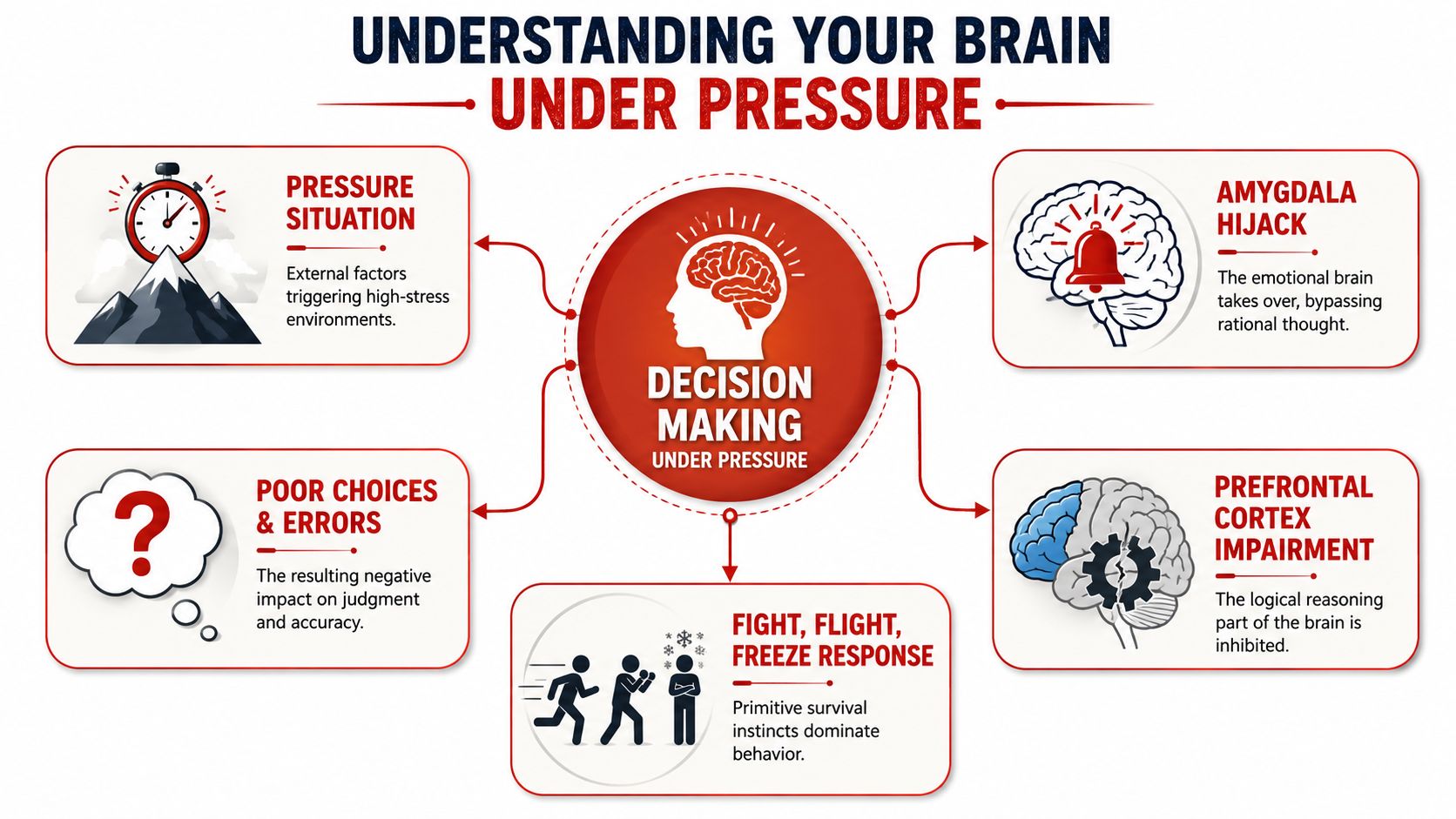
Even very smart people make worse choices when the heat rises. That isn't a character flaw. It's a predictable shift in how the brain handles threat, uncertainty, and limited time.
A simple analogy helps. Think of your mind like a laptop with too many heavy applications open at once. Under normal conditions, you can evaluate options, compare trade-offs, and notice weak signals. Under stress, your mental CPU gets maxed out. The system doesn't stop working, but it starts simplifying aggressively. You narrow attention, miss context, lean on habits.
Stress reduces flexibility
One of the most useful findings for leaders is this: stress reliably pushes people toward more rigid, less flexible choices. A 2024 review in PMC summarizes evidence that stress can shift behavior from goal-directed actions to more rigid stimulus-response behaviors. In plain language, people under pressure are more likely to default to habits or automatic reactions instead of deliberate evaluation.
That explains a lot of familiar executive behavior. A leader keeps asking for more data long after the decision window has closed. Another forces a solution that worked in the last incident even though the current situation is different. Someone else overcorrects after one loud piece of feedback because it feels urgent and concrete.
The issue isn't that pressure creates "bad judgment." It changes the process by which judgment happens.
Common failure modes in live decisions
When pressure hits, I usually see one of four breakdowns.
- Analysis paralysis: The team keeps expanding the question because uncertainty feels intolerable.
- Impulsive action: Someone decides fast to escape discomfort, not because the option is strong.
- Cognitive tunneling: Attention locks on one threat or one metric and ignores the broader system.
- Authority drift: The room waits for the most senior person to react, even when the best information sits elsewhere.
These are expensive because they feel productive while they are happening. A long debate can look thoughtful. A fast move can look decisive. Neither is useful if the team is solving the wrong problem.
Under pressure, people rarely rise to their ideals. They default to their patterns.
Why prior feedback changes the next move
Pressure also changes risk behavior. The same PMC review notes that acute stress can alter subsequent decisions, including how people react after feedback from a prior choice. In practical terms, a leader who just got rewarded for a bold move may become more aggressive on the next one, even when the context doesn't justify it.
That matters in technology environments because decisions often happen in sequence. An outage response affects a launch call. A failed pricing move affects the next negotiation. A rough board meeting affects a staffing decision later that day. If leaders don't recognize that stress distorts the next decision, not just the current one, they carry hidden bias forward.
What doesn't work
Most bad advice in this area sounds reasonable and fails in practice.
| Approach | Why it fails under pressure |
|---|---|
| "Just stay calm" | It gives no operating method |
| "Gather all the facts" | You usually won't have all the facts in time |
| "Trust your gut" | Untrained instinct is often just stress wearing confidence |
| "Move fast" | Speed without framing creates avoidable mistakes |
Better decision making under pressure starts with a humbling truth. Your brain is not a neutral tool in a crisis. It is part of the environment you have to manage.
Proven Frameworks for High-Stakes Decisions
Under pressure, strong leaders get more disciplined. They use decision models that cut noise, speed up orientation, and keep the team tied to what is true now, not what was true ten minutes ago.
Two frameworks hold up especially well inside tech companies: OODA and recognition-primed decision-making. One gives pace. The other gives judgment. Together, they close the distance between theory and what a founder, GM, or functional leader has to do in a live situation.
OODA when the situation keeps changing
The OODA loop came from military strategy, but it has clear value in corporate decision environments where conditions shift by the hour. IMD includes it among core tools for making better decisions under pressure because it replaces the search for perfect information with a faster cycle of Observe, Orient, Decide, Act.
That matters in operating roles. In a product outage, pricing dispute, or security event, the leader who waits for full clarity usually falls behind the problem.
Here is what OODA looks like in practice:
- Observe: Gather the few signals that matter to the decision. Customer impact, system behavior, contractual exposure, revenue risk.
- Orient: Interpret those signals in context. What changed? Which constraint matters most? Which assumption is now weak?
- Decide: Pick the next move based on current conditions.
- Act: Execute quickly, then reassess as new facts come in.
Used well, OODA creates tempo. It helps a leadership team avoid two common failures at once: acting on stale assumptions and delaying action until the window has closed.
Recognition first, comparison second
A second model explains what experienced operators do when there is no time for a long options memo. Recognition-primed decision-making comes from the observation that experts often identify a familiar pattern, choose the first workable response, and run a quick mental test before acting.
That is how many senior leaders operate in high-stakes moments. They do not line up six elegant options and score them in a spreadsheet. They ask a harder question: "What does this situation resemble, and what breaks if we choose this path?"
Leader's cue: If you cannot compare every option, pressure-test your first option against the failure modes most likely to hurt customers, trust, or cash flow.
This is not guesswork. It is pattern recognition shaped by repetition, feedback, and scar tissue. A strong incident leader has seen enough near misses, launches, escalations, and stakeholder reactions to spot the difference between a temporary disruption and a deeper structural problem.
That is why scenario reps matter. Teams improve judgment by practicing realistic decisions, reviewing misses, and building the kind of pattern library that supports fast calls later. If you want a broader structured path for team choices, that resource is useful for turning these ideas into repeatable team routines.
Decision frameworks at a glance
| Framework | Best For | Core Principle |
|---|---|---|
| OODA | Fast-moving situations with changing inputs | Move through observe, orient, decide, act faster than the situation shifts |
| Recognition-primed decision-making | Crises where experience changes decision quality | Match the situation to prior patterns, then test the first workable option |
Good leaders use both. OODA gives a cadence for action. Recognition-primed thinking sharpens the quality of the call inside that cadence.
What this looks like inside a tech company
A VP of Engineering managing a degraded service needs more than calm. They need a usable sequence. OODA helps them update the picture as telemetry, customer reports, and internal assessments change. Recognition-primed thinking helps them see whether the incident resembles a dependency failure, a rollout defect, or a security issue presenting as a reliability problem.
The same logic applies outside engineering. A revenue leader facing an unexpected pricing move from a competitor can observe the actual threat, orient around deal stage and account sensitivity, decide whether to match or reposition, and act before the field starts sending mixed messages.
These frameworks work because they respect real trade-offs. Speed, accuracy, and team alignment all matter. The best model is the one people can still use when Slack is flooding, customers are waiting, and the executive team wants an answer now.
If you want to strengthen the underlying capability behind these decisions, this guide on developing problem-solving skills in leaders and teams is a useful companion.
Your Four-Step Technique for Any Crisis
A leader in a live incident does not need another abstract model. They need a short sequence they can run while alerts are firing, customers are asking questions, and senior executives want a recommendation in minutes.
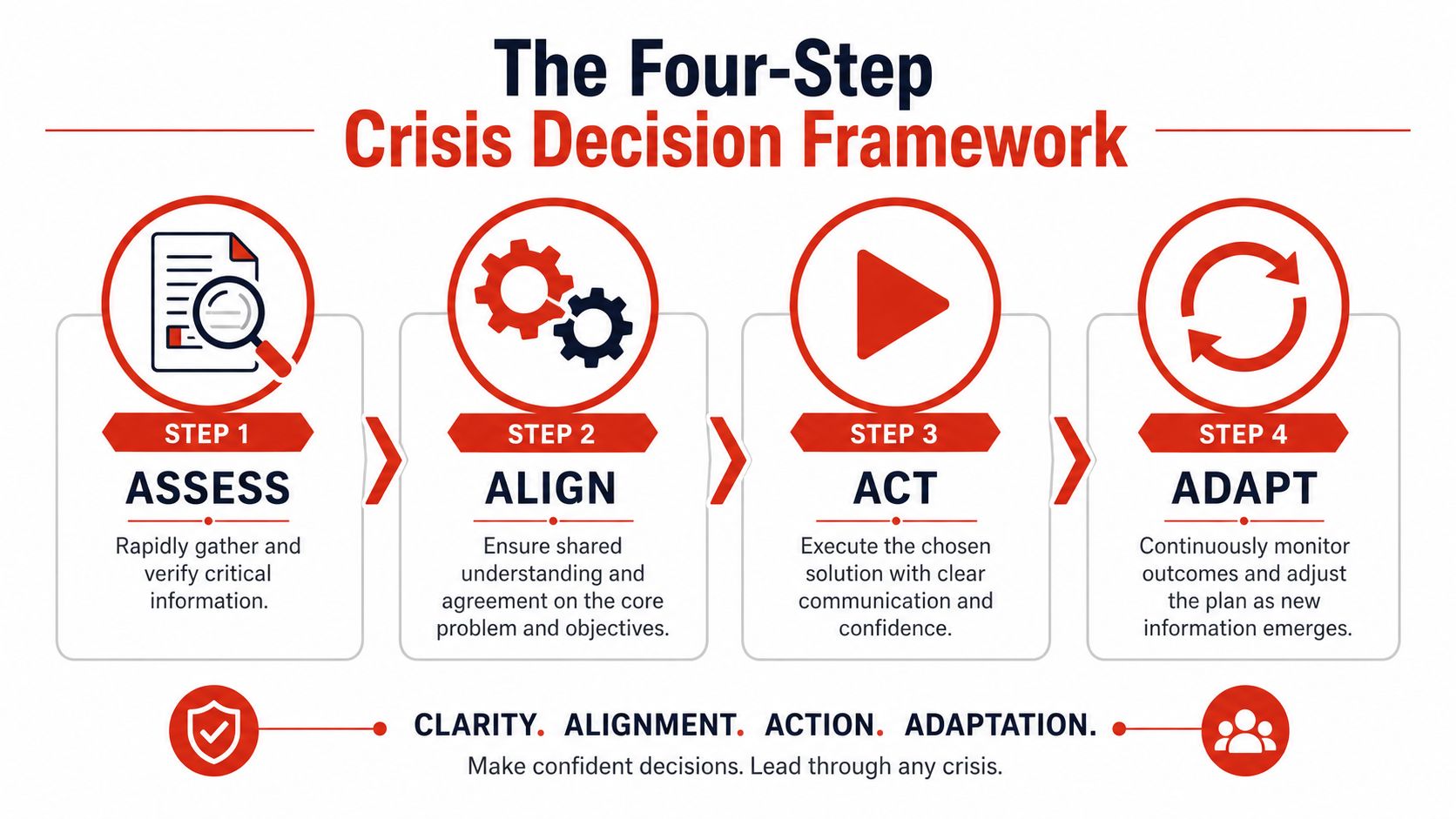
The method I teach is Assess, Align, Act, Adapt. It draws from OODA and pattern recognition, but it is built for corporate reality. Founders, VPs, and incident leaders use it because it helps them make a call before the organization drifts into noise.
Assess the actual problem
Start by defining the decision in one sentence.
Are you deciding whether to pause a release, notify customers, approve a workaround, or brief the board? If the decision itself is blurry, the conversation gets wider and slower. Teams start arguing about side issues because no one has named the call that must be made.
Research on high-risk decision-making has shown the same pattern noted earlier in this article. Time pressure and uncertainty increase error rates, and experienced operators often rely on recognition under stress. That is why the assess step matters. It forces the team to separate signal from activity before they commit resources.
I tell leaders to ask two questions first. What decision are we making now? What decision can wait one hour?
That split saves time.
Align on stakes and ownership
Once the decision is clear, get the right people on the same page fast. Alignment is about shared understanding and a named owner, not a round of equal opinions.
Use a few direct questions:
- What do we know for sure right now
- What are we assuming
- What happens if we wait
- Who owns the recommendation
- Who must be informed before we move
This is also where executive presence matters. Under pressure, teams follow the leader who sounds clear, bounded, and calm. Leaders who want to improve that skill can study these executive presence habits for high-pressure conversations.
A short explainer can help teams internalize the flow before they need it. This video is a useful prompt for team discussion during training sessions.
Act with a clear call
Make the decision in plain language, with a visible owner and a time boundary.
Say, "We are delaying the release for two hours while engineering validates the fix," or, "We are continuing the launch, disabling Feature X, and preparing customer communication." That level of clarity prevents shadow debates after the meeting ends and gives every function the same operating instruction.
The rationale should also be short. Tie it to risk, timing, and business impact. If a leader needs a few more examples of how to structure decisions under pressure, this collection of actionable decision strategies is useful reference material.
Adapt without ego
Good crisis leaders treat decisions as temporary working judgments. They monitor what changed, what broke, and what the first action triggered elsewhere in the system.
Ego gets expensive here. A leader who defends the original call after the facts change usually burns time, trust, or both. Strong operators revise openly and explain why.
Use a simple review loop:
- Check outcomes: What changed after the action?
- Scan for side effects: Did the fix create a new problem?
- Reassess timing: Has the decision window changed?
- Revise openly: Tell the team what changed and why the plan is changing with it.
How Winning Leaders Act Under Fire
The difference between average and strong leadership under pressure usually shows up in behavior, not slogans.
Take a tech lead handling a potential data breach. Security sees unusual access patterns. Legal wants caution. Customer success is worried about inbound questions. The weak version of leadership starts with broad alarm, too many voices, and no decision owner. The strong version starts narrower. What is confirmed? What is customer-facing? What must be decided in the next hour? That leader doesn't perform certainty. They create order.
I've watched leaders improve dramatically once they stop treating pressure as a test of personality and start treating it as a test of process. The best ones sound almost boring in a crisis. They ask clean questions, keep everyone tied to the same objective, and don't reward drama.
Two contrasting scenes
A sales leader gets word that a competitor has changed the pricing structure in a late-stage enterprise deal. The instinctive response is usually emotional. Match immediately, blame product, or escalate everything to the CRO. The better response is disciplined. Reassess the account's buying criteria. Confirm whether price is the actual obstacle or just the easiest objection for the buyer to voice. Decide whether to defend value, adjust packaging, or walk away with intention.
A founder facing an investor or board challenge has a similar choice. They can overexplain, become defensive, or flood the room with activity. Or they can narrow the question and answer it directly. What is the immediate decision? What evidence supports it? What risk are we accepting? That style builds trust because it shows command without pretending there is zero uncertainty.
If you want examples that are easy to use in workshops or sales leadership discussions, this collection of actionable decision strategies can help teams compare weak and strong responses.
Composure is trainable
Shannon Rowbury's work on leadership and peak performance is useful here because elite competition and executive pressure share one hard truth. You don't get to wait for ideal conditions. You have to perform while your body is sending noise.
That is why composure should be treated as a capability, not a personality trait. Leaders can learn to shorten the delay between emotional reaction and useful action. They can also learn to project steadiness without becoming robotic. That's a major part of executive presence in difficult moments, and this perspective on building executive presence that holds under scrutiny is especially relevant for leaders who need to communicate tough calls.
Strong leaders under fire don't eliminate pressure. They stop pressure from choosing for them.
Building a Resilient, High-Pressure Team
A company can't rely on one calm executive to save every difficult moment. Pressure resilience has to exist at the team level.
That starts with a simple shift. Stop treating decision making under pressure as an individual talent and start treating it as an operating capability. Teams need shared language, shared drills, and shared standards for how decisions are made when the clock is running.
What teams need before the crisis
The best time to improve crisis decision quality is before anything breaks.
Teams benefit from a few concrete practices:
- Scenario reps: Run through launch failures, customer escalations, security events, and competitive surprises before they happen.
- Decision roles: Clarify who recommends, who decides, who executes, and who communicates.
- Escalation rules: Define what must move up fast and what should stay with frontline leaders.
- After-action reviews: Look at how decisions were made, not just whether the outcome was good.

The goal isn't to script every future event. It's to reduce confusion and speed up useful coordination. Teams that practice together get faster at cue detection, cleaner in their communication, and less likely to freeze when the stakes rise.
Why workshops work better than passive advice
Pressure skills are behavioral. That means they respond better to rehearsal than to theory alone.
A keynote can give leaders a memorable model and language they can carry back to work. An interactive workshop goes further. It lets a team pressure-test assumptions, practice live trade-offs, and expose weak spots in communication before a real incident does it for them.
This is especially important in fast-moving organizations where leaders are balancing technical complexity, public visibility, and internal alignment. The strongest companies build these muscles intentionally. They don't wait for a rough quarter or a public failure to discover that nobody knows how decisions get made.
For teams trying to turn these ideas into a broader leadership system, this resource on building high-performing teams in demanding environments is a useful next step.
Pressure will always reveal something. With the right training, it can reveal a team that knows how to think, align, and act together.
If you're planning a leadership offsite, annual meeting, SKO, or workshop focused on resilience, decision quality, innovation, or high-performance teamwork, Silicon Valley Speakers can help you find a speaker who has operated under real pressure. Their roster includes builders, founders, AI pioneers, and peak-performance voices like Shannon Rowbury who bring practical insight, not generic motivation.