You're probably planning an offsite, annual meeting, sales kickoff, or leadership summit right now, and someone has put “innovation” on the agenda. The problem is that the word is doing too much work. One executive means AI. Another means new products. Someone in operations means cost reduction. The CEO says the company needs to “reinvent the business.” Nobody is talking about the same thing.
That's where most strategy events go sideways. Teams spend a day discussing trends, hear an energetic keynote, and leave with a list of ideas that don't change how the company makes money. If you want the next event to matter, center it on business model innovation. That's the level where companies stop tweaking and start repositioning.
For leadership teams, this topic belongs at the strategic offsite. For event planners, it belongs in the design of the agenda itself. A keynote can create urgency, a workshop can expose the weak points in the current model, and a well-run session moves a team from vague ambition to a real set of decisions.
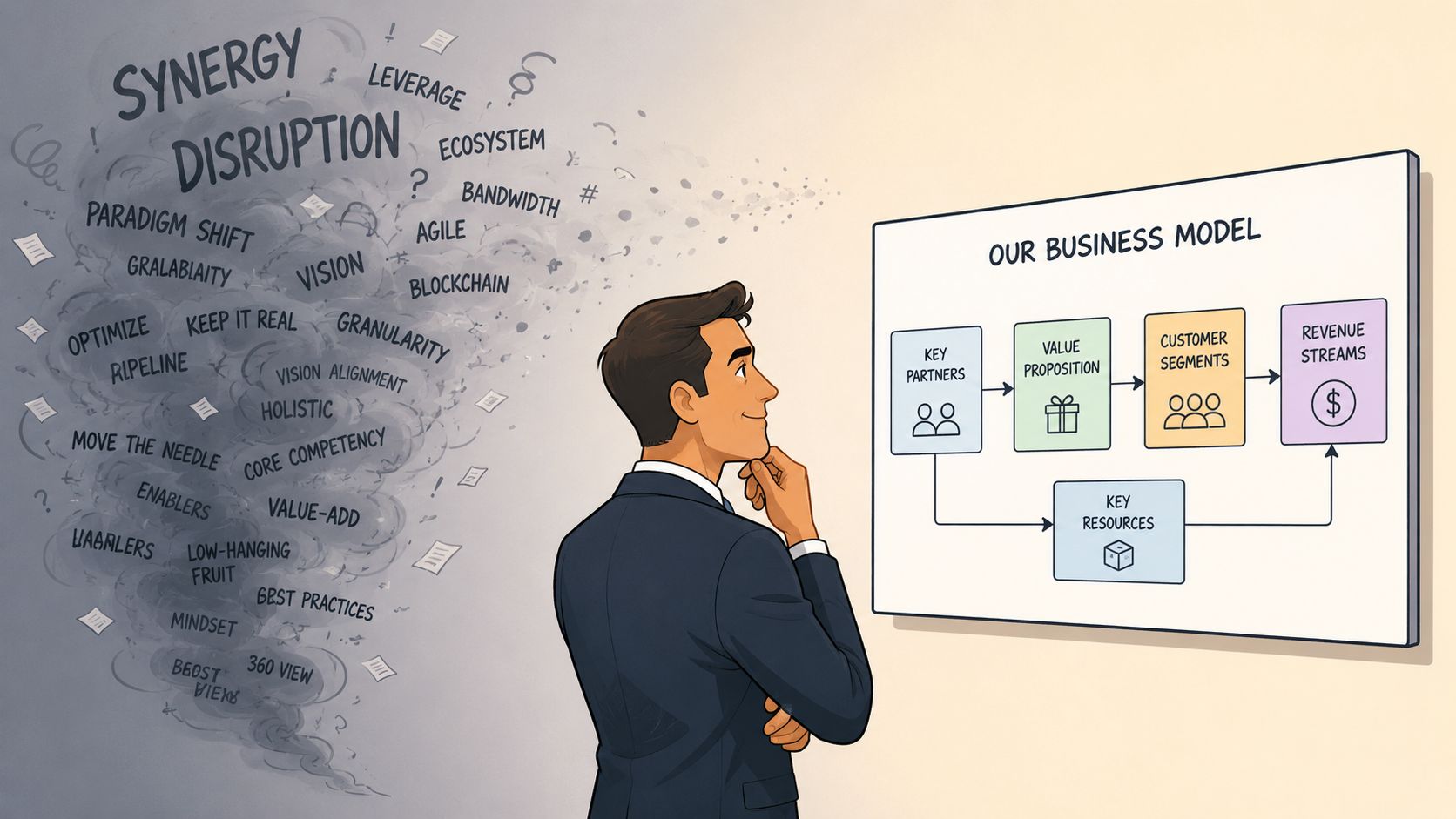
Beyond Buzzwords What Is Business Model Innovation
A company can lead its category for years and still get blindsided. Sales may look stable. The brand may still be strong. Then a competitor changes the rules. Customers start buying differently, paying differently, or expecting a completely different experience. The incumbent didn't fail because it stopped working hard. It failed because it kept improving the wrong model.
That's the simplest way to understand business model innovation. It's not about making your existing offer slightly better. It's about changing how your company creates value, delivers value, and captures value.
What it is and what it isn't
Leaders often confuse three different things:
- Product innovation means you build something new or improve a feature.
- Process innovation means you make delivery faster, cheaper, or more reliable.
- Business model innovation means you change the underlying logic of the business.
A simple analogy helps. If your company is a theater, product innovation changes the show. Process innovation improves backstage operations. Business model innovation changes how tickets are sold, who gets in, what the experience includes, and how the theater makes money in the first place.
That distinction matters because companies rarely lose relevance because one feature fell behind. They lose relevance because their assumptions about buyers, channels, pricing, or value creation no longer fit reality.
Why leaders should care now
Business model innovation forces a harder conversation than product roadmaps do. It asks questions executives often avoid:
- Who is the primary customer now
- What core problem are we being hired to solve
- Where is value shifting in our industry
- What part of our current model has become a constraint
Practical rule: If your strategy discussion stays focused on features, headcount, and quarterly execution, you're not discussing the business model yet.
For an offsite, that's the right starting point. Don't ask, “How do we become more forward-thinking?” Ask, “What assumptions about our business no longer hold?” That reframes the conversation from culture talk to strategic design.
If your team needs a clean primer before the event, this guide on what innovation in business actually means is a useful pre-read. It helps separate the language of innovation from the substance of change.
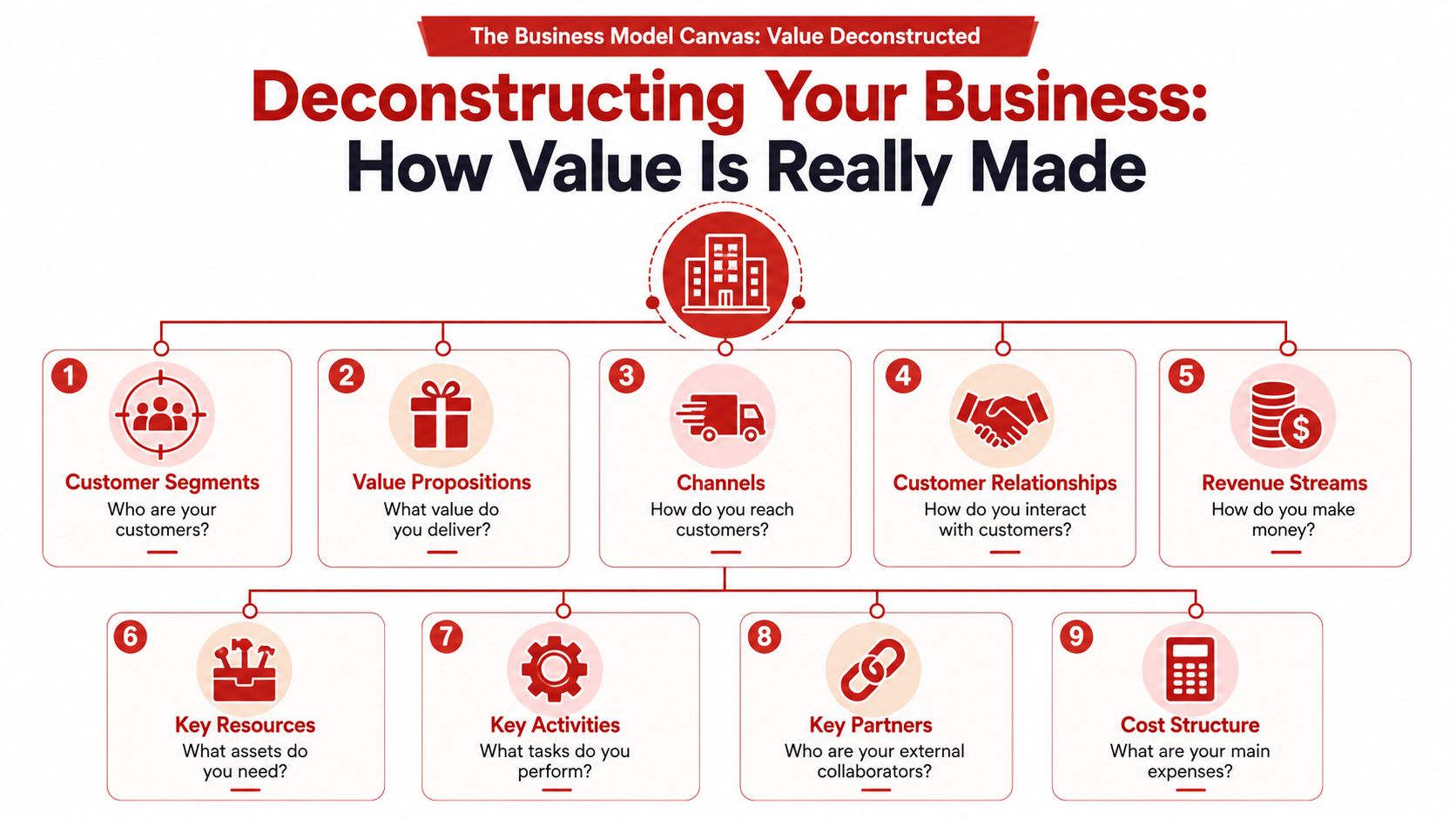
Deconstructing Your Business How Value Is Really Made
Most leadership teams talk about the company as if it were one thing. It isn't — it's a set of connected choices. Until you break those choices apart, you can't change them with any precision.
Use a coffee shop as the model. It's simple enough to see clearly, and the same logic applies to a software company, a manufacturer, a media business, or a services firm.
Start with the customer and the promise
A coffee shop doesn't serve “everyone.” Morning commuters want speed and consistency. Remote workers want space and Wi-Fi. Students want price-sensitive options and long stays. Those are different customer segments, and each one values something different.
The value proposition sits right next to that. For one segment, it's the fastest good espresso near the train station. For another, it's a comfortable place to work for half the day. Same shop. Different promise.
If your leadership team can't clearly state which customer matters most and what distinct value they receive, the business model is already blurry.
Then map the path from value to revenue
Now look at how the shop reaches people and how it gets paid.
| Component | Coffee shop example | Strategic question |
|---|---|---|
| Customer segments | Commuters, students, remote workers | Which group matters most? |
| Value proposition | Fast espresso, workspace, convenience | Why do they choose you? |
| Channels | Storefront, app pickup, delivery app | How do they access you? |
| Customer relationships | Loyalty program, barista familiarity, app notifications | What keeps them returning? |
| Revenue streams | Walk-in purchases, subscriptions, catering | How do you capture value? |
Often, leaders discover they have a channel problem disguised as a sales problem, or a pricing problem disguised as a marketing problem.
A shop that relies only on in-store traffic has one model. Add pre-orders, office delivery, bean subscriptions, or membership perks and the model starts to shift. It's still selling coffee, but it's operating under a different logic.
The engine behind the scenes
The front of the business gets most of the attention. The back of the model determines whether the promise can hold.
Key resources include the location, equipment, staff, brand, and supplier relationships. Key activities include brewing, training, stocking, customer service, and app fulfillment. Key partners may include delivery platforms, local bakeries, or payment providers. Cost structure covers rent, labor, ingredients, packaging, and technology.
A business model breaks when one part changes and the rest of the system doesn't adapt with it.
That's why leadership teams need a full map, not a slogan. The point isn't to complete a framework because a consultant told you to. The point is to see where the model is coherent, where it's under strain, and where one shift could enable several others.
Use this set of nine components in your event workshop, but keep it practical. Have each executive describe the company in plain language under each heading. Ban jargon. If the room can't explain the model in plain language, it won't be able to reinvent it.
Signals for Change When to Rethink Your Model
Most companies wait too long. They react when the pain becomes obvious, not when the pattern becomes visible. By then, the conversation is defensive. Budgets tighten, urgency spikes, and leaders call for innovation as if it were an emergency repair service.
A better approach is to treat your business model like any other critical system. You inspect it before failure.
The clearest warning signs
You don't need a market collapse to justify a rethink. Watch for signals like these:
- Stable sales with weaker economics. Revenue may hold while margin quality, retention quality, or cost to serve gradually deteriorates.
- Competitors winning with “good enough” offers. If lower-cost or simpler alternatives keep gaining traction, customers may no longer value your complexity.
- Customer behavior shifting faster than your operating model. Buyers may prefer self-serve, subscription access, digital delivery, or faster decision cycles than your current structure supports.
- New technology changing expectations. Generative AI is a good example. It doesn't just improve productivity. It can compress service delivery, alter pricing logic, and reset what customers think should be instant.
- Workarounds multiplying inside your company. When teams constantly create exceptions, manual fixes, and side processes to serve the market, the model is fighting reality.
These signals matter because they usually appear before headline performance does. Leaders who catch them early can redesign with choice. Leaders who ignore them redesign under pressure.
Use the canvas as a diagnostic tool
The Business Model Canvas is useful here, not as an academic exercise, but as a stress test. Put the current model on one wall and ask hard questions block by block.
Try prompts like these:
- Customer segments. Are we organized around the buyers we have, or the buyers we want?
- Channels. Are customers moving toward channels we still treat as secondary?
- Revenue streams. Are we paid for outcomes, access, transactions, or something else? Should that change?
- Key activities. What do we still do ourselves that no longer differentiates us?
- Partners. Who now owns the customer relationship that we used to control?
A good workshop doesn't start with ideation. It starts with diagnosis.
The right time to rethink the model is when the old assumptions feel slightly uncomfortable, not when they become impossible to defend.
For event teams planning hybrid leadership sessions, logistics matter too. Format affects decision quality. If you're designing discussions across in-person and virtual audiences, Darkaa's hybrid event management guide is a practical resource for structuring participation without losing momentum in strategic sessions.
What to discuss at the offsite
Keep this part blunt. Ask executives to name the assumptions they believe are aging out. Then push for evidence from customers, sales conversations, lost deals, support friction, and operating bottlenecks. Not anecdotes dressed up as certainty. Real friction points.
A strong offsite discussion usually surfaces one of three truths. The company is serving the wrong segment too broadly. It's using channels and pricing built for an older market. Or it's carrying capabilities that used to matter but now dilute focus. Any one of those is enough reason to rethink the model.
How Visionaries Reinvented Their Industries
The best examples of business model innovation aren't stories about clever products. They're stories about companies changing the way value moves.
Netflix changed the delivery logic
Netflix began with physical DVD rentals by mail. That model solved a pain point in traditional video rental. It was more convenient and removed the friction of the store visit. But the bigger shift came later, when Netflix moved from shipping media to streaming access.
The company didn't just introduce a new format. It changed the customer relationship from occasional rental behavior to ongoing subscription behavior. It also changed the channel from physical logistics to digital delivery. Later, it extended the model again through original content, which gave it more control over differentiation.
The lesson is simple: the product category stayed adjacent to entertainment. The business model changed much more dramatically.
Apple built an ecosystem, not just devices
Apple didn't win by selling hardware alone. It connected devices, software, media, payments, and developer participation into one ecosystem. The iPod mattered. iTunes mattered more strategically because it reshaped how users acquired and managed digital music. The App Store deepened that logic by making the device a platform for ongoing value.
Apple's genius wasn't only design. It was orchestration, making the product the entry point into a larger system that kept customers engaged and reduced friction across use cases.
That's what leadership teams often miss. A strong business model innovation often increases switching costs not by locking customers in aggressively, but by making the entire experience easier to stay with.
Dollar Shave Club removed the retail gatekeeper
Dollar Shave Club didn't need to out-invent the razor. It changed distribution, pricing logic, and the customer relationship. Instead of fighting for shelf space in traditional retail, it went direct to consumer with a subscription model and a simple value story.
That move did three things at once. It made replenishment predictable. It reduced buying friction. It let the company own the relationship instead of renting access through retail channels.
For executives at an offsite, that's a useful provocation. Ask whether your company still depends on channels that add cost but no real value.
Some of the strongest model shifts come from removing an intermediary that the market no longer needs.
Adobe changed when customers pay
Adobe's move from packaged software to subscription access is another classic shift. The company stopped relying on periodic large purchases and moved toward an ongoing service model. That changed revenue timing, customer expectations, and product delivery discipline.
It also forced a different operating rhythm. You can't hide behind a major release cycle when customers expect continuous improvement. A subscription model makes value more visible over time, and that pressure can be healthy if the organization is ready for it.
This is why business model innovation is not a pricing exercise in isolation. A revenue model shift usually demands changes in product, service, support, and internal incentives.
AI pioneers changed the interface itself
AI offers another lens. The creators behind virtual assistants like Siri didn't just add a feature. They helped normalize a different way for humans to interact with technology. That matters because interface shifts often trigger business model opportunities. When users can ask, speak, automate, and receive help differently, distribution, engagement, and monetization options change with them.
Adam Cheyer's work is relevant here because it sits at the intersection of invention and adoption. Leaders don't need another abstract AI talk. They need examples of how new interfaces create new behaviors, and how new behaviors open new business models.
What these examples have in common
These companies didn't all use the same playbook, but they did share a pattern:
- They challenged inherited assumptions about distribution, pricing, customer access, or ownership.
- They redesigned multiple parts of the model at once, not one isolated lever.
- They aligned operating choices with the new model instead of treating it like a side experiment forever.
- They made the customer experience easier, simpler, or more continuous.
That's the benchmark for your event discussion. Don't fill the room with innovation theater. Put examples like these on the agenda and ask one sharp question after each: what old assumption did this company stop obeying?
Sparking Change With Inspiring Keynotes
Most internal strategy conversations suffer from one problem. The people in the room already know the company too well. They know the politics, the legacy decisions, the failed pilots, and all the reasons something “won't work here.” That knowledge is useful for execution and terrible for imagination.
That's why a keynote matters at the front end of a business model conversation.
A strong keynote does three jobs: it creates a shared language, breaks internal pattern lock, and raises the ambition of the room before the workshop gets practical. If you skip that stage, the working session often collapses into incrementalism.
Why an external voice works
Internal leaders usually carry too much baggage to reset the conversation cleanly. People hear the title before they hear the idea. They filter the message through org structure and history.
An external speaker with real building experience cuts through that. Not because outsiders are automatically wiser, but because they can say what insiders often can't. They can challenge stale assumptions without triggering the same internal defensiveness.
That's especially true when the speaker has built a category, changed user behavior, or helped create a new market interface. Founders and inventors who've lived through reinvention bring credibility that generic motivational speakers don't.
If you're looking at options for speeches on innovation that move a leadership team toward action, focus on speakers who can connect invention to operating reality. You want someone who understands adoption, not just inspiration.
What the keynote should do
Don't book a keynote as entertainment between meals. Use it as the opening argument for why change is necessary.
Here's the brief I'd give any leadership event team:
- Start with disruption pressure. Show why staying on the current path is a strategic choice, not a neutral default.
- Use credible examples. The speaker should explain how business models changed in real companies, not recycle generic trend slides.
- Connect innovation to decisions. The talk should push the audience toward questions about customers, channels, pricing, and value capture.
- Create tension, not comfort. If everyone leaves saying, “That was inspiring,” but nobody feels challenged, the keynote failed.
Leadership advice: Book the keynote for relevance, not celebrity. The room needs conviction and clarity more than recognition.
The best keynotes create just enough productive discomfort that the workshop can become honest.
A strong example of the tone and substance that works in this context is below.
How to place it in the agenda
Put the keynote before executives start diagnosing the current model. Give people a break after it. Then move into facilitated work while the message is still fresh.
Don't bury the keynote at the close of the event day. By then, energy is lower and people have already settled into defensive postures. Opening with a credible external perspective makes the rest of the event sharper because the room has permission to think beyond its own habits.
From Keynote to Action A Practical Workshop Blueprint
Inspiration is cheap. Design is what matters. If your event ends with applause and no operating decisions, you didn't host a strategy session. You hosted content.
The fix is straightforward. Match the workshop format to the decision you need the group to make. Don't ask a keynote to produce alignment, diagnosis, and future-state design all at once.
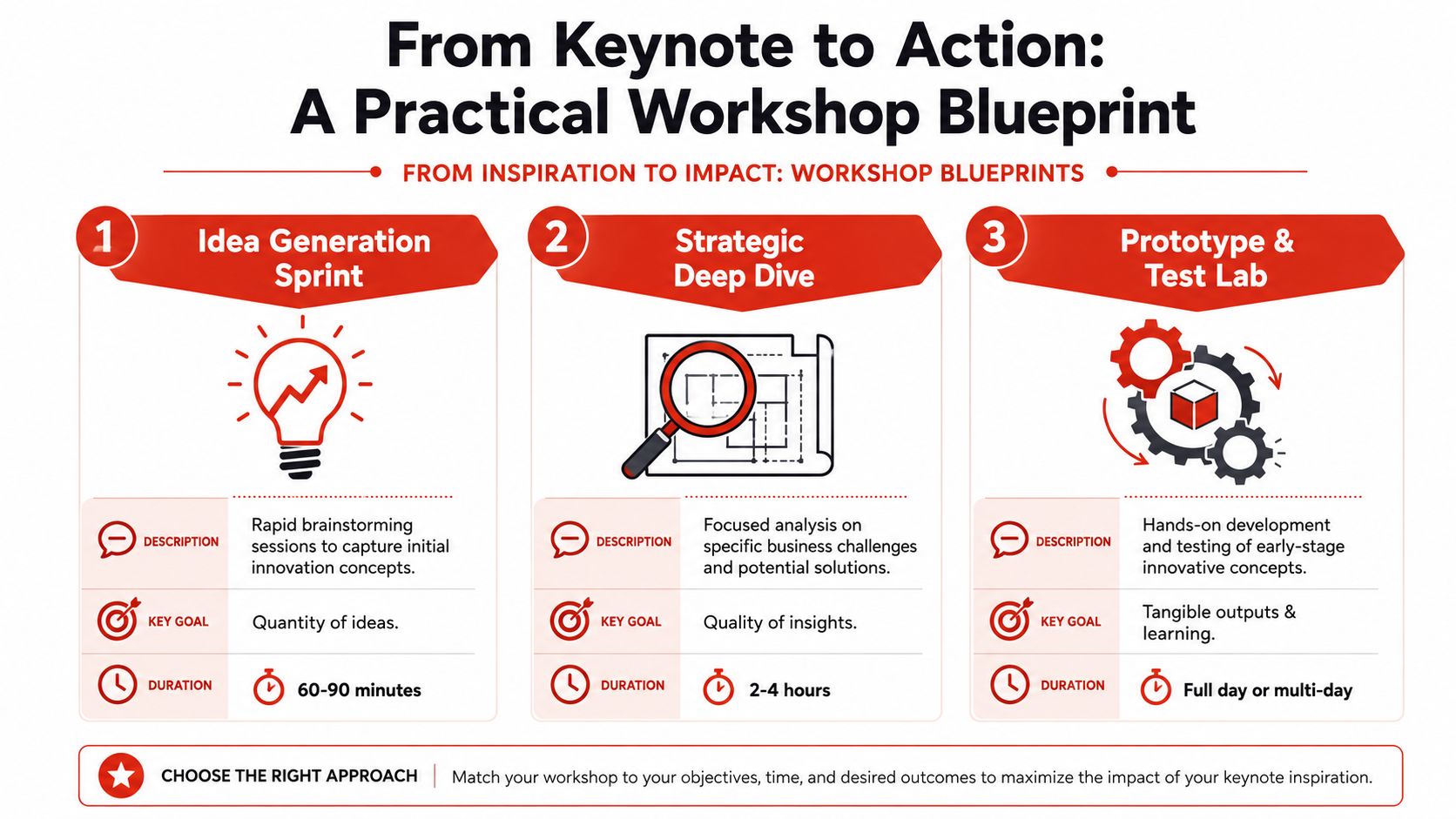
Three formats that actually work
Use one of these formats depending on your goal.
Idea generation sprint
Best when the company needs energy, shared language, and a fast collection of opportunities.
Run this after a keynote for a broad audience. Break participants into mixed groups. Give them a simple prompt such as, “What if we had to serve the same customers with half the friction?” or “What if we could no longer rely on our current channel?” Keep the pace high.
Expected outputs:
- A set of opportunity areas
- A shortlist of assumptions worth testing
- Stronger cross-functional visibility into where people see risk and possibility
This works well for all-hands, innovation days, and customer-facing conferences where the goal is direction, not final decisions.
Strategic deep dive
Use this when the leadership team needs diagnosis, not just ideas.
Limit the room to decision-makers and critical operators. Map the current business model in plain language. Then identify where the model is under pressure. Push the group to rank vulnerabilities and discuss which parts of the model deserve redesign first.
Activities usually include:
- Current-state canvas mapping
- Friction-point review from sales, product, operations, and customer success
- Debate on which assumptions should be preserved and which should be challenged
Expected outputs are tighter. You should leave with a prioritized list of model risks, a few design principles for the future, and named owners for the next stage.
Prototype and test lab
This is the right format when the company is ready to shape future models, not just talk about them.
The group should work on a small number of candidate models. Build rough versions of each. Define the customer, the value proposition, the channel logic, and the revenue logic. Then pressure-test each model against capabilities, timing, and customer adoption barriers.
Don't ask executives whether they “like” a new model. Ask what assumption would have to be true for it to work.
Expected outputs:
- Draft future-state business models
- Clear assumptions to validate
- Early experiment plans
- Decision criteria for what moves forward
Business Model Innovation Session Formats
| Format | Duration | Primary Goal | Key Outcomes |
|---|---|---|---|
| Idea Generation Sprint | Short session | Generate options and create energy | Opportunity themes, assumptions, team alignment |
| Strategic Deep Dive | Half-day session | Diagnose the current model | Prioritized risks, design principles, ownership |
| Prototype & Test Lab | Full-day or multi-day session | Design and pressure-test future models | Draft models, experiment plans, decision criteria |
How to choose the right one
Don't choose based on what sounds exciting. Choose based on organizational readiness.
- Use the sprint if your audience is broad and your main problem is lack of shared language.
- Pick the deep dive if leaders disagree on where the current model is failing.
- Go with the lab if you already know the status quo isn't enough and need concrete alternatives.
The biggest mistake I see is forcing a large mixed audience into strategic design before the executives have aligned on the diagnosis. That wastes time and produces vague outputs.
If you're planning interactive formats beyond the keynote, corporate workshops built for leadership teams and technical groups offer a useful reference point for structuring sessions around real outcomes rather than passive participation.
A practical agenda pattern
Here's the sequence I recommend for an offsite focused on business model innovation:
- Opening keynote to widen perspective and challenge assumptions
- Executive diagnostic session on the current model
- Small-group design work on targeted future-state options
- Readout and critique with clear criteria
- Decision session on experiments, owners, and timing
That sequence respects how strategic change unfolds. First the room opens up, then it gets honest, then specific.
Turning Ideas Into Impact Without Breaking The Business
The biggest blocker isn't lack of ideas. It's fear. Leaders worry that changing the business model means betting the company on an unproven concept. That fear is understandable and often badly managed.
The answer isn't caution disguised as delay. The answer is disciplined experimentation. Don't replace the core business overnight. Test the risky assumptions around a new model in contained ways. Pilot with a defined segment. Offer a new pricing structure to a narrow group. Trial a new channel without rebuilding the whole company around it.
Measure learning before you measure scale
Early business model work shouldn't be judged only by short-term revenue. That pushes teams to kill good ideas before they've been properly tested.
Use forward-looking indicators instead:
- Validated assumptions about customer need, willingness to buy, or channel fit
- Rate of learning across short test cycles
- Quality of customer feedback from live experiments
- Evidence of repeat behavior in the target segment
- Internal capability gaps identified early, before scale makes them expensive
For leadership teams thinking about value over time, retention and repeat engagement still matter. This practical piece on improving customer loyalty for businesses is a useful companion read because it reinforces a core truth of business model design: lasting value often comes from stronger relationships, not just more transactions.
The real risk isn't testing a new model carefully. The real risk is defending an aging one until the market makes the decision for you.
If you want your next event to drive actual change, build it around that principle. Use the keynote to create urgency, the workshop to expose assumptions, and follow-up sessions to test what the team learns. That's how business model innovation becomes a management discipline instead of a conference theme.
If you're planning an offsite, leadership retreat, annual meeting, or customer event and want a speaker who's built the future instead of just talking about it, explore Silicon Valley Speakers. Their roster is intentionally focused on proven builders, inventors, and operators who can help your team move from inspiration to action through keynotes and hands-on workshops.