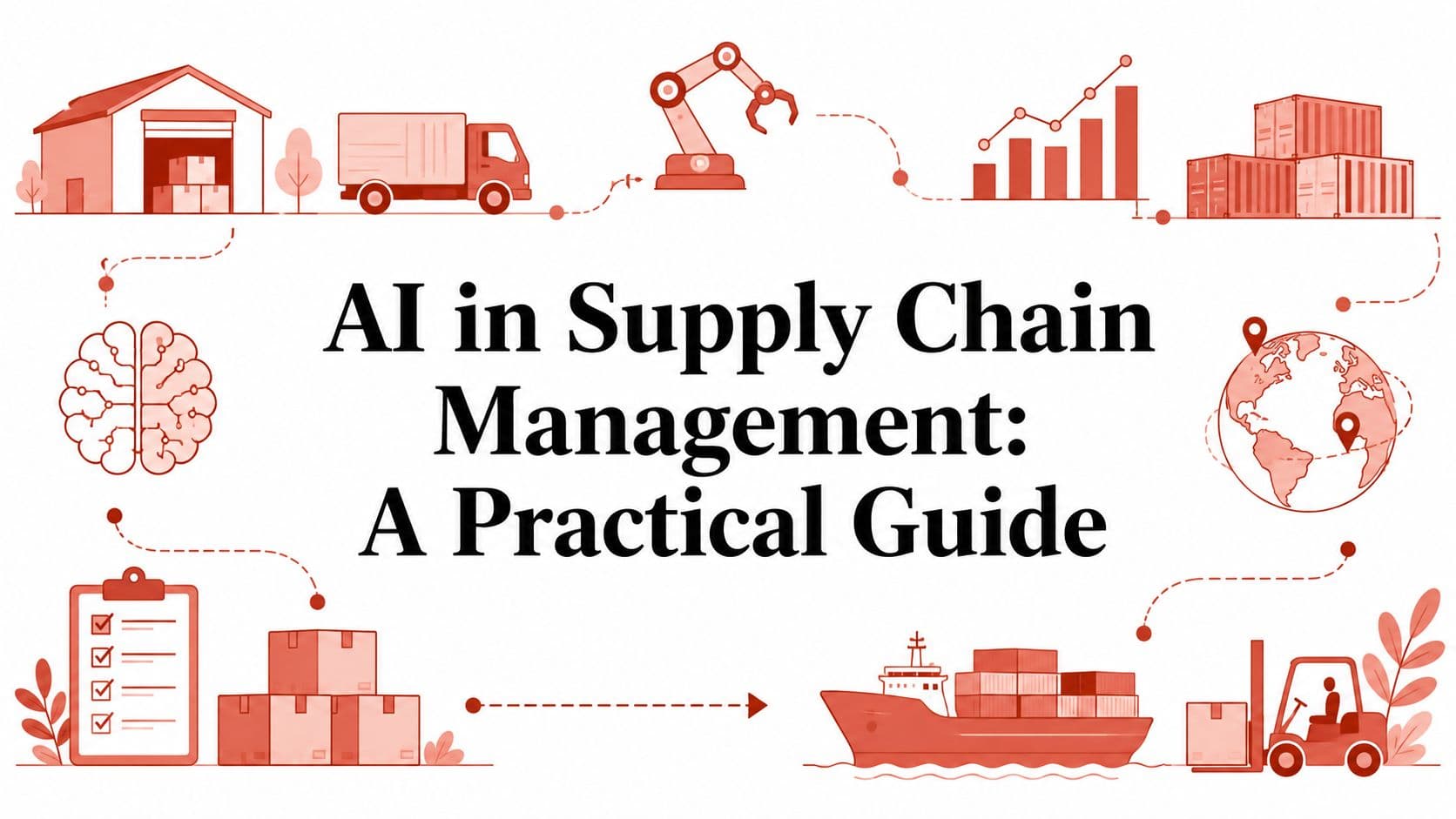
A planner watches demand soften in one region, then a port delay pushes inbound stock into the wrong lane, and a supplier flag arrives before the morning standup ends. By the time the team has aligned on the facts, the decisions are already stacked, expedite, substitute, hold, or reroute. That's why AI in supply chain management has moved from a side project to a leadership topic, because the issue isn't only automation, it's how fast and how well teams can make decisions under pressure.
If you're preparing a leadership offsite, a keynote briefing, or a workshop for ops and executive teams, this topic needs to be explained in plain language. The most useful way to approach it is as a working guide to resilience, decision quality, and working capital, not as a buzzword tour.
Why AI in Supply Chain Management Matters Now
A delayed shipment, a supplier exception, and a sudden shift in demand can all arrive before a team has finished its morning review. In that moment, the question is not whether software can automate a task. It is whether leaders can see risk early enough, choose the better response, and keep service levels steady while cash stays tied to the right places.
That is why AI in supply chain management has become a board-level topic. Analysts at ABI Research survey results reported that 64% of supply chain leaders said AI and generative AI capabilities matter when evaluating new technology investments, while 57% of operations and supply chain leaders had already integrated AI into selected functions or across their organization. The same market summaries also said 94% of supply chain companies planned to use AI or GenAI for decision support within two years, yet only 23% reported a formal AI strategy. That pattern shows adoption moving faster than governance.
For leaders, that distance between adoption pace and strategy is where the real conversation starts. The useful questions are simple to state and hard to answer well. Where does AI improve a decision, who owns that decision, and what controls keep the team from acting quickly in the wrong direction?
Practical rule: If a supply chain use case does not change a decision, it probably does not deserve executive attention yet.
The business value shows up in three places. It can strengthen planning by giving teams earlier signals, support sourcing and logistics decisions when conditions shift, and flag supplier risk before it shows up as a service failure. For event planners and workshop designers, that creates a clear keynote thread, from volatility, to decision quality, to resilience. It also helps frame AI as a management discipline first and a technology investment second, the same lens used in this overview of artificial intelligence in business.
The Core Concepts Behind AI in Supply Chains
AI in supply chain management is easiest to understand as a stack of four capabilities. Each one answers a different business question, and each one shows up in a different part of the operation.
Machine learning, computer vision, natural language processing, and optimization
Machine learning looks for patterns in data. Think of it as the memory of an experienced demand planner, except it can scan more signals than one person can hold in their head. In practice, that means sales history, weather, supplier reliability, and transport delays can all feed a forecast model.
Computer vision reads images and video. A warehouse supervisor might use it like an extra set of eyes on the line, checking cartons, pallets, or product quality where humans would otherwise sample manually. It's especially useful when inspection is repetitive, time-sensitive, or safety-sensitive.
Natural language processing, or NLP, reads and interprets text. You can think of it as a fast analyst for supplier documents, emails, contract language, and customer complaints. A procurement team can use it to scan long supplier packets or pull risk signals from unstructured notes that usually get ignored.
Optimization chooses the best action under constraints. A simple way to picture it is a chess engine for routing, inventory, or network decisions. It doesn't just predict what might happen, it weighs options and recommends the move that best fits cost, service, and capacity limits.
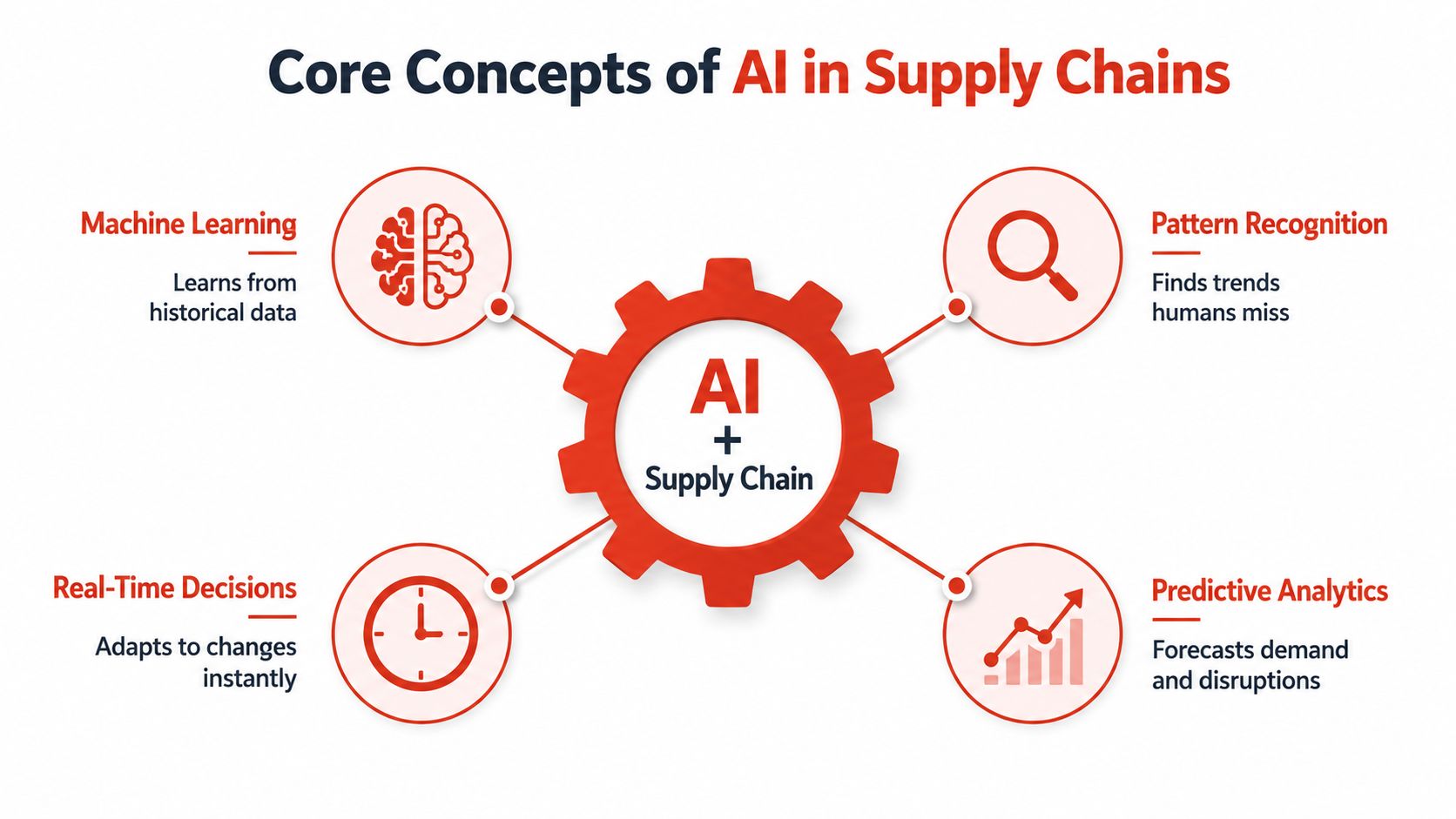
A 2024 systematic review identified artificial neural networks, fuzzy logic, and agent-based systems as the most prevailing AI techniques in supply chain management, which shows the field isn't using AI in a vague, one-size-fits-all way. It's concentrating on a small number of methods that keep appearing in forecasting, planning, and coordination problems. Systematic review of AI techniques
The shift is from descriptive reporting, “what happened,” to prescriptive decision support, “what should we do next.”
If you want a broader business primer that defines AI in a non-technical way, this guide on artificial intelligence in business is a useful companion piece for executives who are still building vocabulary.
Five High-Impact Use Cases Worth Briefing
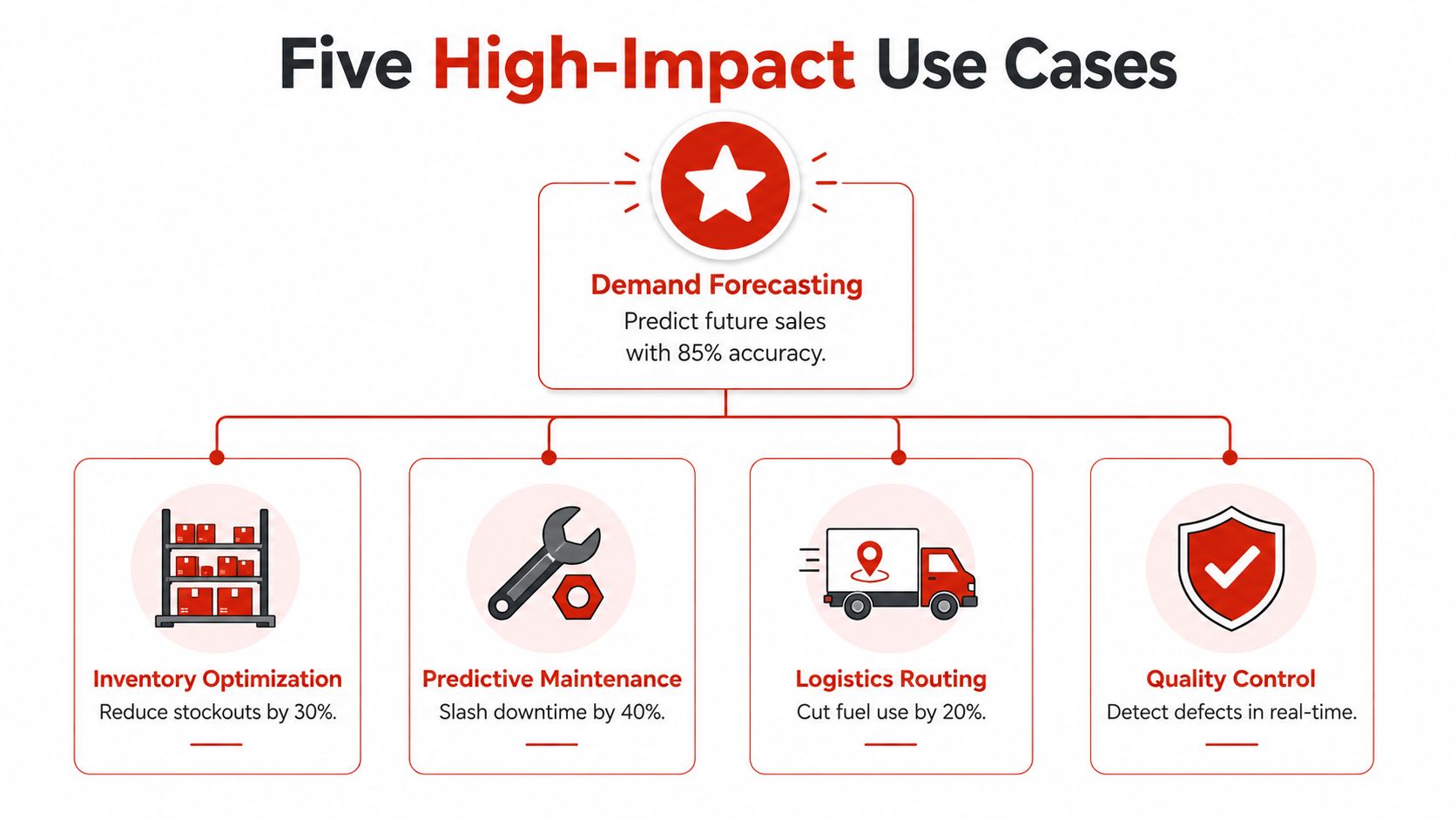
Start with the decision a team has to make, then trace it back to the data behind it. That keeps the conversation on resilience, service, and working capital, instead of turning AI into a vague technology discussion.
Demand forecasting and inventory optimization
A forecast is only useful if it helps a planner make a better call. Demand forecasting combines sales history with outside signals, then uses machine learning to estimate what is likely to move next, so teams can place orders with fewer surprises and less cushion stock built on guesswork. A McKinsey-cited summary says AI can cut forecasting errors by 20% to 50% and reduce inventory levels by 20% to 50%, which is why executives often treat this as the first pilot when they want to improve service without letting inventory swell. AI supply chain statistics
Inventory optimization turns that forecast into a stocking decision. It helps teams decide how much to hold, where to hold it, and when to replenish, so cash is not trapped in the wrong place while service still holds.
Predictive maintenance and logistics routing
Predictive maintenance uses sensor data, usage patterns, or repair history to flag trouble before equipment stops a line or a truck fleet. The business outcome is fewer unplanned disruptions and fewer emergency calls for maintenance managers. One broken machine rarely stays local, it can ripple into labor schedules, service commitments, and shipping plans downstream.
Logistics routing is where prescriptive AI becomes easy to see. Traffic, weather, delivery windows, and capacity are weighed together, then the model recommends the route or load plan that best fits the constraints. In practice, that can mean fewer late deliveries, better vehicle use, and lower expediting pressure. Teams that want a practical reference point for live transport oversight can look at haulage visibility tools, because they show the operational information leaders need before they redesign routing and dispatch routines.
Supplier risk
Supplier-risk analysis is one of the most overlooked uses for mid-sized firms. Research on smaller and mid-sized companies says supplier-risk AI looks promising, but inconsistent data quality and limited platform integration often slow adoption, so many teams cannot begin where glossy enterprise case studies begin.
That matters in a leadership briefing because the goal is not only to reduce manual work in a transaction process. It is to spot fragility sooner, especially when supplier data is scattered across disconnected systems and email threads. Better visibility can protect service levels, reduce scramble buying, and keep more working capital from being tied up in last-minute fixes.
The global AI in supply chain market was estimated at USD 5.05 billion in 2023 and is projected to reach USD 51.12 billion by 2030 at a 38.9% CAGR. Those figures are less important as a sales pitch than as a signal that these use cases are moving into standard operating practice, not experimental territory.
Demand sensing and exception management
Demand sensing is a closer-in version of forecasting. Instead of relying only on longer-range planning cycles, it watches recent signals, such as order changes, channel shifts, or customer behavior, so planners can adjust before a small change becomes a service problem. That helps leaders brief their teams on a simple idea, better signal quality leads to better decisions, and better decisions protect both fill rate and cash.
Exception management uses AI to sort through the noise and surface the issues that need human attention first. A late shipment, a supplier delay, or a sudden stockout does not need the same response as every other alert. The value is in helping operations teams focus on the exceptions that threaten service most, while routine cases stay on track without extra effort.
Network design and scenario planning
Network design asks where inventory, capacity, and fulfillment points should sit if the business wants to serve customers well without carrying unnecessary cost. AI helps teams test more scenarios than a manual model can handle, which makes the trade-offs easier to explain in a leadership workshop. If a site changes, a lane shifts, or demand moves, the team can see how the decision affects service and working capital before committing.
Scenario planning adds a resilience lens. It lets planners examine what happens if a supplier slips, a route closes, or demand changes quickly, then compare options side by side. That is the kind of discussion executives can use in a keynote or offsite, because it turns AI from a technical topic into a tool for better decisions under pressure.
Business Outcomes and KPIs to Track
A leadership team often asks a practical version of the same question, “What changes on the scorecard if we use AI well?” That question belongs at the center of the discussion, because AI in supply chain management only has value when it improves metrics that finance, operations, and customer teams already track.
The metrics that matter
Forecast accuracy shows how close the plan comes to reality. The business question is straightforward, “Are we making fewer bad bets on demand?” When AI improves the quality of the input signal, planners spend less time on emergency adjustments and late expedites. That makes the planning process less like reacting to a weather alert after the storm has started, and more like seeing the front moving in earlier.
Inventory carrying cost shows how much money is tied up in stock. A Capgemini result cited by Kinaxis reported excess inventory and carrying-cost reductions of up to 15% in organizations using AI in supply chains. Lower stock at the same service level frees working capital, which is why this metric often matters in finance conversations. AI in supply chain management outcomes
Fulfillment cost per order measures the cost of getting an order out the door. The same cited result reported 23% lower fulfillment costs, which helps explain why AI often gets attention from finance once it starts reducing rework, expediting, and manual exception handling.
On-time-in-full, or OTIF, asks whether customers received the right order, in the right quantity, on time. AI improves this outcome when forecasts are cleaner, routing is smarter, and shortages are caught earlier, because the work reaches the customer in the shape that was promised.
Supplier risk score is the practical question behind resilience, “Which supplier relationships need attention before a disruption hits?” Procurement, operations, and finance all need the same risk picture, because each group feels the impact in a different way. A sourcing issue that looks small on paper can become a service problem, then a cash problem, if it is ignored too long.
Unplanned downtime matters for factories, fleets, and any operation that depends on assets staying available. If AI gives maintenance teams earlier warning, they can schedule around failure instead of reacting to it after the equipment stops.
| AI Use Cases Mapped to KPIs | ||
|---|---|---|
| Use Case | Primary KPI | Typical Direction of Move |
| Demand forecasting | Forecast accuracy | Improves |
| Inventory optimization | Inventory carrying cost | Decreases |
| Predictive maintenance | Unplanned downtime | Decreases |
| Logistics routing | OTIF | Improves |
| Supplier risk | Supplier risk score | Improves |
That table is useful in a workshop or leadership offsite because it links use cases to business results people already understand. Better sensing reduces forecast error, better forecasts reduce stock inflation, and both effects support service and working capital at the same time.
Teams that want a practical roll-out can use this step-by-step AI adoption guide alongside a focused pilot-to-production AI initiative workshop.
An Implementation Roadmap for Real Organizations
A supply chain team can have a strong AI idea and still stall at rollout. The usual problem is not the model. It is the distance between a promising demo and a process that planners, buyers, warehouse leads, and finance teams will trust during a busy week.
Assess and pilot
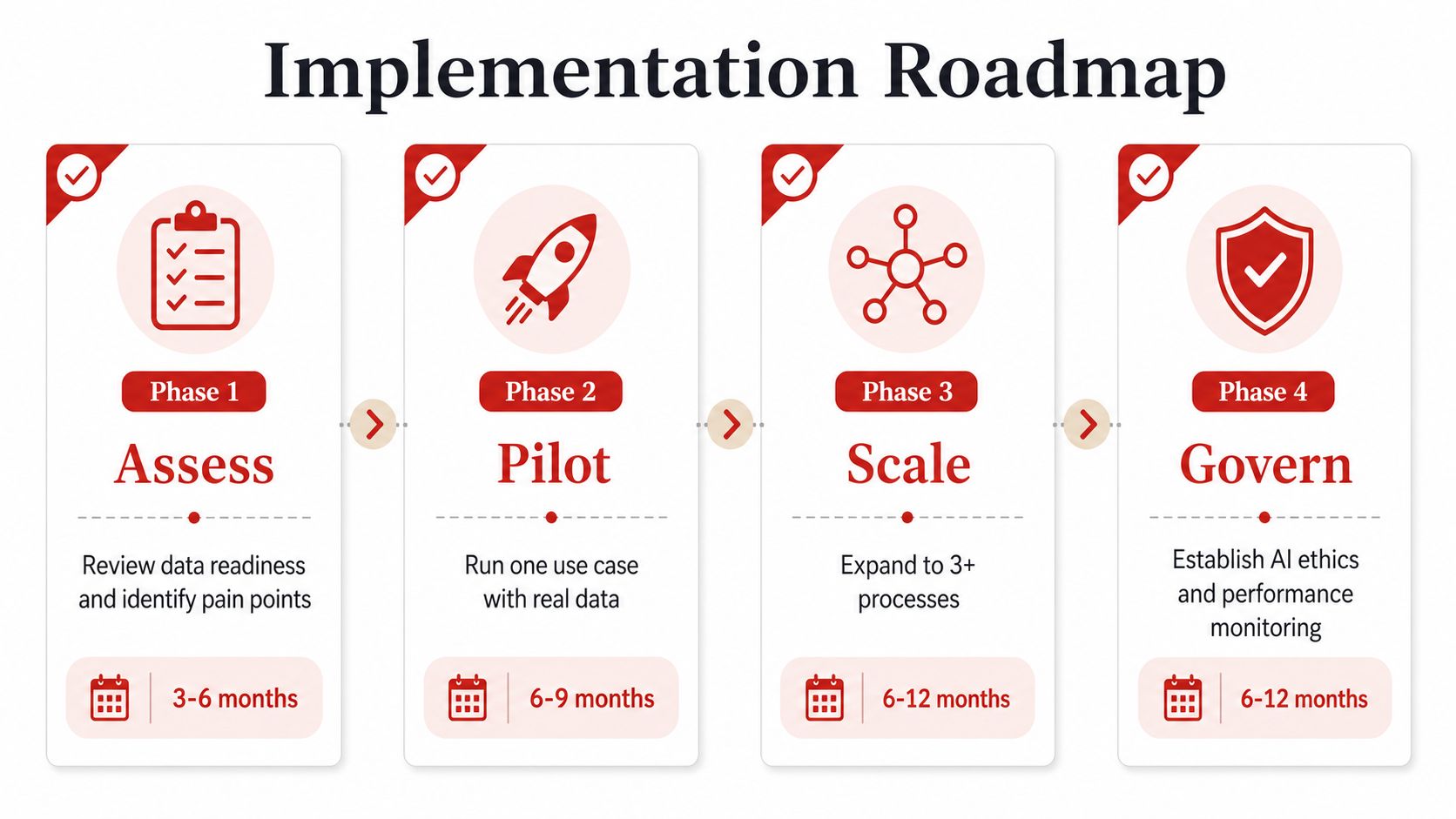
The assess phase starts with a simple question: which decisions hurt the business most when they go wrong, and do we have the data to improve those decisions? That usually means looking at planning accuracy, service risk, inventory pressure, and the places where teams still rely on manual judgment because the information is scattered. The work often takes a few months because the first job is to map the data flow, not just the system chart.
A useful way to explain this phase to leadership is to treat it like checking a venue before a major event. You would not promise a flawless guest experience if the entrances, staffing, and backup plans have not been reviewed. The same logic applies here, because AI can only improve working capital and service if the inputs are understood and the decision owner is clear.
The pilot phase should stay narrow and live. Pick one use case, one business owner, and one operational decision that happens often enough to learn from. A demo that looks polished but never touches real orders, real exceptions, or real replenishment choices will not tell the team much about whether the approach can hold up under pressure.
Scale and govern
The scale phase begins after the pilot proves it can support a real workflow and the operating team can repeat the result without hand-holding. The question leaders should ask is whether the same approach can extend to more products, sites, suppliers, or routes without turning into a custom project every time. This stage usually takes longer than the pilot because the work shifts from proving the idea to fitting it into standard planning and execution routines.
The govern phase keeps the program from becoming a one-time success story. Teams need clear ownership for monitoring model performance, handling exceptions, updating inputs, and deciding when a model should be retrained or paused. As noted in the earlier ABI Research survey results, adoption can move faster than formal oversight, which is why governance needs to be designed as part of the operating model, not added after the fact.
If the pilot works but no one owns model monitoring, you do not have a program, you have a one-time experiment.
A useful outside reference for sequencing the work is this step-by-step AI adoption guide, especially for teams that want a practical internal playbook before they meet vendors. For organizations that want to build a shared understanding across supply chain, operations, and IT, this pilot-to-production AI workshop can help leaders turn the roadmap into an operating plan.
Readiness checklist
- Assess: Do we know which decisions AI should improve, and who owns them?
- Pilot: Is the data live, usable, and owned by a business lead?
- Scale: Can the process expand without custom work every time?
- Govern: Who reviews performance, fairness, and exceptions when conditions change?
Common Pitfalls and How to Mitigate Them
Most bad AI outcomes in supply chains are predictable. The teams see the warning signs, but the project keeps moving because the business wants a quick win and nobody wants to slow down the roadmap.
Five failure points leaders can sponsor around
Dirty and fragmented data usually shows up first. One planner trusts the ERP, another trusts a spreadsheet, and the model inherits both problems. Mitigation: sponsor a single source of truth for the pilot use case before you expand the scope.
Pilot purgatory happens when teams build a promising proof of concept and never operationalize it. The dashboard looks good, but nobody changed how work gets done. Mitigation: assign a process owner and a go-live date before the pilot starts.
Model drift appears when the business changes and the model gets less accurate. A routing model trained on one demand pattern can become stale when a supplier or lane shifts. Mitigation: require regular performance checks, not just launch approval.
Vendor lock-in reduces optionality and raises switching costs. Leaders often discover this too late, when the model is embedded but the contract makes change difficult. Mitigation: ask for portability, documentation, and clear data ownership from day one.
Skill shortages drive a divide between data teams and operations teams. One side understands the math, the other understands the plant, the warehouse, or the network. Mitigation: build a cross-functional steering group so the business never depends on one technical team to translate everything.
Recent research on smaller and mid-sized firms backs up this reality, pointing to data quality, skills shortages, high investment needs, and unclear economic benefits as major barriers, with supplier-risk use cases especially constrained by inconsistent data quality and limited platform integration. Research on SME implementation barriers
The leadership shift is simple. These are not just technology problems, they're governance and change-management problems, which means executives have to sponsor data discipline, role clarity, and adoption habits, not just software purchases.
Real-World Stories From Operations, Retail, and Logistics
A factory manager sees a line go down too often, so the maintenance team starts using AI to flag failure patterns earlier. The work changes in a practical way, technicians move from reacting to alarms to scheduling service before a costly stop, which fits the broader finding that AI can reduce costs and lead times while improving service, quality, safety, and sustainability. Review of AI in operations and supply chain management
A retailer faces a different problem, inventory sits in the wrong place while demand shifts by channel. The planning team combines demand sensing with inventory optimization, then uses that signal to stop over-ordering where it isn't needed and to protect service where it is. The lesson for a workshop audience is straightforward, better demand signals can support better working capital choices.
A logistics provider hits disruption and can't rely on static routes anymore. The dispatch team uses route optimization to adjust quickly, protect service windows, and reduce the cost of improvisation. For a keynote speaker, the reusable line is simple, resilience is what happens when better decisions arrive before the disruption becomes visible to customers.
From Briefing to Keynote to Workshop
A 45-minute executive briefing works best when it starts with a real operating scenario, then moves to one KPI slide, then to one use case, usually demand forecasting or supplier risk. Keep the anchor points tight, the decision question, the metric, and the operating owner, so leaders leave with a shared language instead of a tool discussion.
A 20-minute keynote slot should center on resilience. Open with how volatility changes decision quality, move into the shift from descriptive to prescriptive AI, then close on the idea that the best supply chains do not just forecast better, they respond better. If you are shaping a leadership event, the story works especially well when paired with a speaker who can connect operational discipline to change leadership, like the kind of builder, inventor, or visionary featured through Silicon Valley Speakers.
A half-day workshop needs more hands-on structure. Use the implementation roadmap for breakout groups, then give each table a pitfall to solve, dirty data, pilot purgatory, model drift, vendor lock-in, or talent gaps. End with a 30-day action list so each team leaves with one use case, one KPI, and one owner. For teams new to AI, the AI 101 for Executives workshop provides a hands-on introduction to building your first agent.
A 2024 systematic literature review concluded that the main AI applications in supply chain management are demand forecasting, inventory management, logistics optimization, and risk mitigation, and that these uses help organizations reduce forecasting errors, optimize inventory levels, and improve overall supply chain efficiency. That gives planners a clean way to build a talk, a workshop, or an executive agenda around the decisions leaders need to make. Systematic literature review of AI applications
Speakers on This Topic
Several speakers in the SVSB network connect directly to the decisions this post covers.
Philip Lakin works with companies on technology adoption and helping teams move from pilot to operational scale. He is well-suited for events focused on AI implementation, change management, and what it takes to get leaders and operations teams moving in the same direction.
Cassie Kozyrkov built and led the Decision Intelligence practice at Google. Her work is directly relevant to the decision quality framing in this post — she talks about how organizations structure decisions, what makes AI judgment trustworthy, and how leaders can apply machine intelligence without losing control of the call.
Allie Miller advises business leaders on AI strategy and practical adoption. Her sessions work well for executive audiences who need to understand what AI actually changes in their operations, where the business risk sits, and how to lead teams through it.
If you are planning an offsite, summit, or leadership workshop on AI in supply chain management, Silicon Valley Speakers can help you turn this topic into a sharp executive experience with the right keynote speaker or workshop format. Visit Silicon Valley Speakers to explore speakers who can make resilience, decision quality, and AI strategy concrete for your team.