A team member sees the flaw in the plan. The deadline is tight, the room is full, and the most senior person has already said, “This is the right direction.” Nobody says anything. The meeting ends. Two weeks later, the problem becomes expensive.
That scene is common because silence often looks like agreement. It isn't. In many teams, people stay quiet because speaking up feels risky. They don't want to sound unprepared, slow the meeting down, challenge a leader in public, or become the person associated with “negativity.”
That's where psychological safety at work becomes practical, not theoretical. It describes the shared sense that people can raise ideas, questions, concerns, and mistakes without getting punished, dismissed, or embarrassed. When that condition is missing, teams lose useful dissent, early warnings, and honest learning. They also lose good people.
Leaders feel this in meetings, performance reviews, project handoffs, and postmortems. Event planners and HR leaders feel it too. You can hear it in the hallway after the keynote, when people say, “That was inspiring,” but nothing changes because the team still doesn't know how to speak candidly with each other.
The Invisible Barrier in Every Meeting
A junior product manager spots a customer risk during a launch review. She starts to speak, then stops when a director interrupts someone else with, “We've already debated that.” No one returns to her point. The team ships. Support tickets rise. In the retro, people say the warning signs were there.
This is the invisible barrier in many workplaces. People technically have permission to talk, but they don't feel safe doing it. The barrier isn't policy. It's climate.
What silence usually means
Managers often misread a quiet room. They assume the team is aligned, the presentation was clear, or the decision was obvious. In reality, quiet can mean several different things:
- People are calculating risk and deciding whether the cost of speaking up is worth it.
- Junior staff are reading hierarchy and waiting for cues from senior voices.
- Past interactions are shaping behavior because someone saw a colleague get shut down before.
- The meeting format is working against candor because the pace, audience, or tone rewards certainty over inquiry.
A lot of leaders focus on agenda quality, slide quality, or even the right theme for meeting. Those things matter. But even a strong meeting design fails if people think honesty will be punished.
A team doesn't need more reminders to “be collaborative” if people still believe candor is career-limiting.
The issue isn't whether employees care. Most do. The issue is whether the team has created conditions where it's safe to say, “I think we're missing something,” “I don't understand,” or “I made a mistake.”
That's the practical lens for this topic. Not abstract culture language. Not niceness. Not vague engagement. The core question is simple: when the moment of interpersonal risk arrives, do people speak?
What Psychological Safety Really Means
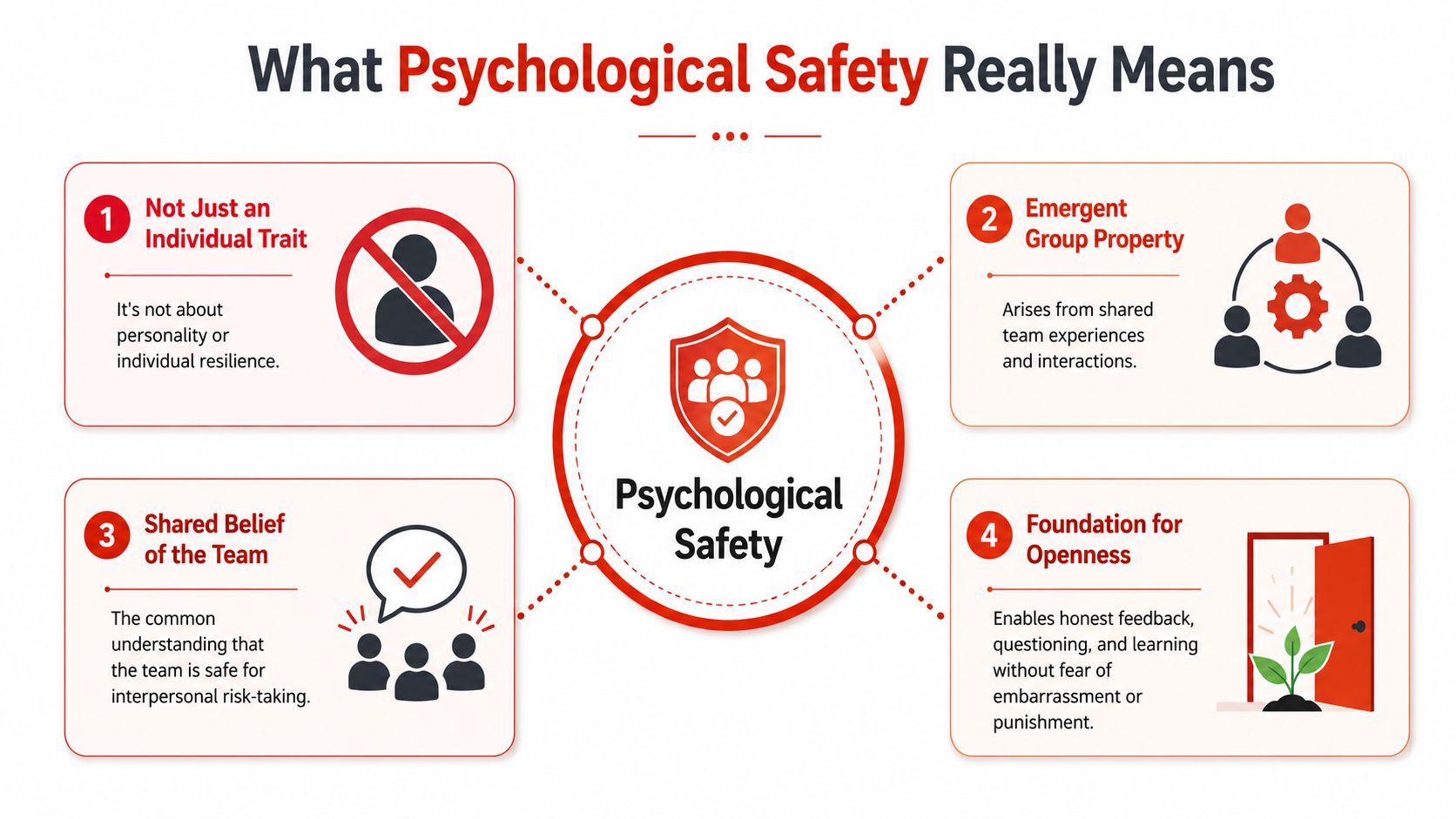
Psychological safety at work is best understood as a team climate, not a personality trait. It isn't about hiring more confident people or telling employees to be more resilient. It's the shared belief that people can speak up with ideas, questions, concerns, or mistakes without being punished or humiliated, as described in this overview of psychological safety as an emergent group-level climate.
Think of it as the operating system
A useful way to explain it to new managers is this. Psychological safety is the operating system for team collaboration. You don't see the operating system directly when a meeting goes well, a launch gets fixed quickly, or a debate produces a better decision. But it determines whether those higher-level functions work.
When the operating system is weak, teams avoid interpersonal risk. They hedge, perform certainty, and protect status. When it's strong, people ask for help sooner, challenge assumptions earlier, and admit errors while there's still time to correct them.
That's why what is psychological safety at work is such an important management question. It shapes whether a team can learn in public.
What it is, and what it isn't
Psychological safety overlaps with trust, engagement, and belonging, but it isn't identical to any of them.
- Trust is often relational. I trust you to follow through.
- Engagement is about involvement and commitment.
- Belonging is about feeling accepted and included.
- Psychological safety is about voice under risk. Can I say the hard thing here?
That distinction matters. A team can like each other and still avoid difficult conversations. A team can feel engaged and still stay quiet when a senior leader is wrong. A team can report decent morale and still punish honest mistakes.
For leaders who want a broader lens on values and youth development, Soul Shoppe's resources on understanding psychological safety offer a helpful complement to workplace-focused practice.
Practical rule: Don't ask whether your team feels comfortable. Ask whether they can disagree, admit error, and ask basic questions without losing status.
Why managers own so much of it
Team climate forms through repeated interactions. Who gets interrupted. How bad news is handled. Whether questions are welcomed. Whether a failed idea becomes a learning moment or a character judgment.
That's why this isn't solved by one workshop or one memo from HR. Teams infer safety from patterns. Leaders create those patterns faster than anyone else.
Why Safety Is a Business Imperative Not a Luxury
Leaders sometimes treat psychological safety like a “soft” culture topic that matters only when business conditions are stable. That's backwards. It matters most when stakes are high, information is incomplete, and people need to raise concerns fast.
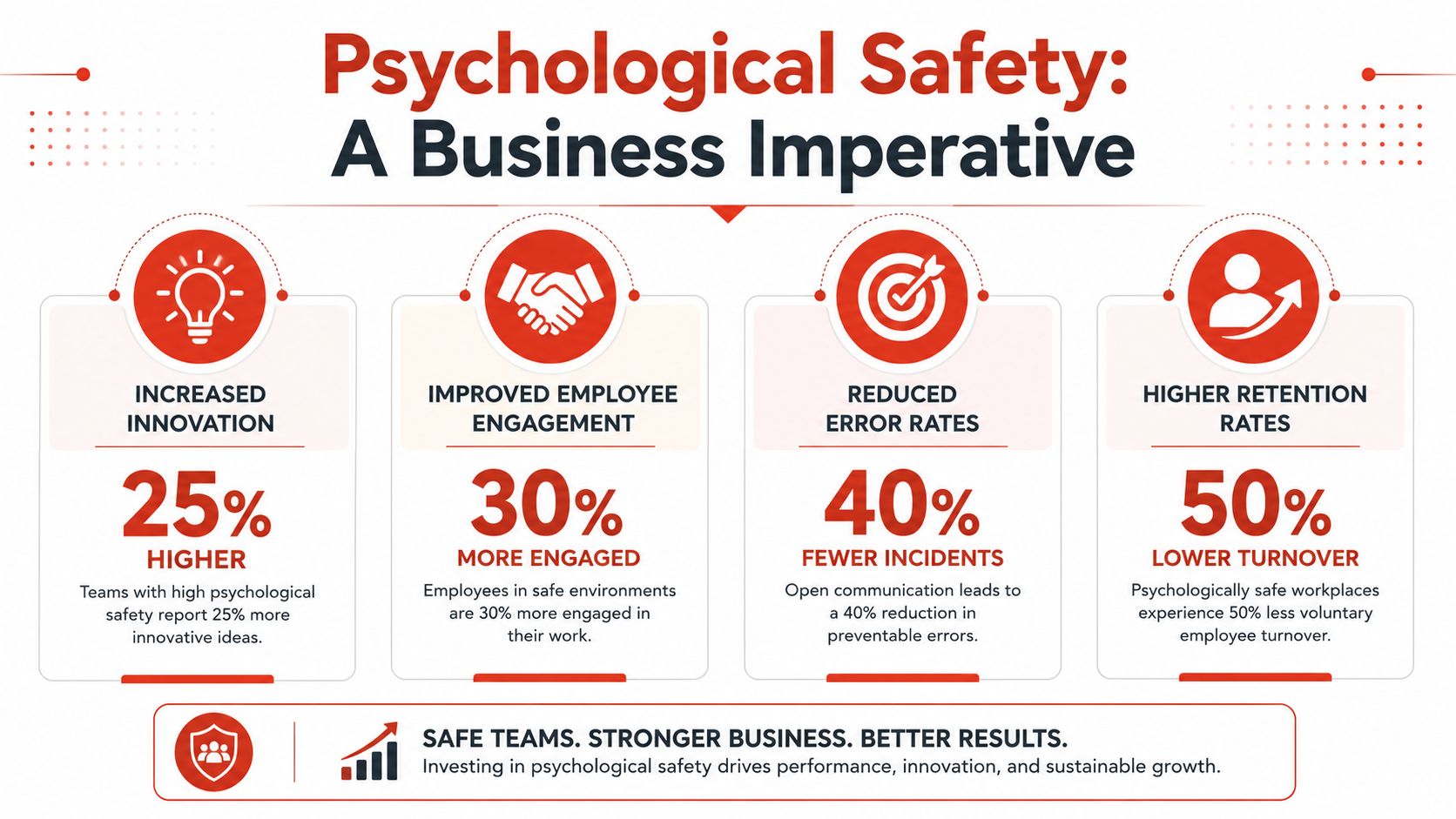
The business case is strongest when you look at retention, burnout, and risk. Harvard Business School research summarized by Harvard notes that increasing psychological safety by one standard deviation reduced burnout by 0.72 points and increased an employee's willingness to stay by 0.63 points, showing a measurable link between safety, stress, and retention in Harvard's summary of the research.
Retention is where many leaders feel it first
Turnover risk rises when people don't feel safe enough to contribute openly. Boston Consulting Group found that 12% of employees with the lowest levels of psychological safety said they were likely to quit within a year, compared with 3% of employees who felt psychologically safe at work, according to BCG's analysis of psychological safety levels.
That difference matters because people rarely leave only for compensation or title. They also leave managers, climates, and patterns of interaction that make work emotionally costly.
Here's what that often looks like before someone exits:
- Questions get delayed until a mistake is harder to fix.
- Concerns move offline into private chats instead of open forums.
- Employees self-censor because dissent feels politically dangerous.
- Managers hear less reality and more polished optimism.
Burnout and performance are connected
When employees believe they have to monitor every comment, avoid looking wrong, and manage the emotional reaction of others, work becomes heavier. Not because the tasks changed, but because the interpersonal load did.
That's why conversations about well-being shouldn't stop at benefits design. Organizations working on boosting employee well-being and productivity often discover that support programs help more when team norms also allow honesty, questions, and early escalation.
A wellness strategy can support employees. It can't substitute for a manager who punishes candor.
Safety affects execution, not just morale
The practical value shows up in how teams operate. Safer teams surface weak signals earlier. They challenge assumptions before they become commitments. They recover from errors faster because people report them sooner.
Executives usually don't need more slogans about openness. They need a reliable way to hear what is happening. Psychological safety provides that channel.
Recognizing the Signs in Your Workplace
You can usually spot low psychological safety before you can measure it. It shows up in meeting behavior, response patterns, and how people handle mistakes. The key is to look past surface politeness.
A common misunderstanding is treating safety as the absence of tension. That's not it. According to the Center for Creative Leadership's guidance on what psychological safety at work is and isn't, the point is not being “nice” or avoiding conflict. It's being able to challenge ideas, ask hard questions, and disagree without humiliation or retaliation.
Warning signs you shouldn't ignore
If you're managing a team, these are the patterns that usually deserve attention:
- Meetings feel tidy but uninformative. Few questions. Little pushback. Decisions get made quickly, then revisited later in private.
- Postmortems turn into blame hunts. People explain who caused the problem instead of what conditions allowed it.
- Help-seeking is delayed. Team members wait too long to say they're stuck because they don't want to look incapable.
- Only senior people shape the conversation. Others contribute after the meeting, not during it.
- Bad news arrives late. Risks become visible only when they're already expensive.
Green flags that signal a healthier climate
Healthy teams don't look conflict-free. They look candid and steady.
- People admit mistakes directly and move quickly into problem-solving.
- Questions are common, including basic clarifying questions.
- Disagreement stays respectful and improves the quality of decisions.
- Managers change course in public when someone presents a better idea.
- New or junior employees contribute early, not only after they've earned unofficial permission.
If all the honesty happens in side conversations, the team doesn't have enough safety where decisions are actually made.
Psychological safety what it is vs what it is not
| What Psychological Safety IS | What Psychological Safety is NOT |
|---|---|
| Speaking up with concerns, ideas, and questions | Agreeing with everything to keep the peace |
| Respectful disagreement | Avoiding conflict |
| Admitting mistakes early | Escaping accountability |
| Asking for help when stuck | Looking weak or unprepared |
| Challenging assumptions in service of better work | Publicly attacking people |
| Learning from error | Lowering standards |
This table matters because many managers overcorrect. They hear “create safety” and become hesitant to challenge weak work. But accountability and safety aren't opposites. In strong teams, people can hear, “This missed the mark,” without feeling personally shamed.
Three Core Actions Leaders Can Take Today
Managers influence psychological safety through small repeated signals. The team watches what you do when the work gets messy, when somebody disagrees with you, and when a mistake becomes visible.

The fastest progress usually comes from changing leader behavior, not launching another values campaign. If you want a broader performance context, this perspective on building high-performing teams pairs well with the actions below.
Frame the work as uncertain when it is uncertain
Many leaders accidentally shut people down by acting like the path is obvious when it isn't. If the work involves judgment, experimentation, ambiguity, or cross-functional complexity, say so plainly.
Useful phrases include:
- “We're dealing with incomplete information.”
- “I want competing interpretations before we decide.”
- “There are likely risks we haven't seen yet.”
This framing gives people permission to contribute what they know. It also removes the pressure to perform certainty.
Model curiosity and fallibility
Leaders don't create safety by saying “my door is always open.” They create it by showing that they don't need to be the smartest voice in every room.
That means asking questions you don't already know the answer to. It means saying, “I may be missing something,” and meaning it. It means acknowledging your own misses without turning the moment into a speech about vulnerability.
A simple example: if someone points out a flaw in your plan, don't explain your intent first. Thank them, clarify the issue, and explore the implication.
Manager move: When a team member raises a concern, your first response should make it easier for the next person to speak.
There's a safety implication beyond culture. The National Safety Council reports that workers who felt psychologically unsafe were 80% more likely to report a workplace injury requiring medical attention and/or missed days, as explained in its review of how psychological safety correlates with physical safety. In plain terms, fear suppresses voice, and suppressed voice creates operational risk.
Respond productively to bad news
The defining moment is rarely when someone shares a good idea. It's when someone admits an error, flags a risk, or questions a decision that already has momentum.
A productive response usually has three parts:
- Acknowledge the raise. “I'm glad you brought this up.”
- Separate person from problem. Focus on the issue, not the identity of the messenger.
- Turn the moment into learning. Ask what the team should adjust going forward.
Later, if you want a concise explainer to use in manager training, this short video works well as a discussion starter.
What doesn't work is just as important:
- Public sarcasm
- Defensive over-explaining
- Rewarding only polished contributions
- Punishing the messenger for uncomfortable information
Those behaviors teach the team to manage your reaction instead of helping the team see reality.
How to Measure What Matters
You don't need a complex diagnostic to start measuring psychological safety. You need a baseline, a few consistent questions, and enough discipline to track patterns over time.
Start with a simple pulse
Many leaders begin with a short team survey based on the well-known question sets associated with Amy Edmondson's work. The point isn't to chase a perfect score. The point is to understand whether people feel able to speak up, ask for help, and admit mistakes on this team.
Keep the survey language plain. Use it consistently. Then compare responses over time rather than obsessing over a single snapshot.
Add observational data
Survey results help, but behavior tells you whether the climate is changing. During meetings, watch for patterns like these:
- Who speaks first and most often
- Who gets interrupted
- Whether junior voices enter early or late
- How the leader reacts to disagreement
- Whether bad news is discussed in the room or only afterward
This kind of observation is especially useful because teams often rate themselves more positively than their day-to-day interactions suggest.
Use one-on-ones to surface hesitation
The best qualitative data often comes from direct manager conversations. Instead of asking, “Do you feel safe?” ask questions that surface real behavior.
Try prompts like:
- “What's one thing you've hesitated to bring up?”
- “Where do you think this team avoids hard conversations?”
- “What happens here when someone challenges a popular view?”
- “When was the last time you changed your mind because of something a teammate said?”
Measure trends, not slogans. If people are speaking sooner, asking more, and correcting faster, the climate is improving.
The goal is not to prove the culture is healthy. The goal is to learn whether candor is becoming easier in the moments that matter.
Bringing Psychological Safety to Life at Your Next Event
A keynote on psychological safety can either energize leaders or wash over them. The difference is whether the session moves beyond definitions and into behavior. Event planners and HR leaders should look for speakers and facilitators who can translate the concept into concrete leadership choices.
That means choosing formats that help people practice, not just agree. A strong session should leave managers with language they can use in Monday's meeting, not just a renewed belief that openness is important. Teams often get more value from interactive corporate workshops than from a standalone inspirational talk because they can rehearse the hard parts in real time.
What strong programming looks like
The most useful sessions usually include a mix of story, evidence, and rehearsal. Good topics include:
- Leading through uncertainty when the answer isn't obvious and teams need to surface risk quickly
- The ROI of candor for leaders who still see open dialogue as a culture issue rather than an execution issue
- How to run a better postmortem so mistakes lead to learning instead of blame
- How to challenge without diminishing for managers who confuse directness with harshness
A workshop can go further by giving leaders a structure. Practical exercises include a failure résumé, structured dissent rounds, red-team reviews before major decisions, and role-play around how to respond when an employee raises uncomfortable information.
What to ask before you book a speaker
If you're planning an all-hands, leadership retreat, or manager offsite, vet the session the way you'd vet any business-critical program.
Ask questions like:
- Will the speaker address accountability as well as openness?
- Do they offer practical language leaders can use immediately?
- Can they handle skeptical executives who think this is too soft?
- Will participants practice behaviors, or only hear stories?
The strongest experiences don't present psychological safety as a feel-good ideal. They treat it as a performance condition that leaders can shape through meeting design, feedback habits, and response patterns.
That's what makes the topic useful on stage. It gives organizations a way to connect culture, management quality, and execution in one conversation.
If you're planning a leadership offsite, annual meeting, or manager workshop and want a speaker who can turn ideas like candor, resilience, innovation, and team performance into a practical experience, Silicon Valley Speakers can help you find the right fit. Their roster focuses on builders, inventors, and high-performance voices who bring real-world stories and actionable insight to the room.