If you're looking for a Tristan Harris book, the direct answer is no: he hasn't authored a traditional standalone book, even though his ideas reached 38 million households in the first 28 days of The Social Dilemma and over 100 million people globally. The “book” frequently inquired about is a book about his thinking, while his biggest impact came through the documentary, his talks, and his broader humane technology work.
That distinction matters if you're planning an event. You're probably not trying to solve a publishing trivia question. You're trying to decide whether this topic belongs on your main stage, whether it fits your leadership audience, and how to turn a high-level conversation about AI ethics into something your attendees can use on Monday morning.
A lot of planners get stuck right at the start. Someone on the executive team says, “Let's anchor this around the Tristan Harris book,” and suddenly the room assumes there's a definitive volume everyone should read. There isn't. What exists is more interesting, and more useful for programming. Harris's influence comes from a set of ideas that moved from social media harms into AI risk, workplace disruption, and the design of systems that either protect or erode human agency.
That makes this a content strategy question, not a bookshelf question.
Your Guide to Tristan Harris and Humane Technology
You're likely building one of three things right now: a leadership offsite, a customer conference, or an internal AI event. In each case, the same pressure shows up. Leaders want substance, not hype. Employees want clarity, not panic. You need a session that feels urgent without collapsing into vague ethics talk.
That's why the Tristan Harris book question keeps coming up. Planners want a clean artifact they can point to. A title. A reading list item. A tidy way to explain why “humane technology” belongs in the agenda.
Start with the real answer
Here's the practical framing: Harris is best understood through his public body of work, not through a single authored book. His ideas sit at the intersection of attention, incentives, product design, and AI governance. If you're evaluating whether this belongs in your event, treat the “book” question as the entry point, not the end point.
For planners, that changes the job. You're not curating a book club. You're curating a strategic conversation about what happens when technology optimizes for engagement, speed, and capability without equal attention to human consequences.
Practical rule: Don't book this topic as “AI ethics.” Book it around a business problem your audience already feels, such as distraction, adoption, trust, burnout, product responsibility, or leadership under fast technological change.
What planners should do next
Use this topic when your event needs one of these outcomes:
- Executive alignment: Leaders need a shared language for responsible innovation.
- Team reflection: Product, HR, legal, and engineering need to discuss tradeoffs before AI use sprawls.
- Audience trust: Customers want to hear that your company is serious about where technology is heading.
- Cultural reset: Employees need permission to talk about attention, overload, and the human cost of always-on systems.
If that's your brief, you don't need a literal Tristan Harris book. You need the right framing, the right speaker profile, and a format that moves from awareness to action. A curated roster of relevant voices matters more than a reading list, especially when you're matching topic to audience and event format. You can start that process by reviewing speaker options for AI, innovation, and future-focused events.
The Definitive Answer on a Tristan Harris Book
The clean answer is simple. There is no standalone, traditionally authored Tristan Harris book. If someone on your team says, “Order the Tristan Harris book,” they're usually referring to a title that interprets his ideas rather than a primary text written by Harris himself.
The book people are actually referring to
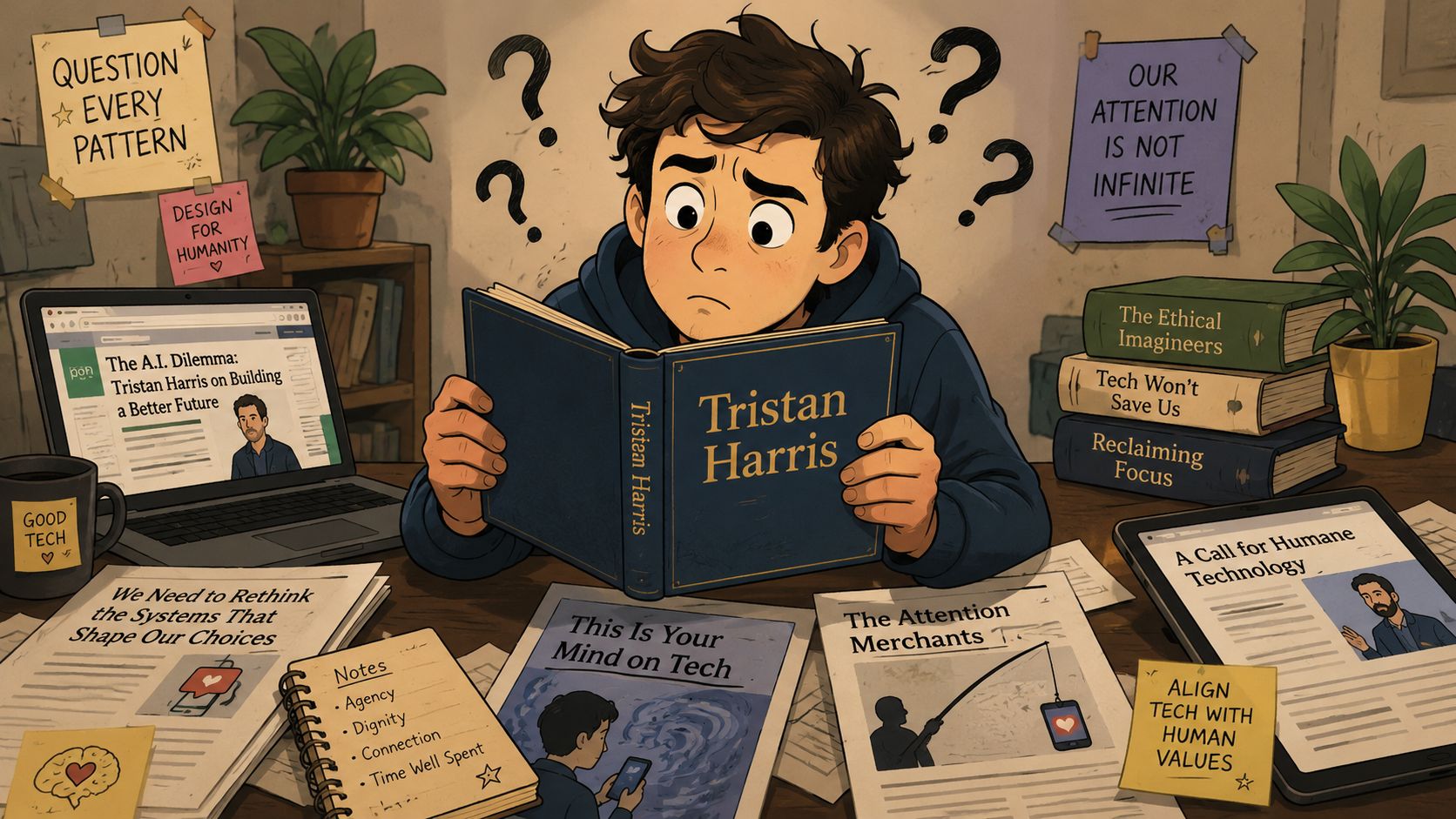
The work most often mistaken for a Tristan Harris book is Tristan Harris on Purposeful Intelligence: Why Intention Matters More Than the Technology by Isla Kerr. That distinction matters because Kerr's book translates Harris's abstract ethical concepts into frameworks for human-AI partnerships. It is commentary and interpretation, not an authored manifesto from Harris himself.
That's not a knock on the book. It's useful. But planners should be precise. If you're building conference messaging, pre-read materials, or an executive briefing packet, label it correctly. Call it a book about Tristan Harris's ideas.
What counts as the primary material
If you want Harris in his strongest form, go to the sources where his thinking landed hardest in public culture:
- The documentary format: Harris became widely known through The Social Dilemma.
- Talks and public briefings: His influence is often delivered verbally, not as long-form print.
- Humane tech frameworks: His work focuses on intention, incentives, and the consequences of product design.
That means your event programming should follow the medium that made his ideas matter. Use documentary clips, moderated discussion, and workshop prompts. Don't force everything into a “one book, one keynote” model if the intellectual material didn't originate that way.
A lot of event teams lose momentum because they chase the wrong asset. The book isn't the asset. The framework is.
The planner's takeaway
If your audience asks for a Tristan Harris book, give them the accurate answer and then move the conversation forward. Position the Kerr book as supplemental reading. Treat Harris's talks and documentary-driven ideas as the primary intellectual source. Then design your agenda around the live question that matters most: how should leaders, teams, and companies build technology without letting incentives outrun judgment?
From The Social Dilemma to The AI Dilemma
Tristan Harris matters because he helped turn a technical critique into a mainstream one. He didn't just argue that social platforms had problems. He argued that the underlying incentive system was the problem. That framing is what gave his work staying power.
The first dilemma was about incentives
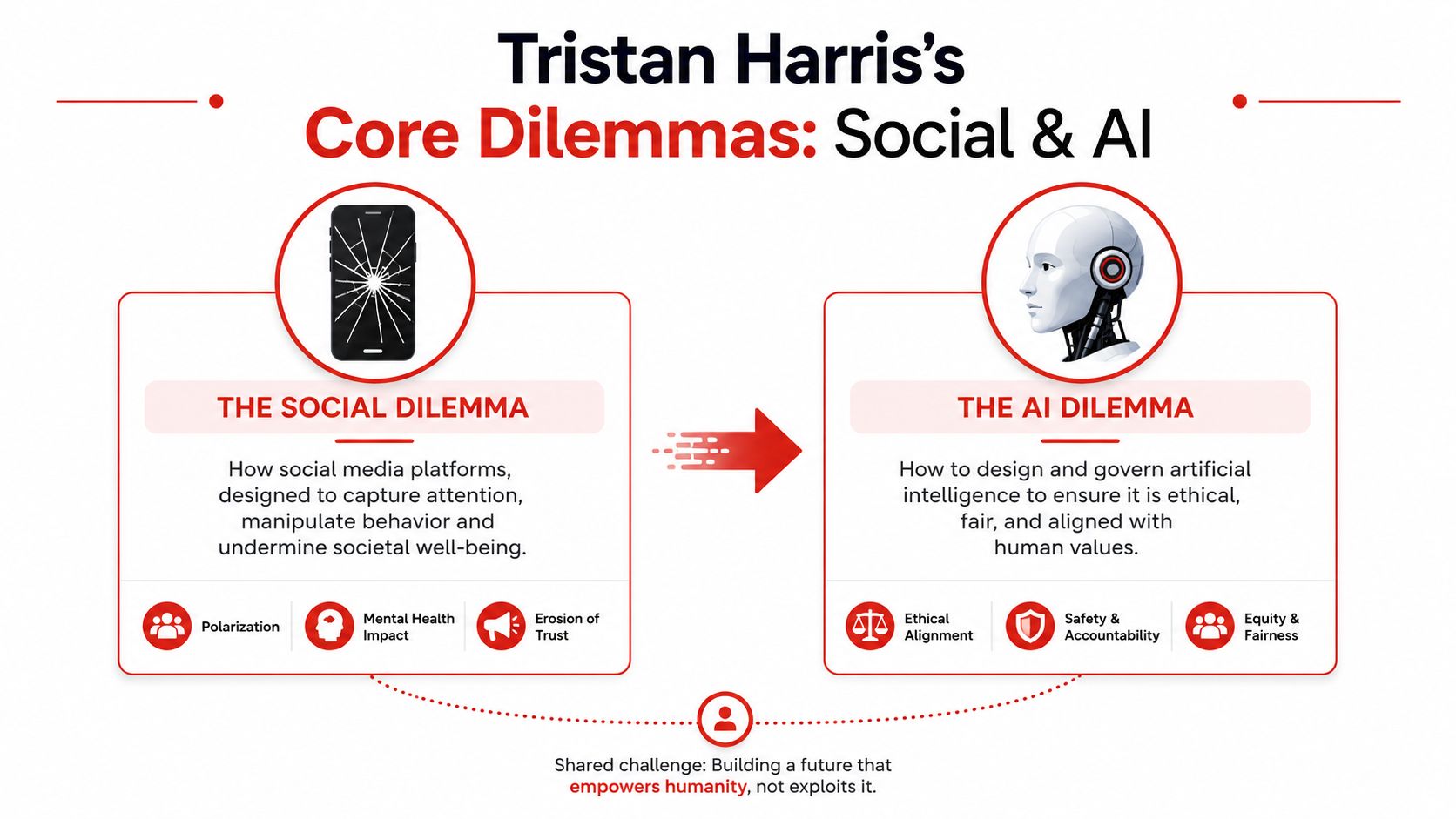
In The Social Dilemma, the central issue wasn't that phones are distracting. That's too small. The core argument was that platforms optimize for attention in ways that shape behavior, reward outrage, and train people into compulsive use patterns. Harris became one of the public faces of that critique.
The documentary featuring Harris reached 38 million households in its first 28 days and over 100 million people globally across 190 countries, which is why event audiences already recognize the core language around algorithmic incentives and social media harms. That reach is documented in the 80,000 Hours conversation on changing social media incentives.
For planners, this is why the topic works. Your audience doesn't need a technical primer to understand it. They already know what it feels like to compete with feeds, notifications, and fragmented attention.
The second dilemma raises the stakes
His newer focus shifts from social platforms to artificial intelligence. The broad question changes from “what is technology doing to our attention?” to “what happens when powerful systems scale faster than human judgment, governance, and adaptation?”
That evolution matters for business audiences because AI is no longer abstract. It's in product roadmaps, content workflows, recruiting, customer support, software development, and internal tools. The pressure to move fast is real. So is the temptation to skip the harder conversation about guardrails.
A useful adjacent read for teams thinking about operational impact is this piece on AI in publishing industry, because it shows how quickly AI changes professional roles, workflows, and expectations when an industry starts reorganizing around new tools.
Here's a short visual worth embedding in pre-event materials or session pages:
Why this progression works on stage
This topic lands when a speaker connects the two dilemmas rather than treating them as separate issues.
| Focus | Core question | Why an event audience cares |
|---|---|---|
| Social media | What happens when products optimize for attention? | Teams recognize distraction, burnout, and trust erosion immediately |
| Artificial intelligence | What happens when capability outpaces governance? | Leaders are already making budget, hiring, and product decisions around AI |
| Humane technology | How do we build tools that protect agency? | This gives the audience a constructive path, not just a warning |
That's the move planners should make. Don't present Harris's ideas as a morality lecture about screens. Present them as a leadership framework for incentive design. That opens the door to a much stronger conversation about product decisions, culture, responsibility, and long-term trust.
Translating Humane Tech Into Keynote Themes
The biggest mistake planners make is keeping humane technology at the level of abstraction. “Ethics” sounds worthy, but it often dies in the conference room because no one knows what business problem it solves. You need sharper framing.
Theme one for leadership teams
A strong executive keynote is Leading With Digital Responsibility. This works for annual meetings, leadership retreats, and customer-facing conferences because it speaks to decision quality, reputation, and trust.
The core message is straightforward: every system encodes incentives, and leaders own those incentives whether they admit it or not. That lands with senior audiences because it puts responsibility where it belongs.
Best fit:
- C-suite and senior leaders: The conversation centers on governance, trust, and strategic judgment.
- Board or advisory audiences: It helps frame technology decisions as risk and stewardship issues.
- Cross-functional leadership groups: It gives legal, HR, product, and engineering a shared vocabulary.
Theme two for AI transformation audiences
If the event is already AI-heavy, the better title is The Humane Use of AI. This keeps the topic from sounding anti-innovation. It says, clearly, that the issue isn't whether to use AI. The issue is how to use it without degrading human agency, accountability, and work quality.
Harris's current AI framing includes the claim that job shock from AI could result in approximately 10 million job losses per year, which he uses to argue for urgent regulatory resets and more responsible leadership. That estimate appears in the Wikipedia overview of Tristan Harris's current work.
That number gives planners a hard edge when they need one. Use it carefully. Don't turn the talk into doom. Use it to justify why the room should take implementation choices seriously.
Book this theme when your attendees are already deploying AI tools and leadership wants a more mature conversation than “how to prompt better.”
Theme three for culture and performance
Not every audience needs a societal critique. Some need a workplace lens. A keynote on Winning the War for Attention works well for all-hands meetings, SKOs, and manager summits because it connects humane tech to focus, communication norms, and burnout.
That topic opens three productive angles:
- Team attention as an operating asset: If every workflow competes with alerts and fragmented channels, quality drops.
- Manager behavior: Leaders often create digital overload through default urgency and poor communication design.
- Culture design: Teams can set norms around meetings, notifications, and deep work.
If you're shaping a conference around future-of-work content, a broader set of themes for conferences can help you position this topic alongside AI, innovation, leadership, and culture without making it feel isolated.
What good keynote framing sounds like
Weak framing sounds like this: “A thought-provoking talk on ethics in technology.”
Strong framing sounds like this:
- For executives: Build faster without surrendering judgment.
- For product teams: Design incentives before incentives design user behavior.
- For company-wide audiences: Protect attention, trust, and human agency in an AI-saturated workplace.
That's the standard. If the session title could fit any generic futurist, tighten it. Humane technology only works when it feels operational.
Designing Workshops for Actionable Outcomes
A keynote can change the temperature in the room. It rarely changes behavior by itself. If you want the topic to stick, pair the talk with a workshop that forces decisions, tradeoffs, and language people can effectively use later.
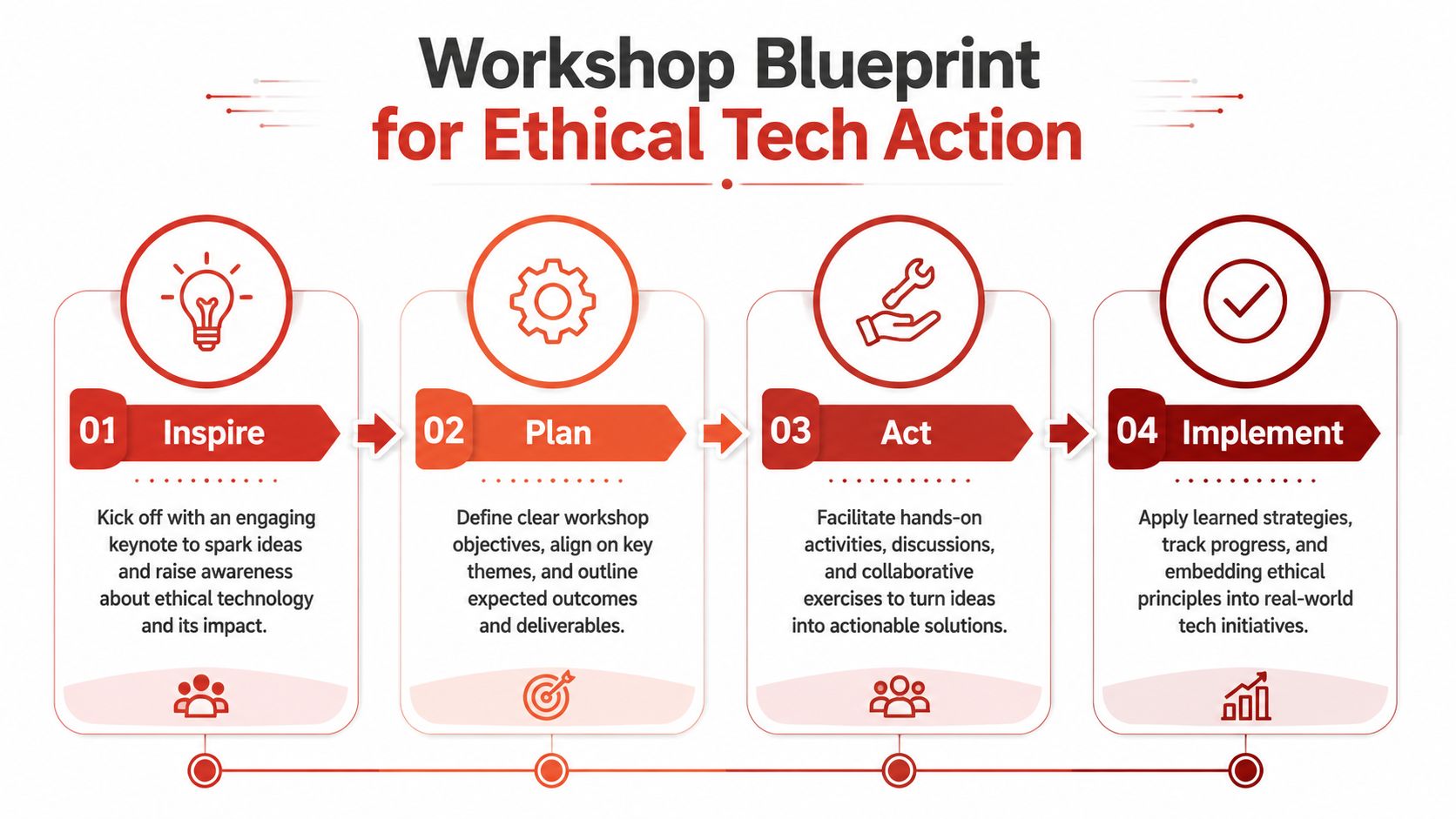
There's a real opening here. Public discussion of Harris's ideas is influential, but there's still a notable gap in showing how his AI ethics framework translates into actual corporate policy. That gap is exactly why workshops matter. The point isn't to admire the framework. The point is to create internal benchmarks your teams can use.
Workshop format that works for mixed teams
A half-day session for leadership, HR, product, legal, and operations can produce useful outputs if you structure it around decisions instead of philosophy.
Use a sequence like this:
Map the pressure points
Identify where your company is already feeling tension. Hiring. AI adoption. customer communication. Productivity expectations. Data use. Product velocity.Name the incentive conflicts
Ask where speed, engagement, or automation goals might be pushing teams toward poor outcomes.Set practical guardrails
Define what needs review, who owns it, and where teams need escalation paths.Create one-page operating principles
Keep them short enough to use. If they can't fit into a briefing deck or manager toolkit, they won't survive.
Two workshop models planners can pitch internally
Here's a simple comparison you can put in front of stakeholders:
| Workshop type | Best audience | Useful output |
|---|---|---|
| Digital wellness for teams | Company-wide groups, managers, people leaders | Communication norms, focus practices, meeting boundaries |
| Ethical AI design sprint | Product, engineering, legal, ops | Review criteria, risk prompts, launch guardrails |
The first model is cultural. The second is operational. Don't combine them unless you have a full day and a very clear facilitation plan.
What a strong brief looks like
For a digital wellness workshop, ask for outcomes such as:
- Attention norms: Teams define what counts as urgent and what doesn't.
- Manager practices: Leaders reduce always-on behaviors that spread anxiety through Slack, email, and meetings.
- Recovery space: Employees get concrete ways to protect focused work.
For an ethical AI design sprint, push for different outcomes:
- Use-case review: Teams identify where AI adds value and where it creates unacceptable ambiguity.
- Decision ownership: Someone owns escalation when a tool crosses legal, trust, or brand lines.
- Governance language: Product and leadership teams leave with common terms, not vague principles.
Workshops are where humane technology stops being a talking point and starts becoming company policy, team norms, and shipping criteria.
Don't ask for a “discussion”
That word kills momentum. Ask for deliverables. Ask for a decision framework. Ask for language your managers can repeat. Ask for a checklist your product team can use in planning meetings. If your internal sponsor can't state the post-session artifact in one sentence, the workshop isn't designed tightly enough.
How to Book a Visionary Speaker on Ethical Tech
Don't approach this topic like celebrity booking. You're not hiring a famous name to validate a trend. You're hiring someone to help your audience think better about the systems they build, buy, or work inside every day.
What to look for in the speaker
The strongest ethical tech speakers usually come from one of these backgrounds:
- Builders: Founders or inventors who created widely used products and can candidly discuss consequences.
- Operators: Leaders who've had to implement AI, data, or product governance inside real organizations.
- Translators: People who can connect technical risk to leadership decisions without drowning the room in jargon.
That profile matters more than title prestige. A speaker who built something consequential will usually handle audience questions better than a generic commentator. They can talk about tradeoffs because they've lived them.
Questions planners should ask before booking
Use this filter in your speaker selection process:
| Question | Why it matters |
|---|---|
| Have they built or led real technology? | Audiences trust lived experience more than abstract critique |
| Can they tailor for executives, product teams, or all-hands? | Ethical tech talks fail when they're too broad |
| Do they offer frameworks, not just warnings? | You need takeaways people can use |
| Can they support a workshop after the keynote? | This is where real event value compounds |
If you want a useful outside perspective on how credible speakers shape their positioning, BAMF's founder speaking guide is worth scanning. It's helpful because it shows how speakers package expertise into themes, and that makes it easier for planners to tell the difference between a compelling operator and a polished generalist.
Match the format to the outcome
For an all-hands meeting, book a keynote that clarifies the stakes and gives people a shared language. For a product summit or leadership offsite, add a workshop. For a customer conference, use a moderated conversation so the speaker can connect ethical technology to trust, market credibility, and responsible innovation.
If you're evaluating format, budget, and audience fit at the same time, this guide on how to hire a keynote speaker is a practical starting point.
Speakers who continue this conversation
If your audience already engages with Tristan Harris's arguments about attention, incentives, and AI, two speakers on our roster carry that conversation forward from the builder side.
Adam Cheyer co-created Siri and has spent his career at the human-AI intersection. He's shipped consumer AI products, made the design tradeoffs Harris writes about, and can talk about why intention behind a product decides what it does to the people using it. Strong fit for leadership audiences that want a builder's view on responsible AI, not a critic's view.
Either of them pairs well with the workshop formats above.
One more recommendation. Ask for customization examples before you sign. A speaker who can adapt humane technology for an HR audience, a sales kickoff, and a technical team is far more valuable than one who delivers the same cautionary talk every time.
Frequently Asked Questions for Event Planners
Is this too soft a topic for a business event
No. Frame it around risk, trust, adoption, culture, and decision quality. That moves the conversation out of abstract ethics and into leadership practice.
Who should attend a humane technology session
The short answer is everyone. The better answer is to tailor the framing. Executives need governance and trust. Product and engineering teams need incentives and design tradeoffs. Company-wide audiences need a language for attention, overload, and responsible AI use.
Should I book a keynote or a workshop
Use a keynote when you need alignment, urgency, and a shared narrative. Use a workshop when leadership wants outputs, operating principles, or implementation decisions. If the topic is new to the organization, start with the keynote. If the conversation has already started, go straight to a working session.
How do I explain the Tristan Harris book issue internally
Say it plainly: there isn't a traditional standalone book by Tristan Harris. The title people usually mean is a book about his ideas, and the more important source material is his documentary-driven and public-facing work.
Silicon Valley Speakers helps event planners book the builders, inventors, and operators who can turn topics like humane technology, AI responsibility, and the future of work into high-impact keynotes and workshops. If you need a speaker who can move past theory and give your audience a clear, credible path forward, explore Silicon Valley Speakers.